
Key takeaways
- Check 21 took effect on October 28, 2004.
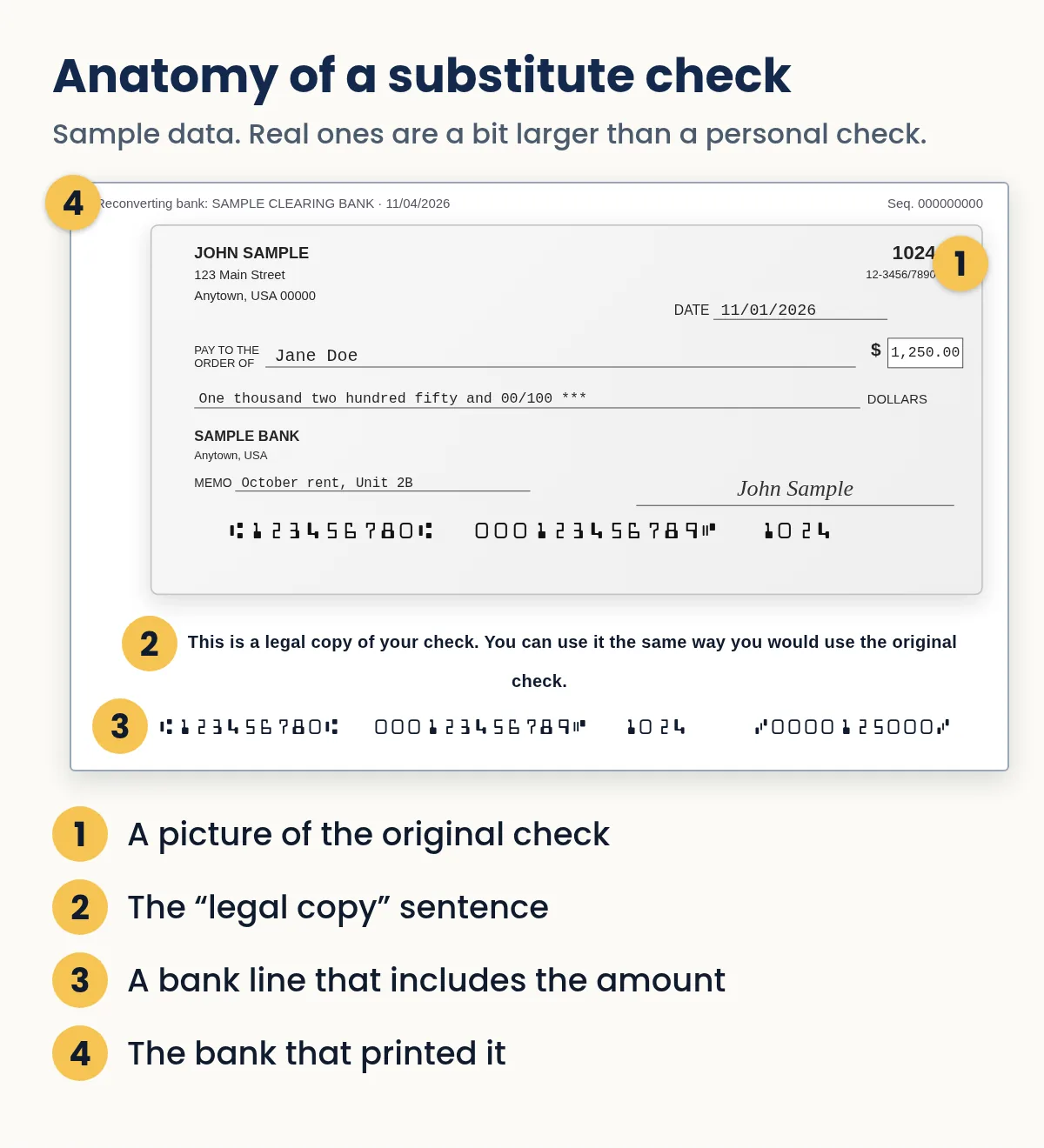
- A substitute check is a bank-made paper copy that counts as the original.
- It must carry the legend “This is a legal copy of your check…”
- If a substitute check is wrongly charged to you, claim an expedited recredit within 40 days.
- Industry standards still call for the MICR line in magnetic ink when you print it yourself.
On this page
- What Check 21 is
- What a substitute check is
- What Check 21 means for you
- Expedited recredit: your special refund right
- Substitute check, image or electronic payment?
- Check 21 and printing your own checks
- Common myths about Check 21
- Worked example: a check charged twice
- What is the same everywhere, and what varies
- Checklist: protecting yourself in an image-based system
- Check 21 for small businesses
- How Check 21 changed everyday banking
- FAQ
What Check 21 is
Check 21 is the short name for a federal law called Check Clearing for the 21st Century Act. It was signed on October 28, 2003 and took effect on October 28, 2004. Its purpose was to make check processing faster and cheaper by removing a legal obstacle to “check truncation”: taking the paper check out of the process early and moving information about it electronically instead.
Before Check 21, a bank that wanted to collect a check usually had to physically deliver the original paper to the bank that would pay it, unless the two banks had agreed to accept something else. Paper had to be sorted, bundled and flown or trucked around the country. Check 21 solved this by creating a new kind of paper document, the substitute check, that every bank must accept as if it were the original.
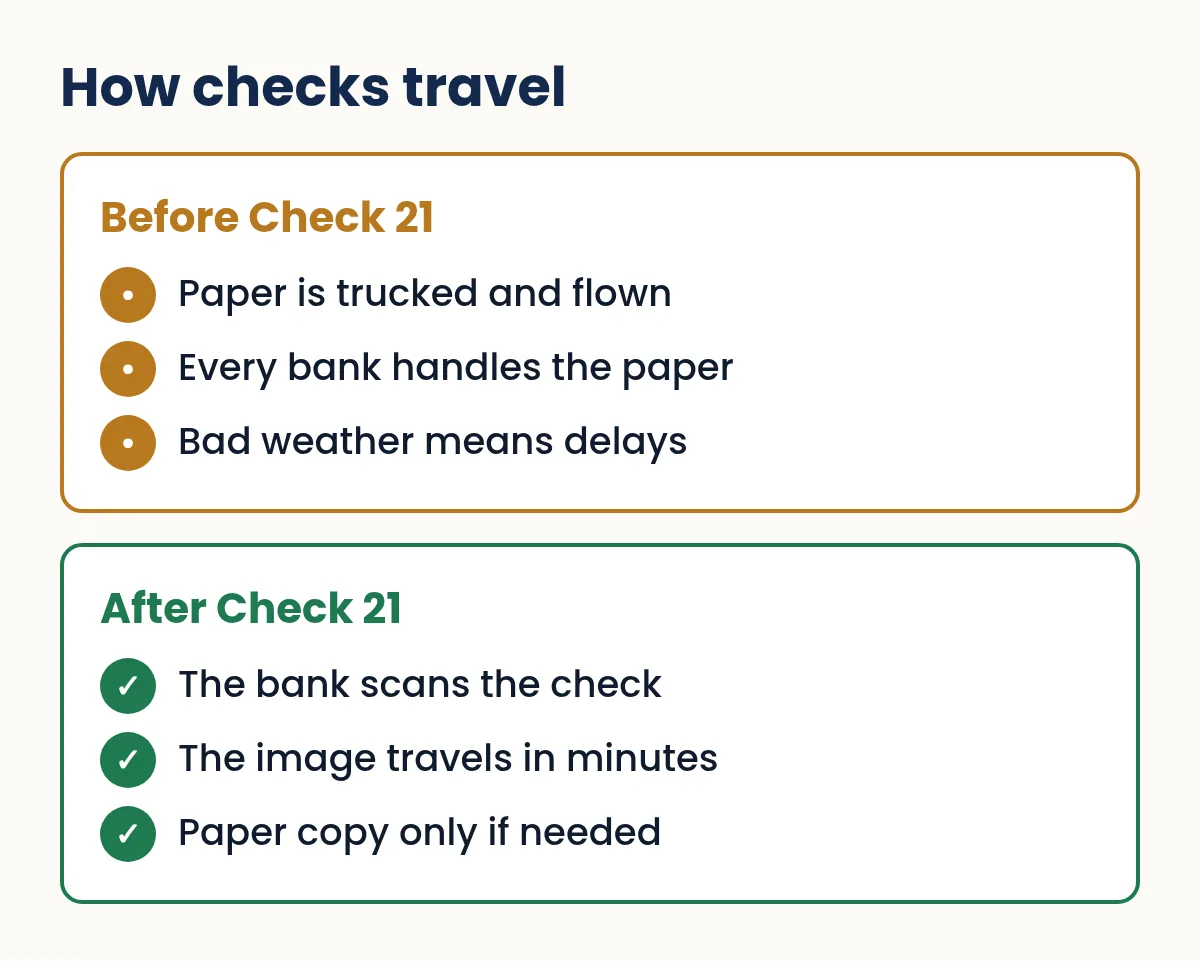
Notably, the law did not force anyone to go electronic. According to the Federal Reserve, Check 21 does not require banks to accept checks in electronic form, and it does not require them to create substitute checks. What it did was give a bank that wants paper a legal paper equivalent. In practice, banks built electronic image exchanges on top of that foundation, and most checks today travel as images.
What a substitute check is
A substitute check is a paper copy of the front and back of an original check, made by a bank from an image. The Federal Reserve describes it as slightly larger than a standard personal check, so that it can hold a picture of the original.
Under Regulation CC, a substitute check is the legal equivalent of the original check, for all purposes and all people, when it meets two conditions:
- It accurately represents the original
All the information on the front and back of the original check, as it was when the paper was taken out of the process, must be shown.
- It carries the legend
It must bear the words “This is a legal copy of your check. You can use it the same way you would use the original check.”
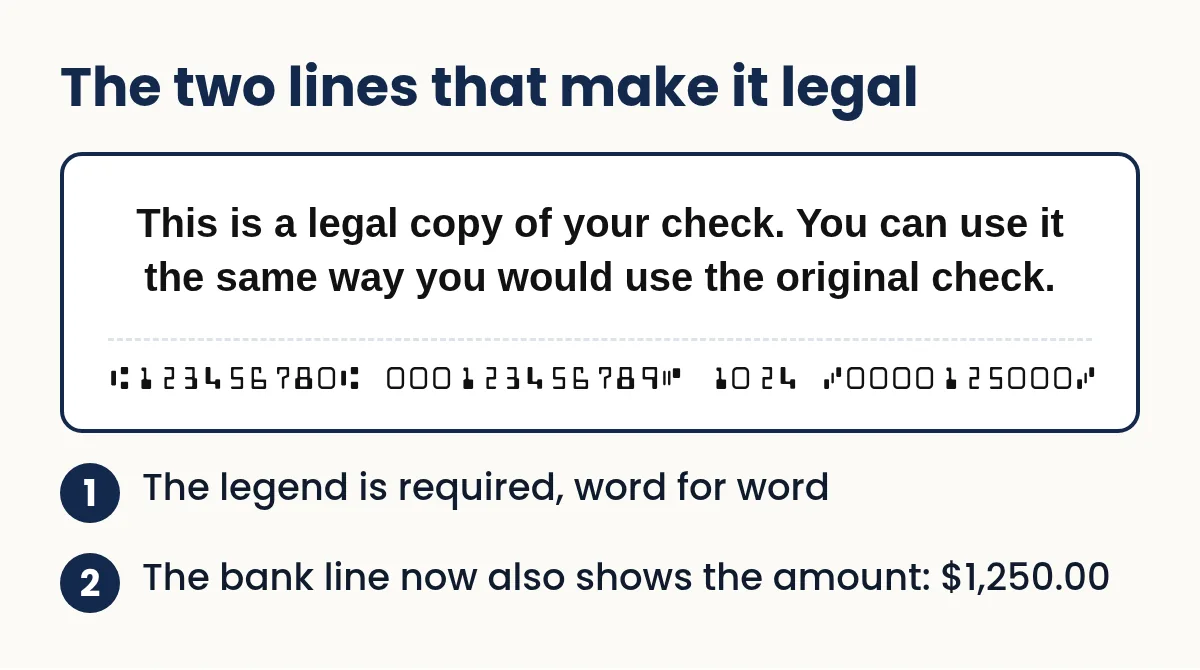
It also has to have been handled by a bank, which gives the warranties the regulation requires, and it must carry a machine-readable bank line so it can be processed like any other check. Once those boxes are ticked, nobody can insist on the original instead.
- Original check
- The first paper check, the one the writer filled in and signed.
- Truncation
- Removing the paper check from the collection process and sending information or an image instead.
- Electronic check image
- A digital picture of the front and back. Not itself a substitute check.
- Substitute check
- A bank-made paper reproduction with the legal-copy legend. Legally the same as the original.
- Image statement
- A bank statement with small pictures of your paid checks. Useful, but not a substitute check.
What Check 21 means for you
You may not get your original checks back
Many banks stopped returning canceled checks years ago. The Federal Reserve notes that banks aren't required to keep your original check for any specific length of time, and that Check 21 added no new retention requirement; in many cases the original is destroyed. If your account agreement says you get paid checks back, the bank may send either the original or a substitute check.
A substitute check works as proof of payment
Because it is legally the original, a substitute check proves payment just as well. The Federal Reserve gives the IRS as an example of a party that accepts one. Your bank isn't required to give you a substitute check on request, though; if it provides a copy or an image instead, that copy usually still works as proof.
You can't block a substitute check
Generally, any check except a foreign check can be turned into a substitute check, and banks and their customers must accept it. Ordinary check-law protections against errors and unauthorized payments still apply.
Need to write a check right now?
Quick Check Writer fills in the amount in words, adds the bank line and prints on blank check stock or saves a PDF. Your first check is free, with no account and no card.
Write your first check free →Expedited recredit: your special refund right
Check 21 added one new consumer protection. If you received a substitute check and you believe it was charged to your account incorrectly, you can file a claim for an “expedited recredit”. It applies when you received an actual substitute check, not just an image statement.
You can claim if all three are true: the substitute check was incorrectly charged to your account, you lost money because of it, and you need the original check, or a better copy, to show the charge was wrong.
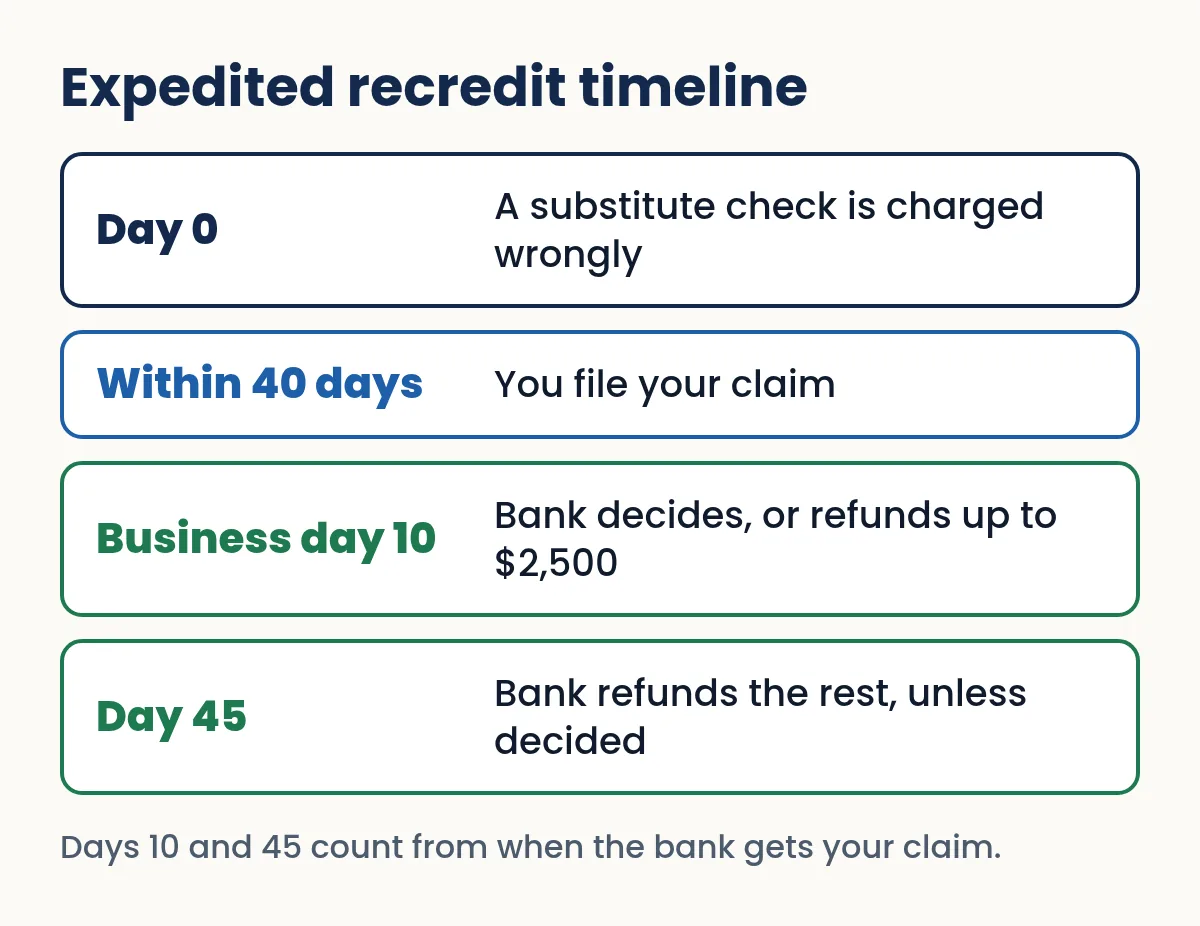
- Claim within 40 calendar days
The deadline runs from the later of the day your bank mailed or delivered the statement showing the charge, or the day it made the substitute check available to you. Extenuating circumstances extend it by a reasonable time.
- Give the bank what it needs
Describe the problem, estimate your loss, explain why the substitute check isn't enough, and identify it. If you claim by phone, the bank may require the claim in writing within 10 business days.
- The bank investigates
If it finds the claim valid, it must recredit you, plus interest on an interest-bearing account, by the end of the next business day.
- If it hasn't decided by business day 10
It must recredit your loss up to $2,500 (or the substitute check's amount, if less), plus interest, and the rest by the 45th calendar day after it received the claim, unless it has decided by then.
Read your statement as soon as it arrives. The 40-day clock starts when the bank sends it, not when you get around to opening it.
Substitute check, image or electronic payment?
Three different things can show up on your statement after you write a check, and they come with different rules:
| What you see | What it is | Which rules protect you |
|---|---|---|
| Substitute check | A bank-made paper copy with the legal-copy sentence | Check law, plus Check 21's expedited recredit |
| Image statement or online image | Pictures of paid checks, which may be originals or substitute checks | Check law; no expedited recredit unless you received an actual substitute check |
| Converted check (shown as an electronic payment) | A merchant used your check's details to start an electronic transfer | Electronic fund transfer rules, not check law; you must be told beforehand |
If a check you wrote shows up as an electronic debit rather than a check, it was probably converted, not handled under Check 21. The Consumer Financial Protection Bureau explains that your statement will often show this.
Check 21 and printing your own checks
People who print checks at home often ask whether Check 21 means they no longer need magnetic ink. The Federal Reserve's answer is careful. Bank sorting equipment reads the line of numbers at the bottom of a check, the MICR line, and industry standards have long required that line to be printed in magnetic ink. That requirement comes from those standards, not from Check 21. Only the MICR line must be magnetic; the date, payee and amount can be printed in ordinary ink. And if you print the MICR line yourself because your check stock doesn't have it, the Federal Reserve says you should print it in magnetic ink.
In practice many checks are now captured and processed as images, which is why some people deposit home-printed checks without trouble. But the safest approach is to follow the standard and to test with your own bank. Our guide do you need MICR ink to print checks? covers printers and toner, and MICR font for checks explains the E-13B characters.
Quick Check Writer always lays out the MICR line in the E-13B font at the standard position, with your routing, account and check numbers, so it reads correctly whether a check is handled as an image or on magnetic equipment, provided your printer uses MICR toner or ink where your bank requires it.
Common myths about Check 21
| Myth | Reality |
|---|---|
| “Check 21 made all checks electronic.” | It allowed electronic processing but didn't require banks to accept images or create substitute checks. |
| “Any copy of a check is now legal.” | Only a bank-made substitute check with the legend and required information has the original's legal status. |
| “I can insist on my original check.” | Banks must accept a valid substitute check in its place, and they aren't required to keep originals. |
| “Checks now clear instantly.” | Images move faster, but banks can still hold funds under Regulation CC's availability rules. |
| “Check 21 removed the need for MICR ink.” | The magnetic-ink standard for the MICR line predates Check 21 and still applies to original checks. |
Worked example: a check charged twice
John Sample writes check 1024 for $1,250.00 to Jane Doe for October rent. Jane deposits it with her phone. Two weeks later John's statement arrives with two substitute checks for check 1024, and $2,500 has left his account.
- Day 0: John reads his statement
The 40-day window for an expedited recredit claim is already running from the day the bank sent it.
- Day 3: he files a claim
He calls the bank, explains that the same check was paid twice, says he lost $1,250, and explains why he needs the original or a better copy to prove it. The bank asks him to confirm in writing, which he does within 10 business days.
- Business day 10 after the claim
If the bank hasn't finished investigating, it must put the $1,250 back, plus interest if the account earns interest, because the amount is under the $2,500 limit.
- If the check had been for $4,000
The bank would owe up to $2,500 by business day 10 and the remaining $1,500 by the 45th calendar day, unless it had decided the claim by then.
Double payments like this often trace back to a check deposited by phone and then deposited again on paper. John shouldn't pay twice for one check, and Regulation CC lets the banks shift that loss to the bank that accepted the phone deposit.
What is the same everywhere, and what varies
- The same in every state. Check 21 is a federal law, and Regulation CC's substitute check rules apply to banks, savings institutions and credit unions alike.
- Varies by bank. Whether you get paid checks or images with your statement, how a copy is delivered, and how long your bank tells you to keep checks you deposit by phone are set by your account agreement.
- Record-keeping. Under federal record rules, banks must keep a copy of the front and back of most checks over $100 for five years. That is a copy or image, not the paper, which is why you can usually get a picture of an old check even when the original is long gone.
Checklist: protecting yourself in an image-based system
- Open each statement as soon as it arrives; the 40-day clock doesn't wait.
- Download images of important paid checks, front and back, while they are easy to find.
- After a phone deposit, keep the paper for as long as your bank says, mark it as deposited, then shred it.
- Never deposit the same check a second time, by any route.
- Don't expect a fax or photocopy to work like a substitute check.
Check 21 for small businesses
Many businesses now deposit checks with a desktop check scanner or their bank's app, a service banks call remote deposit capture. The scanner creates the image; the bank exchanges it; the paper stays in your office. That puts the paper in your hands, so set a routine: store scanned checks securely, keep them for the period your bank's agreement specifies, then destroy them so they can't be deposited twice.
When a customer's check is returned unpaid, you may receive a substitute check or an image rather than the original. You can redeposit or pursue a returned substitute check the same way you would the original, subject to your bank's rules on redeposits.
How Check 21 changed everyday banking
- Faster processing. Images move in minutes, not days, which is why check holds are shorter than they once were. See how long a check takes to clear.
- Less “float”. A check you write may be paid from your account very soon after it's deposited, so don't write a check expecting a few days of mail and transport time before it clears.
- Image deposits. ATM image deposits and mobile deposits rely on banks exchanging images rather than paper. See how to deposit a check with your phone.
- Different-looking returns. A check that bounces may come back to you as a substitute check rather than your original paper. See what happens when a check bounces.
One thing Check 21 doesn't do is let ordinary people create substitute checks. A fax, a photocopy or a picture you take is not one. Read can you fax a check? for why.
Frequently asked questions
What is Check 21?
It is the short name of a federal law, effective October 28, 2004, that allows banks to process checks electronically and created the substitute check as the legal equivalent of an original paper check.
Is a substitute check the same as a photocopy?
No. A substitute check is made by a bank to precise standards, shows the front and back of the original, has a machine-readable bank line, and carries the legal-copy legend. A photocopy has none of that legal status.
Can I get my original check back?
Often not. Banks are not required to keep originals for a set time, and many destroy them after capturing an image. Your bank may give you a substitute check or a copy instead.
Can I use a substitute check as proof of payment?
Yes. It is legally the same as the original check, so it works as proof of payment, including with the IRS, according to the Federal Reserve.
How long do I have to claim an expedited recredit?
Your bank must receive the claim by the 40th calendar day after the later of the date it sent your statement or made the substitute check available to you.
Did Check 21 get rid of MICR ink?
No. The magnetic-ink requirement for the MICR line comes from industry standards, not Check 21. The Federal Reserve says that if you print the MICR line yourself, you should print it in magnetic ink.
When did Check 21 take effect?
Check 21 was signed into law on October 28, 2003 and took effect a year later, on October 28, 2004.
Does Check 21 apply to credit unions?
Yes. Regulation CC's definition of a bank, which the substitute check rules use, includes insured credit unions as well as banks and savings institutions.
Why is my returned check bigger than a normal check?
It is probably a substitute check. The Federal Reserve notes that a substitute check is slightly larger than a standard personal check so that it can hold a picture of the original.
Related guides
- Do You Need MICR Ink to Print Checks?
- How Long Does a Check Take to Clear?
- Can you fax a check?
- How to Deposit a Check With Your Phone
- MICR font for checks: E-13B explained
- What happens when a check bounces
Sources
- Federal Reserve: Frequently asked questions about Check 21
- 12 CFR § 229.51, general provisions governing substitute checks (Cornell LII)
- 12 CFR § 229.54, expedited recredit for consumers (Cornell LII)
- eCFR: 12 CFR 229.2(e), definition of bank (includes credit unions)
- eCFR: 12 CFR 229.34(f), remote deposit capture indemnity
- eCFR: 31 CFR 1020.410, bank records of checks over $100
- eCFR: 31 CFR 1010.430, copies of front and back; five-year retention
- CFPB: My check was turned into an electronic funds transfer
- CFPB: How can I tell if a check was processed as an electronic payment?
Last updated November 1, 2026. This page is general information, not legal or financial advice. Quick Check Writer is check printing software; it is not a bank and does not move money.