
Key takeaways
- A bounced check is returned unpaid, most often for non-sufficient funds (NSF).
- The payee's bank can reverse the credit and charge a fee; the payee must collect from the writer.
- The writer may face fees from their bank and the payee. Banks may re-present a check, with fees each time.
- A bounce normally does not appear on your credit report, but repeated ones can show up on checking-history reports.
- Knowingly writing bad checks can break state law. Pay promptly when you get notice.
On this page
- What “bounced” really means
- Step by step: the life of a bounced check
- Paid into overdraft or returned: the bank's choice
- What it means for the person who wrote the check
- What it means for the person who deposited the check
- If a check you wrote bounced: what to do
- If a check you deposited bounced: what to do
- Collecting on a bounced check: the demand letter
- Common mistakes after a bounce
- How to avoid bouncing a check
- For businesses that accept checks
- FAQ
What “bounced” really means
A check "bounces" when the bank it is drawn on refuses to pay it and sends it back. The banking term is a returned or dishonored check. By far the most common reason is that the writer's account does not have enough available money, which is why you will see it stamped or coded NSF, for non-sufficient funds.
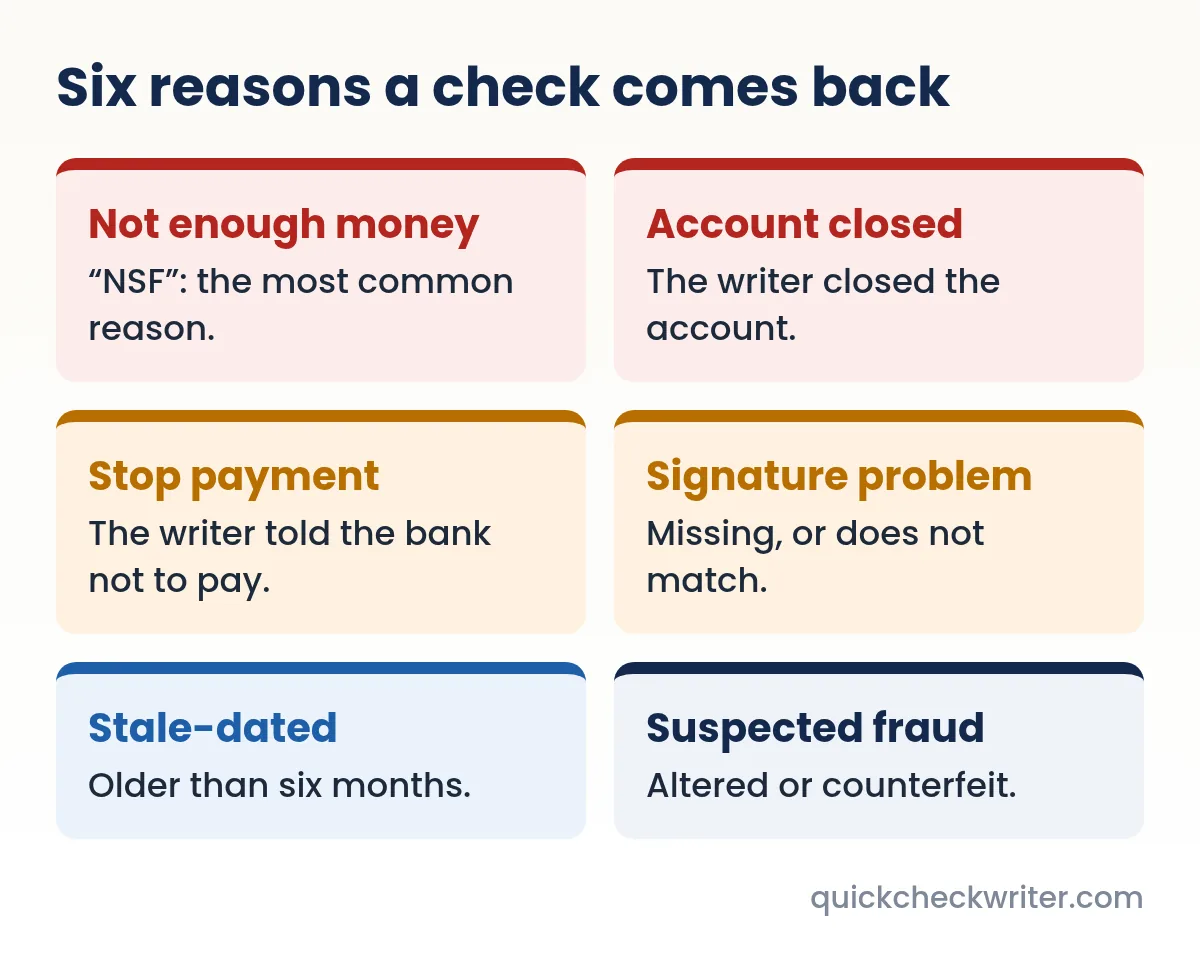
Insufficient funds is not the only reason a check comes back, though. A paying bank can also return a check because:
- the account is closed or frozen,
- the writer placed a stop payment on it,
- the signature is missing or does not match, or the check looks altered,
- the check is more than six months old (stale-dated),
- the bank believes it is counterfeit or fraudulent.
The effects on the person who deposited the check are similar in each case. This guide focuses on the NSF bounce, since that is what most people mean.
Step by step: the life of a bounced check
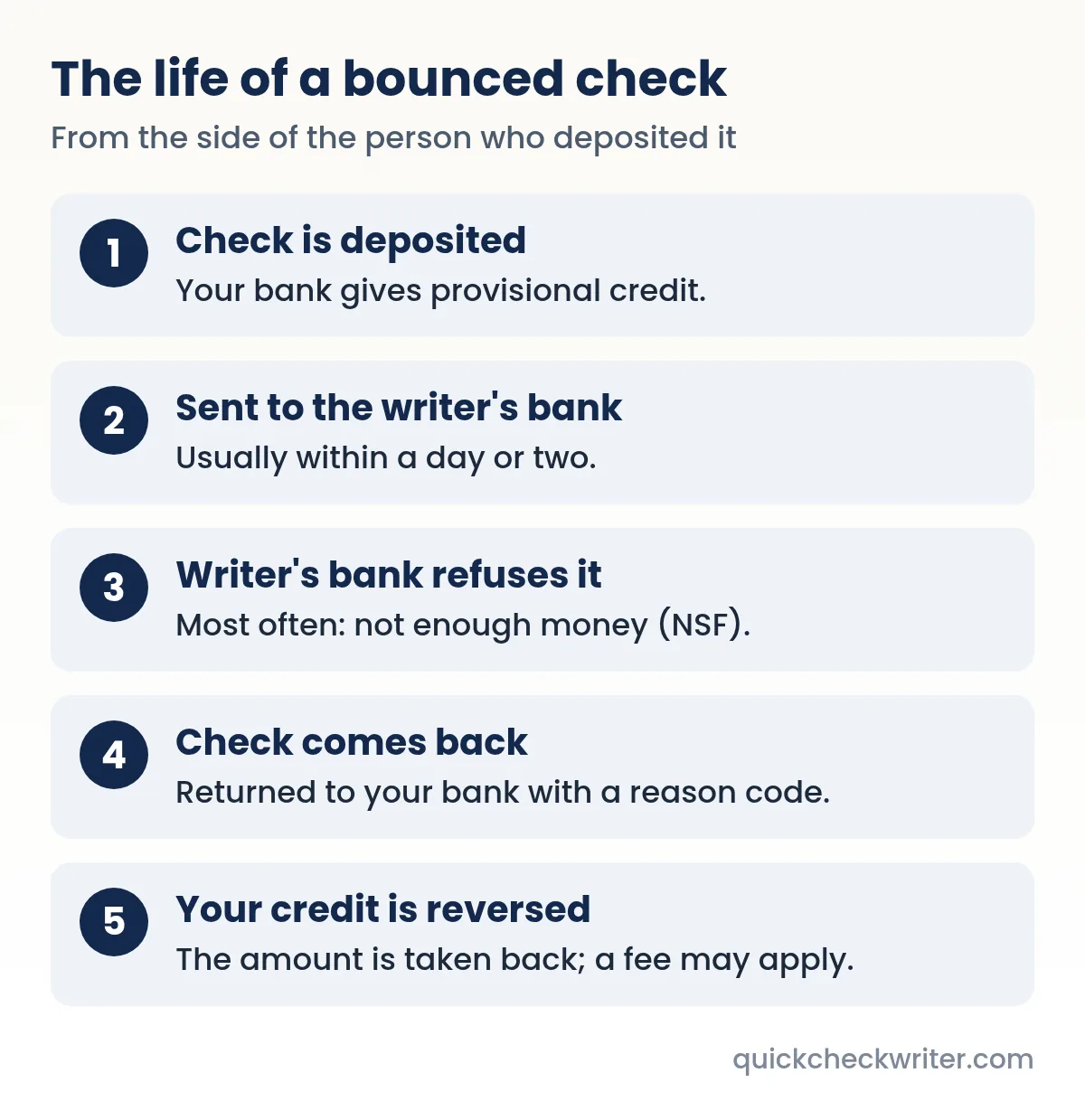
From the payee's side, the first sign is usually a notice from their own bank and a deduction from their balance. Here is what happens behind the scenes.
- The check is deposited
The payee's bank gives provisional credit and sends the check through the collection system to the writer's bank.
- The writer's bank checks the account
If the available balance is too low, the bank chooses. It may pay the check anyway, creating an overdraft, or it may refuse and return it. The law lets a bank pay a properly payable check even when that overdraws the account, but it does not require the bank to do so.
- The check is returned
If the bank refuses, it sends the check (or an electronic image of it) back with a return reason. The writer typically sees a returned-item or NSF fee, if the account agreement allows one.
- The payee's bank takes the money back
Under the UCC's charge-back rule, a collecting bank can reverse a provisional credit for an item that is returned unpaid. Any funds made available to the payee are clawed back, and a returned deposited item fee may apply.
- The check may be presented again
Some payees or banks redeposit the check in the hope that funds have arrived. The federal bank regulator's help site notes that banks generally try two or three times, that no law sets the number, and that fees can be charged each time the check is presented.
- The debt is still there
A check is a way of paying a debt. When it is dishonored, the payee can generally go back to the original obligation as well as the check itself. Bouncing a check does not cancel a bill.
Paid into overdraft or returned: the bank's choice
Whether your short check is paid or bounced depends on your bank and your account settings, not on you. Many banks have an overdraft program that decides item by item.
| Paid into overdraft | Returned unpaid (NSF) | |
|---|---|---|
| Payee gets the money? | Yes | No |
| Your account balance | Goes negative; you must repay | Unchanged by the check |
| Fee from your bank | Overdraft fee, if your account has one | NSF/returned-item fee, if your account has one |
| Fee from the payee | Usually none | Possible returned-check fee |
| Bill still unpaid? | No | Yes |
Fees vary a lot. Some large banks have dropped NSF fees entirely, while others still charge them. The Consumer Financial Protection Bureau says many banks and credit unions charge $30 or more per overdraft transaction and that several fees can land on the same day. Federal rules require your periodic statement to show your total overdraft fees and your total returned-item fees for the period and the year to date, so you can see exactly what bounces have cost you.
If paying into overdraft is better for you than a returned check, read our guide to overdraft protection and checks; a link to a savings account is often the cheapest backstop.
What it means for the person who wrote the check
Fees, twice over
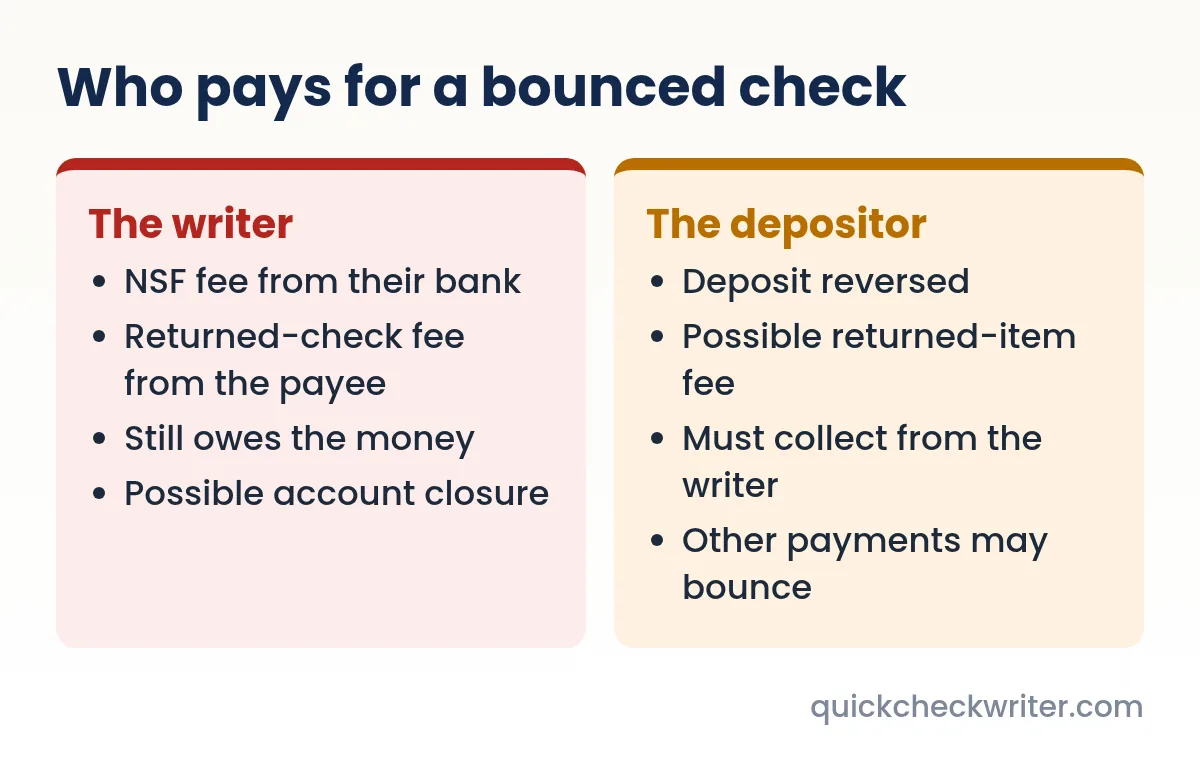
Expect a fee from your own bank if your account agreement provides for one, and possibly a fee from the payee. Many businesses post a returned-check fee at the register or in their terms, and state law sets the limits. In Kansas, for example, a county prosecutor's office explains that a merchant may require up to $30 per returned check, payable with the check amount within seven days of notice.
Your credit score
A single bounced check normally does not show up on your credit report. The CFPB explains that banks and credit unions usually do not report bounced checks to the major credit bureaus. The indirect damage is the risk: if the check was paying a credit card, loan or mortgage, that creditor may report the payment as late.
Your banking history
If you bounce checks often, your bank may report it to a specialty consumer reporting company that tracks checking accounts, such as ChexSystems. A bad record there can make it harder to open a new account, and a bank may close an account with repeated overdrafts. You can request your own report from these companies free once every 12 months.
The law
Every state has its own bad-check law, and the details differ. As one example, Missouri's statute makes it an offense to pass a check with the purpose to defraud, or to pass a check knowing there are insufficient funds and then fail to pay it within ten days after receiving written notice that it bounced. An honest mistake that you fix quickly is treated very differently from a pattern of deliberately bad checks, but the safe course is simple: respond fast and make the payment good.
If you receive a letter saying a check you wrote was returned, pay the amount (and any lawful fee) promptly and keep proof. Ignoring the notice is what turns a bank error or a timing mistake into a legal problem in many states.
What it means for the person who deposited the check
If you deposited a check that bounced, the bank will usually reverse the deposit even if you have already spent the money. The regulator's guidance is direct: the bank can take back the funds and may charge a fee, and it is up to you, as the payee, to pursue the person who wrote the check.
A bounce can also affect how your bank treats your account. Under Regulation CC, if your account is repeatedly overdrawn, your bank can apply longer holds to your deposits for six months after the last overdraft. And when a bank has reasonable cause to believe a check will not be paid, it can hold that deposit longer too.
A classic scam sends you a check for more than you are owed and asks you to wire or send back the difference. Even after the funds appear in your account, the check can bounce days later as counterfeit, and you are responsible for the money. The FDIC recommends reporting suspected fake checks to the U.S. Postal Inspection Service if they came by mail, and to your state attorney general.
Need to write a check right now?
Quick Check Writer fills in the amount in words, adds the bank line and prints on blank check stock or saves a PDF. Your first check is free, with no account and no card.
Write your first check free →If a check you wrote bounced: what to do
- Confirm what happened
Log in to your bank and find the returned item and any fees. Check whether it was NSF or another reason, such as a signature problem.
- Cover the shortfall
Move money into the account so that a redeposit, or any other checks you have outstanding, will clear.
- Contact the payee quickly
Apologize, explain, and ask how they want to be paid: a redeposit once funds are in, a new check, or a different method such as a cashier's check.
- Pay any lawful returned-check fee
If the payee charges one under their posted policy or state law, include it.
- Ask your bank about the fee
If this is rare for you, ask politely whether the bank will refund it. Many will consider a first-time request.
- Fix the cause
Usually it is timing: a deposit not yet available, or a forgotten check. A check register and low-balance alerts prevent most repeats.
If a check you deposited bounced: what to do
- Read the return reason
Your bank's notice or the returned item shows why. NSF suggests the writer may be able to pay soon; "account closed" or "stop payment" means you need to talk to the writer.
- Contact the writer in writing
Keep it factual: the check number, amount, date and return reason, and how you would like to be paid. A written record matters if you need to rely on your state's bad-check law later.
- Do not redeposit blindly
A second bounce can mean a second fee for you. Ask the writer to confirm funds first, or ask for a different form of payment.
- Escalate if needed
If the writer will not pay, options include small claims court, a collection agency, or your local prosecutor's bad-check program where one exists.
Collecting on a bounced check: the demand letter
If a friendly call does not fix it, many states give payees a formal route: a written demand. The exact rules are set by each state, so look up your own state's statute or consumer agency before you send anything. Two large states show how it works.
Florida
Under Florida Statutes § 68.065, a payee can collect bank fees they actually incurred plus a service charge: $25 if the check was $50 or less, $30 if it was over $50 up to $300, $40 if it was over $300, or 5% of the face amount, whichever is greater. If the writer still does not pay in cash within 30 days of a written demand, the payee can sue for the amount owed plus damages of triple that amount, with a minimum of $50, plus court costs and reasonable attorney fees. The statute even spells out the wording the notice should use.
California
California Civil Code § 1719 works in a similar way. The Los Angeles County Department of Consumer and Business Affairs explains that you first send a demand letter by certified mail asking for the check amount, bank fees and mailing cost. If you are not paid within 30 days, you can sue in small claims for the check plus damages of three times its amount, at least $100 and at most $1,500. A writer who stopped payment because of a real dispute over the goods or work may not owe damages.
Jane Doe, a landscaper in California, takes a $250 check from John Sample. It bounces as NSF. Jane mails a demand letter by certified mail on May 2 for $250 plus her $12 bank fee and postage. If John does not pay by June 1, Jane can file in small claims for the $250 plus damages of three times $250, which is $750. Had the check been $25, three times would be only $75, so the $100 minimum would apply instead.
A demand letter states the facts and the amount owed. Do not threaten arrest; whether a bounced check is a crime depends on intent and is for prosecutors to decide, as the guidance from county prosecutors above shows.
Common mistakes after a bounce
- Writer: paying with another check from the same account. If the account is still short, the second check can bounce too. Pay by cash, a card or a cashier's check instead.
- Writer: ignoring the payee. In states like Florida and California, the 30-day clock after a written demand is what turns a small debt into triple damages.
- Payee: depositing again without asking. A second presentment while the account is still short only adds fees on both sides. Ask the writer whether funds are there first.
- Payee: throwing the returned check away. Keep the check or its image and the bank's return notice. They are your evidence if you need small claims.
- Both: losing track of outstanding checks. A check register that shows what has not cleared yet prevents most bounces in the first place.
How to avoid bouncing a check
Most bounces come from timing rather than real shortage. A few habits prevent nearly all of them:
- Record every check when you write it. The money is committed the moment the check leaves your hand. Quick Check Writer logs every check you print in its register automatically, so your outstanding checks are always in one list.
- Know when your deposits are available. A deposit that appears in your balance may not be available yet. See how long a check takes to clear.
- Turn on low-balance alerts in your banking app.
- Link a savings account or line of credit as overdraft protection.
- Reconcile monthly. Comparing your register with your statement catches forgotten checks; our checkbook balancing guide shows how.
- Do not rely on postdating. A future date does not stop a bank from paying early. See postdated checks.
For businesses that accept checks
If you take checks from customers, a short written policy saves arguments: the returned-check fee you charge (within your state's limit), what ID you require, and the point at which you stop accepting checks from a customer. For large or one-off sales to people you do not know, asking for a cashier's check, and verifying it with the issuing bank using a phone number you look up yourself, is a common safeguard. Our guide on how to verify a check covers the steps.
Frequently asked questions
What happens if you write a check with insufficient funds?
Your bank either pays it and overdraws your account or returns it unpaid. Either way you may be charged a fee under your account agreement, and if it is returned, the payee may charge a fee and ask you to pay another way.
Does a bounced check hurt your credit score?
Usually not directly. Banks generally do not report bounced checks to the major credit bureaus. But if the check was paying a loan or card, the creditor may report a late payment, and repeated bounces can be reported to checking-account reporting companies.
Can you go to jail for bouncing a check?
State laws differ. Criminal bad-check laws generally target checks written with intent to defraud or knowingly bad checks that are not made good after written notice. An honest mistake fixed promptly is very different. For your situation, check your state's law or ask a lawyer.
How many times will a bank try to cash a bounced check?
There is no legal rule. The federal bank regulator says banks generally try two or three times, that a check may not be resubmitted at all, and that fees can be charged each time it is presented.
I deposited a check that bounced. Do I have to pay the bank back?
Generally yes. If your bank credited you for a check that was later returned unpaid, it can reverse the funds and may charge a fee. You then pursue the person who wrote the check.
How long does it take to find out a check bounced?
Often within a few business days of deposit, but it can be longer, especially for fraudulent checks. Funds being available in your account does not mean the check has finally been paid.
Is a bounced check fee the same as an overdraft fee?
No. An overdraft fee is charged when your bank pays an item into a negative balance; an NSF or returned-item fee is charged when it refuses and returns the item. Your statement shows the totals of each separately.
Can I charge someone a fee for a bounced check?
Usually yes, within your state's limits. In Florida, for example, a payee may collect bank fees actually incurred plus a service charge of $25 to $40 or 5% of the check, whichever is greater. Check your own state's statute and post your fee in advance if you run a business.
What should a bounced check demand letter include?
The check number, date, amount, the bank it was drawn on, the return reason, the total you are asking for, and a deadline. Some states, such as Florida and California, set required wording and how the letter must be sent (for example, certified mail), so use your state's official form or sample if one exists.
Related guides
- Overdraft protection and checks
- How to stop payment on a check
- How Long Does a Check Take to Clear?
- How to verify a check before you deposit it
- Post-dated checks: what they are and whether banks honor the date
- How to balance a checkbook
Sources
- UCC § 4-401, When bank may charge customer's account (Cornell LII)
- UCC § 4-214, Right of charge-back (Cornell LII)
- UCC § 3-310, Effect of instrument on obligation (Cornell LII)
- OCC HelpWithMyBank: A check I deposited bounced
- OCC HelpWithMyBank: How many times can an NSF check be resubmitted?
- OCC HelpWithMyBank: NSF fees and overdraft protection
- CFPB: Know your overdraft options
- Regulation DD, 12 CFR 1030.11 Overdraft disclosures (eCFR)
- CFPB: I bounced a check. Will this show up on my credit report?
- CFPB: Chex Systems, Inc. (consumer reporting company)
- Regulation CC, 12 CFR 229.13 Exceptions (new accounts, repeated overdrafts) (eCFR)
- Missouri Revised Statutes § 570.120, Passing a bad check (example of a state law)
- FDIC Consumer News: Beware of fake checks
- OCC HelpWithMyBank: Am I liable for a fraudulent check I deposit?
- Shawnee County (Kansas) District Attorney: Worthless checks (returned-check fee example)
- Greene County (Missouri) Prosecuting Attorney: Bad checks program
- Wells Fargo Consumer Account Fees and Information (fee schedule example)
- Florida Statutes § 68.065, Actions on worthless payment instruments
- Los Angeles County DCBA: Bad checks (California Civil Code § 1719)
Last updated November 1, 2026. This page is general information, not legal or financial advice. Quick Check Writer is check printing software; it is not a bank and does not move money.