
Key takeaways
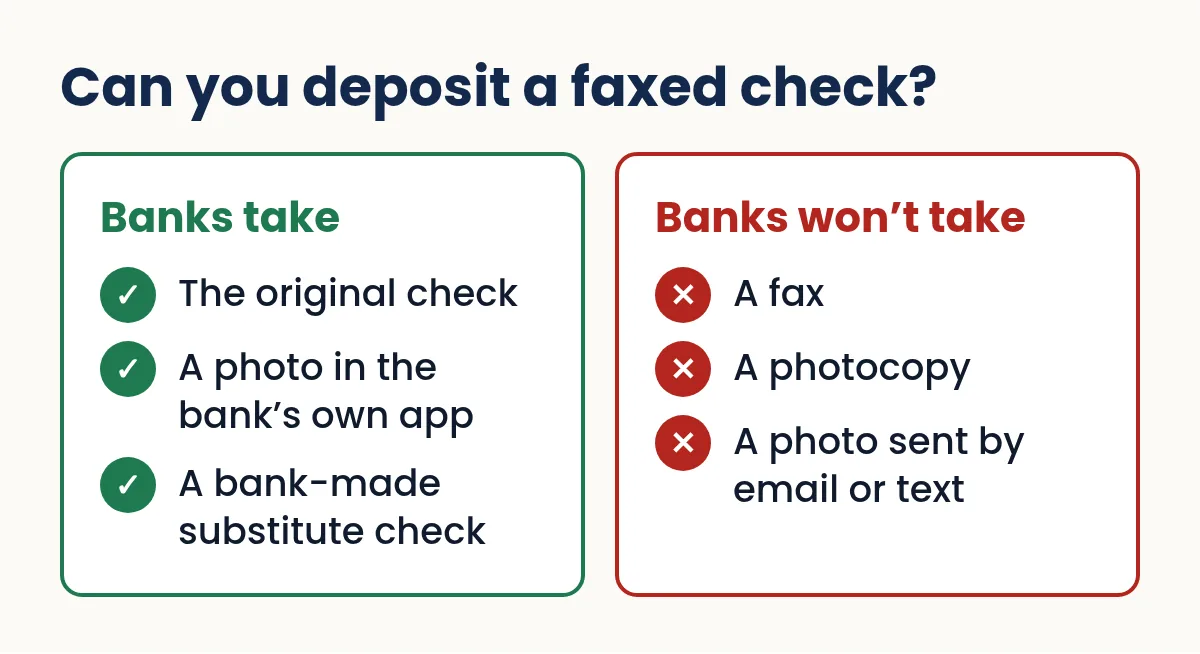
- A fax is not a substitute check and can’t be deposited.
- “Checks by fax” are remotely created checks the payee prints from your account details.
- Remotely created checks carry no signature from the account holder, so share your numbers only with businesses you trust.
- For speed, use hand delivery, overnight mail, a bank transfer or a check PDF the payee agrees to.
On this page
- Why a fax of a check won't work
- What about Check 21 and substitute checks?
- What “checks by fax” really means
- Better ways to get a check to someone quickly
- When sending a copy of a check is normal
- Worked example: rent is due and the tenant is away
- Common mistakes
- If you receive a faxed check
- Where Quick Check Writer fits
- FAQ
Why a fax of a check won't work
Banks process checks either from the original paper or from an electronic image that a bank captured under rules it agreed to. A fax is neither. The image is low resolution, often black and white, and loses the fine detail that banks rely on: the magnetic bank line at the bottom, security features like microprinting and background patterns, and the endorsement on the back.
There is also no way for the bank to know the faxed check is the only copy. If a fax could be deposited, the same check could be deposited again on paper, through an app, or by someone else. Image deposit systems are designed around that risk; a fax machine is not.
What about Check 21 and substitute checks?
A federal law, the Check Clearing for the 21st Century Act, made paper copies of checks legally equal to the originals, but only a very specific kind of copy. A substitute check is a paper reproduction made by a bank from an image of the original. To count as the legal equivalent of the original, it must accurately show the front and back of the check, carry the bank line in a form machines can read, and bear the legend “This is a legal copy of your check. You can use it the same way you would use the original check.”
A fax you send or receive is not a substitute check. Our guide to Check 21 and substitute checks explains what they are and the protections that come with them.
What “checks by fax” really means
You may still see businesses advertising that they “accept checks by fax” or “checks by phone”. That doesn't mean they deposit a faxed check. It means you send them your bank details and permission, and they create a check on your account themselves.
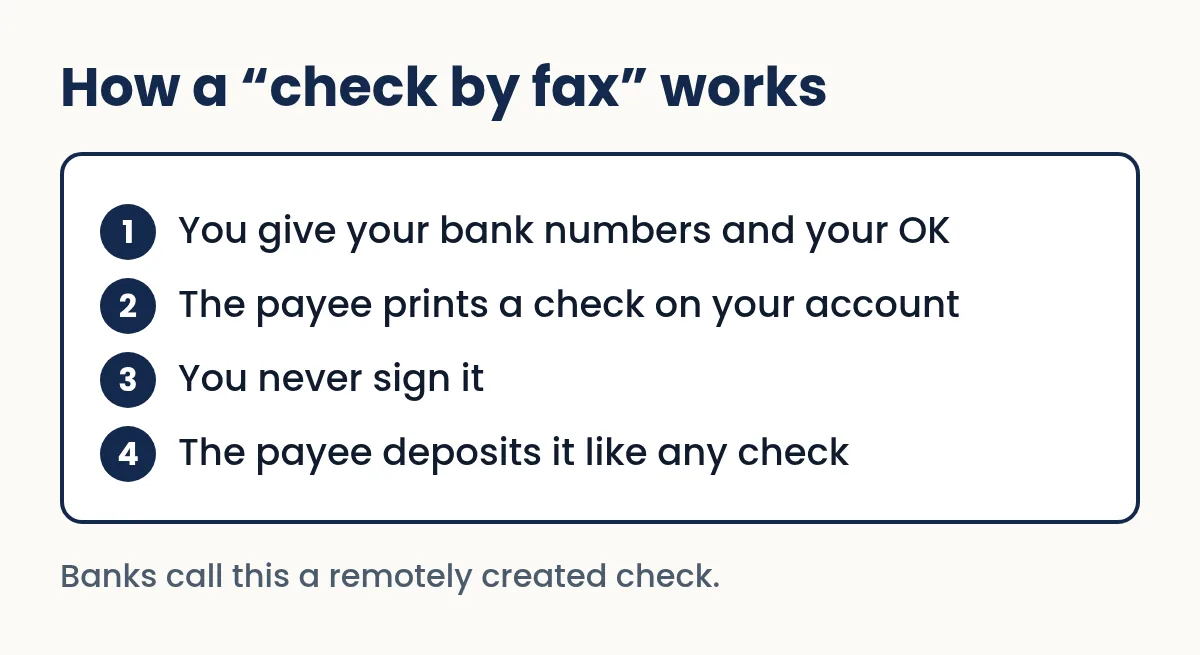
The payee prints a check with your routing number, account number and the amount you agreed to, and instead of your signature it usually carries a line such as “authorized by account holder”. Then the payee deposits it like any other check. Federal Regulation CC calls this a remotely created check: a check not created by the paying bank that doesn't bear a signature applied by the account holder.
These checks are legal when the account holder really authorized them, but they carry real risk because anyone with your account numbers could create one. Regulation CC makes the bank that sends a remotely created check into the system warrant that the account holder authorized it, which helps your bank recover the money if one was not authorized. Federal telemarketing rules have also prohibited sellers from using remotely created checks to take payment for goods or services sold through telemarketing since 2016. Read more in remotely created checks and checks by phone.
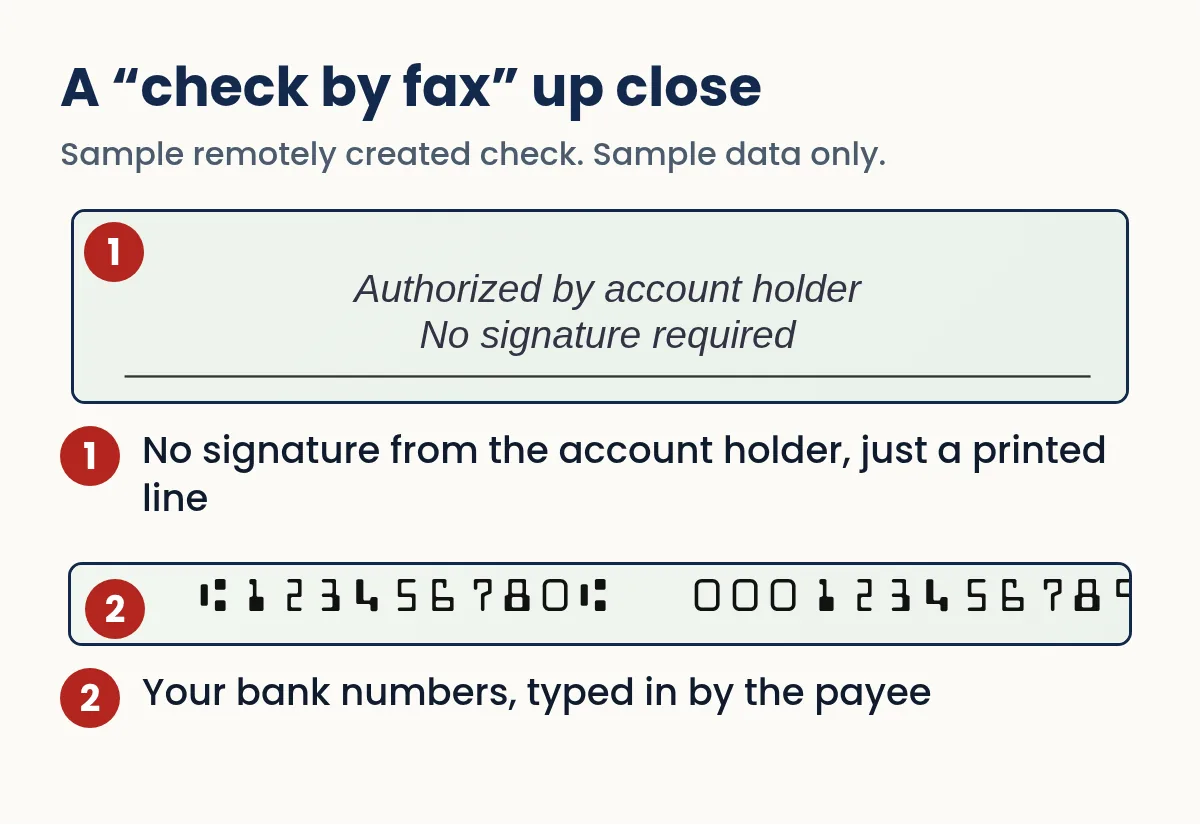
Faxing or reading out your routing and account numbers lets the receiver create checks on your account. Only do it with a business you trust, keep a record of exactly what you authorized, and watch your statement for the payment.
Need to write a check right now?
Quick Check Writer fills in the amount in words, adds the bank line and prints on blank check stock or saves a PDF. Your first check is free, with no account and no card.
Write your first check free →Better ways to get a check to someone quickly
If the goal behind “can I fax a check” is speed, these options actually work:
| Option | Speed | Good to know |
|---|---|---|
| Hand delivery | Same day | Get a receipt for rent and deposits |
| Overnight mail with tracking | Next day or two | See how to mail a check safely |
| Check sent as a PDF | Minutes | Only if the payee agrees and their bank lets them deposit a printed check; see how to email a check |
| Bank transfer (ACH) | About 1 to 3 business days | Needs the payee's bank details; see ACH vs check |
| Wire transfer | Usually same day | Fees apply and wires are hard to reverse; see wire transfer vs check |
When sending a copy of a check is normal
There are good reasons to fax, scan or photograph a check, as long as nobody is trying to deposit the copy:
- Setting up direct deposit. Employers and benefit payers often ask for a voided check, or your bank's direct deposit form, to get your routing and account numbers. A copy does the job because it only carries numbers. See direct deposit and the voided check.
- Proving you paid. The Federal Reserve notes that a copy of an original check usually works as proof of payment. Send the front and back of the paid check from your bank's online images.
- Sharing records. A lender, accountant or landlord may ask for a copy of a check you wrote.
In each case, send it to a number or address you have confirmed, and write “VOID” or “COPY” across it. For proof of payment, you can usually cover all but the last four digits of the account number; for direct deposit you can't, because the payer needs the full numbers.
Worked example: rent is due and the tenant is away
Jane Doe rents an apartment to John Sample. Rent is due today, John is traveling, and he asks whether he can fax a check. Here is what actually works:
- Jane says no to the fax
Her bank won't accept it, and a deposited fax could later be reversed.
- They pick a real payment
If Jane's lease allows electronic payment, John can send a bank transfer. If she wants a check, John can print one, sign it and send it overnight with tracking, or ask someone at home to drop off a check he left signed and sealed.
- Jane notes the date
She records when the payment was sent, so a one-day delay doesn't turn into a late fee dispute.
Common mistakes
- Depositing a fax or photocopy through a mobile app. Your bank's terms generally require the original paper check.
- Faxing your account numbers to a number you got from an unsolicited call or email.
- Shipping goods before a payment has actually cleared.
- Throwing away the original after sending a copy as proof. Keep it until the matter is settled.
If you receive a faxed check
Don't try to deposit the fax, and don't ship goods or send money against it. Ask the payer for the original check, a payment your bank can verify, or a bank transfer. If someone insists that you deposit a faxed or emailed check and send part of the money back, that is a classic fake check scam; see how to verify a check.
Where Quick Check Writer fits
Quick Check Writer can't fax checks, and it doesn't create checks on someone else's account. It prints your own checks, on blank check stock or as a PDF you can share, with the bank line in the standard position and the amount in words filled in. If you need a real check fast, printing one at home and handing it over is often the quickest honest route. See how to print checks at home.
Frequently asked questions
Can I deposit a faxed check?
No. Banks need the original check, an image captured through their own ATM or app, or a bank-made substitute check. A fax printout isn’t accepted.
Is a faxed check legal?
Faxing a picture of a check isn’t illegal, it just isn’t a deposit-able item. What businesses call checks by fax are remotely created checks, which are legal when the account holder authorizes them.
Can I fax a check to pay a bill?
Only if the biller offers to create a check from your account details, which is a remotely created check. Many billers prefer an online or phone payment instead.
Can I email a check instead of faxing it?
Some payees accept a check sent as a PDF, print it, and deposit it with their bank’s app. Ask the payee and check their bank allows it first.
What is a remotely created check?
A check created by the payee using the payer’s account details, without the payer’s signature. Federal rules make the depositing bank responsible for confirming it was authorized.
Can I fax a voided check for direct deposit?
Usually, yes. A voided check only gives the payer your routing and account numbers, and some employers and payroll providers accept a fax, scan or photo of it instead of the paper. Ask which format they take. Send it only to a number you have confirmed with the employer.
Can I deposit a photocopy of a check?
No. A photocopy is not the original check and is not a bank-made substitute check. Deposit the original paper check, in person, at an ATM or through your bank's app.
Does a faxed copy of a check prove I paid?
A copy of a paid check, front and back, usually works as proof of payment. The Federal Reserve notes that even the IRS accepts a substitute check as proof.
Related guides
- Remotely created checks (check drafts) and checks by phone
- Check 21 and substitute checks
- How to email a check
- How to mail a check safely
- ACH vs check: which payment should you use?
- How to verify a check before you deposit it
Sources
- 12 CFR § 229.51, substitute checks (Cornell LII)
- 12 CFR § 229.2(fff), remotely created check definition (Cornell LII)
- 12 CFR § 229.34, warranties for remotely created checks (Cornell LII)
- 16 CFR § 310.4(a)(9), Telemarketing Sales Rule (Cornell LII)
- Federal Register: Telemarketing Sales Rule amendments (Dec 14, 2015)
- Federal Reserve: Frequently asked questions about Check 21
- Bank of America: setting up direct deposit (voided check or form)
Last updated November 1, 2026. This page is general information, not legal or financial advice. Quick Check Writer is check printing software; it is not a bank and does not move money.