
Key takeaways
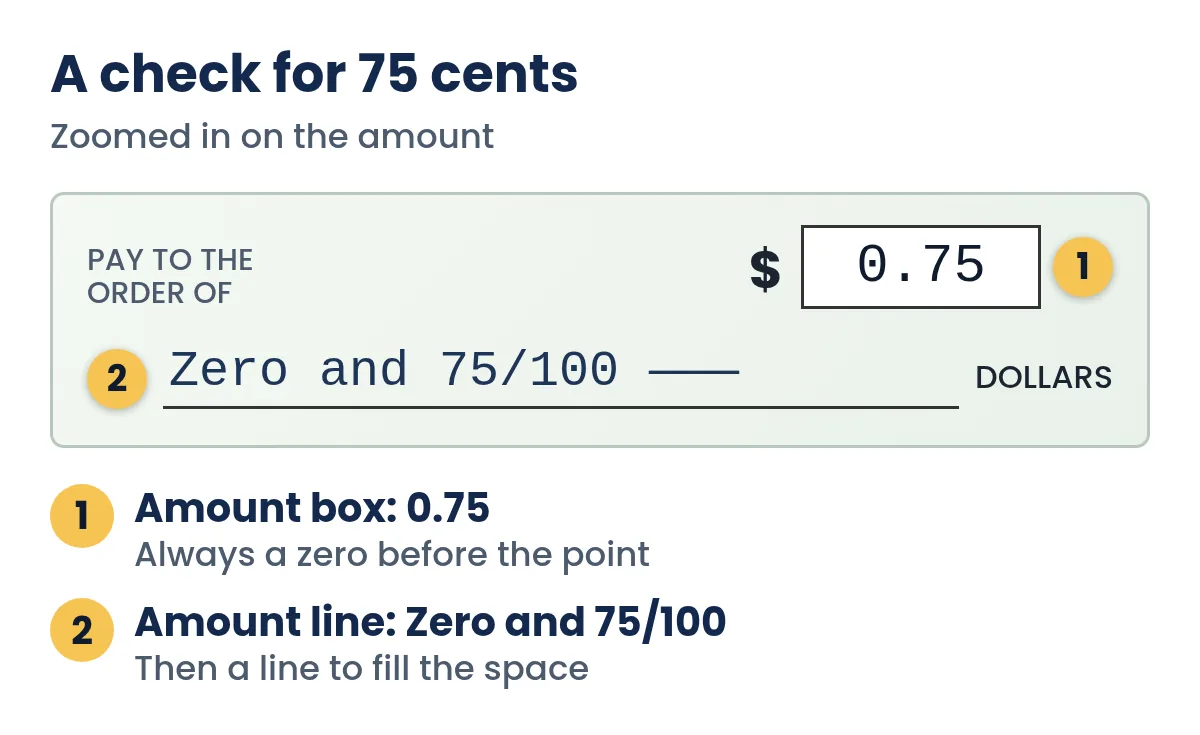
- Amount box: 0.75, with a zero before the decimal point.
- Amount line: Zero and 75/100.
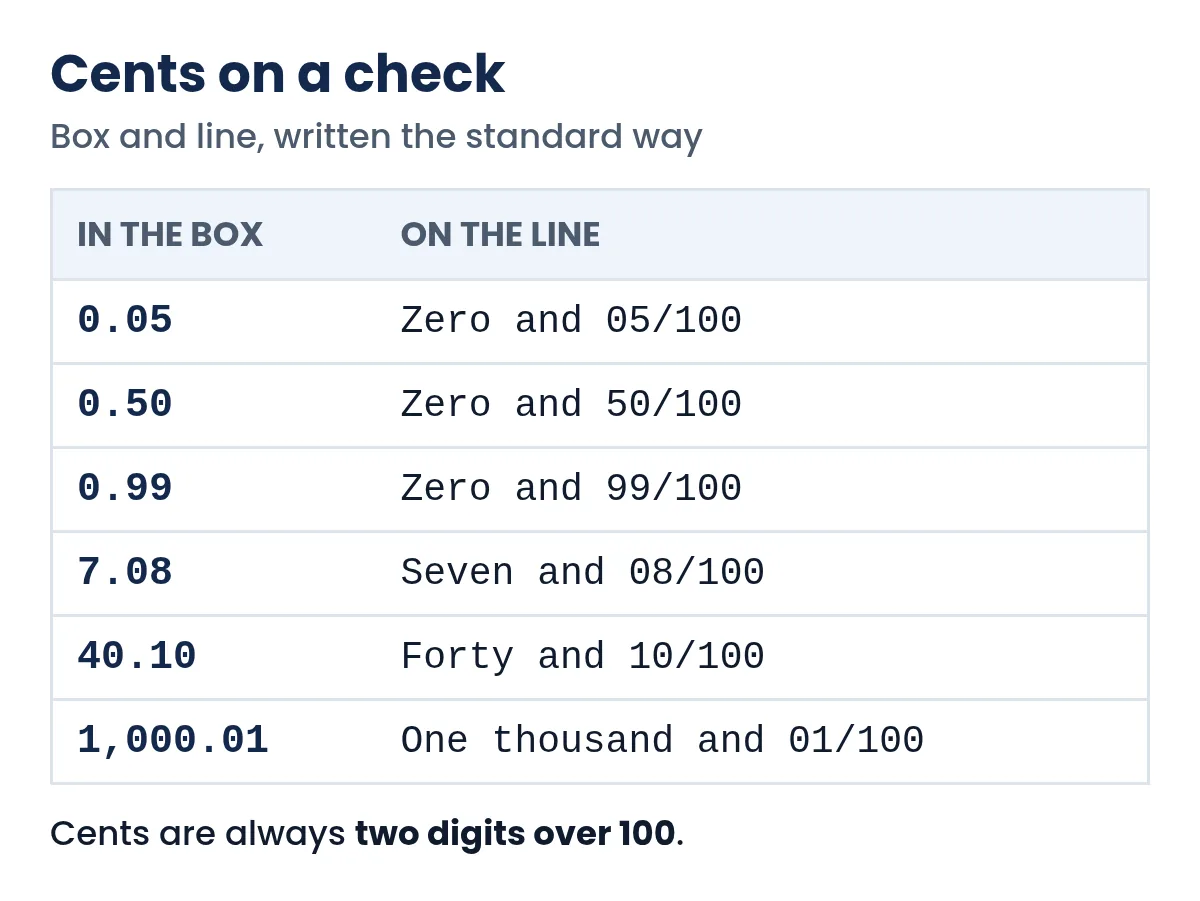
- Cents are always two digits over 100: 05/100, not 5/100.
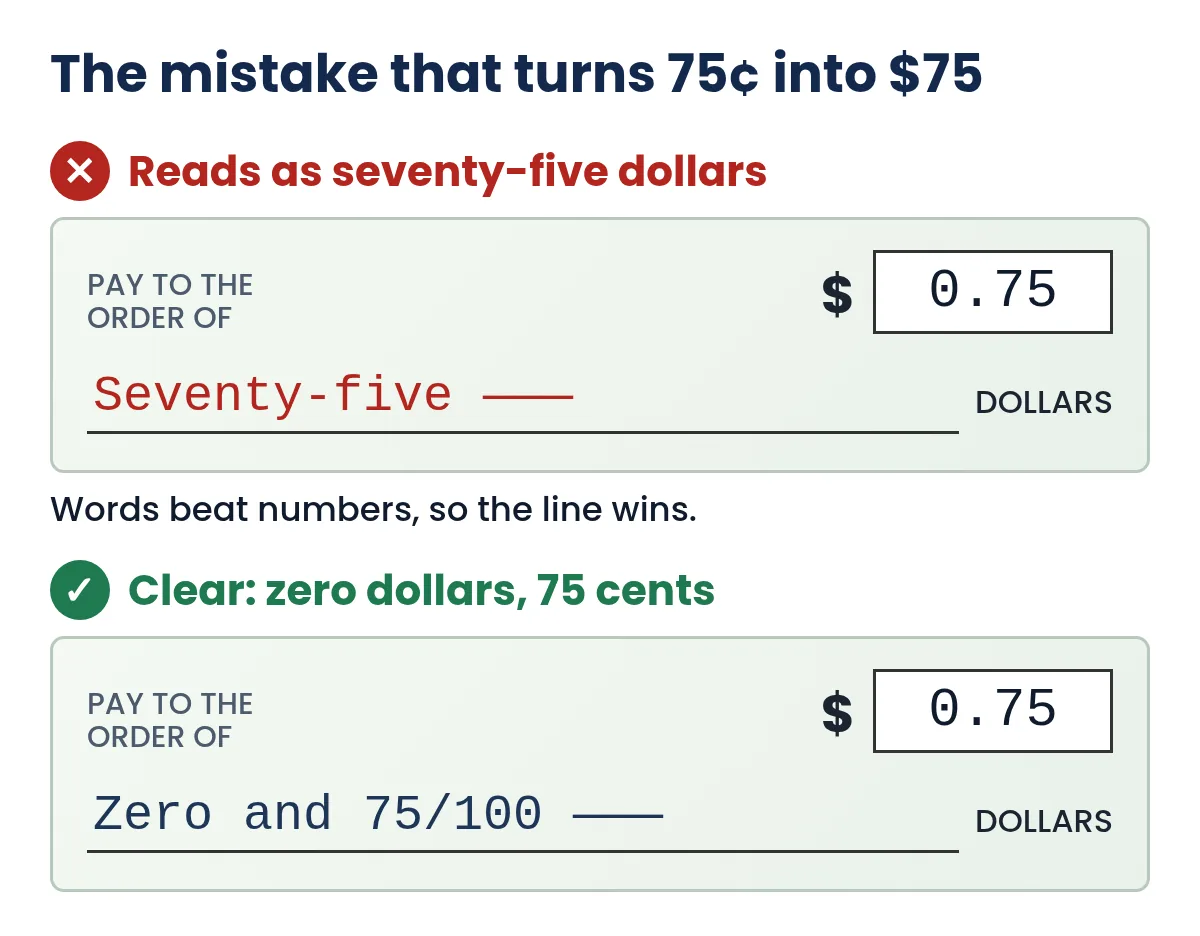
- The written amount wins if the two disagree, so be careful with it.
On this page
- Step by step: a check for 75 cents
- Two accepted ways to write the words
- Why the written amount matters most
- Cents on checks for more than a dollar
- Common mistakes with small amounts
- Worked example: a 42-cent refund
- Quick checklist for a check under a dollar
- Is it even worth writing a check for cents?
- Printing a check for cents
- FAQ
Step by step: a check for 75 cents
- Date and payee
Fill these in exactly as you would for any other check: today's date and the full name of the person or business.
- Amount box: 0.75
Start right next to the dollar sign and write a zero before the decimal point: 0.75. The leading zero shows nothing is missing, and the decimal point shows where dollars end and cents begin. Writing just ".75" or "75¢" is easier to misread or alter.
- Amount line: "Zero and 75/100"
On the long line, write Zero and 75/100, then draw a line to the end of the space. The word "Dollars" is usually already printed at the end of the line.
- Memo (optional)
A short note such as "Refund, invoice 1188" tells the payee why such a small check arrived.
- Sign
Sign as usual. A small amount doesn't need anything special.
That's the whole method. If you're writing a larger amount, the cents part works the same way; see how to write a check amount in words for full-dollar examples.
Two accepted ways to write the words
For amounts under a dollar, you'll see two styles. Both are clear, and banks accept both.
- The fraction style: "Zero and 75/100"
- Matches the way every other check amount is written: dollars in words, cents as a fraction of 100. It's the most common choice and the one check-writing software prints, because it fits the pre-printed "Dollars" at the end of the line.
- The spelled-out style: "Only seventy-five cents"
- Some people prefer spelling out the cents, starting with "Only" so nothing can be added in front. If you use this style, cross out the printed word "Dollars" at the end of the line, so the line can't be read as seventy-five dollars.
Don't write "Seventy-five" on its own, and don't leave the dollars part blank. Next to the printed word "Dollars", "Seventy-five" reads as $75.
Why the written amount matters most
Under the Uniform Commercial Code (§ 3-114), when a check's terms contradict each other, words prevail over numbers. If the box says 0.75 but the line says "Seventy-five", a bank could read the words as $75. That's the real risk with tiny checks: not that they're refused, but that a sloppy amount line can be read as a much larger sum.
The CFPB puts it the same way for consumers: a check whose words and figures disagree is still valid, and the amount spelled out in words is the one used.
So the rule for any amount, large or small:
- The amount line should state the dollars, even when it's zero.
- Cents go as a two-digit fraction: 05/100, not 5/100.
- Fill or strike out the empty space so nothing can be added.
- The figures and the words should match exactly.
Need to write a check right now?
Quick Check Writer fills in the amount in words, adds the bank line and prints on blank check stock or saves a PDF. Your first check is free, with no account and no card.
Write your first check free →Cents on checks for more than a dollar
Cents trip people up on bigger checks too. A few patterns worth knowing:
$7.08 is "Seven and 08/100". $40.10 is "Forty and 10/100" (ten cents, so 10/100). $250.00 is "Two hundred fifty and 00/100" (no cents, written as 00/100, or "and no/100"). $1,000.01 is "One thousand and 01/100".
The most common mistake is dropping the leading zero on single-digit cents: "Seven and 8/100" is understandable, but "08/100" keeps the format consistent with the figures in the box and leaves no room for a second digit to be squeezed in.
Common mistakes with small amounts
| Written as | Problem | Better |
|---|---|---|
| .75 in the box | The decimal point is easy to miss or alter | 0.75 |
| 75¢ in the box | Doesn't fit the dollar format the box expects | 0.75 |
| "Seventy-five" on the line | Reads as $75 next to the printed "Dollars" | Zero and 75/100 |
| "Zero and 5/100" for five cents | Inconsistent; leaves room for a digit | Zero and 05/100 |
| "Only 75 cents" with "Dollars" left printed | Mixed units on one line | Cross out "Dollars" |
Worked example: a 42-cent refund
Jane Doe overpaid an invoice from John Sample's small business by 42 cents, and John wants to refund it exactly. He writes:
| Field | What John writes |
|---|---|
| Pay to the order of | Jane Doe |
| Amount box | 0.42 |
| Amount line | Zero and 42/100, then a line to "Dollars" |
| Memo | Refund of overpayment, invoice 1188 |
He records check 1024 for $0.42 in his register, and if it hasn't cleared after a couple of months he follows up with Jane rather than leaving it open indefinitely.
Quick checklist for a check under a dollar
- Box: a zero, a decimal point and two digits (0.42).
- Line: "Zero and 42/100", or "Only forty-two cents" with "Dollars" crossed out.
- A line drawn through any leftover space.
- Words and figures say the same amount.
- A memo explaining the small amount.
- Logged in your register so it doesn't get forgotten.
Is it even worth writing a check for cents?
Sometimes there's no better option: a business refunding a small overpayment, a landlord returning the last bit of a deposit, or settling a balance exactly. There's no legal minimum for a check; a check only needs to be for a fixed amount of money. Still, think about the practicalities:
- Bank fees. If your account charges per check or per item, a check for cents can cost more than it's worth. Check your fee schedule.
- The payee's effort. Depositing a tiny check takes the same time as a large one. Mobile deposit makes it easier, but some recipients may not bother.
- Outstanding checks. Small checks are often never cashed, which leaves them hanging in your register. Note them and follow up. Under UCC § 4-404 a bank isn't obliged to pay an ordinary check presented more than six months after its date (though it may), so a tiny check that sits in a drawer can go stale. See outstanding checks.
- Alternatives. For a refund under a dollar, a credit on the next invoice may be simpler for everyone.
Printing a check for cents
Check-writing software takes the guesswork out of this. In Quick Check Writer you type 0.75 into the amount field and it fills in "Zero and 75/100" for you, prints both amounts in neat type, and adds the check to your register. Want to see how a check looks before you print it? Try the printable check template or learn the full routine in how to write a check.
Frequently asked questions
How do you write a check for under a dollar?
Write the amount with a leading zero in the box (0.75) and write "Zero and 75/100" on the amount line, then draw a line through the leftover space.
How do you write 50 cents on a check?
Put 0.50 in the amount box and "Zero and 50/100" on the line. You can also write "Only fifty cents" and cross out the printed word "Dollars".
Can I write "Only 75 cents" instead of 75/100?
Yes. Start with "Only" and cross out the pre-printed "Dollars" so the amount can't be read as $75. The fraction style is more common.
Will a bank cash a check for less than a dollar?
There's no legal minimum amount for a check, so small checks are valid. Your own account fees still apply, so check whether a per-item fee makes it worthwhile.
How do you write cents when there are no cents?
Write 00/100 (or "and no/100") after the dollars, for example "Fifty and 00/100". It shows the amount is exact.
What if the numbers and words don't match?
Words prevail over numbers under UCC § 3-114, so the written amount usually controls. Some banks return mismatched checks instead.
How do you write one cent on a check?
Put 0.01 in the box and "Zero and 01/100" on the line. The leading zero in 01 keeps the two-digit cents format.
Do you write "and" before the cents?
Yes. "And" separates the dollars from the cents, as in "Zero and 75/100" or "Seven and 08/100". Avoid using "and" anywhere else in the amount.
Related guides
- How to write a check amount in words (with cents)
- How to write a check, step by step
- Parts of a check, explained
- Printable check template that fills itself in
- Outstanding checks
Sources
- UCC § 3-114 (contradictory terms: words prevail over numbers), Cornell LII
- UCC § 3-104 (negotiable instrument: fixed amount of money), Cornell LII
- CFPB: A check where the words and the numbers for the amount are different
- UCC § 4-404 (bank not obliged to pay check more than six months old), Cornell LII
Last updated November 1, 2026. This page is general information, not legal or financial advice. Quick Check Writer is check printing software; it is not a bank and does not move money.