
Key takeaways
- The payee line says who gets paid; the signature authorizes payment.
- Write the amount twice. If they differ, the words win under UCC § 3-114.
- The bottom MICR line holds the routing number, account number and check number.
- The memo is optional and has no legal effect on the amount.
On this page
- The quick map: front of a check
- Who's who on a check
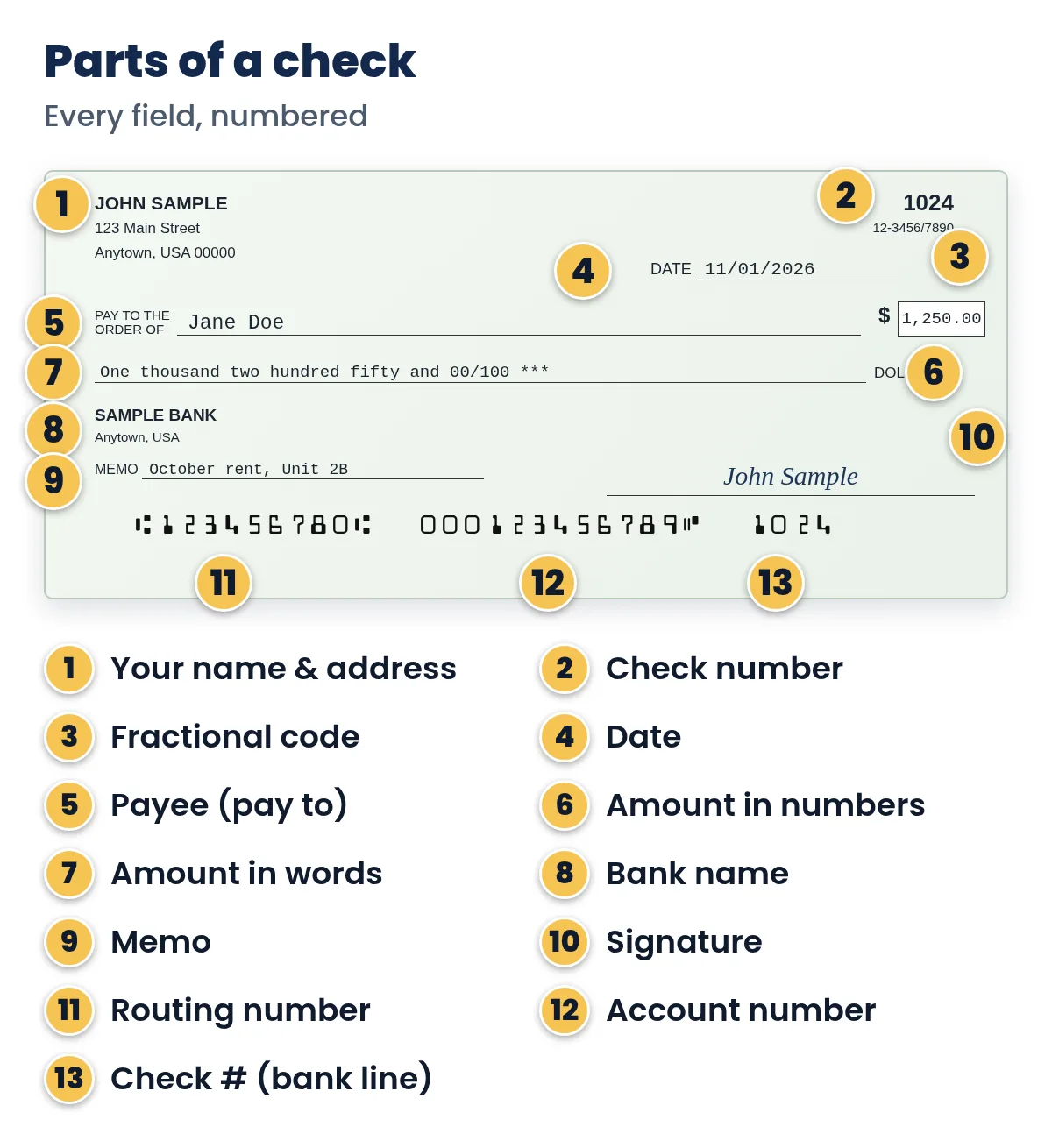
- 1. Your name and address
- 2. The check number
- 3. The fractional routing code
- 4. The date line
- 5. "Pay to the order of": the payee line
- 6. The amount box (numbers)
- 7. The amount in words (the legal line)
- 8. The bank name
- 9. The memo line
- 10. The signature line
- 11–13. The bank line: routing, account and check number
- What's on the back?
- Personal vs business checks: the same parts, different layout
- Worked example: reading a real-looking check, part by part
- Common mistakes, part by part
- How to check a check before you send or accept it
- Printing checks with all the parts in the right place
- FAQ
The quick map: front of a check
Every US check follows the same basic layout, whether it came in a box from your bank or you printed it yourself on blank stock. Once you know where each field lives, reading, writing and checking a check takes seconds. The diagram above numbers each part; the sections below explain what each one does and the mistakes people make with it.
It helps to sort the fields into three groups:
- Pre-printed information that identifies you and your bank: your name and address, the bank's name, the check number and the bank line at the bottom.
- Fields you fill in each time: the date, the payee, the amount (twice) and, optionally, the memo.
- Your signature, which turns a piece of paper into an order to your bank.
Who's who on a check
Banking law uses a few formal words for the people involved. You will see them in bank agreements, on statements and in the Uniform Commercial Code (UCC), the set of state laws that governs checks.
- Drawer
- The person or business who writes and signs the check and whose account pays it. In our sample, that is John Sample.
- Payee
- The person or business the check is made out to. In the sample, Jane Doe.
- Drawee
- The bank ordered to pay the check: the one named on the front and identified by the routing number. Here, Sample Bank.
- Endorser
- Whoever signs the back to cash, deposit or transfer the check, usually the payee.
Legally, a personal check is a "draft": a written order from the drawer telling the drawee bank to pay money on demand. That is why the signature matters so much. Without it, there is no order.
1. Your name and address
The top-left corner shows the account holder's name, and usually a mailing address. On a business check, this is the company's legal or trade name, often with a logo. The block tells the payee and the bank who is paying.
The address is optional on many personal checks; plenty of people leave it off for privacy. Some merchants like seeing it, and a business check almost always carries one. If you move, update it before your next batch rather than crossing it out by hand.
2. The check number
The number in the top-right corner identifies this particular check. It appears a second time in the bank line at the bottom, so your statement can list each check by number. Use it to keep your register in order, to spot a missing check and to give your bank the right details for a stop payment. Our separate guide on where to find the check number covers personal and business layouts in detail.
3. The fractional routing code
Under or near the check number, many checks carry a small number shaped like a fraction, such as 12-3456/7890 on our sample. It is an older way of writing the paying bank's identifying information. Today's machines read the nine-digit routing number in the bottom line instead, so you can usually ignore the fraction. It still appears because some checks carry it by tradition and it can help a bank identify the paying institution by eye.
4. The date line
Write the date you sign the check. Any clear format works: 11/01/2026, Nov. 1, 2026 or 1 November 2026.
Two date rules are worth knowing. First, under UCC § 4-404, a bank is not obliged to pay an ordinary check presented more than six months after its date, although it may choose to. Second, dating a check in the future does not reliably hold it back: UCC § 4-401(c) lets a bank pay a postdated check early unless you have given the bank notice describing it. Our guides on how long a check is good for and post-dated checks explain both.
5. "Pay to the order of": the payee line
This is where you name who gets the money. Write the full name of the person or the exact name of the business: "Sample Electric Co.", not "the electrician". If a company asks you to pay a specific name or account number, copy it exactly.
A check payable to "Cash" can be cashed or deposited by anyone who holds it. If it is lost or stolen, the money can be gone. Name a payee whenever you can.
Writing two names raises its own questions. "Jane Doe and John Roe" usually needs both people to endorse, while "Jane Doe or John Roe" lets either one cash it. See checks made out to two people for how banks treat each form.
6. The amount box (numbers)
The small box at the right of the payee line holds the amount in figures, such as 1,250.00. Start writing right next to the dollar sign so nobody can squeeze in an extra digit, and always include the cents, even when they are zero.
7. The amount in words (the legal line)
The long line below the payee spells out the amount: "One thousand two hundred fifty and 00/100". Cents are written as a fraction over 100. Draw a line through any empty space to the right so nothing can be added.
The written amount is the one that counts. Under UCC § 3-114, when an instrument's terms conflict, words prevail over numbers. If the box says 1,520.00 but the words say one thousand two hundred fifty, the bank may pay $1,250. Banks may also return a check where the two do not match, so it is worth getting both right. For more examples, read how to write a check amount in words and, for small amounts, how to write a check for cents.
$84.07 is written "Eighty-four and 07/100". $1,005.50 is "One thousand five and 50/100". $0.75 can be written "Zero and 75/100" or "Only seventy-five cents".
Need to write a check right now?
Quick Check Writer fills in the amount in words, adds the bank line and prints on blank check stock or saves a PDF. Your first check is free, with no account and no card.
Write your first check free →8. The bank name
Usually on the left, between the amount line and the memo, you'll find the name of the bank that holds the account, sometimes with its city or logo. It tells the payee where the money is coming from. It does not have to match the bank the payee uses. A check drawn on one bank can be deposited at any other.
9. The memo line
The memo is optional. It is a note for you and the payee: an invoice number, "October rent, Unit 2B", or an account number a company asked you to include. It has no legal effect on how much the bank pays. Keep it short, and never write sensitive data such as a full Social Security number on it.
10. The signature line
The signature, at the lower right, is the drawer's authorization. Sign the way you sign for your bank. A business check is signed by someone authorized on the business account, and some companies require two signatures above a set amount (a policy they agree with their bank).
When you print checks, you can sign by hand or add a signature image. Our guide to adding a signature to printed checks covers both approaches and the security trade-offs.
11–13. The bank line: routing, account and check number
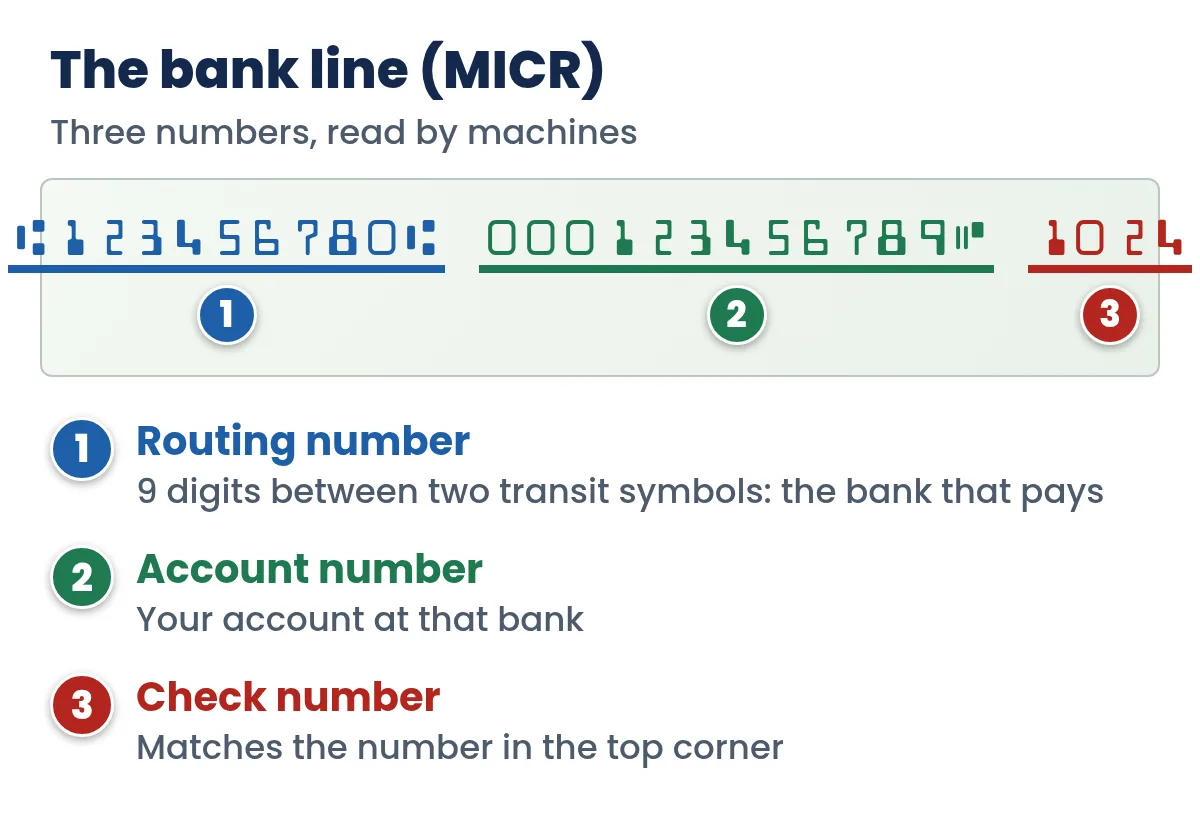
The row of odd-looking numbers along the bottom is the MICR line. MICR stands for magnetic ink character recognition: the characters use a special font (E-13B in the US) printed in magnetic toner or ink, so check-sorting equipment can read them. It holds three numbers, separated by special symbols.
Routing number
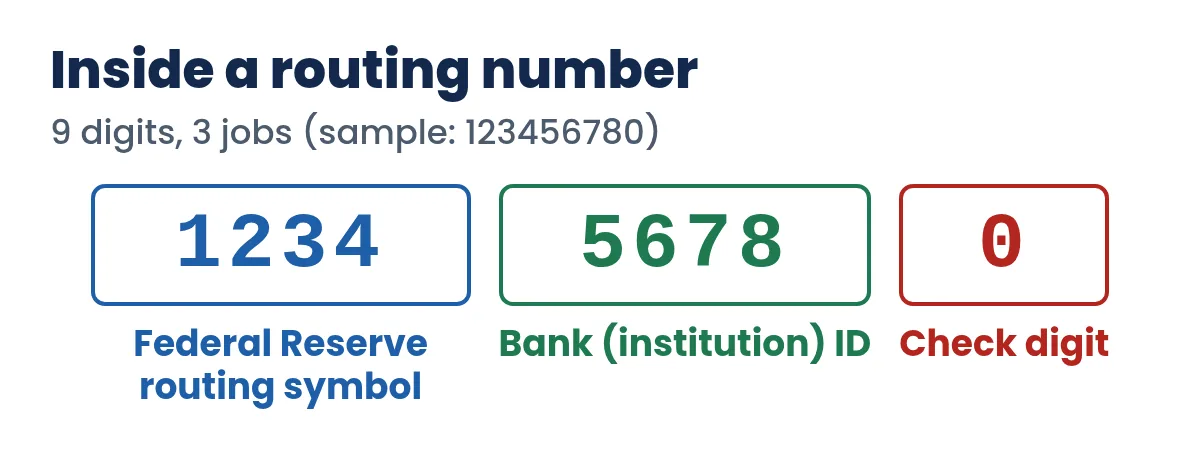
On a personal check, the first number, set between two transit symbols, is the nine-digit routing number. It identifies the bank that pays the check. According to the American Bankers Association's routing number policy, the first four digits are the Federal Reserve routing symbol, the next four identify the institution, and the ninth is a check digit calculated from the first eight. The first two digits also tell you something: a number starting 00 belongs to the US government, and 01 to 12 is the range used by ordinary banks.
The system is older than most people guess: the American Bankers Association devised the routing number in 1910, and the industry adopted it in 1911. The magnetic MICR printing came decades later, but the nine-digit number still does the same job.
Account number
Next comes your account number, followed by the on-us symbol. Its length varies by bank, often with leading zeros.
Check number
The last group repeats the check number from the top-right corner. On larger business checks, the check number is often placed in an extra field to the left of the routing number instead; the check number guide shows that layout.
Need these numbers for direct deposit or a payment form? Our guide to the routing and account number on a check shows exactly where to read them, and MICR font explained goes deeper on the characters themselves.
Never write on, staple or fold through the MICR line. Smudges or marks there can stop machines from reading the check and slow it down.
What's on the back?
The back of a check is mostly for the payee and the banks. There is an endorsement area near one end where the payee signs, and the rest is reserved for bank stamps as the check moves through collection. If you are the payee, sign only in the marked area. Our page on the back of a check walks through it, and how to endorse a check covers every type of endorsement.
Personal vs business checks: the same parts, different layout
Business checks contain the same fields but often look different:
| Feature | Personal check | Business check |
|---|---|---|
| Typical format | Wallet size, from a booklet | Larger, often one per letter-size sheet with a stub, or three per page |
| Name block | Your name, optional address | Company name, address, often a logo |
| Stub / voucher | Rare | Common (invoice or pay details) |
| Check number in bank line | After the account number | Often in a separate field before the routing number |
| Signers | Account holder(s) | Authorized signers; some require two |
For the full comparison, including when a sole proprietor should switch, read business check vs personal check.
Worked example: reading a real-looking check, part by part
Here is how Jane Doe, a landlord, reads check number 1024 from her tenant John Sample before she deposits it. The same routine works for any check you receive.
- Top left: who is paying
"JOHN SAMPLE, 123 Main Street." That matches the tenant on her lease, so she knows whose account the money comes from.
- Top right: which check
Number 1024. She writes it in her rent log so a later question ("did you get my October check?") has a quick answer.
- Date
11/01/2026, today. Not post-dated and not stale, so nothing stops her from depositing it now.
- Payee
"Jane Doe," exactly the name on her bank account. A nickname or a misspelling can lead to questions at the teller window.
- Both amounts
$1,250.00 in the box and "One thousand two hundred fifty and 00/100" on the line. They agree, and a line fills the space after the words.
- Memo
"October rent, Unit 2B." Useful for her records, though it has no effect on the payment.
- Signature
Present. Without it, there is no order to the bank.
- Bank line
Clean and unmarked. She then turns it over and endorses it in the marked area on the back.
The whole check takes under a minute to read this way, and it catches almost every problem that would otherwise surface days later as a returned deposit.
Common mistakes, part by part
- Date: writing last year's date in January. It still works in most cases, but it confuses records; fix it and initial the change, or void the check and write a new one.
- Payee: leaving space before or after the name. Start at the far left and draw a line after it so nobody can add "or cash" or a second name.
- Amount box: starting the figures far from the dollar sign. Write them right against it so no digit can be squeezed in front.
- Amount in words: forgetting the cents ("and 00/100") or writing a different number than the box. Words win under UCC § 3-114, so a slip here changes what you pay.
- Memo: using it for sensitive data. An invoice number is fine; a full Social Security number or card number is not.
- Signature: signing differently from the way your bank has it on file, or signing a check before the rest is filled in.
- Bank line: writing, stapling or taping across it. Machines read that strip, and damage there slows the check down.
How to check a check before you send or accept it
- Date
Today's date, or a recent one. A check more than six months old may be refused.
- Payee
Spelled correctly and matching the name on the receiver's bank account.
- Both amounts
Figures and words match, cents included, with no room left to add digits.
- Signature
Present, and from someone authorized on the account.
- Bank line
Clean, unmarked and complete: routing number, account number and check number.
If you write checks regularly, keep a register of every one: number, date, payee and amount. It makes reconciling your statement simple. With a check register that fills itself in, each check you print is logged automatically.
Printing checks with all the parts in the right place
If you print your own checks on blank check stock, the software has to put every field above in the correct position, and the bank line has to follow the standard layout. Quick Check Writer does that for you: you type the date, payee, amount and memo, the amount in words fills itself in, and the MICR line is laid out with your routing, account and check number in E-13B. You can add your logo and a signature, then print on a home inkjet or laser printer. See how to print checks at home to get started.
Frequently asked questions
What are the main parts of a check?
The front of a check has the account holder's name and address, the check number, the date, the payee line, the amount in numbers and in words, the bank's name, a memo line, the signature line and the MICR bank line with the routing, account and check numbers.
Which number on a check is the routing number?
On a personal check, the routing number is the nine-digit number on the bottom left, between two transit symbols. The account number follows it, then the check number. See routing number on a check.
What happens if the numbers and the words don't match?
Under UCC § 3-114, words prevail over numbers, so a bank may pay the written amount. Some banks return a mismatched check instead, so make both amounts agree.
Is the memo line required?
No. The memo is an optional note, such as an invoice or account number. It does not change the amount the bank pays.
What is the fraction-like number near the check number?
It is the fractional routing code, an older way of showing the paying bank's identifying numbers. Machines use the nine-digit routing number in the bottom line instead.
Who is the drawer and who is the drawee?
The drawer is the person who writes and signs the check. The drawee is the bank ordered to pay it, the one named on the check.
Can I print a check that has all these parts at home?
Yes. Software such as Quick Check Writer prints every field, including the MICR line, on blank check stock with a regular printer. Your bank may have its own requirements, so ask if unsure.
Where is the account number on a check?
On a personal check it is the middle group of numbers in the bottom bank line, after the nine-digit routing number and before the check number. On many business checks the order is check number, routing number, then account number.
Do I have to print my address on my checks?
No. Your name is the important part; the address is optional on personal checks and many people leave it off for privacy. Business checks usually carry the company address because vendors expect it.
Which parts of a check do I need for direct deposit?
The routing number and the account number from the bottom bank line. Employers often ask for a voided check so they can read both without errors; write VOID across the front in large letters first.
When was the routing number invented?
The American Bankers Association devised the routing number in 1910 and the industry adopted it in 1911, according to the ABA's own routing number policy.
Related guides
- How to write a check, step by step
- Where to find the routing and account number on a check
- The back of a check: what goes there and what to leave blank
- Where is the check number on a check?
- How to write a check amount in words (with cents)
- Types of checks: personal, business, cashier's, certified and more
Sources
- UCC § 3-114 (contradictory terms), Cornell LII
- UCC § 4-404 (checks more than six months old), Cornell LII
- UCC § 4-401 (postdated checks), Cornell LII
- UCC § 3-103 (drawer and drawee definitions), Cornell LII
- UCC § 3-104 (check definition), Cornell LII
- American Bankers Association: About routing numbers
- Federal Reserve Bulletin 2008, Recent Payment Trends (business checks and the auxiliary on-us field)
- American Bankers Association: Routing Number Policy & Procedures (history: devised 1910, adopted 1911; number structure)
Last updated November 1, 2026. This page is general information, not legal or financial advice. Quick Check Writer is check printing software; it is not a bank and does not move money.