
Key takeaways
- Outstanding = written and recorded, but not yet paid by your bank.
- Your app's balance includes uncleared checks; your register does not.
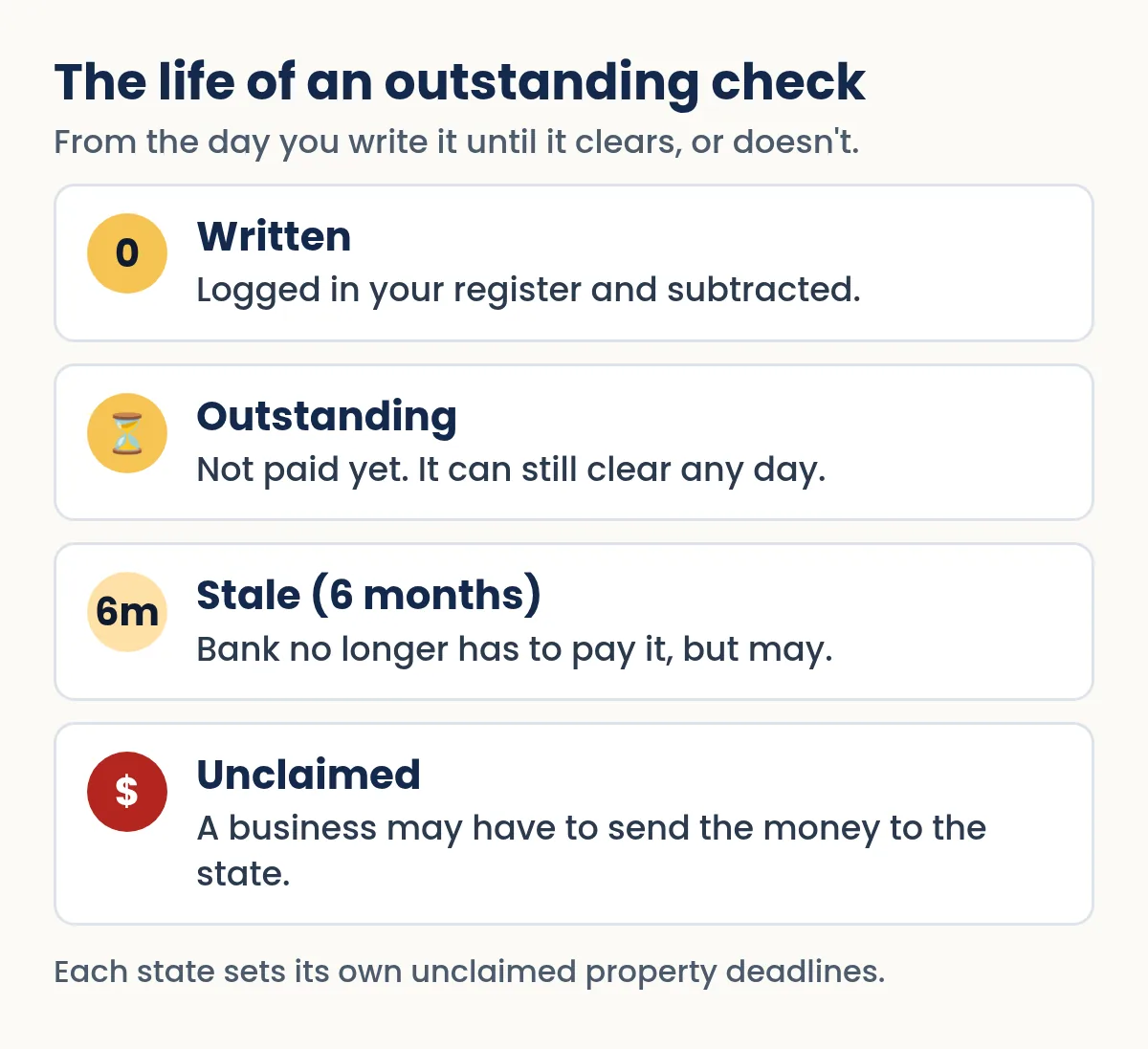
- After six months a bank is not obliged to pay a check, but it still may.
- Lost check? Stop payment on the original before you issue a replacement.
- Businesses may have to turn very old uncashed checks over to the state.
On this page
- What "outstanding" really means
- Why outstanding checks matter
- How to track outstanding checks
- Why a check stays outstanding
- How to keep the list short
- What to do with a check that has not cleared
- How long a stop payment protects you
- Outstanding checks by situation
- Common mistakes with outstanding checks
- Outstanding checks and unclaimed property
- If you are holding an old check
- Outstanding checks in business bookkeeping
- FAQ
What "outstanding" really means
When you write a check, the money does not leave your account at that moment. The check has to travel to the payee, get deposited or cashed, and then be presented to your bank for payment. Until your bank actually pays it, the check is outstanding.
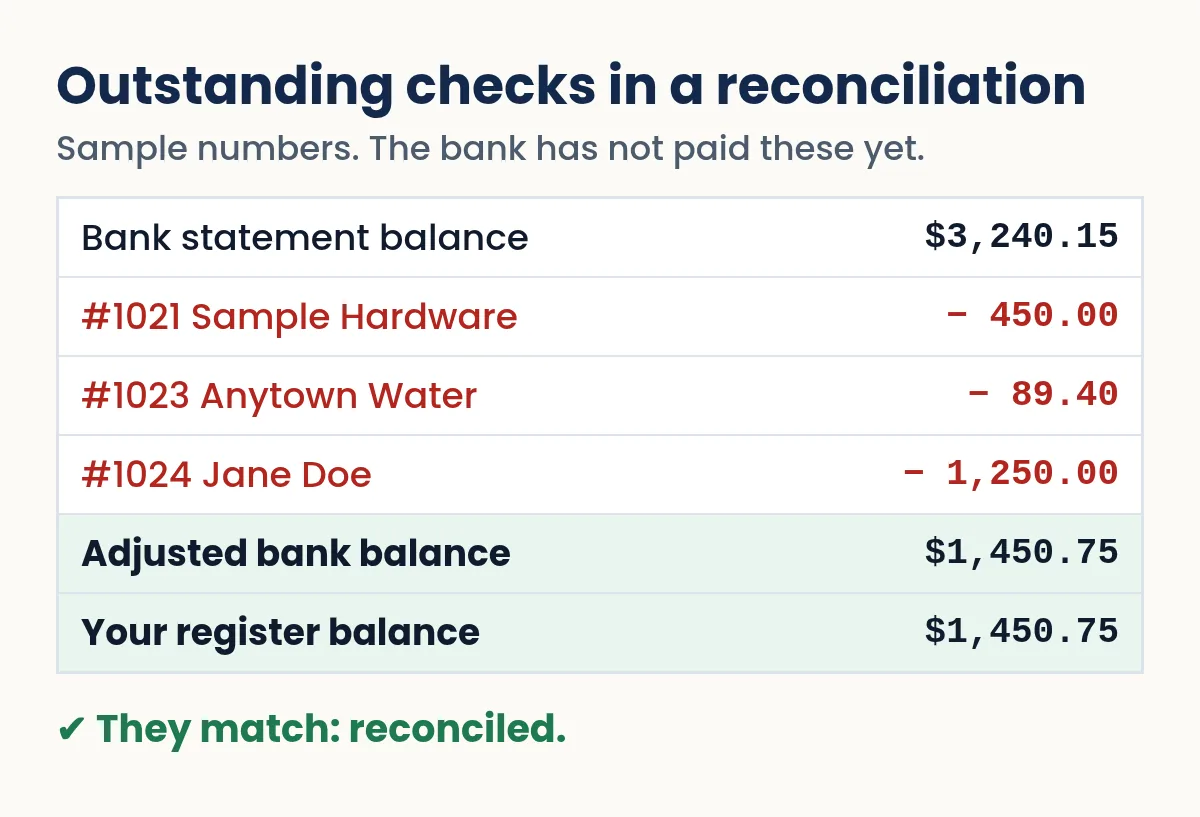
That gap creates two balances for the same account. Your register balance already subtracts the check, because you know the money is spoken for. Your bank balance still includes it, because the bank has not paid it yet. Outstanding checks are the main reason those two numbers differ, and accounting for them is the heart of a bank reconciliation.
- Outstanding check
- A check you have written and recorded that has not yet been paid by your bank.
- Deposit in transit
- The mirror image: money you deposited and recorded that does not yet appear on the bank's statement.
- Stale-dated check
- A check more than six months past its date. Under UCC § 4-404, a bank is not obliged to pay it, although it may choose to.
- Unclaimed property
- Money owed to someone that has gone untouched for a set "dormancy period." Businesses and organizations holding it must eventually report it and turn it over to the state.
Why outstanding checks matter
They can make you think you have more money than you do
Glancing at your banking app is not the same as knowing your balance. If you have $1,800 in checks that have not cleared, the app overstates what you can safely spend by $1,800. When those checks finally arrive at your bank, an account you thought was healthy can go negative. The cure is simple: trust your register, not the app, and keep the register current. Our guide on how to balance a checkbook shows how.
They can be paid long after you forget them
A check does not expire on a particular day for the bank. Even past six months, UCC § 4-404 lets a bank pay a stale check in good faith and charge your account. If you have quietly moved the money elsewhere, an old check can still bounce. See how long a check is good for for the details.
They can signal a problem
A check that should have been deposited weeks ago may have been lost or stolen. A long-outstanding check to a vendor might mean the vendor never received payment, and an angry call is on its way.
How to track outstanding checks
- Record every check the moment you write it
Check number, date, payee and amount, in a paper register, a spreadsheet or check software. A missing entry is the most common reason reconciliations fail.
- Mark checks as cleared when they show up on your statement
Each month, tick off every check that appears as paid. Whatever is left unticked is your outstanding list.
- Carry the list forward
Unpaid checks from last month go on this month's list until they clear. Do not drop them because they are old.
- Review the age of each item
Anything older than about 30 to 60 days deserves a look. Anything approaching six months deserves action.
Quick Check Writer logs every check you print in a searchable register with number, date, payee and amount, and you can export it to CSV. That gives you a ready-made list to match against your bank statement each month.
Why a check stays outstanding
Most checks clear within days of being deposited. When one lingers, it is usually for one of these reasons:
| Reason | What it looks like | What to do |
|---|---|---|
| Payee hasn't deposited yet | A relative, a small vendor or a landlord who batches deposits | A friendly reminder usually fixes it |
| Check lost in the mail | Payee says it never arrived | Stop payment, then reissue |
| Check lost by the payee | Payee received it but can't find it | Stop payment, then reissue |
| Payee moved or closed | Mail returned, phone disconnected | Document your attempts; businesses follow unclaimed property rules |
| Recording error | The check cleared but under a different amount or number | Compare the check image with your register and correct the entry |
| Check stolen | Cleared to an unfamiliar name, or a payee says unpaid while your bank shows paid | Call your bank immediately; see check fraud prevention |
How to keep the list short
- Note the delivery method. Writing "mailed 11/1" or "handed over" next to each register entry makes follow-up easy.
- Set a review rhythm. A monthly reconciliation catches stragglers before they become stale.
- Print a "void after" date. A printed reminder such as "Void after 90 days" nudges payees to deposit promptly, although banks are not bound by it.
- Put a stub or memo on business checks. An invoice number on the memo line or voucher stub helps the payee match the check and deposit it faster.
What to do with a check that has not cleared
How long is "too long" depends on the situation, but this sequence works for most people and small businesses.
- Confirm it was actually received
Contact the payee. Ask whether they received the check and whether they still have it. Sometimes a check is sitting in a drawer; sometimes it was never delivered.
- If it was lost, stop payment before you reissue
Place a stop-payment order with your bank on the original check number, then write a replacement with a new number. Without the stop, both checks could be paid. Our guide on stopping payment on a check explains fees and timing.
- Void it in your records
When you cancel a check, mark it void in your register and add the amount back to your balance. Keep the record; do not delete it. See how to void a check.
- If the payee can't be found, follow unclaimed property rules
For businesses, money owed to someone who cannot be located may eventually have to be reported to the state as unclaimed property. Do not simply write it off as income.
John Sample writes check 1024 for $1,250 to Jane Doe for a used piece of equipment. Seven weeks later it still has not cleared. He calls Jane, who realizes the check fell behind a drawer and is now torn. John asks his bank to stop payment on 1024, prints a replacement as check 1031, voids 1024 in his register, and keeps a note of both numbers.
Need to write a check right now?
Quick Check Writer fills in the amount in words, adds the bank line and prints on blank check stock or saves a PDF. Your first check is free, with no account and no card.
Write your first check free →How long a stop payment protects you
A stop-payment order is the safety net when you reissue a lost check, but it has a clock. Under UCC § 4-403, a written stop-payment order is effective for six months. An oral order (by phone, for example) lapses after 14 calendar days unless you confirm it in a record within that time. You can renew the order for further six-month periods.
That timing matters because of the stale-check rule. After six months, a bank is not obliged to pay a check, but UCC § 4-404 lets it pay one in good faith. So if a large original check might still turn up, renew the stop before it expires rather than assuming the check is dead. Ask your bank how it handles renewals; fees and procedures vary.
Outstanding checks by situation
| Situation | Typical cause | Best next step |
|---|---|---|
| Rent check not cashed after two weeks | Landlord batches deposits, or it's lost | Ask the landlord; keep proof of the date you paid |
| Gift or birthday check to a relative | Kept as a keepsake or forgotten | A gentle reminder; keep the funds set aside |
| Vendor check outstanding 45+ days | Wrong remit-to address, or misplaced | Confirm receipt; stop and reissue if lost |
| Employee paycheck never cashed | Employee left or lost it | Contact them; if unreachable, follow unclaimed property rules |
| Refund to a customer never cashed | Customer moved or ignored it | Send a letter; track for unclaimed property reporting |
Common mistakes with outstanding checks
- Dropping old checks from the list. The check can still be paid, so it must stay on your reconciliation until it clears, is stopped, or is reported as unclaimed property.
- Reissuing without a stop payment. The original and the replacement can both clear. Stop the first, then print the second with a new number.
- Closing the account too soon. Checks presented after the account is closed are returned unpaid, which can mean fees and an unhappy payee. Wait until every check has cleared, or contact the payees first.
- Writing old checks back to income. For a business, unclaimed money usually belongs to the payee and, eventually, the state, not to you.
- Trusting the app balance. The bank's balance does not know about checks still in the mail.
Outstanding checks and unclaimed property
Every state has unclaimed property laws. The National Association of Unclaimed Property Administrators explains that when property such as an uncashed payroll check, a refund or a customer overpayment has had no activity or owner contact for a designated period, called the dormancy period, it must be turned over to the state. The state then holds it for the owner to claim.
For a business, this means a stack of old uncashed checks is not free money. Typical examples include uncashed paychecks, vendor payments, customer refunds and security deposit returns. The usual process is:
- Identify checks outstanding past the dormancy period that applies (periods vary by state and by type of property).
- Make a good-faith attempt to contact the payee, often by letter, before reporting. Many states require this "due diligence" step.
- Report and remit the money to the state by its deadline.
- Void the original check in your records and keep documentation.
Dormancy periods, notice requirements and reporting dates differ from state to state and change from time to time. Look up your state's unclaimed property office, or ask your accountant, before you write off or report any old check.
If you are on the other side, holding an old check someone wrote to you, it is worth searching your state's unclaimed property database. Uncashed checks you never received may already be waiting there.
If you are holding an old check
Received a check months ago and never deposited it? Here is what to know:
- Under six months: deposit it as soon as possible. Most banks will accept it.
- Over six months: the paying bank is not required to honor it, though it might. Ask your bank before depositing, or better, contact the writer and ask for a new check.
- Checks marked "Void after 90 days": banks treat such notes differently, so the safest move is to ask the writer for a replacement once that date has passed.
- Government checks: follow the issuing agency's rules, which can differ from those for ordinary checks.
Outstanding checks in business bookkeeping
In standard bookkeeping, the expense and the reduction in cash are recorded when the check is written, not when it clears. That keeps your books matching your register, and outstanding checks only appear as a reconciling item on the bank side. IRS Publication 583 walks through exactly this: start from the bank statement's ending balance, add deposits not yet credited, subtract outstanding checks, and compare the result with your checkbook balance after adjusting for bank charges and errors.
Two situations need extra care:
- Year-end: a large batch of checks written in late December but cashed in January can confuse anyone looking only at bank activity. The written date in your records is what drives the books.
- Reissued checks: record the void of the original and the new check as separate entries so the trail is clear.
An outstanding check is money you have already spent that the bank does not know about yet. Keep a list, chase the old ones, and never let the app's balance fool you.
Frequently asked questions
What is an outstanding check?
A check you have written and recorded in your register that has not yet been paid by your bank. It reduces your register balance but still appears in your bank balance until it clears.
How long can a check be outstanding?
There is no fixed expiration for the writer. Under UCC § 4-404 a bank is not obliged to pay a check more than six months old, but it may still pay it in good faith, so keep the funds available or cancel the check properly.
How do outstanding checks affect a bank reconciliation?
You subtract them from the bank statement's ending balance, along with adding deposits in transit, to get an adjusted bank balance that should match your register.
What should I do about an old outstanding check?
Contact the payee to find out if they have it. If it was lost, place a stop payment, void it in your records and issue a replacement with a new check number.
What happens to uncashed checks a business wrote?
After the state's dormancy period, uncashed checks such as payroll, refunds and vendor payments may have to be reported and turned over to the state as unclaimed property. Rules vary by state.
Can I deposit a check that is more than six months old?
You can try, but the paying bank does not have to honor it. Ask your bank first, or ask the writer for a replacement check.
Does a stop payment last forever?
No. Under UCC § 4-403, a written stop-payment order lasts six months, and an oral one lapses after 14 days unless confirmed in writing. You can renew it for additional six-month periods. Ask your bank about its renewal process and fees.
Should I close my bank account if a check is still outstanding?
It is better to wait. A check presented after the account is closed will be returned unpaid, which can cost the payee fees and you goodwill. Let outstanding checks clear first, or contact each payee and arrange another payment.
Is an outstanding check the same as a bounced check?
No. An outstanding check simply has not been presented to your bank yet. A bounced check was presented and returned unpaid, usually for insufficient funds. Outstanding checks can turn into bounced ones if the money is spent before they clear.
Related guides
- How to do a bank reconciliation
- How to balance a checkbook
- How long is a check good for?
- How to stop payment on a check
- How to Void a Check
- Check register app that fills itself in
Sources
- UCC § 4-404, Checks more than six months old (Cornell LII)
- NAUPA: What is unclaimed property?
- IRS Publication 583: Starting a Business and Keeping Records
- UCC § 4-403, Customer's right to stop payment (Cornell LII)
Last updated November 1, 2026. This page is general information, not legal or financial advice. Quick Check Writer is check printing software; it is not a bank and does not move money.