

Key takeaways
- No single sign on the paper proves a check is real. Look at the check, the situation and the source.
- If the check carries a verification QR, scan it and compare the page to the paper. It takes about 10 seconds.
- The page must open on quickcheckwriter.com/v/. Any other address is a red flag.
- A match confirms the details, not the money. Only the bank the check is drawn on can confirm funds.
On this page
Why fake checks are hard to spot
Most bad checks aren’t crude. Some are counterfeits printed from scratch, often copied from a real check. Others are real checks that were stolen and changed. In its September 2024 analysis of bank reports on mail theft-related check fraud, FinCEN found that 44 percent of the stolen checks were altered and then deposited, and 26 percent were used as templates for counterfeits.
An altered check is printed on real check paper, from a real bank account, so it passes a quick look. That’s why it helps to check three things: the paper, the situation, and the record behind the check.
Check the paper
None of these signs is proof on its own, but each is worth a second look:
- Amounts that disagree. The amount in numbers and the amount in words should say the same thing. See how amounts are written in words.
- Signs of changes near the payee or amount. Smudges, faded patches, uneven lettering, or a name that looks squeezed into the line.
- A missing or odd check number. The number at the top should match the number in the line of bank numbers along the bottom.
- A bank you can’t confirm. Look up the bank’s phone number yourself. Don’t trust a number printed on the check.
- A damaged or covered area on the front. If the writer normally prints a verification QR and it’s scratched or covered, treat that as a reason to slow down.
Our check security features guide explains what the common printed features are for.
Watch the situation, not just the check
The situation often gives a fake check away before the paper does. The Office of the Comptroller of the Currency lists warning signs like these:
- You’re asked to deposit a check and send part of the money back, or to someone else.
- The check is for more than you’re owed, followed by a request to refund the difference.
- It arrives from a stranger for a prize, a mystery-shopper job or a personal-assistant job.
- Someone is pushing you to act fast, before the check has had time to clear.
The easy step: scan the verification QR
Some checks now carry a verification QR printed on the front. Checks written with Quick Check Writer Pro can include one. The QR opens the record the writer saved when they issued the check, so you can see what was really issued:
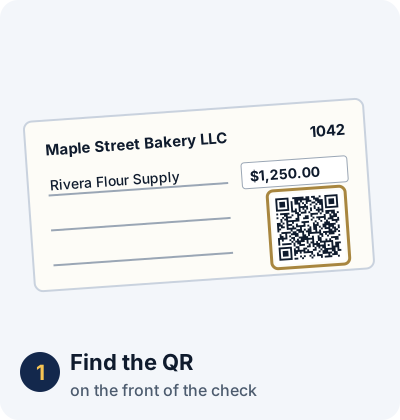
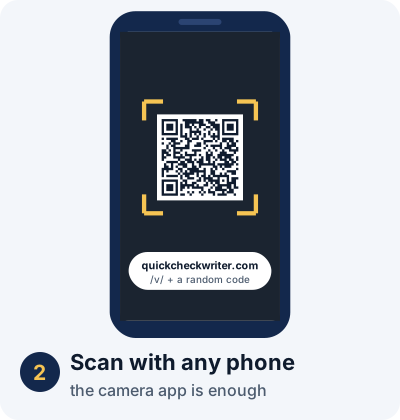
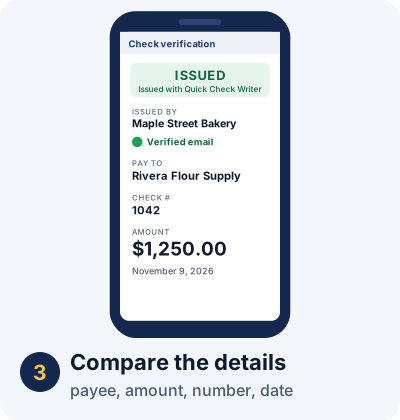
- Scan the QR on the front of the check with any phone camera. No app or account is needed.
- Check the address. The page must open on quickcheckwriter.com/v/. Any other website is a red flag.
- Read the status. ISSUED is what you want. VOIDED means the writer cancelled the check. SAMPLE – NOT VALID means it was never a real check. NOT FOUND means the code doesn't belong to any check.
- Compare the details with the paper: payee, amount, check number and date. They should match exactly.
If someone changed the amount or washed and rewrote the payee, the page still shows the original, so the two won’t match. A photocopy that reuses the QR opens the same original record, so a copy with a new amount gets caught too. The full guide to verification QR codes walks through every status on the page.
What a match tells you, and what it doesn’t
A match tells you the check was issued with those exact details and hasn’t been voided by the writer. It doesn’t tell you there’s money in the account. Funds your bank makes available early can still be taken back if the check later bounces.
For a large check from someone you don’t know, still confirm it with the bank it’s drawn on, using a phone number you looked up yourself.
If something is off
- Don’t deposit it yet, and don’t send any money back.
- Contact the writer on a phone number you already have, not one printed on the check.
- Tell your bank.
- Report it. The OCC points people to the FTC’s IdentityTheft.gov, the FBI’s IC3, and the U.S. Postal Inspection Service for mail-related scams.
Put a verification QR on your checks
Verification QR is included with Quick Check Writer Pro on the website. Tick one box when you issue a check, and anyone you pay can confirm it in seconds.
See Pro plans →Related guides
- How to Verify a Check and Stop Check Fraud with a Verification QR Code
- Can a QR Code on a Check Be Removed or Faked? The Honest Answer
- Check Washing: What It Is and How to Protect Your Checks
- How Banks and Tellers Can Verify a Check in Seconds with a QR Scan
- How Small Businesses Can Prevent Check Fraud
- How to verify a check before you deposit it
Frequently asked questions
Can a fake check clear my bank?
A fake check can look like it went through at first, because banks often make some funds available before a check has fully cleared. If the check turns out to be fake, the bank can take the money back from your account. That’s why scammers push you to send money back quickly.
Does a matching QR scan mean the check is good?
It means the check was issued with Quick Check Writer with those exact details and hasn’t been voided. It doesn’t confirm the money is in the account. Only the bank the check is drawn on can tell you that.
What if the check has no QR code?
Most checks don’t have one, and that’s normal. Check the paper and the situation, and confirm a large or unexpected check with the bank it’s drawn on. A missing QR is only a red flag when the writer normally prints one.
What if the QR opens a different website?
Don’t trust it. A real Quick Check Writer verification page always opens on quickcheckwriter.com/v/ followed by a long code. Anything else could be a lookalike site made to show matching details.
Sources: FinCEN: In-depth analysis of check fraud related to mail theft (Sept 9, 2024) · OCC: Check fraud.
Last updated November 9, 2026. This page is general information, not legal or banking advice. Quick Check Writer is check printing software; it is not a bank, does not move money, and a verification QR does not guarantee that a check will be paid.