
Key takeaways
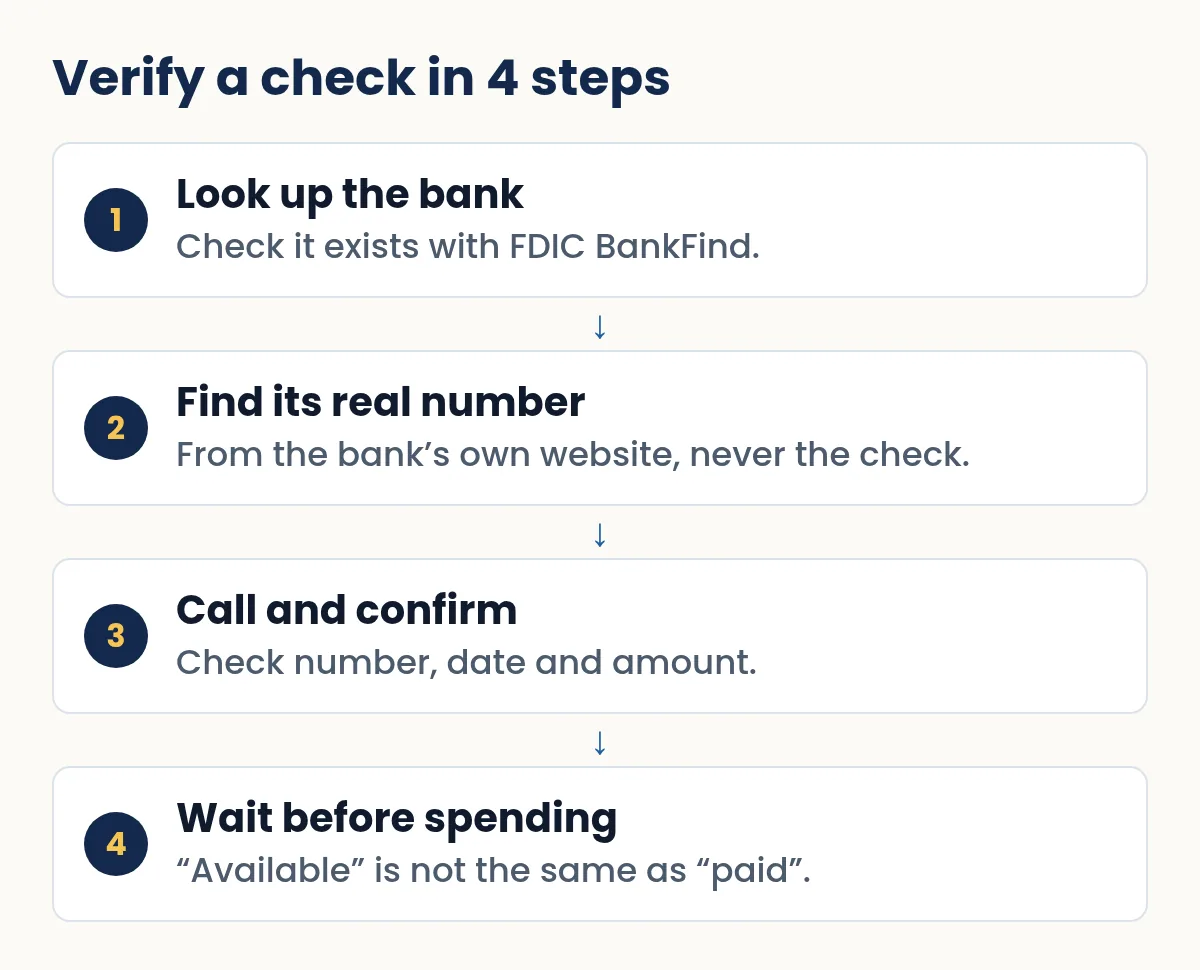
- Only the bank the check is drawn on can confirm it.
- Use a phone number from the bank’s official website, never the one printed on the check.
- Have the check number, date and amount ready when you call.
- Funds being available doesn’t mean the check cleared; fakes can bounce weeks later.
- Never send money back from a check someone just gave you.
On this page
- Why verifying matters more than it seems
- How to verify a check, step by step
- Red flags of a fake check
- Common fake check scams
- How to verify each type of check
- How long your bank can hold a check
- Checking the details on the check itself
- For businesses that accept checks
- Common mistakes when checking a check
- If you think you've received a fake check
- What Quick Check Writer can and can't do
- FAQ
Why verifying matters more than it seems
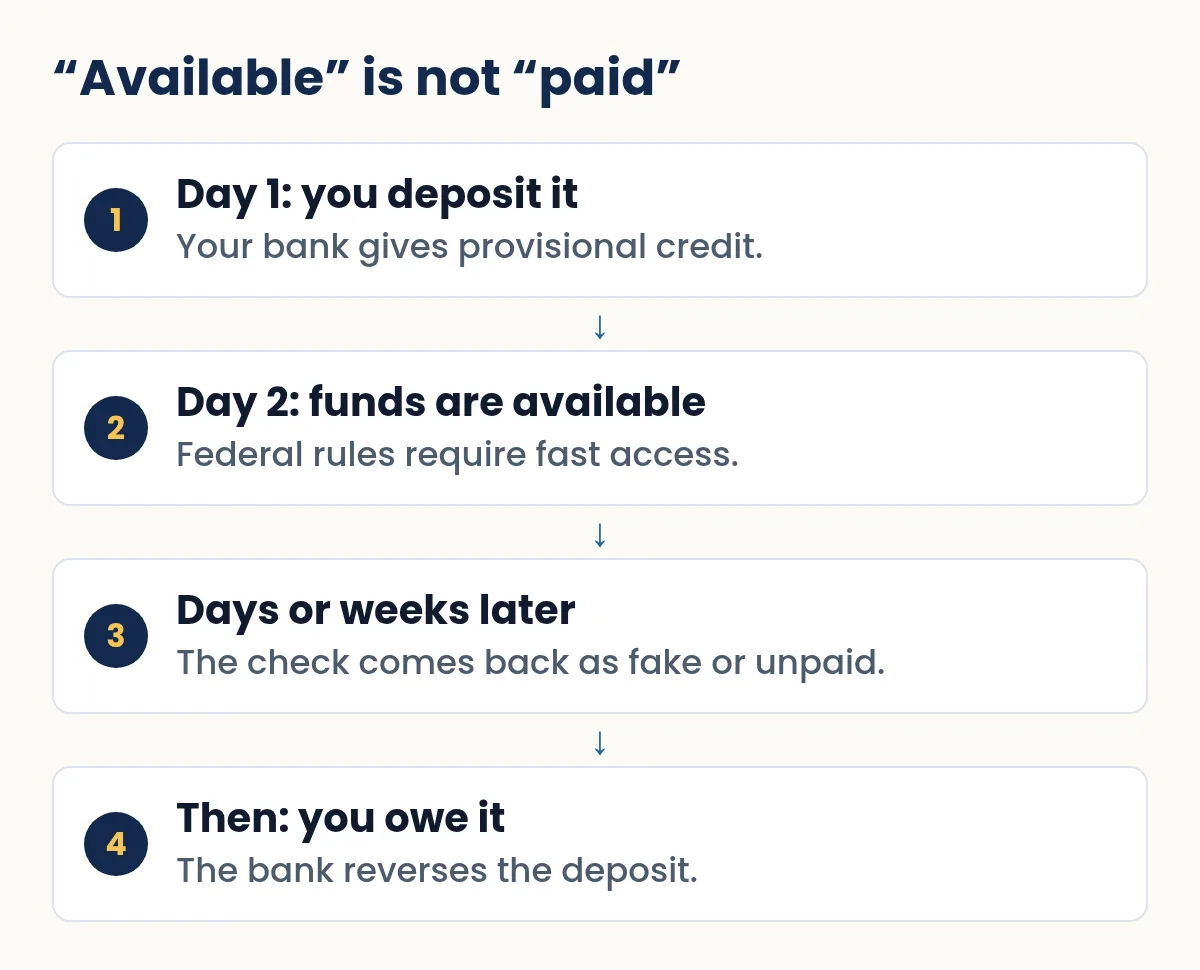
Most people assume that once a check's money shows up in their account, the check is good. It isn't necessarily. Federal rules require banks to make deposited funds available quickly, often by the next or second business day, while the check itself is still on its way to the bank that has to pay it. If that bank later returns the check as counterfeit or unpaid, your bank reverses the deposit.
The OCC warns that it may take weeks to discover that a cashier's check is fraudulent, and that by then the person who deposited it may have sent the money on and owe the bank the full amount. The FDIC says the same about fake bank checks: if the check turns out to be counterfeit, you will likely be held responsible for the funds you passed on.
So verification is about one question: will the bank the check is drawn on actually pay it? Only that bank can answer.
How to verify a check, step by step
- Identify the bank on the check
Read the bank name printed on the front, usually near the payer's details. The FDIC suggests confirming the check was issued by a legitimate bank; its BankFind tool lists FDIC-insured banks. A bank name you can't find anywhere is a strong sign of a fake.
- Get the bank's phone number from an independent source
Use the bank's official website, a statement or card from that bank, or a directory you trust. The FDIC specifically warns not to use the phone number printed on the check, because it may be answered by the scammer.
- Call and ask the bank to confirm the check
Explain that you've received a check drawn on their bank and want to confirm it. For a cashier's or official check they can usually tell you whether they issued it. Have the check number, issue date and amount ready, which the FDIC notes they will likely need.
- Ask the right question for the type of check
For a cashier's check: “Did you issue check number 1024 for $2,450.00 on November 1, and is it outstanding?” For a personal or business check, many banks won't disclose the balance of someone else's account, but some will tell you whether the check would clear right now, if the account holder allows it. Policies vary by bank.
- Deposit it, then wait
Even a confirmed check can be stopped or reversed later. Don't spend the money, ship goods or send anything back until your bank tells you the check has been paid, or until enough time has passed that you're comfortable. Ask your bank how long that is for this check.
Red flags of a fake check
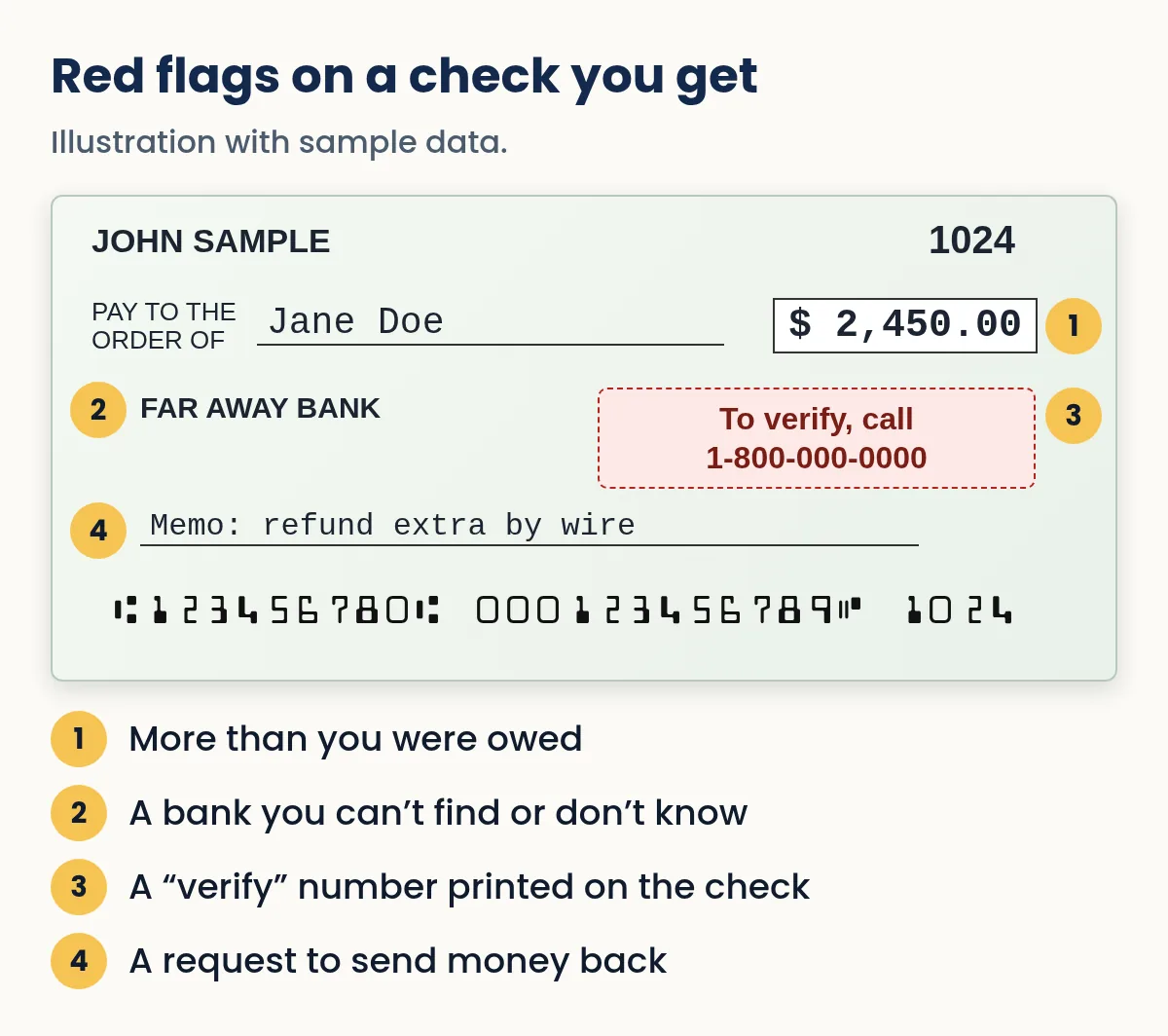
Fake checks can look so real that, in the FDIC's words, they are very hard for consumers or even bank employees to detect. The context usually gives them away before the paper does:
| Warning sign | Why it matters |
|---|---|
| The check is for more than you're owed | The overpayment is the scam: you're asked to send the “extra” back |
| You're asked to return money by wire, gift card, cash or a payment app | Those payments are hard or impossible to reverse |
| It came from someone you've never met, often by email or text | Scammers rarely meet their victims in person |
| The postmark doesn't match the bank's city or state, or it came from overseas | The FDIC lists a mismatched postmark as a sign of a fake |
| A “verify this check” phone number is printed on it | Real banks don't need you to call a number on the check |
| You “won” a prize or lottery you didn't enter | Legitimate prizes don't require you to pay fees first |
| A job sends you a check before you've done any work | Mystery shopper and “equipment” checks are common fake-check scams |
| Poor print quality, missing security features, misspellings | Official checks usually have watermarks, security threads and color-shifting ink |
Need to write a check right now?
Quick Check Writer fills in the amount in words, adds the bank line and prints on blank check stock or saves a PDF. Your first check is free, with no account and no card.
Write your first check free →Common fake check scams
- Overpayment
- A “buyer” for something you're selling, or a “tenant” for your rental, sends a check for more than the price and asks you to return the difference.
- Prizes and inheritances
- You're told you've won or inherited money and must pay taxes or fees first. A check arrives to “cover” them, and you're asked to wire the fees.
- Jobs and mystery shopping
- A new “employer” sends a check to deposit, then asks you to buy gift cards, test a money transfer service, or pay for equipment from a specific vendor.
- Fake cashier's checks
- Because people trust cashier's checks, scammers counterfeit them. A cashier's check is only as good as the bank that really issued it. See cashier's check vs certified check.
Never send money back to anyone from a check they just gave you. A legitimate payer who overpaid can wait until the check has cleared, or send a corrected payment.
How to verify each type of check
Who can confirm a check depends on who issued it. Use this as your map.
| Type | Who can confirm it | How |
|---|---|---|
| Cashier's or official check | The bank that issued it | Call the bank's number from its own website; ask if it issued that check number and amount |
| Personal or business check | The payer's bank, within limits | Call the bank; many won't discuss someone else's balance |
| U.S. Treasury check | The Bureau of the Fiscal Service | Treasury Check Verification System at tcvs.fiscal.treasury.gov |
| USPS money order | The Postal Service | tools.usps.com/money-orders.htm or 1-866-459-7822 |
| Other money orders | The company that issued it | The issuer's official phone line or website |
Fake cashier's checks are popular with scammers for a reason. Regulation CC generally requires a bank to make funds from a cashier's, certified or teller's check available by the next business day when you deposit it in person into your own account as the payee. The money looks real long before anyone has confirmed the check.
How long your bank can hold a check
Banks follow federal availability rules, with exceptions that give them more time when there's a real reason to wait.
- The first $275 of a day's check deposits that aren't already next-day items must generally be available the next business day.
- Large deposits: on checks totaling more than $6,725 in one banking day, the bank may hold the amount above $6,725 longer.
- Reasonable cause to doubt: if the bank has facts suggesting a check won't be paid, it can hold the funds longer, and it must give you a written notice with the reason and when the money will be available.
A hold isn't a verdict on the check, and the end of a hold isn't a sign it cleared. If something feels off, ask your bank whether the check has actually been paid. See ways to deposit a check.
Checking the details on the check itself
A physical look won't prove a check is real, but it can catch obvious problems. Compare these before you deposit:
- The amount in words matches the amount in figures. If they differ, the words generally control, but the mismatch itself is a warning.
- The bank line at the bottom is clean and even. The routing number, account number and check number should be printed in the special MICR font. Read where to find the routing and account number and MICR font for checks.
- The check number matches the number in the bank line. On most personal checks the number at the top right appears again at the bottom.
- The payee name is yours, exactly. A check made out to someone else and signed over to you is a third-party check, which many banks won't accept.
- Security features are present where you'd expect them. See check security features, explained.
Remember that home-printed and business-printed checks are normal and legal; a plain-looking check isn't automatically fake. See is it legal to print your own checks?
For businesses that accept checks
If customers pay you by check, a few routines cut your risk:
- Ask for identification for large or first-time checks and note it.
- For big-ticket sales to new customers, wait for the check to be paid before releasing goods, or ask for a bank transfer instead.
- Consider a third-party check verification or guarantee service, which checks the account against databases or guarantees payment for a fee. Read the terms carefully.
- Deposit checks promptly; the sooner a bad check comes back, the sooner you know.
- Keep a copy or image of every check you accept, so you can follow up on returns. See what happens when a check bounces.
Jane Doe is selling her car for $8,500. The buyer, John Sample, offers a cashier's check from Sample National Bank. Before handing over the keys, Jane:
- Looks up Sample National Bank in FDIC BankFind and finds its official website.
- Calls the customer service number listed there, not the one on the check, and reads out the check number, date and $8,500 amount.
- Hears the bank confirm it issued that check and it is still outstanding.
- Deposits it, and waits until her bank confirms it has been paid before signing over the title.
Had the bank said it never issued that number, Jane would have kept the car, kept the check, and reported it.
Common mistakes when checking a check
- Calling the number printed on the check. It can ring straight back to the scammer.
- Trusting a “cleared” or “available” balance. Availability is a legal deadline, not a confirmation.
- Verifying the bank but not the check. A real bank's name on a fake check proves nothing.
- Accepting an overpayment. Any check for more than you're owed, with a request to send back the difference, is a classic setup.
- Releasing goods the same day. For big sales to strangers, wait for your bank to confirm payment.
- Depositing at an ATM or by phone to “speed it up”. It doesn't make the check any more real.
If you think you've received a fake check
- Stop
Don't deposit it, or if you already have, don't spend or send any of the money.
- Tell your bank
Contact your bank immediately; the OCC's first instruction to someone passed a fraudulent cashier's check is exactly that.
- Tell the bank named on the check
Using its official number, so it can warn others.
- Report it
The FDIC points to the U.S. Postal Inspection Service if the check came by mail, your state attorney general's consumer protection office, and the FBI's Internet Crime Complaint Center for online scams. You can also tell the website or app where you met the scammer.
What Quick Check Writer can and can't do
Quick Check Writer doesn't verify or guarantee checks, and it can't see anyone's bank balance. It is software for writing and printing your own checks. If you're the payer and want the people you pay to trust your checks, print them cleanly with the standard MICR line, use your real bank details, keep each payment logged in the check register, and don't be surprised if a cautious payee calls your bank to confirm. That is exactly what they should do.
Frequently asked questions
Can I verify a check online?
You can confirm the bank exists with the FDIC’s BankFind tool, but only the bank itself can confirm a specific check. That usually takes a phone call or a branch visit.
Will a bank tell me if a check is good?
For cashier’s and official checks, the issuing bank can usually confirm whether it issued the check. For personal checks, many banks won’t share account information; policies vary.
How long should I wait before spending money from a check?
Until your bank confirms the check has been paid, especially for large checks or checks from people you don’t know. Ask your bank how long that usually takes.
Why can a check bounce after the money is available?
Federal rules make banks give you access to deposits quickly, before the paying bank has finished processing the check. If it is returned, your bank takes the money back.
Who pays if I deposit a fake check?
Usually you do. If the check is returned as counterfeit, your bank reverses the deposit, and you are responsible for any money you already withdrew or sent.
Is a cashier’s check always safe?
No. Cashier’s checks are often counterfeited. Verify one with the issuing bank, using an independently found phone number, before relying on it.
Can Quick Check Writer verify a check?
No. Quick Check Writer prints checks; it does not verify or guarantee checks or access bank accounts.
How do I verify a U.S. Treasury check?
Use the Bureau of the Fiscal Service’s Treasury Check Verification System at tcvs.fiscal.treasury.gov. You’ll need the routing number, check number and amount from the check.
How do I verify a USPS money order?
Check its status at tools.usps.com/money-orders.htm or call the Postal Service’s Money Order Verification System at 1-866-459-7822.
Can my bank hold a check longer if it looks suspicious?
Yes. Regulation CC lets a bank extend a hold when it has reasonable cause to believe a check won’t be paid. It must give you a written notice with the reason and when the funds will be available.
Related guides
- Check fraud prevention for people and small businesses
- Cashier's check vs certified check
- What happens when a check bounces
- Ways to deposit a check
- Check security features, explained
- How to cash a check (with or without a bank account)
Sources
- FDIC Consumer News: Beware of fake checks
- OCC HelpWithMyBank: I was passed a fraudulent cashier’s check
- OCC: Check fraud
- FDIC: BankFind Suite
- 12 CFR § 229.10 and § 229.12, funds availability (Cornell LII)
- UCC § 3-114, words prevail over numbers (Cornell LII)
- 12 CFR § 229.10(c), next-day availability incl. cashier’s checks and the $275 rule (Cornell LII)
- 12 CFR § 229.13, large-deposit ($6,725) and reasonable-cause exceptions (Cornell LII)
- Bureau of the Fiscal Service: Treasury Check Verification System
- USA.gov: Government checks and payments (verify a Treasury check)
- USPS: Sending money orders (verification)
- FTC: How to spot, avoid, and report fake check scams
Last updated November 1, 2026. This page is general information, not legal or financial advice. Quick Check Writer is check printing software; it is not a bank and does not move money.