
Key takeaways
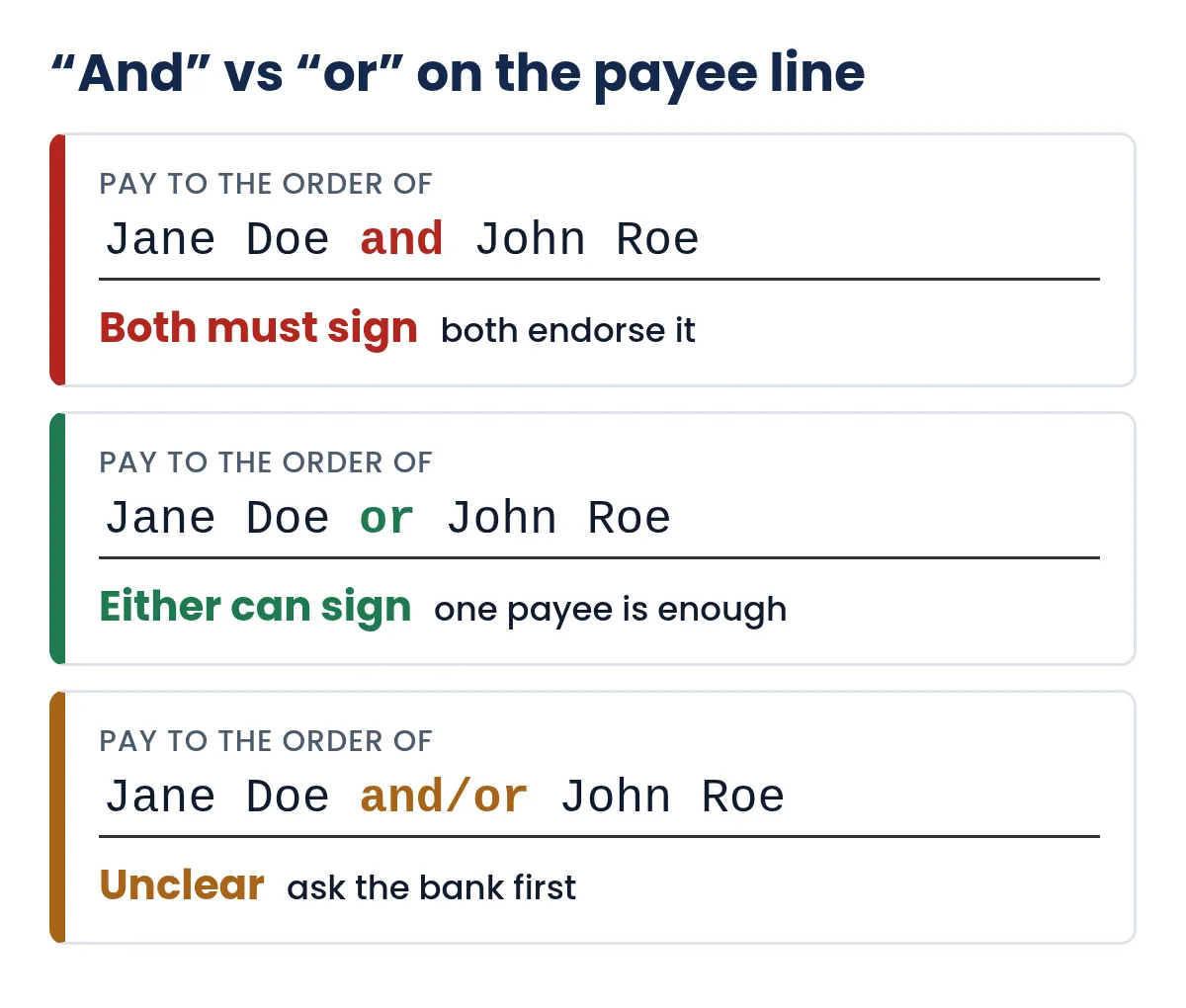
- "And" (or "&") means both payees must endorse.
- "Or" means either payee can endorse alone.
- Ambiguous wording defaults to "or" under UCC § 3-110(d), but your bank decides what it accepts.
- Writing the check? Choose the word on purpose, or use one payee.
On this page
- The short answer: "and" means both, "or" means either
- What happens when the wording is unclear
- How the rules vary by bank and by check
- How to endorse a check made out to two people
- Depositing into one person's account
- Four common situations, step by step
- When one payee isn't available
- Common two-payee checks
- Don't confuse this with checks from a joint account
- Worked example: a deposit refund to two tenants
- Checklist before you deposit a two-payee check
- Mistakes that get two-payee checks rejected
- If you're writing the check: choose the word on purpose
- FAQ
The short answer: "and" means both, "or" means either
The Uniform Commercial Code, the state law that governs checks, puts it plainly in § 3-110(d). A check payable to two people "alternatively" (the "or" form) can be negotiated by any of them. A check payable to them "not alternatively" (the "and" form) can be negotiated only by all of them together. The OCC, which supervises national banks, gives the same practical guidance: with "and", a bank can generally require both signatures; with "or", generally only one payee needs to sign.
| Payee line says | Who must endorse | Can one person deposit alone? |
|---|---|---|
| Jane Doe and John Roe | Both | No, both signatures are needed |
| Jane Doe & John Roe | Both (the ampersand means "and") | No |
| Jane Doe or John Roe | Either | Yes |
| Jane Doe and/or John Roe | Unclear; often treated as either | Depends on the bank |
| Jane Doe, John Roe (no word between) | Unclear; often treated as either | Depends on the bank |
What happens when the wording is unclear
Real checks are not always tidy. Names may be stacked on two lines, joined with a slash or separated by a comma. For these, the UCC has a tie-breaker: if a check payable to two or more people is ambiguous about whether it is payable to them alternatively, it is treated as payable alternatively. In other words, unclear wording defaults to "or".
That is the legal default, but your bank still decides what it will accept over the counter or in its app. The OCC's advice for a check reading "John and/or Jane Doe" is to ask your bank what its guidelines are. If you want to avoid the question entirely, have both payees endorse.
How the rules vary by bank and by check
The UCC sets the legal baseline, and every bank then layers its own deposit policy on top. Both federal regulators that answer consumer questions on this, the OCC and the CFPB, describe the "and" and "or" rules as what banks generally do, not as a guarantee. In practice, the differences show up in a few predictable places:
| Situation | What usually happens | Do this first |
|---|---|---|
| Teller deposit, "and" check, joint account | Accepted with both endorsements | Both payees sign before you go |
| Teller deposit, "and" check, one payee's account | Varies: some banks accept it with both signatures, some want both people present, some refuse | Call the branch |
| Mobile deposit, two payees | Often stricter than a teller; some apps reject it | Read your app's deposit rules |
| Insurance claim check to you and your lender | The lender usually endorses and may release funds in stages | Call your mortgage servicer |
| "Jane Doe and ABC Roofing LLC" | Same as any "and" check: both must endorse | Get the business's endorsement first |
Check-type rules matter too. New Jersey's banking and insurance regulator, for example, explains that property-claim checks are usually made payable jointly to the homeowner and the mortgage holder, because the lender is listed as the loss payee on the policy and has a secured interest in the home. It also notes the lender may pay the money out in installments as repairs progress, to protect against contractors who are paid in full for unfinished work.
When in doubt, two signatures never hurt. A bank that would accept one endorsement will also accept two.
How to endorse a check made out to two people
- Read the payee line
Look for "and", "&", "or", "and/or" or just a comma. That word decides how many signatures you need.
- Agree where the money goes
Before anyone signs, decide which account the check goes into. A joint account in both names is the simplest.
- Each payee signs
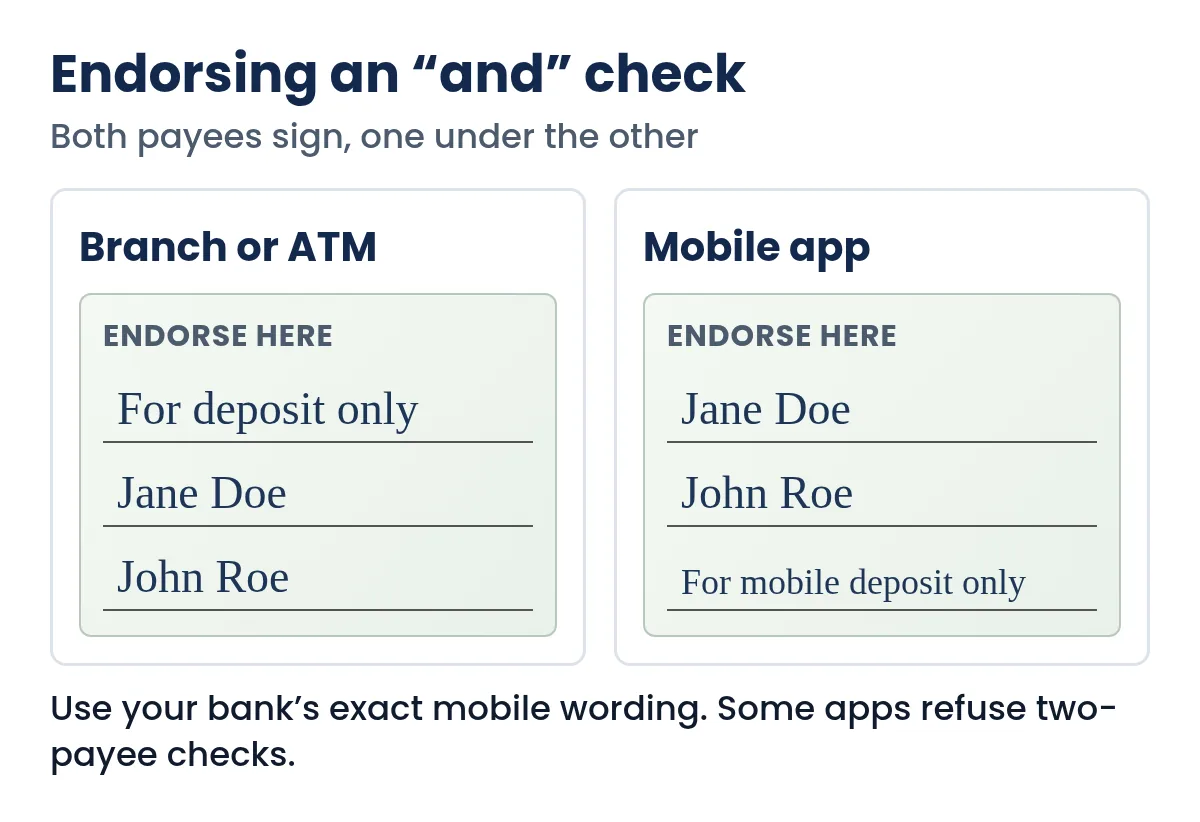
For an "and" check, both people sign in the endorsement area, one under the other, each using the name as it appears on the front.
- Add a restriction
Write "For deposit only" above the signatures (or your bank's mobile wording) so the endorsed check can't be cashed by someone else if it's lost.
- Deposit it
Deposit at a branch, ATM or app. If the account is in only one payee's name, ask the bank first whether it accepts the check that way.
For the general rules on endorsements, including mobile deposit wording, see how to endorse a check and the back of a check.
Depositing into one person's account
With an "or" check, whichever payee holds it can endorse and deposit it into their own account. With an "and" check, both payees must endorse, and many banks also want the check deposited into an account that both payees own, or want both people present when it goes into an individual account. Rules vary by bank, and apps are often stricter than tellers. If one payee is depositing an "and" check alone, call the bank first so the deposit isn't reversed later.
Jane Doe and John Roe sell a used car and receive a $4,800 check payable to "Jane Doe and John Roe". They share a joint account, so both sign the back, write "For deposit only" and deposit it at a branch. If they had separate accounts, they would ask their bank before depositing, and split the money afterwards.
Need to write a check right now?
Quick Check Writer fills in the amount in words, adds the bank line and prints on blank check stock or saves a PDF. Your first check is free, with no account and no card.
Write your first check free →Four common situations, step by step
1. A couple with a joint account gets an "and" check
- Both sign the back
Each partner signs their name as it appears on the payee line, one under the other.
- Restrict it
Add "For deposit only" (or your app's required wording) above the signatures.
- Deposit to the joint account
This is the case every bank handles most easily, at a branch, ATM or app.
2. An "and" check, but the payees have separate accounts
- Call the bank where it will be deposited
Ask whether it accepts a two-payee check into an account only one payee owns, and whether both people must come in.
- If it does, both endorse
Both payees sign, and one of them deposits it under the bank's procedure.
- Split the money afterwards
The depositing payee transfers the other person's share once the funds are available.
- If it doesn't
Ask the writer to reissue it as two separate checks, or with "or" between the names.
3. An insurance check made out to you and your mortgage company
- Don't deposit it yet
The lender's endorsement is required, so your bank can't simply accept it with your signature alone.
- Call your mortgage servicer
Ask how it handles claim checks: where to send the check, whether you endorse it first, and what repair estimates or inspections it needs. The OCC's advice is the same: notify the bank and ask what steps to take.
- Expect staged payments on big claims
The servicer may hold the money and release it as work is done, rather than all at once.
- Keep copies
Photograph both sides of the check and keep the claim paperwork until the repairs are paid off.
4. One payee wants to use mobile deposit
- Check the app's rules
Look in the app's help or deposit agreement for anything about checks with more than one payee.
- Both endorse, plus the app's wording
Your bank may require exact wording with the signatures, such as "For mobile deposit only".
- Keep the paper check
Hold it until the deposit has fully cleared, then destroy it so it can't be deposited twice.
When one payee isn't available
If the check says "and" and one payee can't sign, you have a few options:
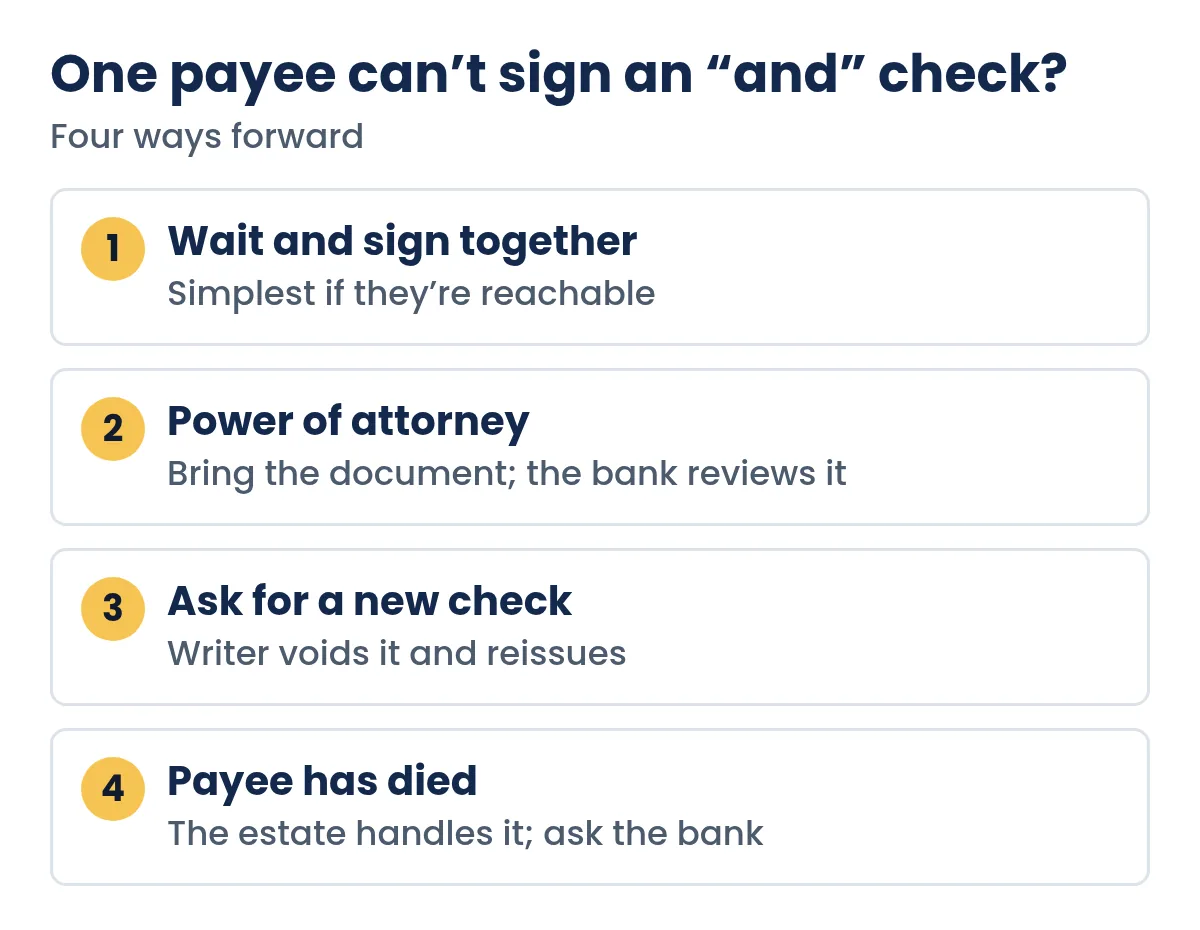
- Wait and sign together. Simple, if the other payee is reachable.
- Use a power of attorney. If one payee holds a valid power of attorney for the other, the bank may accept an endorsement signed on their behalf. Bring the document. The CFPB notes that many state laws require banks to accept a valid power of attorney, with exceptions such as a suspected forgery or a revoked document, so it doesn't have to be on the bank's own form.
- Ask for a reissued check. The writer can void the original and write a new one payable to the right person, or with "or" between the names.
- Estates. If a payee has died, the bank will usually ask for estate documents. Ask the bank what it needs before signing anything.
Don't sign the other person's name for them without authority. Under UCC § 3-403, an unauthorized signature doesn't count as the real payee's signature, so the check hasn't been properly endorsed, the deposit can be reversed, and the person who signed can still face civil or criminal liability.
Common two-payee checks
- Married couples and partners
- Gifts, refunds and settlements are often written to both partners. With a joint account, "and" is easy; with separate accounts, "or" is more convenient for the payees.
- Insurance claim checks
- Property claim checks are sometimes made payable to the policyholder and a mortgage lender or contractor together. Both parties have to endorse, and the lender may hold the funds until repairs are done. Ask your insurer and your loan servicer how they handle it.
- Business partners
- A check to two people doing business together usually belongs in a business account. Make the check out to the business name instead of the individuals when you can.
- Joint sellers
- Private sales of a car, boat or equipment owned by two people often produce "and" checks.
Don't confuse this with checks from a joint account
Two names can appear on a check in two very different places. On the payee line, they decide who must endorse. In the top-left corner, they simply show who owns the account the check is drawn on.
A check written from a joint account usually needs only one owner's signature on the front, because most joint accounts let either owner write checks alone. Some accounts, often business accounts, are set up to require two signatures; that is an agreement between the account owners and the bank, and it applies to the drawer's signature, not the payee's endorsement. If you're not sure how your own account is set up, your account agreement or the bank will tell you.
Worked example: a deposit refund to two tenants
John Sample is a landlord. His tenants, Jane Doe and John Roe, are moving out, and he owes them a $1,800 security deposit refund. They are splitting up and will have separate bank accounts. Here is how the payee wording plays out:
| John writes | What happens next |
|---|---|
| One check to "Jane Doe and John Roe" | Both must endorse. Unless their bank accepts it into one account, they have to meet up, deposit together and split the money. |
| One check to "Jane Doe or John Roe" | Whoever holds the check can deposit all $1,800. Fast, but only safe if they trust each other to split it. |
| Two checks of $900, one to each | Each tenant deposits their own share. Cleanest when the payees are separating. |
John asks them in writing which they prefer, they choose two checks, and he notes both check numbers in his register so he can see when each one clears.
Checklist before you deposit a two-payee check
- Read the payee line: "and", "&", "or", "and/or", a comma or a slash.
- Every payee needed has signed, each name matching the front.
- "For deposit only" or your app's exact wording is above the signatures.
- The account you're depositing into belongs to at least one payee, and the bank has said yes if only one.
- Anyone signing for another payee has a valid power of attorney with them.
- For an insurance check, your mortgage servicer has told you its process.
- You're keeping the paper check until the deposit clears.
Mistakes that get two-payee checks rejected
- Only one signature on an "and" check. The deposit may be refused, or accepted and reversed later.
- One payee signing for the other. Without legal authority, that's a forged endorsement.
- Depositing into an account neither payee owns. Banks generally treat that as a third-party check, which they're free to refuse.
- Signatures spilling below the bank line. Two signatures take more room; write small and stay inside the box.
- Skipping "For deposit only". Once both payees have signed, the check is easy to misuse if it's lost on the way to the bank.
If you're writing the check: choose the word on purpose
As the writer, you control which rule applies. Ask the payees how they want it:
- Use "and" when both people should agree before the money moves, for example a payment that belongs to two co-owners.
- Use "or" when either person may deposit it, which is usually easier for couples with separate accounts.
- Avoid "and/or", commas and slashes. They leave the decision to the bank.
- Better yet, ask whether a single name or a business name works. One payee is always the simplest.
When you print checks, type the payee exactly as agreed. Quick Check Writer lets you save payees in an address book and prints the payee line, amount in words and MICR line on blank check stock, then records the check in your check register. New to the fields? See the parts of a check and how to write a check.
Frequently asked questions
Do both people have to sign a check made out to two people?
If the names are joined by "and" (or "&"), the bank can generally require both endorsements. If they're joined by "or", generally either payee can sign alone.
What if the check says "and/or"?
The UCC treats ambiguous wording as payable to either payee, but banks set their own deposit rules. Ask your bank, or have both payees sign to be safe.
Can one person deposit a check made out to two people?
With "or", yes. With "and", both must endorse, and many banks also want it deposited into an account both payees own, or both people present.
Can I deposit a two-party check with my phone?
Often, if both payees endorse and you add your bank's mobile wording. Some apps reject checks with two payees, so check your bank's rules.
What if one payee is unavailable or has died?
Options include waiting, a valid power of attorney, or asking the writer to reissue the check. For a deceased payee, the bank will usually ask for estate documents.
Does a comma between two names mean "and" or "or"?
It's ambiguous. Under UCC § 3-110(d), ambiguous checks are treated as payable to either person, but banks may still ask for both signatures.
Can my spouse sign my name on a check made out to both of us?
Not without authority, such as a power of attorney. An unauthorized signature isn't treated as yours under UCC § 3-403, so the deposit can be reversed. Each payee should sign their own name.
Can a check be made out to more than two people?
Yes. The same UCC rule covers checks payable to "two or more persons": with "and" every named payee must endorse, with "or" any one of them can.
Why is my mortgage company on my insurance check?
Lenders are usually listed as the loss payee on a home insurance policy because they have a secured interest in the property. Call your mortgage servicer to learn how it endorses the check and releases the money.
Can a payee sign a two-party check over to someone else?
Both payees on an "and" check would have to sign the endorsement, for example adding "Pay to the order of" the new person. Many banks refuse checks signed over like this, so ask the depositing bank first.
Related guides
- How to endorse a check
- The back of a check: what goes there and what to leave blank
- Parts of a check, explained
- How to Deposit a Check With Your Phone
- How to cash a check (with or without a bank account)
Sources
- UCC § 3-110 (instrument payable to two or more persons), Cornell LII
- HelpWithMyBank.gov (OCC): Must both my spouse and I endorse a check made out to both of us?
- UCC § 3-204 (indorsement), Cornell LII
- UCC § 3-206 (restrictive indorsement), Cornell LII
- HelpWithMyBank.gov (OCC): third-party checks
- CFPB: Do both my spouse and I have to sign the back of a check made out to us?
- HelpWithMyBank.gov (OCC): insurance check payable to me and to the bank
- New Jersey Department of Banking and Insurance: FAQ on insurance proceeds checks
- CFPB: power of attorney and the bank's own form
- UCC § 3-403 (unauthorized signature), Cornell LII
- UCC § 3-205 (special and blank indorsement), Cornell LII
Last updated November 1, 2026. This page is general information, not legal or financial advice. Quick Check Writer is check printing software; it is not a bank and does not move money.