
Key takeaways
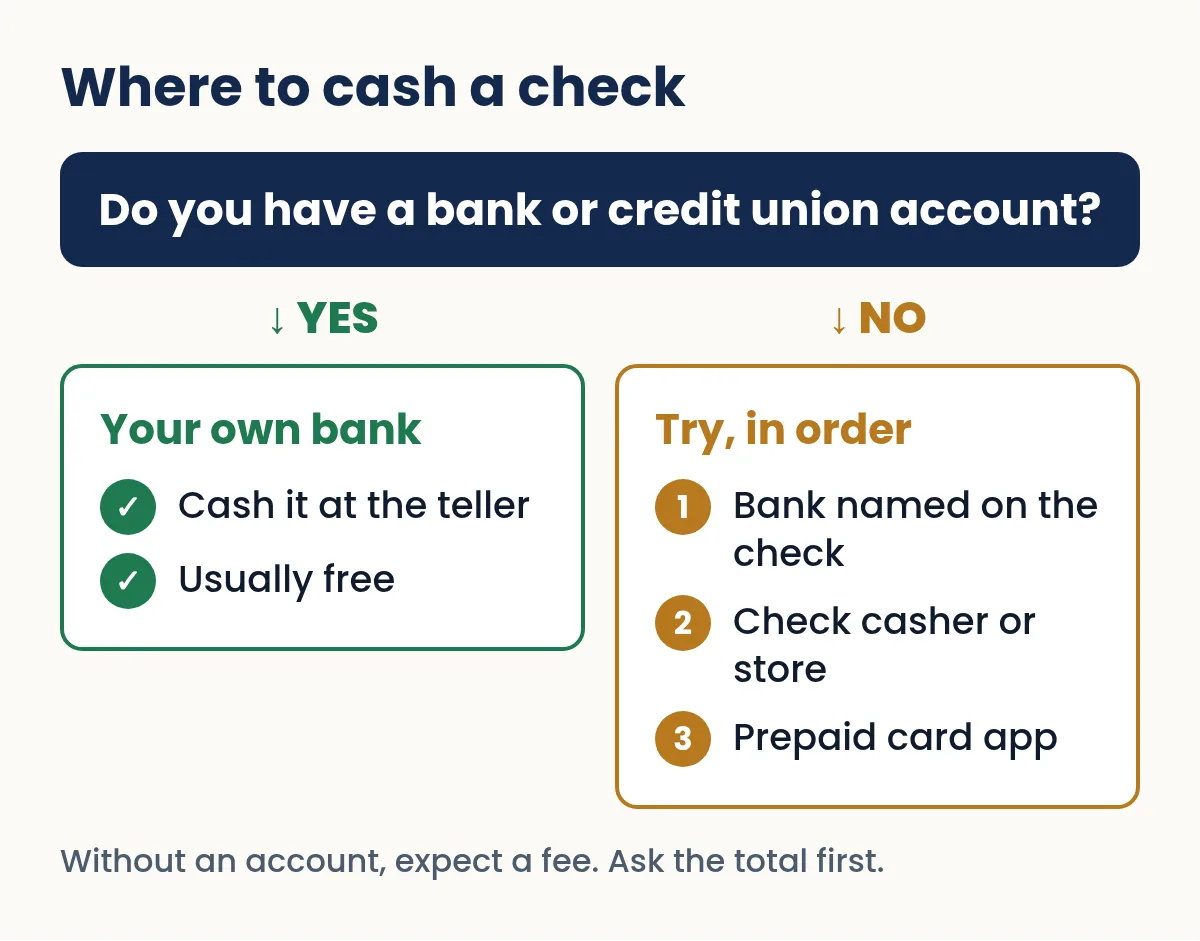
- Your own bank is usually free and the least hassle.
- No federal law makes a bank cash a check for a non-customer; if it does, it may charge a fee.
- The bank named on the check is the best bet without an account.
- Check-cashing stores and apps charge fees that vary by place: ask the total first.
- Never send money back from a check you just cashed for a stranger.
On this page
- The short answer
- Option 1: Your own bank or credit union
- Option 2: The bank the check is drawn on
- Option 3: Check-cashing stores
- Option 4: Retailers and grocery stores
- Option 5: Prepaid cards and apps
- Option 6: Signing it over to someone you trust
- Cashing different kinds of checks
- How state law affects check-cashing fees
- What you need to cash a check
- Why a check might be refused
- Three common situations, step by step
- Worked example: Jane Doe cashes a $1,250 check
- If you deposit instead: how fast you can get cash
- Common mistakes to avoid
- Cash it or deposit it?
- Don't have a bank account? Consider getting one
- Watch for fake checks
- If you are the one writing the check
- FAQ
The short answer
Where you cash a check depends mostly on one thing: whether you have a bank account.
- If you have an account, your own bank or credit union is almost always the cheapest and simplest place. Cash it at the teller window, or deposit it and withdraw the cash.
- If you don't, start with the bank the check is drawn on (its name is printed on the front). If it won't help, check-cashing stores, some retailers and prepaid card apps will, for a fee.
Whatever route you take, bring a government photo ID, don't sign the check until you're asked to, and ask for the total fee before you hand anything over.
Option 1: Your own bank or credit union
This is the default. Your bank knows you, has your signature on file and can recover the money from your account if the check turns out to be bad, so it is usually willing to cash checks for customers at no charge.
- Go to a teller
Hand over the check and your debit card or ID. Endorse it in front of the teller.
- Ask for cash, or part cash
You can cash the whole check or deposit some and take the rest. On a deposit slip, the part you take back goes on the “less cash received” line. See how to fill out a deposit slip.
- Expect a hold on large checks
Even for customers, a bank may give only part of a large check in cash right away and hold the rest until the check clears. That protects both of you.
If you prefer machines, deposit the check at your bank's ATM or app and withdraw cash once the funds are available. Our guide to ways to deposit a check compares each method.
Branches keep limited cash. The OCC suggests that if a bank needs notice to cash a large check, you can take a cashier's check or a wire for part or all of it instead. Your account agreement should say how much notice is needed and what counts as “large”.
Option 2: The bank the check is drawn on
Every check names the bank that holds the writer's account, usually under the writer's details or near the signature line. That bank, sometimes called the issuing or paying bank, can see right away whether the account has the money, so it is the most likely bank to cash a check for a stranger.
It still doesn't have to. According to the OCC, no federal law or regulation requires a bank to cash checks for people who aren't customers, and many banks limit check cashing to account holders. If a bank does agree, it may legally charge a non-customer a fee.
Expect stricter identification than at your own bank. Some banks ask for a fingerprint or thumbprint, which the OCC says federal law does not prohibit.
Option 3: Check-cashing stores
Check-cashing businesses will cash most payroll, government and many personal checks without a bank account. They are convenient and open long hours, but you pay for it, usually a percentage of the check plus sometimes a flat fee. Most states license these businesses and many cap their fees, so the cost depends on where you live and on the kind of check.
- Ask for the total fee in dollars before you hand over the check.
- Personal checks usually cost more to cash than payroll or government checks, because they are riskier.
- Keep the receipt.
Option 4: Retailers and grocery stores
Some large retailers and supermarkets cash certain checks at their customer service or money center counters, typically payroll checks, government checks, tax refund checks and some insurance settlement checks. Many do not take personal checks for cashing. Fees and limits are set by each store and can vary by state, so check the store's current policy before you go.
Option 5: Prepaid cards and apps
Many prepaid debit cards and payment apps let you load a check by photographing it, much like a bank's mobile deposit. A standard load is often free but can take days; getting the money in minutes usually costs a percentage fee. Read the app's fee screen before you confirm, and remember a returned check can be charged back to your card.
Need to write a check right now?
Quick Check Writer fills in the amount in words, adds the bank line and prints on blank check stock or saves a PDF. Your first check is free, with no account and no card.
Write your first check free →Option 6: Signing it over to someone you trust
You can endorse a check to another person, who then deposits it in their own account. This is called a third-party check, and banks often refuse them, especially in apps. If you try it, ask your friend's bank first, and both of you should expect to show ID.
Cashing different kinds of checks
- Payroll checks
- Among the easiest to cash, because they come from a business account. The bank the payroll check is drawn on may cash it, and check cashers often charge less for payroll checks than for personal ones. Direct deposit avoids the trip entirely; see direct deposit and the voided check.
- Government checks
- Federal and state checks are low-risk, so they are widely accepted. Federal paper checks are becoming rare: under Executive Order 14247, Treasury set September 30, 2025 to stop issuing paper checks for federal payments, with limited exceptions.
- Personal checks
- The hardest to cash without an account, because nobody knows whether the writer's account can cover it. The writer's bank is your best bet.
- Cashier's and certified checks
- Backed by the bank, so they are easier to cash, but they are also popular with counterfeiters. See cashier's check vs certified check.
- Checks made out to a business
- A check payable to a company belongs in the company's account. Banks generally won't cash it for an individual, even the owner.
How state law affects check-cashing fees
Check-cashing businesses are regulated at the state level, and the rules differ widely from state to state. New York, for example, sets a maximum fee that licensed check cashers may charge, with a lower cap of 1.5% for public assistance checks issued by a federal or state agency; its regulator noted that two-tier fee limits are similar to the approach of many other states. California takes a different approach in its Civil Code: for payroll and government checks, a check casher may charge no more than 3% of the face amount if you show identification, or 3.5% without it, or $3, whichever is greater. Personal checks fall outside that particular cap.
| State | Example of how fees are limited |
|---|---|
| New York | A maximum fee for licensed check cashers, with a lower 1.5% cap on public assistance checks |
| California | Payroll and government checks: 3% with ID, 3.5% without, or $3, whichever is greater |
| Your state | Check your state banking or financial services department; many states license check cashers and post fee limits |
If you're unsure what is allowed where you live, your state's banking or financial services department publishes the rules.
What you need to cash a check
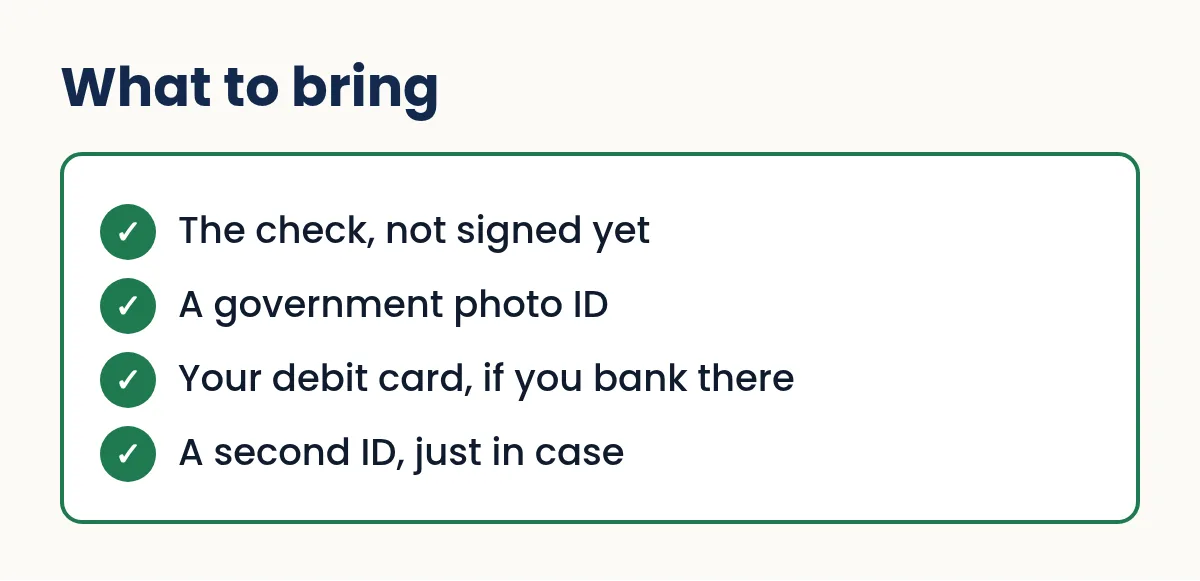
- Valid photo ID
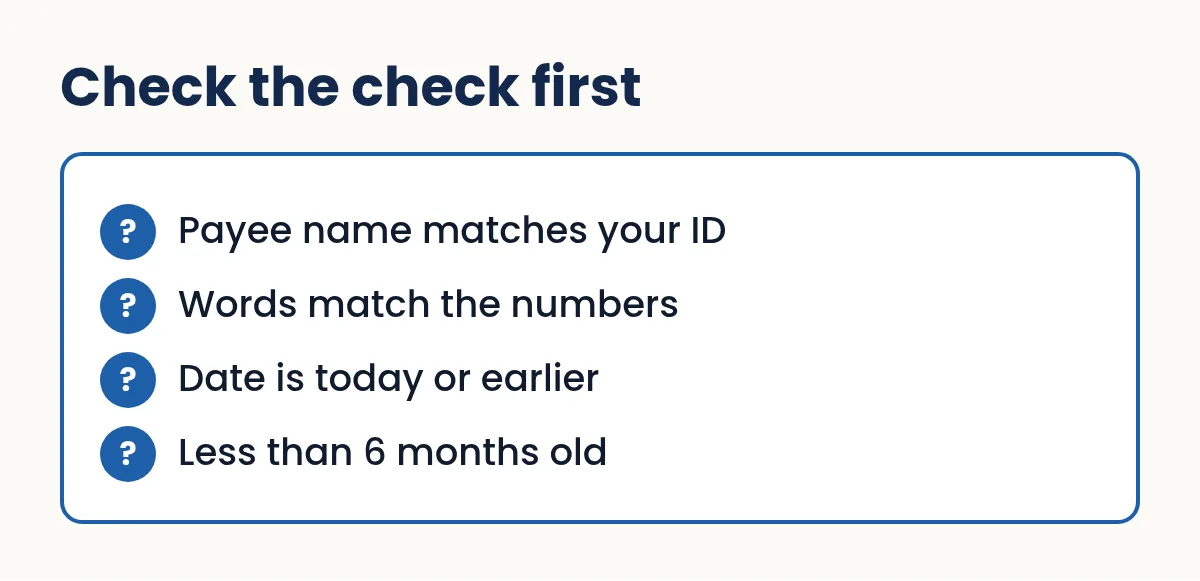
- A driver's license, state ID or passport. The name must match the payee line.
- The check itself
- Intact and readable, with the amount in words matching the figures.
- Your endorsement
- Your signature on the back, usually added in front of the cashier. Read how to endorse a check.
- Sometimes, more
- A second ID, a thumbprint, or a phone call to the writer's bank to confirm the check.
Why a check might be refused
| Problem | What to do |
|---|---|
| You're not a customer | Try the bank on the check, or open an account |
| The name on the check doesn't match your ID | Ask the writer for a corrected check |
| The check is more than six months old | Ask the writer to reissue it. See how long a check is good for |
| The check is post-dated | Wait until the date, or ask the writer. See post-dated checks |
| The account doesn't have enough money | Contact the writer; don't try again and again |
| Made out to two people with “and” | Both payees endorse it and usually both go in. See check made out to two people |
Three common situations, step by step
1. A paycheck, and you have a bank account
- Look it over at home
Your name spelled the way it is on your ID, the amount in words matching the figures, today's date or earlier.
- Go to your own branch
Bring the check and your debit card or ID. Sign the back at the counter.
- Decide how much cash you need
Take only that in cash and deposit the rest. It is safer and costs nothing.
2. A personal check, and you have no account
- Find the writer's bank
Its name is printed on the front. Look up the nearest branch and call ahead to ask whether it cashes checks for non-customers and what it charges.
- Bring two forms of ID
Banks are stricter with people they don't know, and some ask for a thumbprint.
- Have a fallback
If the bank says no, a licensed check casher may take it, though personal checks usually cost more to cash than payroll checks.
3. A very large check
- Call the branch a day or two ahead
Ask how much cash it can have ready and what notice it needs.
- Consider not taking it all in cash
A deposit, a cashier's check or a wire is safer than walking out with a large envelope of bills.
- Expect paperwork above $10,000
Banks must file a currency transaction report for any cash withdrawal or other cash transaction over $10,000. It is routine and is not an accusation. Splitting the money into smaller visits to avoid the report is a federal crime called structuring, even if the money itself is clean.
Worked example: Jane Doe cashes a $1,250 check
John Sample pays Jane Doe $1,250 for a month of design work with a personal check drawn on Sample Bank. Jane doesn't have a bank account.
- First stop: Sample Bank. Because the check is drawn there, the teller can see at once whether John's account can cover it. Jane shows her driver's license and a second ID, endorses the check in front of the teller and pays the bank's non-customer fee, which she asked about on the phone beforehand.
- If Sample Bank had said no, Jane's next stop would be a licensed check casher. Before handing over the check she would ask for the total fee in dollars, not just a percentage, and keep the receipt.
- Next time, Jane might open a basic account. Then a check like this goes into her own account for free, and she can take out cash as the funds become available.
If you deposit instead: how fast you can get cash
When you deposit a check rather than cash it, a federal rule, Regulation CC, sets the latest your bank can make the money available. A few figures from the current rule:
| Rule | What it means for you |
|---|---|
| First $275 of check deposits | Generally available the next business day |
| Cash withdrawal of held funds | On the day funds become available, the bank must let you withdraw at least $550 in cash by 5:00 p.m., on top of the $275 |
| Deposits over $6,725 in a day | The amount above $6,725 can be held longer |
| New accounts (first 30 days) | Fewer protections; holds can be longer |
These are maximum waits. Many banks release money sooner, and your bank's funds availability policy says exactly what it does. Cashing a check at the counter is different: there is no rule that says a bank must hand you cash for a check on the spot.
Common mistakes to avoid
- Signing the back at home. A check with only your signature on the back can be cashed by whoever holds it. Sign at the counter.
- Paying a percentage fee on a big check. On a large amount, a fee of a few percent is real money. A bank account usually costs less.
- Cashing a check you already deposited by phone. Once a check has been deposited through an app, presenting the paper again creates a duplicate. The bank will reverse one of them, and you may owe the money back.
- Cashing a check for a stranger and sending money back. This is how fake check scams work.
Cash it or deposit it?
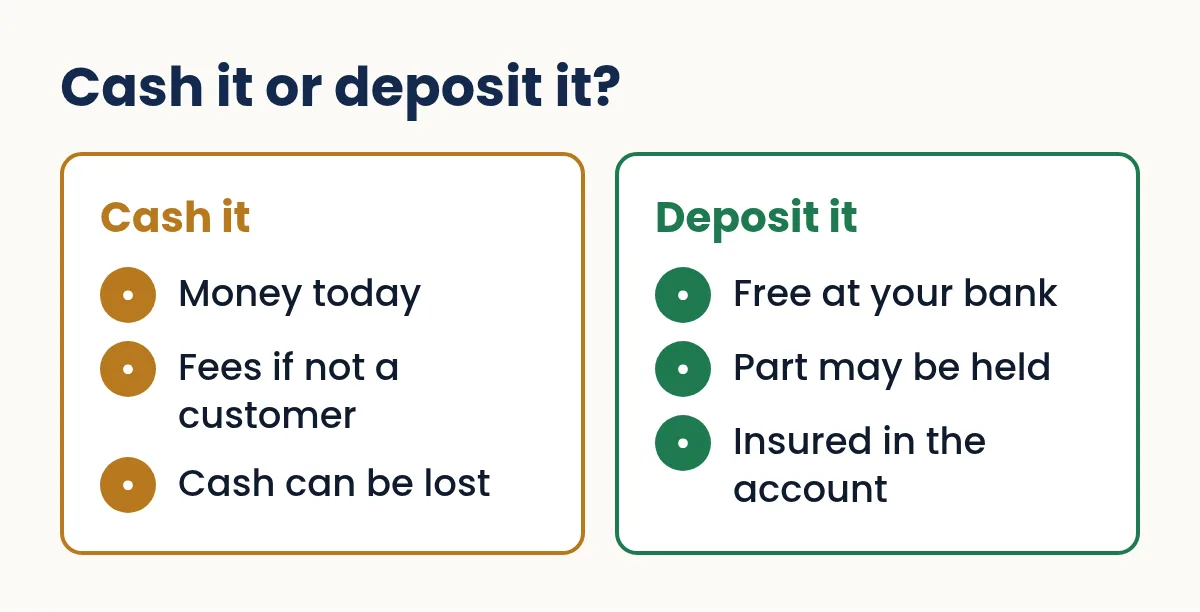
If you don't need physical cash today, depositing is usually the better deal: it is free at your own bank, the money is protected by deposit insurance once it's in your account, and you avoid carrying cash.
Don't have a bank account? Consider getting one
If you cash checks regularly, the fees add up. The FDIC's GetBanked site points out that depositing checks at a bank is free, and that you may be able to open an account with as little as $25. It also notes that certified Bank On accounts have low, transparent costs and don't charge overdraft or insufficient-funds fees, and that some banks offer “second chance” accounts for people with past banking problems.
Watch for fake checks
A check that arrives from someone you don't know, for more than you expected, with a request to send part of the money back, is the signature of a fake check scam. Cashing it doesn't make it real; if it bounces, the business that cashed it can come after you for the money. Learn the warning signs in how to verify a check before you deposit it.
If you are the one writing the check
You can make life easier for the person you pay. Write their full legal name exactly as it appears on their ID, keep the amount in words and figures identical, and date it for today. If you print checks with Quick Check Writer, the amount in words is filled in for you and the bank line is printed in the standard MICR position, so the check is easy for any teller or machine to read.
Frequently asked questions
Can I cash a check without a bank account?
Yes. Try the bank named on the check first; it may cash it for a fee. Check-cashing stores, some retailers and prepaid card apps also cash checks for a fee.
Will any bank cash a check?
No. Banks are not required to cash checks for people who are not customers. Your own bank and the bank the check is drawn on are the most likely to help.
How much does it cost to cash a check?
At your own bank it is usually free. Elsewhere you typically pay a flat fee or a percentage of the check. Check-cashing fees are often limited by state law, so they differ from state to state.
Can I cash a check made out to someone else?
Only in limited cases. A check signed over to you is a third-party check, and many banks refuse them. The safest route is for the named payee to deposit it.
Why does a bank want my fingerprint to cash a check?
Some banks use a thumbprint as an anti-fraud step for non-customers. The OCC says federal law does not prohibit it.
Can I cash a check at an ATM?
You can deposit a check at your bank’s ATM and then withdraw cash once the funds are available. Some banks release part of the deposit immediately.
Can I cash a large check all at once?
A branch may need notice to pay out a large amount in cash. The OCC suggests taking a cashier’s check or wire for some or all of it instead.
Do banks report cashing a check over $10,000?
Yes. Banks must file a currency transaction report for any cash transaction over $10,000. It is a routine filing. Breaking the money into smaller withdrawals to avoid the report is a federal crime called structuring.
How much cash can I get if I deposit a check?
Under Regulation CC, the first $275 of check deposits is generally available the next business day, and on the day held funds become available the bank must let you take at least $550 more in cash by 5:00 p.m. Many banks release money faster.
Can I cash a check without ID?
Rarely. Banks almost always require a government photo ID. Some licensed check cashers will cash certain checks without ID for a higher fee; California, for example, allows 3.5% instead of 3% on payroll and government checks when no ID is shown.
Can I cash a check at a bank where I don't have an account?
Sometimes. The bank the check is drawn on is the most likely to do it, usually for a fee. Other banks generally limit check cashing to their own customers, which federal rules allow.
Related guides
- Ways to deposit a check
- How to endorse a check
- How to verify a check before you deposit it
- How long is a check good for?
- Check made out to two people: "and" vs "or"
- Types of checks: personal, business, cashier's, certified and more
Sources
- OCC HelpWithMyBank: Can a bank refuse to cash a check if I don’t have an account?
- OCC HelpWithMyBank: Cashing a large check
- OCC HelpWithMyBank: Fingerprint to cash a check
- FDIC: GetBanked
- UCC § 4-404, checks more than six months old (Cornell LII)
- NY Department of Financial Services: updated check casher fee regulation (Jan 17, 2023)
- Treasury: implementation of EO 14247 (federal paper checks)
- eCFR: 12 CFR 229.10, next-day availability ($275)
- eCFR: 12 CFR 229.12, cash withdrawal ($550 by 5:00 p.m.)
- eCFR: 12 CFR 229.13, exceptions for new accounts and large deposits ($6,725)
- eCFR: 31 CFR 1010.311, currency transaction reports over $10,000
- 31 U.S.C. § 5324, structuring (Cornell LII)
- UCC § 3-205, blank indorsements (Cornell LII)
- California Civil Code § 1789.35, check casher fees (CA Attorney General statutes)
- eCFR: 12 CFR 229.34(f), remote deposit capture indemnity (duplicate presentment)
Last updated November 1, 2026. This page is general information, not legal or financial advice. Quick Check Writer is check printing software; it is not a bank and does not move money.