
Key takeaways
- A signature alone makes the check payable to whoever holds it. Sign at the bank.
- "For deposit only" above your signature is the safest everyday endorsement.
- Mobile deposits need the wording your bank asks for.
- You can sign a check over with "Pay to the order of", but banks may refuse third-party checks.
On this page
- What an endorsement is (and why banks want one)
- Before you sign: a 30-second check
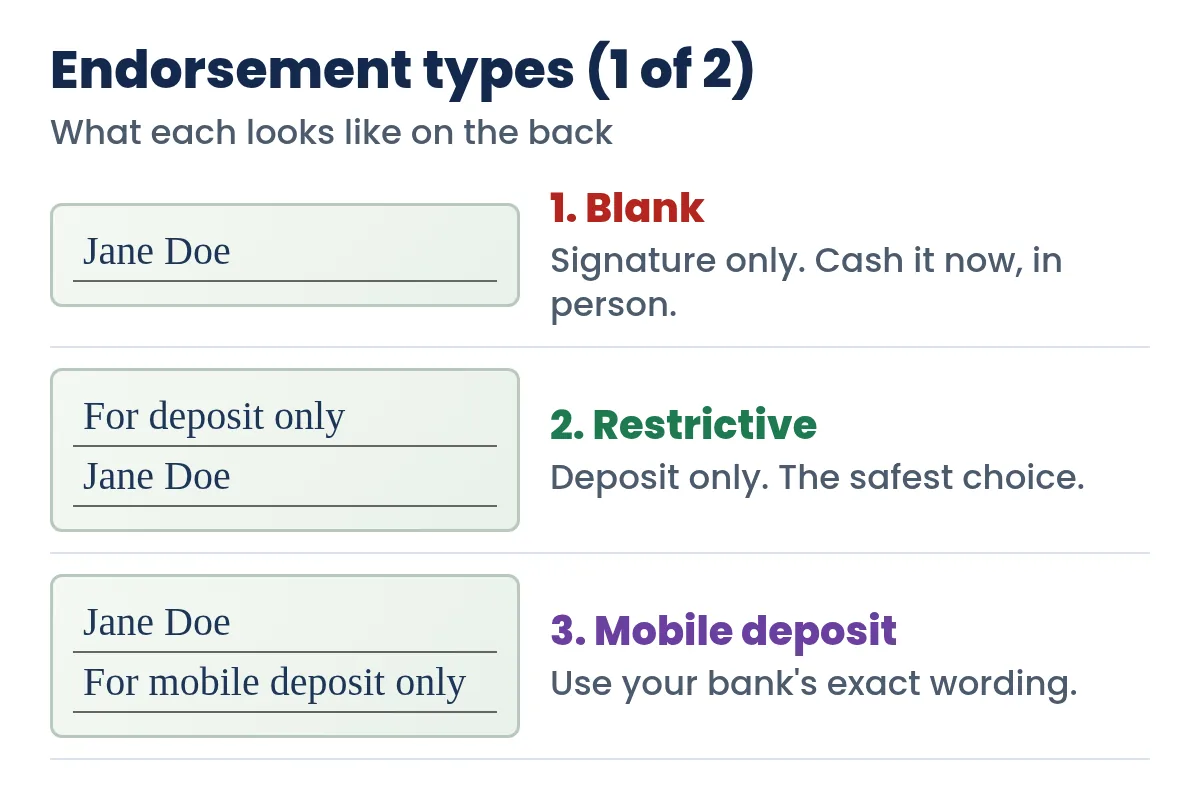
- 1. Blank endorsement: signature only
- 2. Restrictive endorsement: "For deposit only"
- 3. Mobile deposit endorsement
- 4. Special endorsement: signing a check over to someone else
- 5. Endorsing a check made out to a business
- 6. "Without recourse": the qualified endorsement
- All six endorsements at a glance
- Other situations people ask about
- Worked example: one week of checks
- Conditional endorsements usually don't work
- When the name on the check is wrong
- Checks with two payees
- What if you forget to endorse?
- Endorsement mistakes that cause delays
- If you write checks: make endorsing easy for your payees
- FAQ
What an endorsement is (and why banks want one)
An endorsement is a signature on the back of a check, sometimes with a few words, made by the person the check is payable to. Under the Uniform Commercial Code (UCC § 3-204), a signature on a check that isn't the drawer's is treated as an endorsement unless it clearly serves another purpose. It does three jobs: it passes the check on (to a bank or a person), it can limit what happens to the money, and it makes the endorser answerable if the check later bounces.
Banks use the endorsement as evidence that the right person received the money. That is why a teller compares the endorsement with the payee line, and why a check signed by the wrong person can be returned weeks later.
Before you sign: a 30-second check
- Is it made out to you?
Read the payee line. If your name is misspelled, see the section on name mistakes below.
- Is it complete?
Look for a date, a signature on the front and matching amounts in numbers and words. A check missing any of these may be refused.
- Is it current?
A check dated in the future, or more than six months old, can cause problems. See how long a check is good for.
- Do you know what you will do with it?
Cash, deposit in person, mobile deposit or sign it over: each calls for different wording.
Then turn the check over and find the endorsement area: the lined box at the end behind the drawer's name. Use blue or black ink, stay inside the box and leave the rest of the back for the banks. Our guide to the back of a check shows the zones.
1. Blank endorsement: signature only
A blank endorsement is just your signature. It is the most common form and the most fragile one. Under UCC § 3-205(b), a check endorsed in blank becomes payable to bearer: anyone holding it can cash or deposit it until someone adds a more specific endorsement.
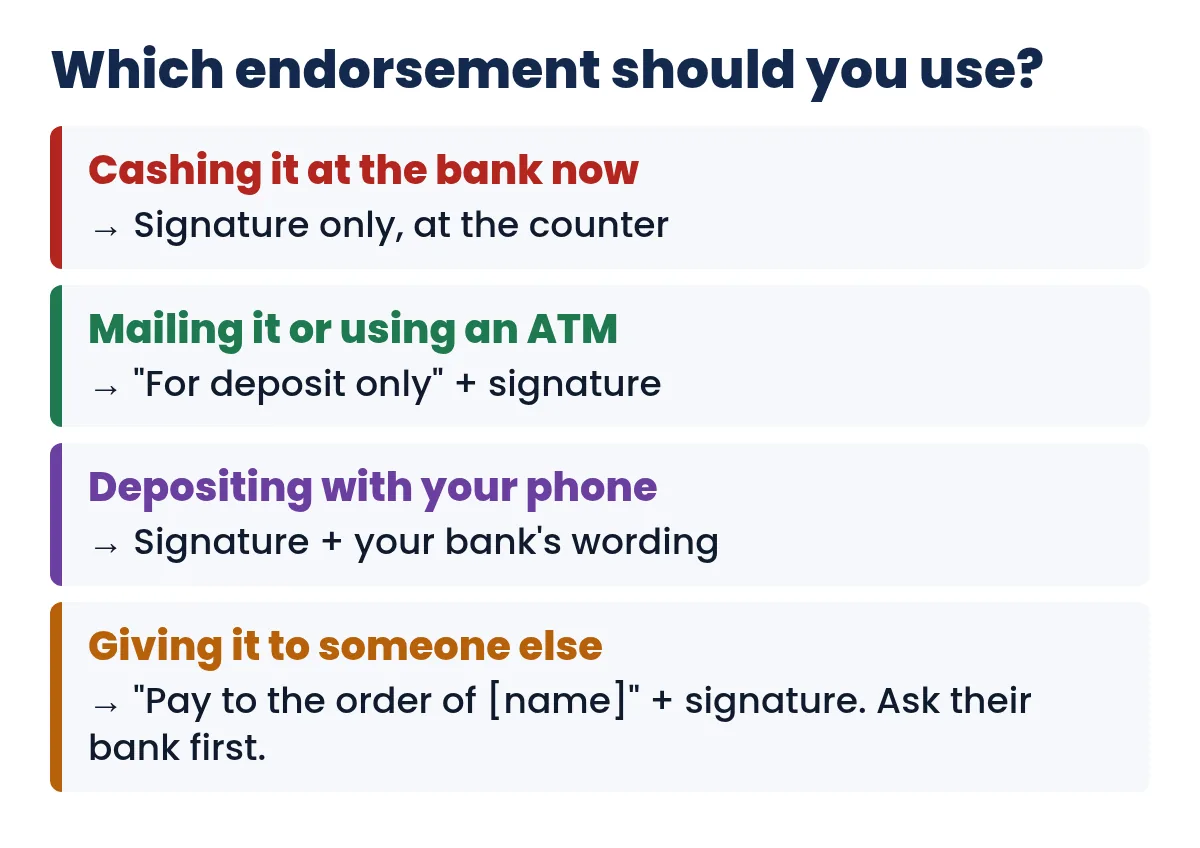
When to use it: at the teller window or ATM, the moment before you hand the check over. When to avoid it: any time the check will leave your hands first, such as in the mail, in a bag or in a drop box.
Signing checks at home "to save time" turns them into bearer paper. If a pre-signed check is lost, whoever finds it may be able to cash it.
2. Restrictive endorsement: "For deposit only"
A restrictive endorsement adds words that limit what can be done with the check. The everyday version is "For deposit only" written above your signature. You can make it tighter by adding the account: "For deposit only to account ending 6789".
The UCC gives this wording real force. Under § 3-206(c), when a check is endorsed "for deposit" or "for collection", a depositary bank that takes it, and anyone other than a bank who buys it, is liable for conversion unless the money goes to the endorser or is applied the way the endorsement says. In plain terms: the money should end up in your account.
When to use it: mailing a check to your bank, using a night drop or ATM, or handing deposits to an employee. It is also the standard for businesses depositing customer payments.
3. Mobile deposit endorsement
Banking apps photograph the back of the check, and most banks ask for specific wording so the check can't be deposited again somewhere else. A common instruction is to sign and add "For mobile deposit only", sometimes followed by the bank's name. Some checks now have a pre-printed box to tick instead.
The exact words are set by your bank, not by law, so read your app's deposit screen. If the wording is wrong, the app may reject the deposit and ask you to endorse again. Our step-by-step guide on depositing a check with your phone covers the photos, limits and what to do with the paper check afterwards.
Need to write a check right now?
Quick Check Writer fills in the amount in words, adds the bank line and prints on blank check stock or saves a PDF. Your first check is free, with no account and no card.
Write your first check free →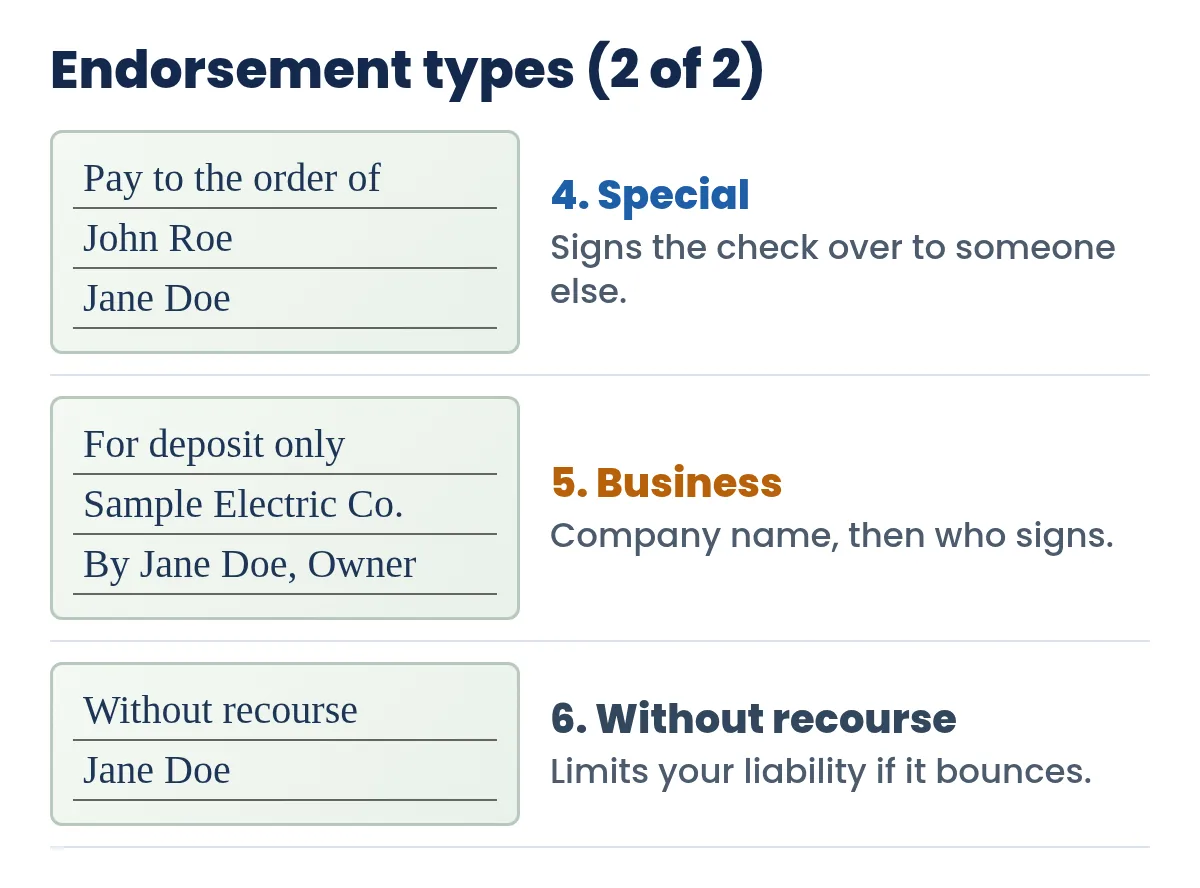
4. Special endorsement: signing a check over to someone else
A special endorsement names a new payee. You write "Pay to the order of John Roe" and sign underneath. Under UCC § 3-205(a), the check then becomes payable to John Roe and can be negotiated only with his endorsement. It's how you "sign over" a check, for example passing a refund check to a family member.
The law allows this, but banks don't have to accept it. A check endorsed over to a new person is often called a third-party check, and the OCC (the federal regulator of national banks) notes that a bank sets its own policy on whether to accept third-party checks. It may refuse them outright or require the original payee to be present.
Jane Doe receives a $200 check and wants to give it to her brother John Roe. She writes "Pay to the order of John Roe" on the back and signs "Jane Doe". John signs under her signature and takes it to his bank. Before he goes, he calls to ask whether his bank accepts third-party checks; if it doesn't, the simpler route is for Jane to deposit the check and pay John another way.
5. Endorsing a check made out to a business
A check payable to a business should be endorsed in the business's name, by someone authorized to act for it. Most businesses simply stamp or write "For deposit only", the business name and, often, the account number, because the money must go into the business account. If you sign by hand, write the company name and then your name and title, for example "Sample Electric Co., by Jane Doe, Owner".
Depositing a business check into a personal account is a common cause of rejected deposits and messy bookkeeping. If you run a business, open a business account and deposit there. See business check vs personal check.
6. "Without recourse": the qualified endorsement
Normally, when you endorse a check and pass it on, you take on some responsibility: if the check is dishonored, the person who took it from you can come back to you for payment. Writing "Without recourse" above your signature disclaims that liability. Under UCC § 3-415(b), an endorser who writes "without recourse" is not liable to pay the check if it is dishonored.
Ordinary people rarely need this. It shows up mainly when a check is passed on by someone acting for others, such as an attorney or agent passing on a client's check. Banks may still refuse a check endorsed this way, so ask first.
All six endorsements at a glance
| Type | What you write | Who can cash or deposit it after | Best for |
|---|---|---|---|
| Blank | Signature | Anyone holding it | At the teller window only |
| Restrictive | "For deposit only" + signature | Only deposited, consistent with the words | Mail, ATM, night drop |
| Mobile | Signature + your bank's wording | Your bank, through the app | Phone deposits |
| Special | "Pay to the order of [name]" + signature | The named person | Passing a check on, if a bank will take it |
| Business | Business name + authorized signer (or stamp) | The business account | Customer payments |
| Without recourse | "Without recourse" + signature | Same as blank, but you limit your own liability | Rare; mostly professional settings |
Other situations people ask about
Signing for someone under a power of attorney
If you hold a power of attorney, you may be able to endorse a check for the person you represent. Under UCC § 3-402, when an authorized representative signs, the person represented is bound as if they had signed. A common format is the payee's name, then "by" your name and your role, for example "Jane Doe, by John Sample, attorney-in-fact". Banks usually want to see the power of attorney document first, so take it to the branch the first time.
A check made out to someone who has died
Don't deposit it into your own account, even as a family member. The money generally belongs to the person's estate, so talk to the bank and to whoever is handling the estate. Often the right step is to deposit it into an estate account, or to ask the payer for a new check made out to the estate.
Several checks at once
Endorse each check individually, even if they are all going into the same deposit. A business that receives many checks usually orders a deposit stamp so every check gets the same, readable endorsement.
Worked example: one week of checks
Jane Doe receives three checks in one week. Here is how she endorses each:
- A birthday check for $50 from her aunt
She deposits it from her phone that evening: signature, then "For mobile deposit only", as her bank's app asks. She keeps the paper for the period her bank states, then shreds it.
- A $1,250 rent check from her tenant, John Sample
She is going to the branch on Friday but won't have time to sign there. She endorses "For deposit only" with her signature at home, so if the check goes missing on the way, it can only be deposited.
- A $300 check payable to her catering business
The check names her business, not her personally, so she stamps it with her business deposit stamp (business name, "For deposit only") and it goes into the business account.
Conditional endorsements usually don't work
People sometimes try to attach conditions, like "Pay John Roe only if the roof is finished". Under UCC § 3-206(b), a condition in an endorsement doesn't affect the right to enforce the check, and a bank paying it can ignore the condition. If you need conditions, put them in a written agreement, not on the back of a check.
When the name on the check is wrong
If the check is made out to "Jane Do" instead of "Jane Doe", you can still endorse it. UCC § 3-204(d) lets you sign in the name written on the check, in your correct name or both, and it allows the bank to ask for both. The safe habit is to sign the misspelled version first and your correct signature under it.
If the name is completely different, or the check is made out to a business name you don't have an account under, ask the writer for a new check.
Checks with two payees
If a check reads "Jane Doe and John Roe", the bank can generally require both signatures; with "Jane Doe or John Roe", either can endorse. The details, including what to do when the wording is unclear, are in our guide to checks made out to two people.
What if you forget to endorse?
If you deposit an unsigned check into your own account, the deposit may still go through. Under UCC § 4-205, a depositary bank that receives a check from its customer for collection becomes a holder of it whether or not the customer endorsed it. Many banks and most apps still require an endorsement by policy, though, and may reject or delay the deposit. Sign it.
Endorsement mistakes that cause delays
| Mistake | What can happen | Fix |
|---|---|---|
| Signing below the bank-use line | Bank stamps become unreadable; delays or rejection | Stay inside the endorsement box |
| Missing mobile wording | App rejects the deposit | Add your bank's exact phrase |
| Pre-signing and losing the check | Someone else may cash it | Sign at the bank, or add "For deposit only" |
| Only one of two "and" payees signs | Deposit refused or reversed | Both payees endorse |
| Business check into a personal account | Deposit refused | Deposit into the business account |
If you write checks: make endorsing easy for your payees
Most endorsement problems start on the front of the check. Spell the payee's name exactly as they asked, use "or" between names only when either person may cash it, and write clearly. If you print your checks, software fills the payee and amount in neat type and keeps a record of each one. Quick Check Writer prints the front of your checks, including the MICR line, on blank check stock and logs every check in a register, so you can see who you paid and when. New to printing your own? Start with how to write a check.
Frequently asked questions
How do you endorse a check?
Turn the check over and sign your name in the endorsement area at one end, in blue or black ink. Add "For deposit only" if you are depositing it, or your bank's mobile wording for app deposits.
What is the safest way to endorse a check?
A restrictive endorsement: write "For deposit only" (optionally with your account number) above your signature. The money then has to be deposited, not cashed.
Can I sign a check over to someone else?
The law allows it with "Pay to the order of" plus the new person's name and your signature, but banks don't have to accept third-party checks. Ask the new person's bank first.
What do I write for a mobile deposit?
Usually your signature and "For mobile deposit only", sometimes with the bank's name, or a ticked box if the check has one. Your bank's app tells you its exact wording.
My name is misspelled on the check. How do I endorse it?
Sign the name as written, then your correct signature underneath. UCC § 3-204(d) allows either, and lets the bank ask for both.
Can I deposit a check without endorsing it?
Sometimes. The UCC lets a bank collect a check its customer deposits even without an endorsement, but many banks and apps require one by policy.
How do I endorse a check made out to my business?
Endorse in the business's name, typically "For deposit only", the business name and account number, or the business name followed by your name and title. Deposit it into the business account.
What does "without recourse" mean on the back of a check?
It means the endorser disclaims liability to pay if the check bounces (UCC § 3-415(b)). It's mostly used by agents and attorneys passing on checks.
Can I endorse a check with a stamp?
Businesses often can. Many banks accept a stamped endorsement such as the business name with "For deposit only" for deposits to a business account. For a personal check, sign by hand unless your bank says a stamp is fine.
How do I endorse a check if I have power of attorney?
Write the payee's name, then "by" your name and your role, such as "Jane Doe, by John Sample, attorney-in-fact". UCC § 3-402 makes an authorized representative's signature binding on the person represented, but banks usually ask to see the power of attorney first.
Should I endorse a check before I get to the bank?
Only with a restrictive endorsement such as "For deposit only". A signature alone turns the check into a bearer instrument that anyone holding it could try to cash.
Related guides
- The back of a check: what goes there and what to leave blank
- Check made out to two people: "and" vs "or"
- How to Deposit a Check With Your Phone
- How to cash a check (with or without a bank account)
- Ways to deposit a check
- Parts of a check, explained
Sources
- UCC § 3-204 (indorsement; misspelled names), Cornell LII
- UCC § 3-205 (blank and special indorsement), Cornell LII
- UCC § 3-206 (restrictive indorsement), Cornell LII
- UCC § 3-415 (obligation of indorser; without recourse), Cornell LII
- UCC § 4-205 (depositary bank holder of unindorsed item), Cornell LII
- HelpWithMyBank.gov (OCC): third-party checks
- HelpWithMyBank.gov (OCC): checks payable to two people
- Chase: How to endorse a check (ink color, mobile deposit wording)
- UCC § 3-402 (signature by representative), Cornell LII
Last updated November 1, 2026. This page is general information, not legal or financial advice. Quick Check Writer is check printing software; it is not a bank and does not move money.