
Key takeaways
- Only the payee writes on the back; the person writing the check does not.
- Sign inside the endorsement area in blue or black ink.
- Add "For deposit only" if the check might get lost before it reaches your bank.
- Leave the bank area blank: banks print their endorsements there.
On this page
- What's printed on the back of a check
- Who writes on the back (and who shouldn't)
- The endorsement area, step by step
- What to write in the endorsement area
- Why you should leave the rest of the back blank
- What banks add to the back
- Special cases
- What to write on the back: situation by situation
- Walk-through: a small business deposits a stack of checks
- Checklist before you hand over or deposit a check
- Myths about the back of a check
- The back of checks you print yourself
- FAQ
What's printed on the back of a check
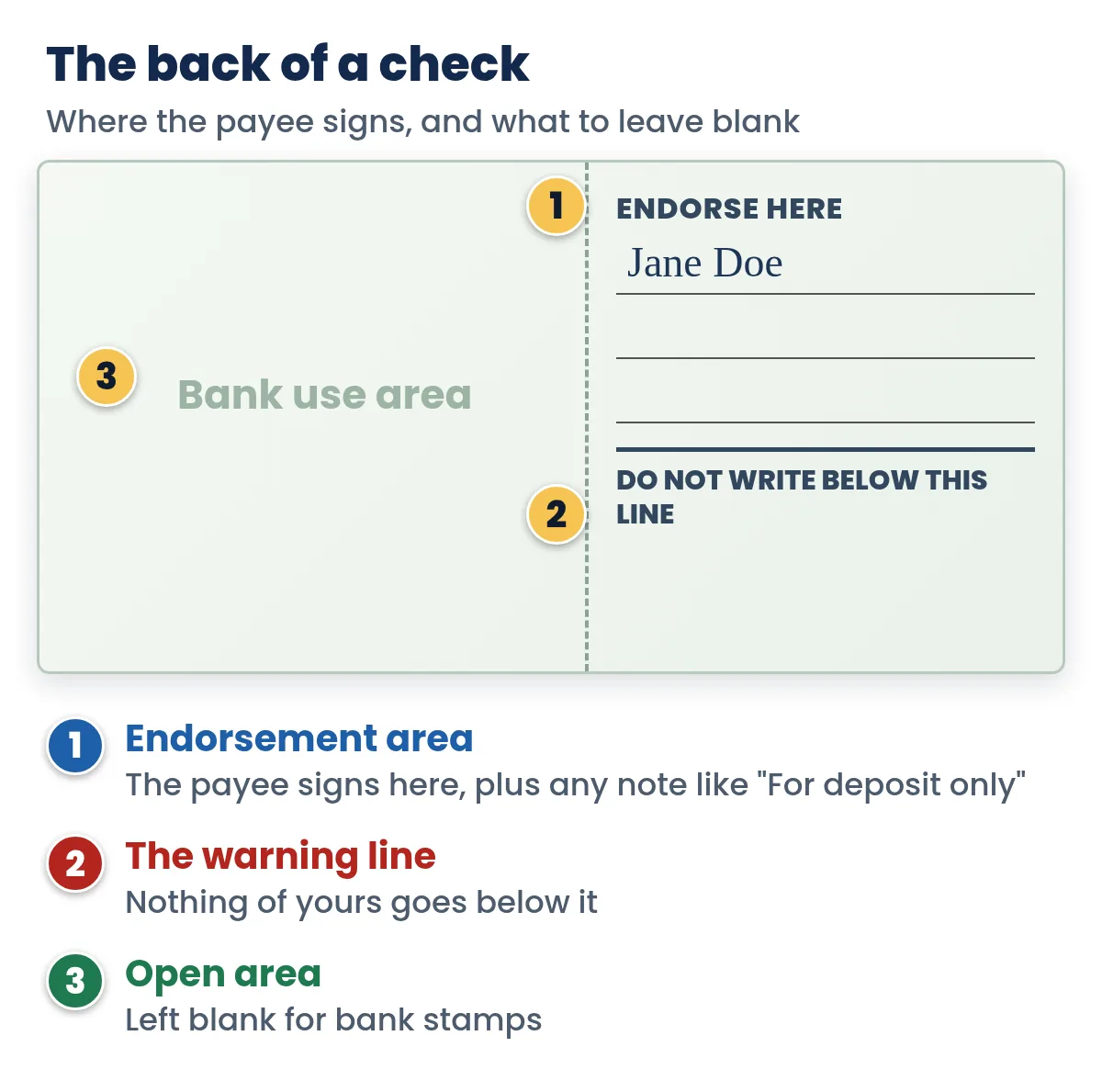
Turn a check over and you will usually see three things:
- An endorsement area with a few lines and a label such as "Endorse here". It sits at one short end of the check, behind the end that carries the drawer's name and address on the front.
- A warning line under it, typically "Do not write, stamp or sign below this line" or "Reserved for financial institution use".
- A large open area that looks empty. It is not spare space: banks stamp and print their own endorsements there as the check travels through collection.
Many checks also print a short list of their security features on the back, such as a warning that the check contains a security screen or chemically sensitive paper, so whoever handles it knows what to look for. Some business checks add a short note about the payment terms; if the check came with a voucher stub, that information is usually on the stub rather than the back.
Who writes on the back (and who shouldn't)
The back belongs to the people who receive and process the check, not the person who writes it.
| Person | Writes on the back? | What and where |
|---|---|---|
| Drawer (you, when you write the check) | No | Nothing. Fill in the front only. |
| Payee (who receives it) | Yes | An endorsement inside the endorsement area. |
| Someone the check is signed over to | Yes | Their own endorsement, under the payee's, if their bank accepts it. |
| Banks | Yes | Endorsement stamps and processing data in the reserved area. |
If you wrote the check, leave the back alone. Notes for the payee belong on the memo line or on a stub, not on the reverse side.
The endorsement area, step by step
The endorsement is the payee's signature on the back, sometimes with a short instruction. It tells the bank that the person entitled to the money is cashing it, depositing it or passing it on. Here is how to fill it in cleanly:
- Check the front first
Make sure your name is spelled the way you would sign, the amount is right and the check is signed and not post-dated.
- Find the right end
Turn the check over. The endorsement lines are at the end behind the drawer's name and address. Turn the check so those lines run left to right in front of you.
- Use blue or black ink
Write with a pen in a dark, standard color. Pencil, markers and gel ink that smears can cause trouble when the check is scanned.
- Sign inside the lines
Sign your name as it appears on the payee line. Add any instruction, such as "For deposit only", on the lines provided.
- Stop above the warning line
Do not let any part of your signature or note cross into the bank area below.
What to write in the endorsement area
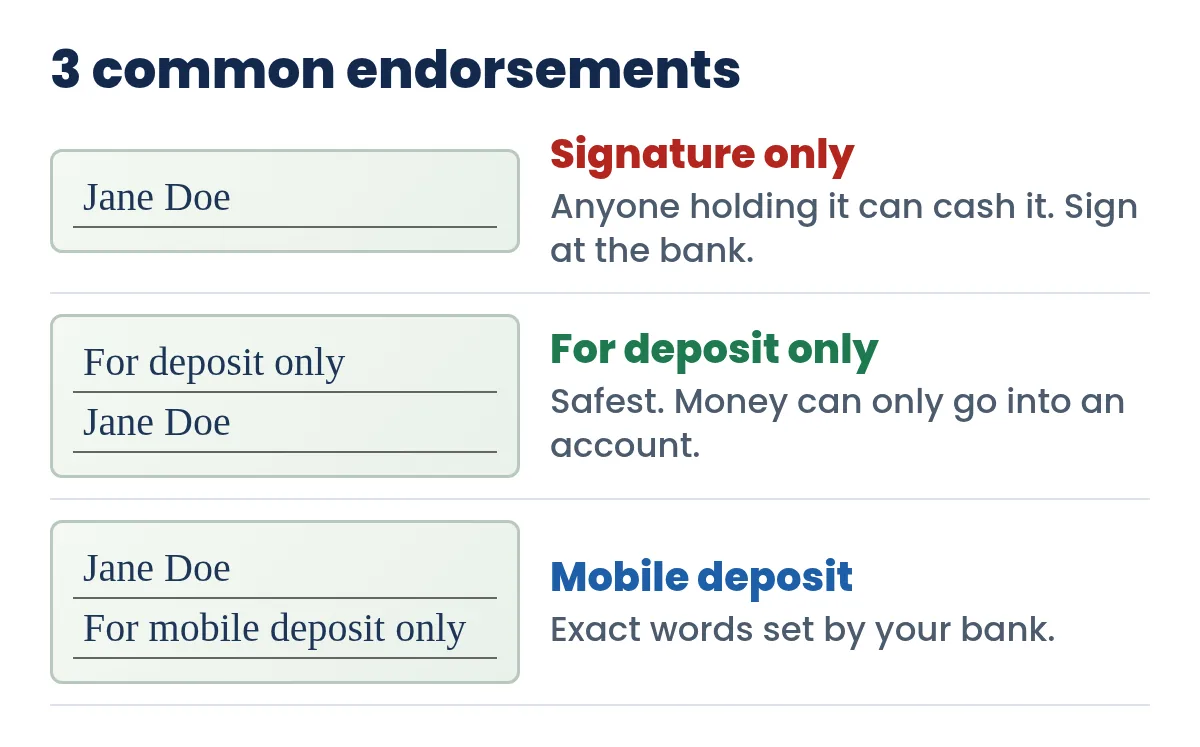
What you write depends on what you plan to do with the check. The three most common choices:
- Your signature only
- A blank endorsement. Under UCC § 3-205, a check endorsed in blank becomes payable to bearer, so anyone who holds it can try to cash it. Sign this way only at the teller window or ATM, right before you hand the check over.
- "For deposit only" plus your signature
- A restrictive endorsement. Under UCC § 3-206, a bank that takes a check endorsed "for deposit" has to apply the money consistently with that instruction. It is the safest choice if you are mailing a check to your bank or dropping it in a night box.
- Mobile deposit wording
- Many banks ask you to write something like "For mobile deposit only" (sometimes with the bank's name) under your signature, or to tick a pre-printed box. The exact wording is set by your bank, so check your app's instructions.
Other endorsements, such as signing a check over to someone else or endorsing for a business, are covered in detail in how to endorse a check. If the check names two people, read checks made out to two people before either of you signs.
Need to write a check right now?
Quick Check Writer fills in the amount in words, adds the bank line and prints on blank check stock or saves a PDF. Your first check is free, with no account and no card.
Write your first check free →Why you should leave the rest of the back blank
The large open area is where the banks that handle the check put their own endorsements. The depositary bank (the bank where the check is deposited) adds its endorsement, usually with its routing number and the date, so the check can be traced and, if needed, returned.
Federal Reserve Regulation CC requires banks that handle a check to endorse it according to an industry standard (ANS X9.100-111), which reserves specific zones on the back for those bank endorsements. The rule also assigns responsibility when the back is cluttered: under 12 CFR § 229.38(d), a depositary bank is responsible if the condition of the back, arising after the check was issued, makes later bank endorsements hard to read. That is why banks care so much about customers writing outside the box.
Writing across the bank area, adding sticky labels or using a stamp that bleeds over the whole back can make bank endorsements unreadable. The check may be delayed, rejected by an ATM or app, or need to be deposited again at a teller.
What banks add to the back
By the time a check comes back to the drawer's statement as an image, its back may carry several marks the payee never wrote:
- The depositary bank's endorsement, often with its name, routing number and the deposit date.
- Endorsements from any other banks that handled the check on its way to the paying bank.
- Processing information, such as sequence numbers added during scanning.
- If the check is returned unpaid, a return reason such as "insufficient funds" or "stop payment".
These marks are how banks prove the check was paid and to whom. If you ever need to confirm that a check you wrote was cashed, ask your bank for an image of the front and back: the endorsements show who deposited it and where.
John Sample pays Jane Doe $1,250 by check. Jane signs the back, writes "For deposit only" and deposits it at her bank. Her bank adds its endorsement in the open area. When John looks up check 1024 in his online banking, the image of the back shows Jane's endorsement and her bank's stamp, which confirms the check reached her.
Special cases
You wrote in the wrong place
If you signed outside the endorsement area or below the line, don't scribble over it. Ask a teller whether the check can still be deposited as is. If the bank won't take it, you may need to ask the drawer for a replacement check and void the first one.
The back has no endorsement lines
Some checks, especially older or homemade ones, have a plain back. Sign across the end behind the drawer's name, within roughly the first inch or two, and keep the rest clear. When in doubt, ask your bank where it wants you to sign.
Mobile deposits
Your banking app photographs both sides. The endorsement has to be readable in the image, so write clearly and avoid smudges.
The "for mobile deposit only" wording is not just a bank habit. Under Regulation CC, a bank that accepts a check by photo, never receives the paper and gets paid on it owes an indemnity to a second bank that later accepts the same paper check, if the second bank loses money because the check was already paid. But under 12 CFR § 229.34(f)(3), the second bank cannot claim that indemnity if the paper check carried a restrictive endorsement inconsistent with how it was deposited. In plain terms: writing "For mobile deposit only" on the back makes it the second bank's problem if someone tries to deposit your paper check again at a counter, which is a strong reason for every bank to insist on it.
After the deposit, keep the paper check for the time your bank says, then destroy it. Policies differ: Chase asks customers to keep the marked check for two business days or until it confirms the deposit was accepted, while Wells Fargo suggests storing it safely for five days and then destroying it. Shred it rather than throwing it away whole.
Cashier's and money order backs
Official checks and money orders follow the same idea: the payee endorses at the marked spot and leaves the rest alone. Some carry extra security warnings on the back, such as a reminder to check a watermark or other feature before accepting them.
What to write on the back: situation by situation
| Situation | Write in the endorsement area | Why |
|---|---|---|
| Cashing at your own bank's teller | Your signature, at the counter | A signature-only endorsement is safe once the teller has the check in hand. |
| Depositing at an ATM | "For deposit only" and your signature | If the envelope or check goes astray, it can only be deposited. |
| Mailing it to your bank | "For deposit only", your account number if the bank asks, and your signature | Mail can be lost; a restrictive endorsement limits what a finder can do. |
| Mobile deposit | Your signature plus the exact wording your bank's app asks for | See the Regulation CC note above; some apps reject checks without it. |
| Check made out to your business | A company stamp or "For deposit only, [business name]" plus an authorized signature | The check belongs to the business, so it must go into the business account. |
| Signing it over to someone else | "Pay to the order of [their name]" and your signature | A special endorsement. Ask first: many banks refuse third-party checks. |
Walk-through: a small business deposits a stack of checks
Jane Doe runs a cleaning company and receives eight customer checks in a week. Signing each one by hand is slow and inconsistent, so most businesses do this instead:
- Order an endorsement stamp
A self-inking stamp with "For deposit only", the business name and, often, the bank's name and the account's last digits. Banks commonly accept a stamped endorsement for a business account; ask yours what it requires.
- Check every front first
Payee name is the business (or a name the business uses), amounts agree, each is signed and dated.
- Stamp inside the endorsement area
Line the stamp up within the endorsement lines, above the warning line, with clean ink that doesn't bleed into the bank area.
- Record and deposit
List each check (customer, number, amount) on the deposit slip or in your books, then deposit them together. Our guide to filling out a deposit slip walks through it.
Checklist before you hand over or deposit a check
- Front checked: your name, matching amounts, signature, a date that isn't months old or in the future.
- Endorsing at the correct end, behind the drawer's name and address.
- Dark blue or black ink, signature inside the lines.
- Restrictive wording added if the check will leave your hands before it reaches a teller.
- Nothing written, stamped or taped below the warning line.
- For mobile deposit: your bank's exact wording, then keep the paper for your bank's stated period and shred it.
Myths about the back of a check
- "Writing my account number on the back makes it safer."
- Not necessarily. "For deposit only" already limits what can happen to the check. Some banks ask for an account number on mail-in or night-box deposits; otherwise, keep your full account number off paper that passes through other hands.
- "The bank won't notice if I sign below the line."
- Scanners and sorting systems read the back as an image. A signature in the bank zone can sit underneath a bank's endorsement and make both hard to read.
- "A check isn't valid without an endorsement."
- The endorsement is about transferring and collecting the check, not its validity. The UCC (§ 4-205) lets a bank collect a check deposited into the payee's own account even without an endorsement, but many banks still require one by policy, so sign unless your bank says otherwise.
- "The person writing the check should sign both sides."
- The drawer signs only the front. A drawer's signature on the back can confuse the bank about who is endorsing.
The back of checks you print yourself
If you print your own checks, you print only the front. The back usually comes from the check paper itself. Blank check stock sold for home and office printing commonly has the reverse side pre-printed with endorsement lines, the "do not write below this line" warning and security notices, so you do not need to design anything. Our blank check stock guide explains what to look for when you buy it.
Two things to keep in mind:
- Load the paper the right way. Print a test sheet first so the front prints on the correct side and the endorsement area ends up behind the name end. Our page on check printing problems and fixes covers alignment.
- Keep the back light. Under Regulation CC, the paying bank is responsible when the condition of a check as issued by it or its customer makes bank endorsements hard to read. Very dark or busy backgrounds on the back are a bad idea for that reason.
Quick Check Writer prints the front of the check (payee, amount in words, date, memo, signature, logo and the MICR line) onto blank stock with a regular printer, and logs every check in your register. See how to print checks at home or the parts of a check for the front side.
Frequently asked questions
Where do you sign on the back of a check?
In the endorsement area: the lines at the end of the check behind the drawer's name and address on the front. Keep your signature above the line that says not to write below it.
What does "do not write, stamp or sign below this line" mean?
The space below that line is reserved for banks. They place their endorsements and processing marks there, and writing in it can make the check hard to process.
Should the person writing a check sign the back?
No. The drawer signs the front. The back is for the payee's endorsement and for the banks that process the check.
What should I write on the back of a check for mobile deposit?
Sign it, and add the wording your bank asks for, often "For mobile deposit only" with the bank's name, or tick the mobile deposit box if the check has one. Your app's instructions are the final word.
Is it safe to sign the back of a check before going to the bank?
A signature alone makes the check payable to whoever holds it. If you need to sign early, add "For deposit only" so the money can only be deposited.
Why is there a list of security features on the back?
It tells tellers and recipients which anti-fraud features the paper has, such as a security screen or chemical-sensitive paper, so they can check the document is genuine.
Do I need to print anything on the back of home-printed checks?
Usually not. Blank check stock commonly comes with the back pre-printed with endorsement lines and warnings. You print only the front.
Can I deposit a check without signing the back?
Sometimes. UCC § 4-205 lets a bank collect a check deposited into the payee's own account even when it isn't endorsed, but many banks require an endorsement by policy, and mobile apps usually do. Sign unless your bank tells you otherwise.
Why does my bank want "For mobile deposit only" on the back?
Because it protects the bank if someone later tries to deposit the same paper check again. Under Regulation CC (12 CFR § 229.34(f)(3)), a bank that accepts a paper check carrying a restrictive endorsement inconsistent with how it is deposited cannot claim the remote-deposit indemnity.
How long should I keep a check after mobile deposit?
As long as your bank says. For example, Chase asks customers to keep it two business days or until the deposit is accepted, and Wells Fargo suggests five days. Then shred it.
Can a business use a stamp instead of signing the back?
Many banks accept a stamped endorsement such as "For deposit only" with the business name for deposits to a business account. Ask your bank what the stamp must include.
Related guides
- How to endorse a check
- Parts of a check, explained
- Check made out to two people: "and" vs "or"
- How to Deposit a Check With Your Phone
- Ways to deposit a check
- Blank Check Stock: A Complete Guide
Sources
- UCC § 3-205 (blank and special indorsement), Cornell LII
- UCC § 3-206 (restrictive indorsement), Cornell LII
- UCC § 3-204 (indorsement), Cornell LII
- 12 CFR § 229.35 Indorsements (Regulation CC), eCFR
- 12 CFR § 229.38 Liability (Regulation CC), eCFR
- Chase: How to endorse a check (ink color, mobile deposit wording)
- UCC § 4-205 (depositary bank holder of unindorsed item), Cornell LII
- 12 CFR § 229.34(f) Remote deposit capture indemnity (Regulation CC), eCFR
- Chase: Mobile deposits (keep the marked check two business days or until accepted)
- Wells Fargo: Mobile deposit FAQs (store the check 5 days, then destroy it)
Last updated November 1, 2026. This page is general information, not legal or financial advice. Quick Check Writer is check printing software; it is not a bank and does not move money.