
Key takeaways
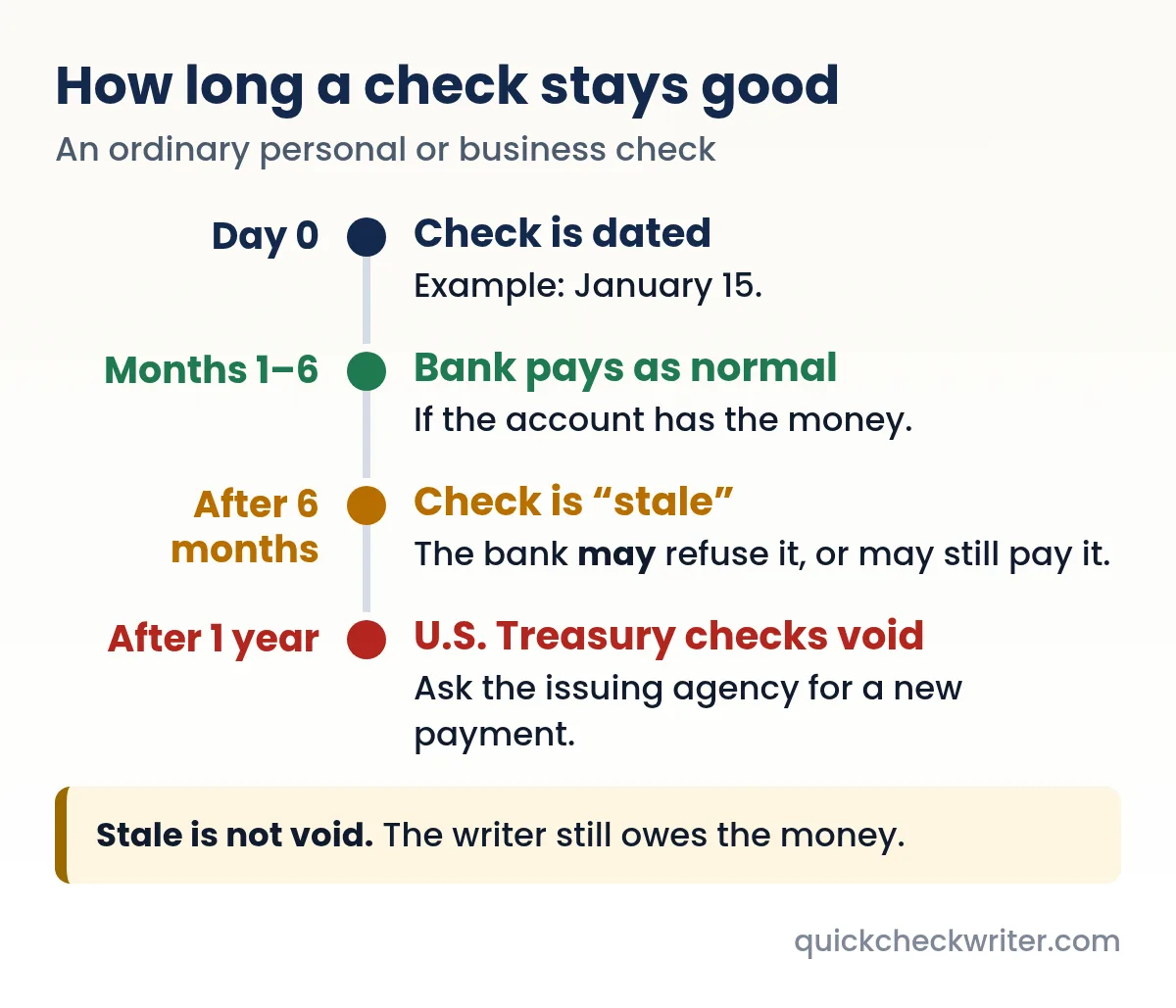
- Banks have no duty to pay an ordinary check presented more than six months after its date, but they may pay it.
- A stale check is not void: the writer still owes the money.
- Certified checks are excluded from the six-month rule; U.S. Treasury checks expire after one year.
- Deposit checks promptly. If a check is old, ask the writer for a new one rather than risk a returned item.
- Writers who want an old check blocked should place a stop payment, not rely on the date.
On this page
- The short answer: six months for most checks
- What “stale” actually means for each person involved
- How long different kinds of checks are good for
- Does “void after 90 days” on a check mean anything?
- What happens if you try to cash or deposit an old check
- How to handle an old check you received
- How to handle an old check you wrote
- Why the six-month rule exists
- Real situations, step by step
- Common mistakes with old checks
- When the writer has died
- Quick reference
- FAQ
The short answer: six months for most checks
For an ordinary personal or business check, the number to remember is six months. The Uniform Commercial Code, which every state has adopted in some form, says a bank does not have to pay a check that is presented more than six months after the date written on it. Bankers call a check that old stale-dated, or simply stale.
Notice what the rule does not say. It does not say the check becomes void, and it does not say the bank must refuse it. The bank simply loses its obligation to pay. It may still pay a stale check in good faith and charge the writer's account for it.
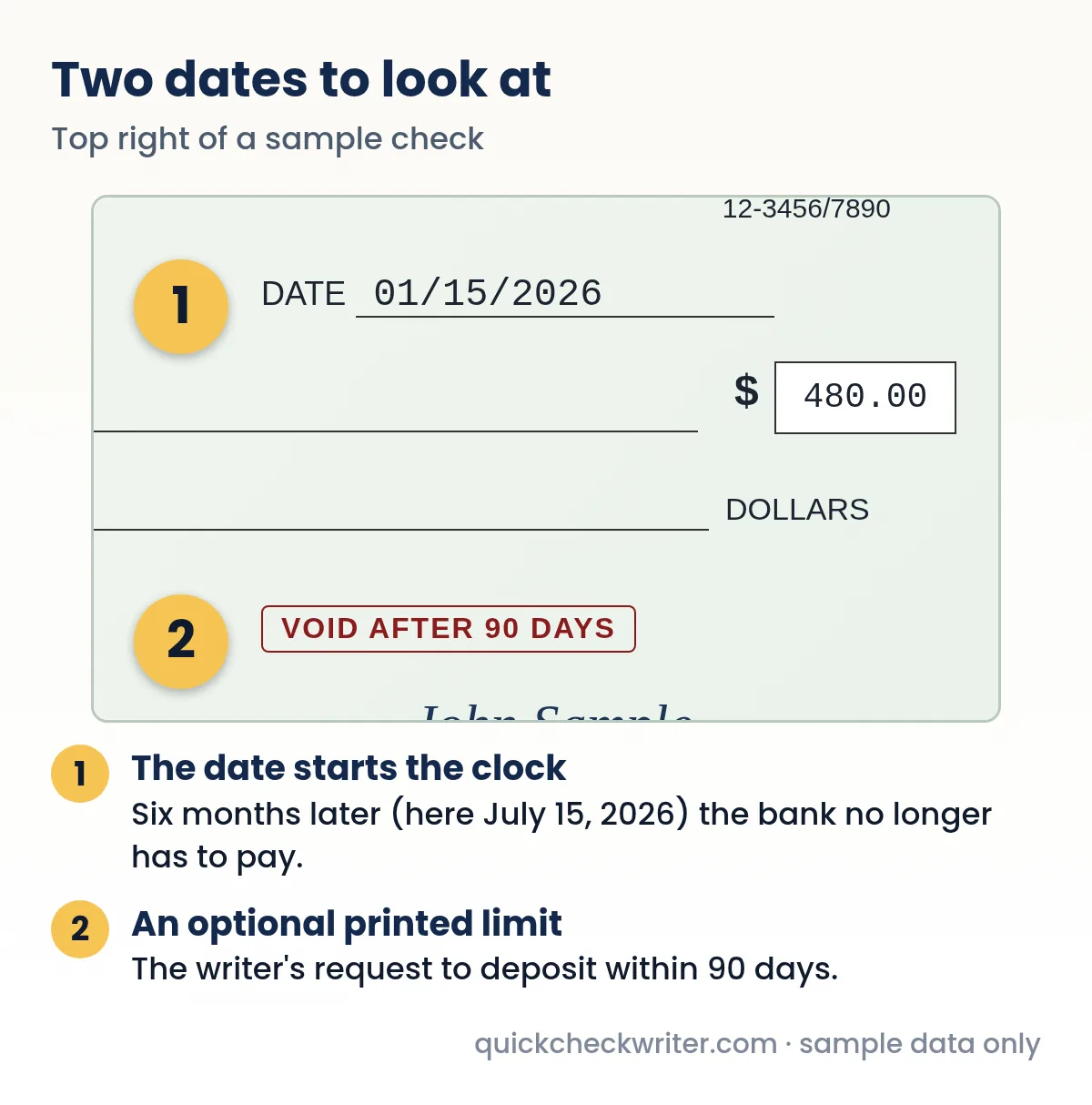
So "how long is a check good for?" really has two answers. Legally, the bank's duty runs six months. In practice, whether an older check still clears depends on the bank, the type of check, and whether the writer has stopped it or closed the account.
What “stale” actually means for each person involved
A check has three parties: the person who wrote it (the drawer), the person it is made out to (the payee), and the bank that holds the writer's account (the paying bank). The six-month mark affects each of them differently.
- For the payee
- Your bank may still accept the deposit, but the writer's bank can send it back unpaid. If that happens, your bank will reverse the credit and may charge you a returned-item fee. The safest move is to deposit any check within a few days of receiving it.
- For the writer
- You still owe the money. A check is a way of paying a debt, and the debt does not disappear because the paper went stale. If you do not want an old check paid, place a stop payment instead of relying on its age.
- For the paying bank
- The bank gets to choose. Some pay older checks without a second look; others flag large or very old items for review. Your deposit agreement is where your own bank describes its practice.
Check processing is largely automated, so a stale check can slip through and be paid without anyone looking at the date. If you lost a check or changed your mind, call your bank and stop payment on the check.
How long different kinds of checks are good for
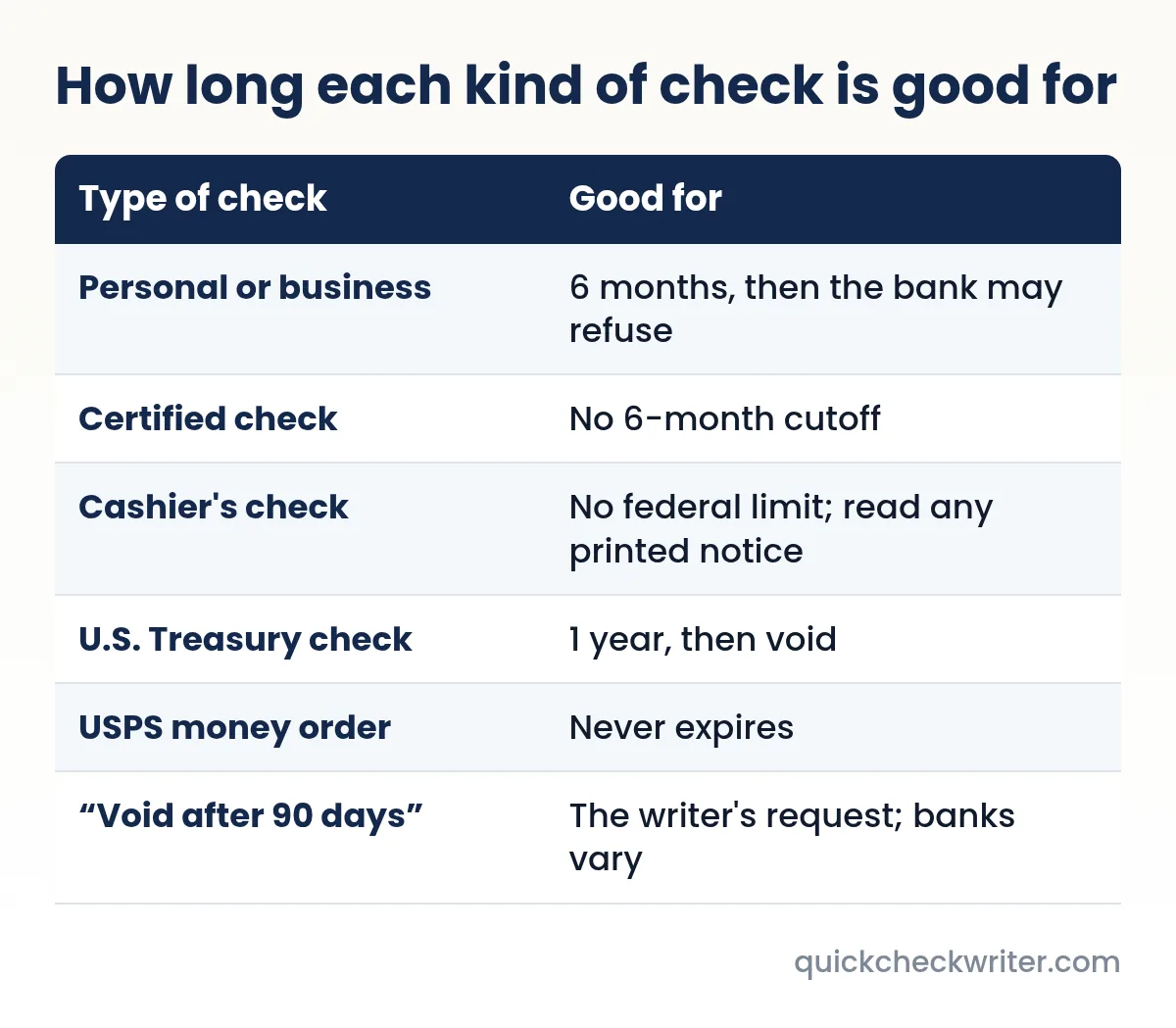
The six-month rule was written for ordinary checks drawn on a customer's account. Other kinds of checks work differently because someone other than the writer is responsible for paying them.
Personal and business checks
These follow the six-month rule above. There is no legal difference between a personal check and a business check on this point, and payroll checks are ordinary business checks. Some companies print "void after 90 days" or a similar line to push payees to deposit promptly; more on that below.
Certified checks
The six-month rule expressly leaves out certified checks. When a bank certifies a check, it has accepted the check and taken on the obligation to pay it, so the stale-date escape hatch no longer applies.
Cashier's checks and teller's checks
A cashier's check is drawn by a bank on itself, and a teller's check is drawn by a bank on another bank. Because the bank is the drawer, the customer-account rule in UCC § 4-404 does not fit them neatly, and there is no federal expiration date. Some banks print a notice such as "void after 90 days" or "void after 180 days" on their official checks; treat that as the issuing bank's stated policy and contact it if you hold an older one.
Money from an official check that is never cashed does not simply stay with the bank forever. Under state unclaimed property laws, after a dormancy period set by each state, the funds must be turned over to the state, where the owner can claim them. See our comparison of cashier's checks and certified checks for more on how these work.
U.S. Treasury checks
Checks issued by the U.S. Treasury, such as tax refunds and some federal benefit payments, carry a firm limit: they are void one year after the issue date. The Treasury cancels uncashed checks after that year, and the payee has to contact the agency that issued the payment to get the money another way.
State and local government checks
These are set by each government's own rules, and many print a validity period on the face of the check. Read the check itself, and ask the issuing agency if the date has passed.
Postdated checks
A check dated in the future can usually be paid before that date unless the writer has given the bank formal notice. We explain the details in our guide to postdated checks.
Does “void after 90 days” on a check mean anything?
Many business and payroll checks carry a line such as "Void after 90 days." The writer prints it, and it signals that they want the check deposited quickly so their books can be closed. It is a useful nudge for the payee and a good reason to deposit promptly.
Whether a bank actually refuses a check because of that line varies. The legal six-month rule still sits in the background, and automated processing may not catch the printed notice. If you are the payee and the date has passed, ask the writer whether they will still honor the check or would rather issue a new one. If you are the writer, keep a record and be ready to reissue.
If you print your own checks, Quick Check Writer can add an optional "Void after 90 days" line to the check face. It is a printed instruction, not a bank control, so pair it with a check register that shows which checks are still outstanding.
What happens if you try to cash or deposit an old check
Here is the sequence for a check that is more than six months old:
- Your bank decides whether to take it
A teller or the mobile app may accept it, may ask questions, or may refuse it outright. Some banks may not take stale checks through mobile deposit.
- The check goes to the writer's bank
That bank can pay it, which is common for modest amounts, or return it unpaid because it is stale, because the account is closed, or because there is a stop payment on it.
- If it comes back, your bank reverses the deposit
Your bank has the right to charge back a deposited check that is returned unpaid. Any funds it made available are taken back, and a returned deposited item fee may apply under your account terms.
- You go back to the writer
The debt still exists. Contact the writer, explain that the check is stale, and ask for a replacement or another form of payment.
Jane Doe finds a $75 birthday check from John Sample in a drawer, dated eight months ago. She deposits it with her phone. Two days later the money disappears from her balance and a returned item notice appears, because John's bank declined to pay a stale check. Jane texts John, who voids the old check in his register and writes a new one. Nothing illegal happened; the check simply sat too long.
Need to write a check right now?
Quick Check Writer fills in the amount in words, adds the bank line and prints on blank check stock or saves a PDF. Your first check is free, with no account and no card.
Write your first check free →How to handle an old check you received
If you have found a check that is past or close to six months old, the cleanest path is to ask for a new one. That avoids the risk of a returned item fee and a frozen balance.
- Look at the date and the type of check
Personal or business check: the six-month rule applies. Official bank check or government check: read any validity notice printed on it and contact the issuer.
- Contact the writer
Ask whether they still want to pay and whether they would prefer to issue a new check. Offer to return or destroy the old one so they can void it in their records.
- Destroy or return the stale check
Once you have the replacement, shred the old check or write VOID across it. That prevents both checks from being deposited and protects the writer's account details.
- If the writer cannot be reached
You can ask your bank whether it will accept the item for collection, which means it sends the check without crediting you until it is paid. For an old cashier's check or an unclaimed refund, search your state's unclaimed property database.
How to handle an old check you wrote
Writers are often the ones who find out about a stale check, usually when balancing the checkbook and spotting a payment that never cleared. Old outstanding checks distort your balance and can surprise you months later.
- Find the outstanding checks. Compare your register against your bank statement. Any check not yet paid is outstanding; our guide to outstanding checks walks through it.
- Contact the payee. Ask whether they received it. They may have lost it, or it may be sitting in a drawer.
- Stop payment before reissuing. If you write a replacement, place a stop payment on the original first so both cannot be paid.
- Keep the money set aside. Until a check clears or is stopped, treat that amount as spent.
A check register makes this easy. Quick Check Writer logs every check you print, so you can search by payee, reprint a lost check, or mark the original void in seconds.
Why the six-month rule exists
A check is a written order to your bank, and the longer it sits, the more likely something has changed. The rule lets a bank question old orders without risk: refusing a stale check is not wrongful dishonor, because the bank's duty to pay ended at six months. It can still pay when that is clearly what the customer wants.
Real situations, step by step
Beyond a personal check found in a drawer, three cases come up often, and each has its own fix.
Your paycheck says “void after 90 days” and it is day 100
Call the employer's payroll or HR team first. Many employers prefer to reissue rather than have an old check clear after they have reconciled the account. If they tell you to deposit it anyway, ask them to note that with their bank. Your wages are still owed either way; the check is only the way they chose to pay.
A refund check from a company is past six months
Contact the company's customer service or accounts payable department and ask for a replacement. If the company says the money was already sent to the state, search your state's unclaimed property site.
A tax refund check from the U.S. Treasury is 13 months old
It is void, so do not try to deposit it. The money is not lost: contact the agency that issued the payment (for a tax refund, the IRS) and ask it to reissue the payment.
Common mistakes with old checks
- Treating “stale” as “cancelled.” A writer who assumes an old check can no longer clear may spend the money. The bank is still allowed to pay it in good faith.
- Using the date as a safety lock. If you want an old check blocked, place a stop payment order. That is the only instruction the bank must follow.
- Depositing an old check right before spending the money. Funds can be made available before the check has actually been paid. If it comes back, your bank can take the money back.
- Forgetting old checks in the register. Unpaid checks make your balance look higher than it is. Review your outstanding checks every month.
When the writer has died
A check does not automatically die with the person who wrote it. Under UCC § 4-405, a bank may keep paying a customer's checks until it knows about the death and has a reasonable chance to act. Even after it knows, the bank may pay or certify checks written on or before the date of death for 10 days, unless someone claiming an interest in the account tells it to stop.
If you hold a check from someone who has since died, deposit it quickly. If it is returned, ask the estate's executor about the debt.
Quick reference
| Type of check | Time limit | Where the rule comes from |
|---|---|---|
| Personal or business check | Bank may refuse after 6 months | UCC § 4-404 |
| Certified check | Not covered by the 6-month rule | UCC § 4-404 |
| Cashier's or teller's check | No federal limit; check any printed notice | Issuing bank policy, state unclaimed property law |
| U.S. Treasury check | Void after 1 year | U.S. Treasury |
| Check marked “void after 90 days” | Writer's printed instruction | The check itself; enforcement varies |
| Stop payment order | Lasts 6 months (14 days if only oral) | UCC § 4-403 |
Frequently asked questions
Is a check still good after 6 months?
It may be. After six months the writer's bank is no longer required to pay it, but it is allowed to. Many banks still pay older checks; others return them. Ask the writer for a new check to be safe.
Can I deposit a check that is a year old?
You can try, but the writer's bank can refuse it and your bank may reverse the deposit and charge a fee. If it is a U.S. Treasury check, it is void after one year and you need to contact the issuing agency.
Do cashier's checks expire?
Federal law sets no expiration date for cashier's checks, but some banks print a validity period on them. If you hold an old one, contact the issuing bank. Funds that are never claimed eventually go to the state as unclaimed property.
Does a check expire if it says void after 90 days?
That line is the writer's instruction. Banks differ on whether they enforce it, so deposit before the date, or ask the writer to confirm or reissue the check if it has passed.
Does the writer still owe me money if the check went stale?
Generally yes. A check is a way of paying a debt; when it is not paid, the underlying debt usually remains, so you can ask the writer to pay another way.
How long is a payroll check good for?
A payroll check is an ordinary business check, so the six-month rule applies unless the employer printed a shorter notice. Many employers print 90 days. Contact your employer for a replacement if it has passed.
Can a bank pay a check after six months without asking me?
Yes. The law lets a bank pay a stale check in good faith and charge your account. If you do not want an old check paid, place a stop payment with your bank.
How long is a money order good for?
U.S. Postal Service money orders never expire, according to USPS. Money orders from banks and other companies follow their own terms, which are printed on the money order or the receipt, so read those or ask the seller.
How long is a check good for in Canada?
Payments Canada says cheques are considered stale-dated after six months unless they are certified, and financial institutions may still honour them but do not have to. Government of Canada cheques do not stale-date.
Can a check be cashed after the person who wrote it dies?
Sometimes. Under UCC 4-405 a bank may pay checks until it knows of the death, and for 10 days after the date of death it may still pay checks written on or before that date unless someone with an interest in the account orders it to stop.
Related guides
- Post-dated checks: what they are and whether banks honor the date
- How to stop payment on a check
- Outstanding checks
- Cashier's check vs certified check
- How Long Does a Check Take to Clear?
- Check register app that fills itself in
Sources
- UCC § 4-404, Bank not obliged to pay check more than six months old (Cornell LII)
- UCC § 4-403, Customer's right to stop payment (Cornell LII)
- UCC § 4-401, When bank may charge customer's account (Cornell LII)
- UCC § 4-214, Right of charge-back (Cornell LII)
- UCC § 4-402, Bank's liability for wrongful dishonor (Cornell LII)
- UCC § 3-310, Effect of instrument on obligation (Cornell LII)
- CFPB: Bank refused to cash a check more than six months old
- Treasury Financial Manual, Chapter 7000 (Treasury checks void after one year)
- U.S. Treasury Check Verification System
- NAUPA: What is unclaimed property?
- UCC § 4-405, Death or incompetence of customer (Cornell LII)
- USPS: Money orders (never expire)
- Payments Canada: Paying by cheque (stale-dated and post-dated cheques)
- Financial Consumer Agency of Canada: Paying by cheque
Last updated November 1, 2026. This page is general information, not legal or financial advice. Quick Check Writer is check printing software; it is not a bank and does not move money.