
Key takeaways
- Act fast: a stop order only works if the bank gets it before it pays the check.
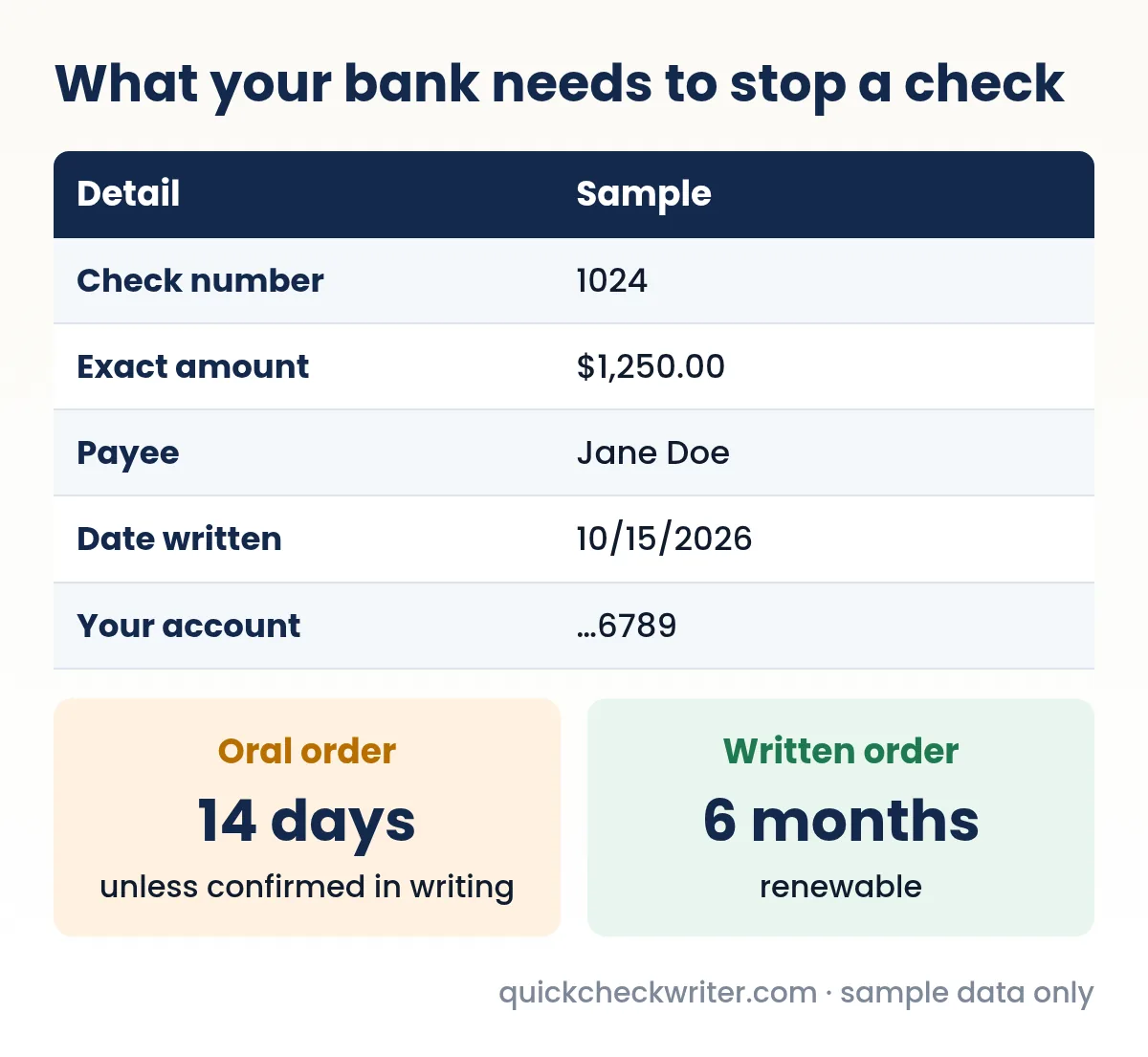
- Give the check number, exact amount, payee and date.
- Written orders last six months; oral orders lapse after 14 days unless confirmed.
- You generally can't stop a cashier's or certified check; lost ones use a separate claim process.
- If the check already cleared, deal with the payee, or report fraud if you didn't write it.
On this page
- When stopping payment makes sense
- The legal basics in one minute
- How to stop payment on a check, step by step
- Timing: why speed matters
- Which payments can be stopped
- What to do if the check already cleared
- Stop payments in a dispute
- What to say: a sample stop payment request
- Common mistakes
- Money orders and other “guaranteed” payments
- Stop payment or close the account?
- Replacing a stopped check
- How to avoid needing a stop payment
- FAQ
When stopping payment makes sense
A stop payment order instructs your bank to refuse one particular check you wrote. It is the right tool when the check has left your hands and you no longer want it paid. Common reasons include:
- the check was lost in the mail or the payee misplaced it, and you want to send a replacement,
- the check was stolen, along with other checks or your checkbook,
- you wrote it for the wrong amount or to the wrong payee,
- a dispute with the seller or contractor means you want to hold payment while it is sorted out,
- you sent a duplicate payment by mistake.
A stop payment is not a way to cancel a debt you owe. If you received goods or services, stopping the check can leave you still responsible for paying, and the payee may pursue you. Use it to fix errors and losses, or alongside a genuine dispute.
The legal basics in one minute
The rules come from Article 4 of the Uniform Commercial Code, section 4-403, which every state follows in some form:
- Who can order it
- The account holder, or anyone authorized to sign on the account. If an account needs two signatures, either signer can stop payment.
- What it must contain
- A description of the check "with reasonable certainty." In practice that means the check number, the exact amount, the payee and the date.
- When it must arrive
- Early enough for the bank to act on it before it pays or otherwise becomes committed to the check.
- How long it lasts
- Six months. An order given only by phone or in person expires after 14 calendar days unless it is confirmed in a record, such as a signed form or an online request. You can renew a written order for further six-month periods before it expires.
- If the bank pays anyway
- The bank may be liable, but you must show what you actually lost because of the payment.
How to stop payment on a check, step by step
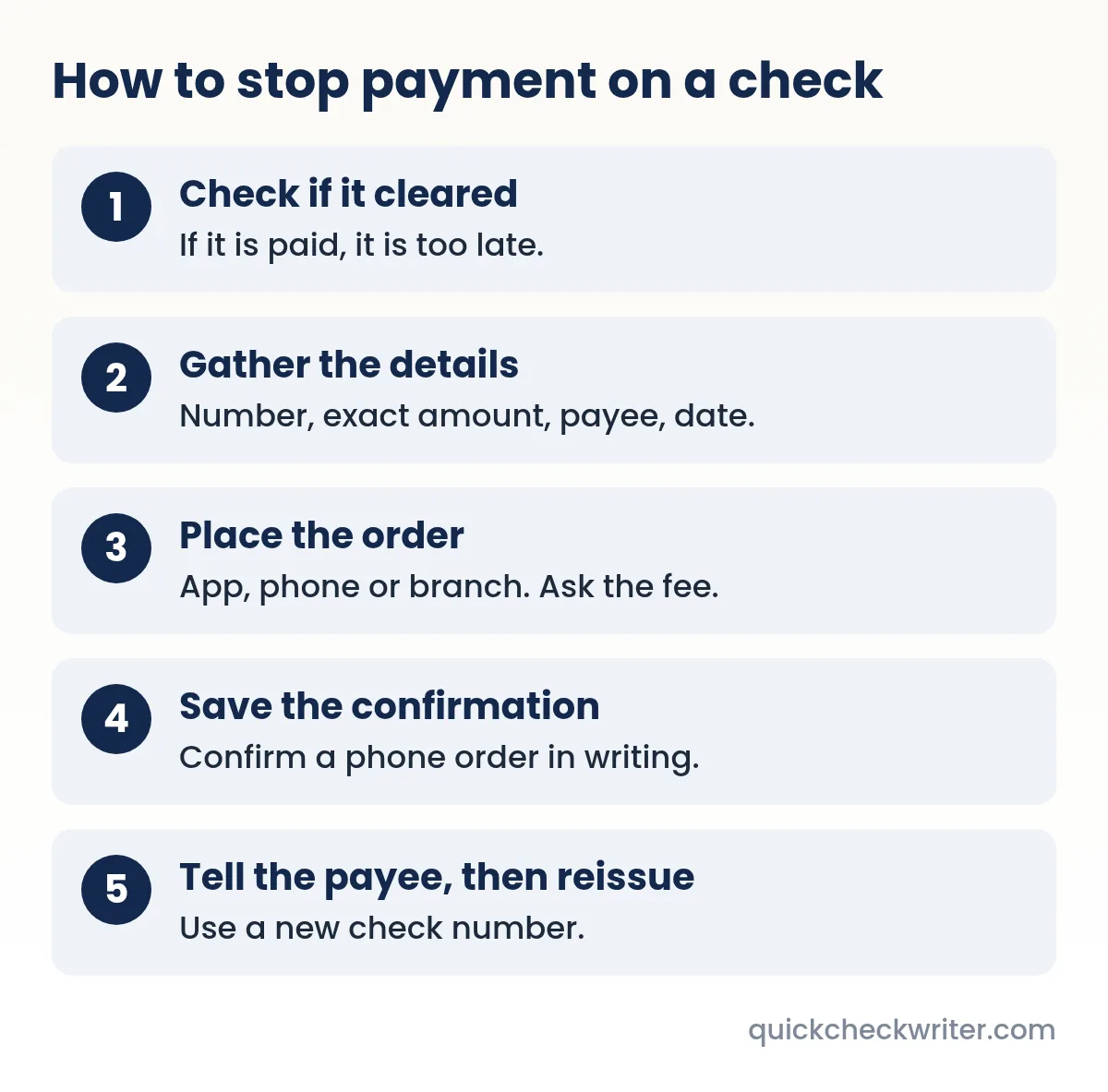
- Check whether it has already cleared
Look at your account activity online. If the check has been paid, a stop payment is too late; skip to the section on what to do instead.
- Gather the details
Check number, exact amount to the cent, payee name, date written, and your account number. Your check register is the fastest place to find them. If you printed the check with Quick Check Writer, all of this is in the register entry, and you can mark the check void there.
- Place the order through your bank
Most banks accept stop payments in online banking or the app, by phone, or at a branch. Online is often fastest and creates a written record automatically.
- Get the order in writing
If you called, confirm in writing or online within 14 days, or the order lapses. Save the confirmation number and the date the order expires.
- Expect a fee
Stop payments usually cost money. At two large banks whose current consumer fee schedules we checked, the charge was $30 and $35 per item, with waivers on some premium accounts. Check your own bank's fee schedule.
- Tell the payee
Let them know the original check will not be paid, so they do not deposit it and face a returned-item fee.
- Send the replacement, if any
Use a new check number and note in your register that it replaces the stopped check.
- Set a reminder
If the original might still surface, renew the order before six months pass, or close that account if many checks are at risk.
Need to write a check right now?
Quick Check Writer fills in the amount in words, adds the bank line and prints on blank check stock or saves a PDF. Your first check is free, with no account and no card.
Write your first check free →Timing: why speed matters
A stop payment only works if it reaches the bank before the bank has dealt with the check. The UCC says a stop order comes too late once the bank has, among other things, paid the check in cash, certified it, settled for it without a right to undo, or passed its processing cutoff for that check, which for checks is no later than the close of the banking day after the one on which the check arrived.
Checks move quickly, often electronically on the day they are deposited. If you are worried about a check, place the order as soon as you can rather than waiting to see whether it turns up.
The federal bank regulator notes that a bank is not liable if you fail to give enough information to identify the check or fail to give it enough notice to act. Double-check the amount: a stop order for $1,250.00 may not catch a check written for $1,205.00.
Which payments can be stopped
Cashier's checks and certified checks
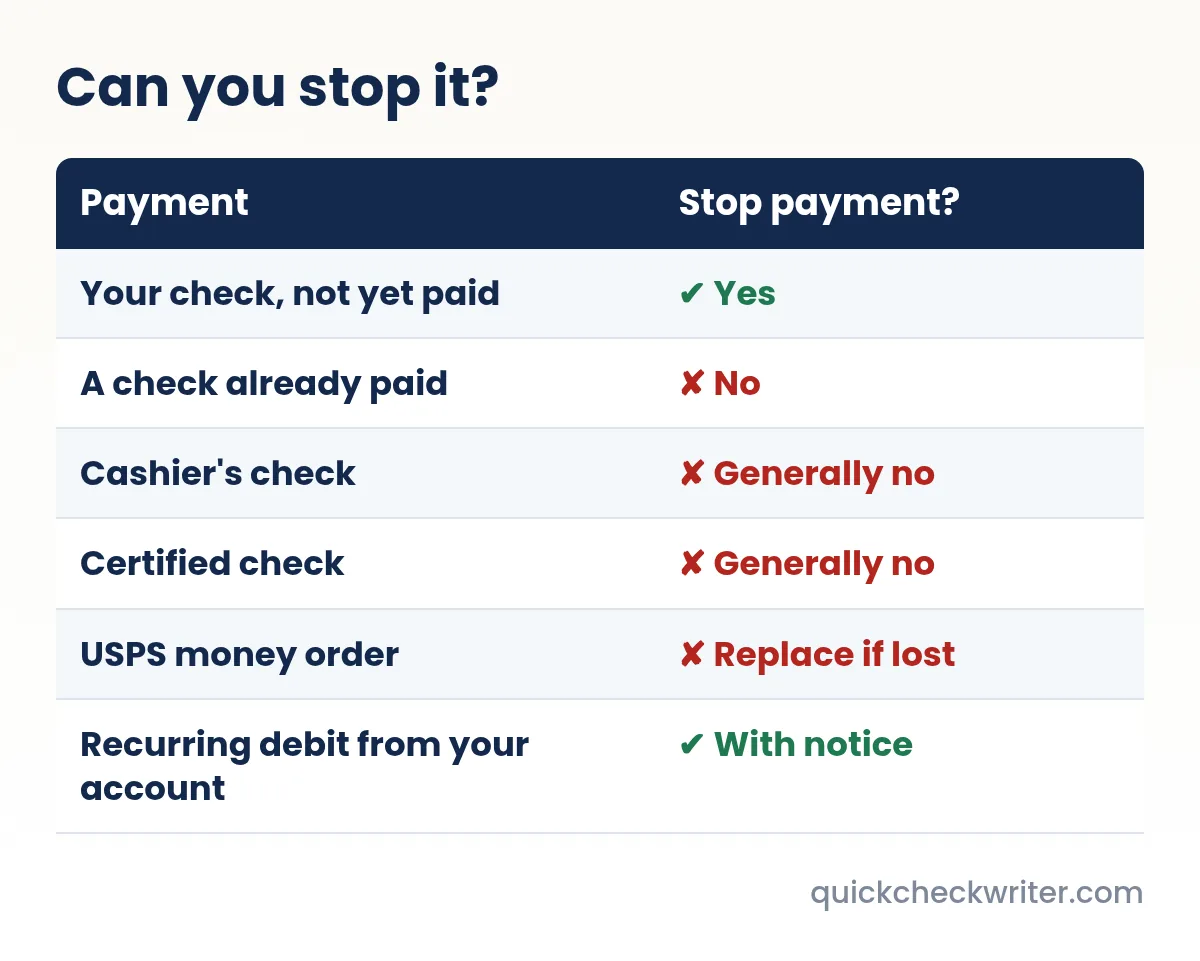
You generally cannot put a stop payment on a cashier's check. The regulator explains why: a cashier's check is drawn on the bank itself, not on your account, and the bank must honor it when it is presented. A certified check is similar, because the bank has already accepted it.
If an official check is lost, stolen or destroyed, there is a separate process. Under UCC § 3-312, the buyer or payee can give the bank a declaration of loss and claim the funds; the claim becomes enforceable 90 days after the date of the check, and the bank can still pay the check if it is presented before then. Many banks instead ask for an indemnity bond before issuing a replacement. See cashier's check vs certified check for details.
Electronic payments
A check you wrote that a business converted into an electronic debit, or a recurring automatic payment, falls under different rules. For recurring electronic transfers, federal Regulation E lets you stop a payment by telling your bank at least three business days before it is scheduled. Ask your bank which rules apply if you are unsure how the payment was processed.
What to do if the check already cleared
Once a check is paid, the bank's part is done. Your options now are with the payee:
- Wrong amount or duplicate payment: ask the payee for a refund of the excess.
- Dispute about goods or services: take it up directly, then through small claims court or your state consumer protection office if needed.
- You did not write or sign the check: this is fraud, not a stop payment situation. Report it to your bank right away. You must review your statements with reasonable promptness, and if you do not report a forged signature or alteration within one year of the statement, you lose the right to make the bank cover it. See lost or stolen checks.
Stop payments in a dispute
People often reach for a stop payment when a purchase goes wrong: a contractor who never finished, a car that broke down the day after a private sale, a product that never arrived. It can be the right move, but understand what it does and does not do.
- It pauses payment, it does not settle the argument. The payee may still claim the money and, depending on your contract and your state's law, may add fees or interest.
- It can be too late to matter. If the payee cashed the check at your own bank or it cleared overnight, the order arrives after the fact.
- It has limits with some buyers. If the payee already passed the check on to someone else who took it in good faith, that person may be able to enforce it against you despite the stop order. Talk to a lawyer if a large amount is involved.
Put your reasons in writing to the payee at the same time you place the stop order. A clear, dated message explaining the problem, and what you will do once it is fixed, keeps the dispute about the work or goods rather than about a bounced check.
John Sample mails a $1,250 check to a contractor, then learns the job was cancelled. He checks online: not cleared. He places a stop payment in his banking app, which shows the fee and an expiry date six months out, and emails the contractor that the check is stopped. Two weeks later the check is presented and returned unpaid as stopped. John marks check 1024 void in his register.
What to say: a sample stop payment request
Most banks have a form in the app or online banking. If you are writing a message, calling, or visiting a branch, have this ready so nothing is vague:
Please place a stop payment on check number 1024 drawn on my checking account ending 6789. The check is dated October 15, 2026, payable to Jane Doe, in the amount of $1,250.00. Reason: lost in the mail. Please confirm in writing when the order is in place and tell me the fee and the date it expires. – John Sample
If you do not know the exact amount or date, say so and give the range you are sure of. Checks are processed by machine, so the more exact your description, the better the bank's chance of catching the check in time.
Common mistakes
- A phone order never confirmed in writing. Under UCC § 4-403, an oral order lapses after 14 calendar days unless it is confirmed in a record. The UCC defines a record to include information stored electronically, so a request confirmed through online banking generally counts.
- A wrong amount or check number. Copy the details from your register or a photo of the check, not from memory.
- Letting the order expire. A written order lasts six months. If the payee could still have the check after that, renew it before it lapses.
- Reissuing before the stop is confirmed. If the original check clears first, you have paid twice and must ask for the money back.
- Using a stop payment to keep goods you received. You still owe for what you kept, and the payee can pursue the debt.
Money orders and other “guaranteed” payments
A money order works more like a cashier's check than like a personal check. The U.S. Postal Service states plainly that you cannot stop payment on a postal money order. If one is lost or stolen, you can ask for a replacement with your receipt. USPS says confirming a loss or theft may take up to 30 days, an investigation may take up to 60 days, and there is a $23 processing fee. Money orders from banks and stores follow their own terms, which are printed on the receipt.
This is a good reason to keep receipts for every money order, cashier's check and official check you buy. Without the serial number and receipt, a replacement is much harder.
Stop payment or close the account?
A stop payment covers one check, or a short range of checks if your bank allows it. If an entire checkbook is missing, or someone has your account number and is writing checks, closing the account and opening a new one is often safer and cheaper than paying for many stop orders. The UCC treats an order to close an account the same way as a stop payment for timing purposes.
| Situation | Stop payment | Close account |
|---|---|---|
| One check lost in the mail | Best fit | Overkill |
| Wrong amount on one check | Best fit | Overkill |
| A few blank checks missing | Possible, if the bank allows a range | Worth considering |
| Checkbook stolen or account number misused | Not enough | Best fit |
Replacing a stopped check
When you issue a replacement, keep the paper trail clean so nobody is paid twice:
- Confirm the stop is in place
Only then write the new check.
- Use a new check number
Never reuse the stopped number.
- Write “replaces check #1024” in the memo
It helps the payee and your own records.
- Void the original in your register
If the original later turns up, write VOID across it and shred it. Our guide to voiding a check shows how.
Quick Check Writer can reprint a check from the register. When replacing a stopped check, give the new one a fresh number, and mark the original void so your register and your bank agree.
How to avoid needing a stop payment
- Mail checks from inside a post office or a secure collection point rather than an unattended mailbox; see how to mail a check safely.
- Double-check the payee and amount before you sign.
- Keep blank checks and check stock locked away.
- Reconcile your account monthly so a stray or altered check is spotted fast.
Frequently asked questions
How long does a stop payment last?
Under the UCC, a stop payment order is effective for six months. An oral order lapses after 14 calendar days unless confirmed in writing or another record. You can renew a written order for another six months before it expires.
How much does it cost to stop payment on a check?
It depends on your bank. Fees at large banks are commonly around $30 to $35 per item, and some premium accounts waive them. Check your bank's fee schedule.
Can I stop payment on a check that has already cleared?
No. Once the bank has paid the check, a stop payment is too late. Ask the payee for a refund, or report it to your bank as fraud if you did not authorize the check.
Can I stop payment on a cashier's check?
Generally no, because a cashier's check is drawn on the bank, not your account. If it was lost, stolen or destroyed, ask the issuing bank about a declaration of loss claim or an indemnity bond.
Can I stop payment online?
Most banks let you place a stop payment in online banking or the app, which also gives you a written record. You can also call or visit a branch.
What happens if the payee deposits a stopped check?
The check is returned unpaid, marked as stopped, and the payee's bank reverses the deposit and may charge them a fee. That is why you should tell the payee and arrange any replacement payment.
Does stopping payment cancel what I owe?
No. If you owe the money, you still owe it. A stop payment is for lost, stolen or mistaken checks, or to hold payment during a genuine dispute.
Can I stop payment on a money order?
Not on a USPS money order. The Postal Service says it cannot stop payment, but it can replace a lost or stolen money order after an investigation, for a $23 processing fee. Other money order sellers set their own rules, so check the receipt.
Can the person I paid stop payment on my check?
No. Only the account holder, or someone authorized to sign on the account, can order the bank to stop payment. If you are the payee and the check is lost, ask the writer to stop it and send a replacement.
Related guides
- Lost or stolen checks: what to do
- How to Void a Check
- How to mail a check safely
- Cashier's check vs certified check
- What happens when a check bounces
- Check register app that fills itself in
Sources
- UCC § 4-403, Customer's right to stop payment (Cornell LII)
- UCC § 4-303, When items are subject to stop-payment orders (Cornell LII)
- OCC HelpWithMyBank: Can the bank pay a check after I place a stop payment?
- OCC HelpWithMyBank: Stop payment on a cashier's check
- OCC HelpWithMyBank: Indemnity bond for a lost cashier's check
- UCC § 3-312, Lost, destroyed, or stolen cashier's, teller's or certified check (Cornell LII)
- UCC § 3-411, Refusal to pay cashier's, teller's and certified checks (Cornell LII)
- Regulation E, 12 CFR 1005.10(c) Stopping preauthorized transfers (eCFR)
- UCC § 4-406, Customer's duty to report unauthorized signature or alteration (Cornell LII)
- Wells Fargo Consumer Account Fees and Information (fee schedule example)
- U.S. Bank Consumer Pricing Information (fee schedule example)
- UCC § 3-305, Defenses and claims in recoupment; holder in due course (Cornell LII)
- USPS: Money orders (lost, stolen and replacement)
- UCC § 1-201, General definitions ("record") (Cornell LII)
Last updated November 1, 2026. This page is general information, not legal or financial advice. Quick Check Writer is check printing software; it is not a bank and does not move money.