
Key takeaways
- Postdating a check is legal; the date is an instruction, not a lock.
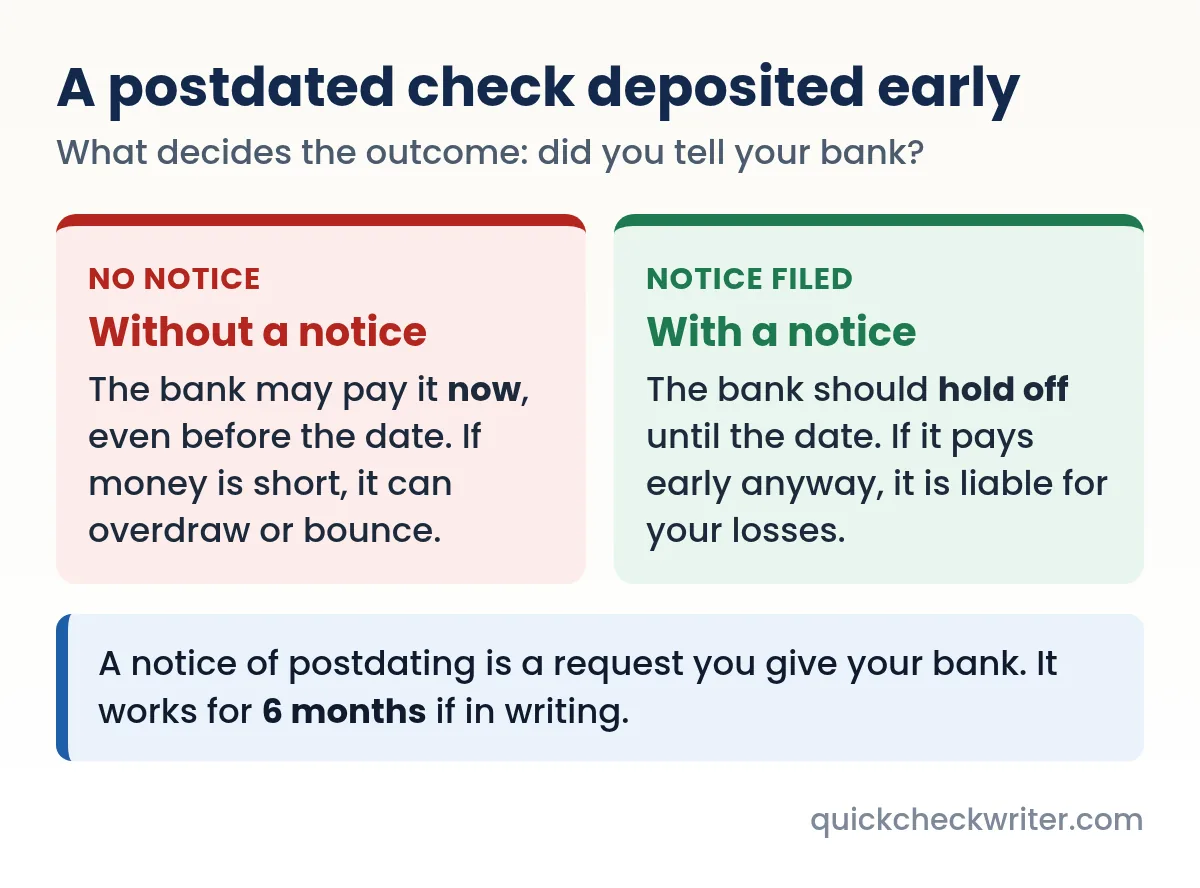
- A bank may pay a check before its date unless the writer has filed a postdating notice (UCC § 4-401(c)).
- A notice lasts six months and must describe the check precisely. Banks may charge a fee.
- If a post-dated check is cashed early without funds, it can bounce, with fees for both sides.
- For a payment on a set date, scheduled bill pay or writing the check on the day is often simpler.
On this page
- What a postdated check is
- Will the bank honor the date? Usually not on its own
- The postdating notice: how to make the date stick
- If your postdated check was cashed early
- Why people write postdated checks
- The risks for the writer
- The risks for the payee
- How to write a postdated check
- Checklist before you hand over a postdated check
- Common mistakes
- Wrote the wrong date by mistake?
- Postdated cheques in Canada
- Better alternatives to a postdated check
- Postdated checks and the six-month rule
- FAQ
What a postdated check is
A postdated check is an ordinary check with a future date written on the date line. You fill in the payee, the amount and your signature today, but the date says next week or next month. The idea is that the payee should hold the check until that day arrives.
The opposite exists too: a check dated earlier than the day it was written is called antedated or backdated. The Uniform Commercial Code allows both. Section 3-113 says an instrument "may be antedated or postdated," so writing a future date is perfectly legal.
What the law does not do is make the date a lock. A check is a demand instrument, meaning the payee can present it for payment on demand. The future date is an instruction and a promise between you and the payee, and the bank is not automatically bound by it.
Will the bank honor the date? Usually not on its own
This is the part that surprises people. Under UCC § 4-401(c), a bank may pay a check that is otherwise properly payable even if it is presented before the date on it. The federal bank regulator's consumer help site says the same thing in plain terms: banks are permitted to pay a check before its date unless you have given a formal postdating notice.
Why would the law work this way? Check processing is largely automated and keyed to the bank line printed at the bottom. Expecting every bank to read every handwritten date would slow the system and shift risk onto banks for something the writer could have controlled. So the law puts the burden on the writer: if the date matters to you, tell your bank.
Writing a future date only protects you if the payee keeps their word or you file a postdating notice with your bank. On its own, the date is a request, not a safeguard.
The postdating notice: how to make the date stick
The UCC gives you a tool: a notice of postdating. If your bank receives a notice that describes the check "with reasonable certainty," early enough to act on it, the bank should not pay the check before the date. If it pays early anyway, the bank is liable for your resulting losses, which can include fees and the damage from other checks that bounce because the money left too soon.
The notice works much like a stop payment order. It lasts for the same period, six months, and it must arrive in time for the bank to act before it processes the check.
- Ask how your bank takes the notice
Some banks handle it at a branch or by phone, some through online banking, and some route it through the same form as a stop payment. Ask whether there is a fee; many banks charge one.
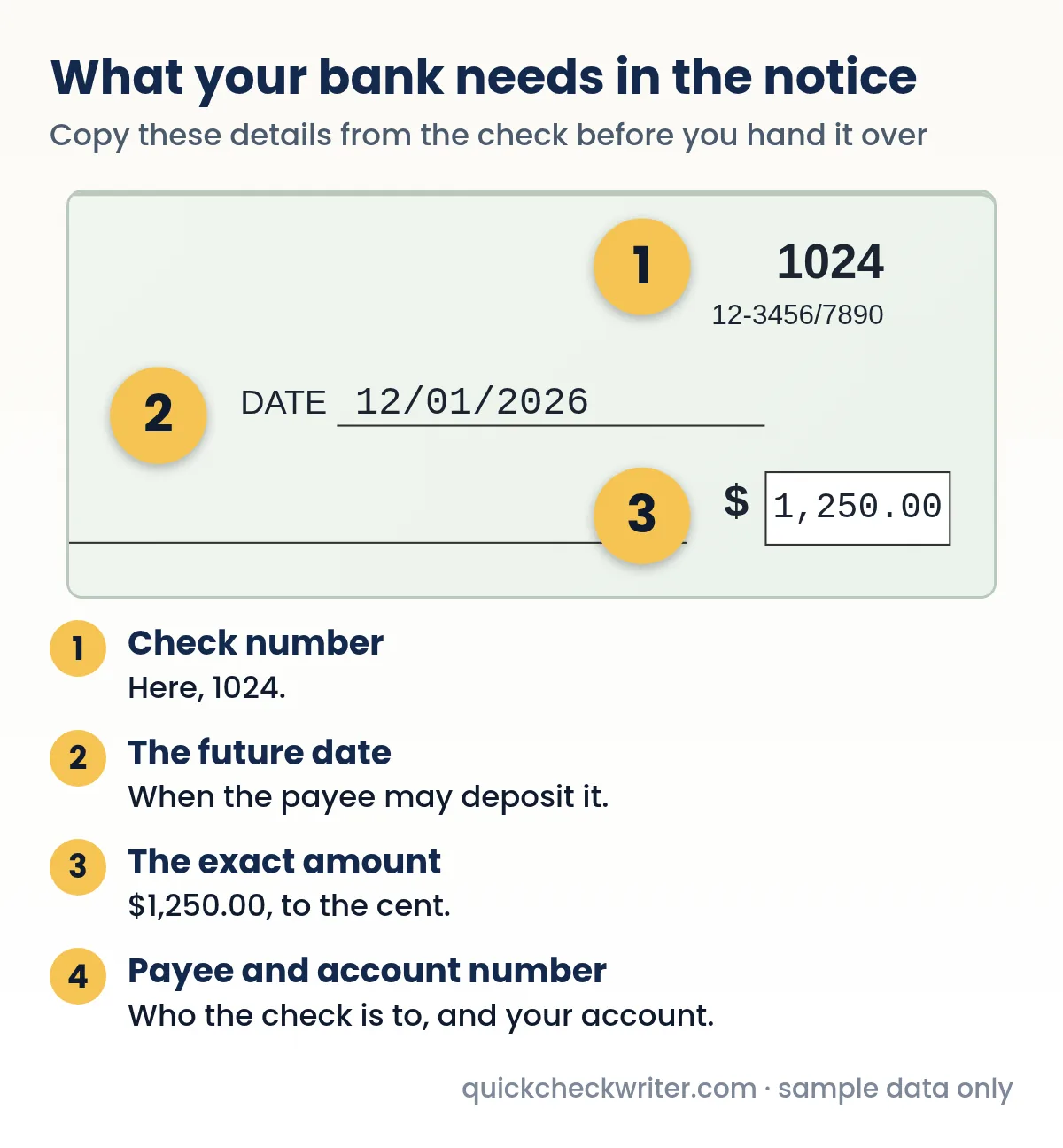
- Describe the check precisely
Give the check number, exact amount, payee, the date written on the check and your account number. A notice that is vague or wrong may not bind the bank.
- Give it early
File the notice right after you hand over the check. Once the check is presented and processed, it is too late.
- Get it in writing
Ask for written confirmation, and keep it with your records until the check clears.
Many people find that the fee and paperwork make this worthwhile only for large checks. For a small check, it is often simpler to wait and write the check on the day you want it cashed.
If your postdated check was cashed early
Finding out that a check you dated for next month has already cleared is stressful, especially if it set off overdraft fees. What you can do depends on whether you filed a notice.
- You filed a postdating notice. Contact the bank right away with your confirmation. The UCC makes a bank that pays early, despite a valid notice, liable for the loss it caused, which can include fees and the harm from other items that bounced as a result. Ask for those fees to be reversed in writing.
- You did not file a notice. The bank was allowed to pay. Your options are with the payee: if they agreed to wait and did not, ask them to cover any fees you were charged. Some banks will also waive a fee as a courtesy if you ask, especially if it is rare on your account.
- Your account is now short. Move money in as quickly as you can to stop further fees, and look at the other checks you have outstanding so nothing else bounces.
Going forward, a simple habit prevents most of this: treat a postdated check as paid on the day you write it. If the money is set aside from the start, an early deposit is an annoyance rather than a crisis.
Why people write postdated checks
The reasons are mostly practical:
- Rent and recurring bills. Some landlords collect several months of rent checks at once, each dated the first of a month.
- Waiting for a paycheck. Someone pays a bill today but asks the payee to wait until payday to deposit it.
- Installment arrangements. A seller accepts a series of dated checks for a payment plan.
- Payday loans. According to the Consumer Financial Protection Bureau, payday borrowers generally repay by writing a postdated check for the full balance, including fees, or by authorizing an electronic debit. If the loan is not repaid by the due date, the lender can cash the check.
- Deposits and holds. Some businesses take a dated check as a deposit they will only cash if something goes wrong.
In every case the arrangement depends on trust. The payee is agreeing to hold the check; the writer is counting on the payee to keep that promise or on the bank notice described above.
The risks for the writer
If a postdated check is deposited early and your account does not have enough money, the result is the same as any other short check. Your bank may pay it and overdraw your account, or return it unpaid. Either way you can face fees, and the payee may charge a returned-check fee of their own. Our guide to what happens when a check bounces covers the chain of consequences.
There is also bookkeeping risk. A postdated check you have handed over is real money already committed. If you forget it and spend the funds, the check can arrive at the worst possible moment. Record it in your register the day you write it, not the day it clears.
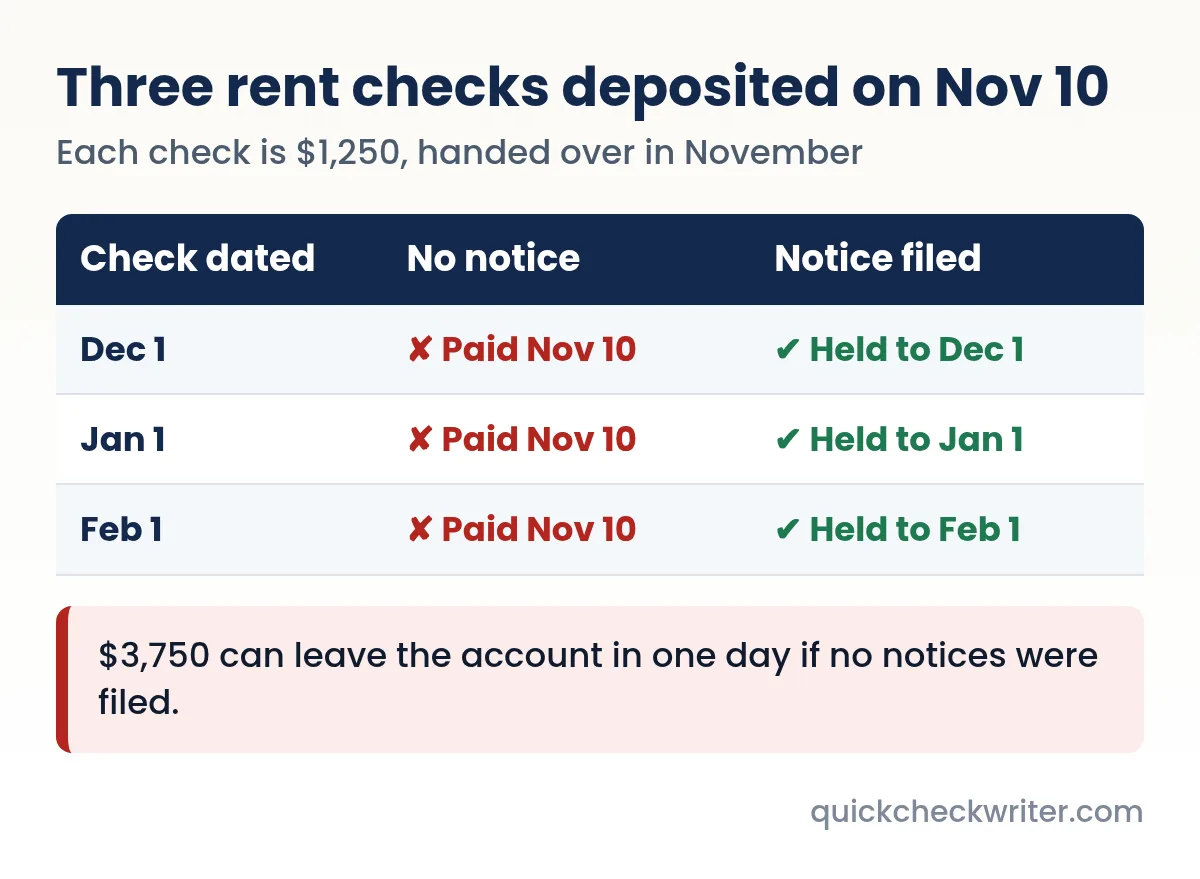
John Sample gives his landlord, Jane Doe, three rent checks in November: one dated December 1, one January 1 and one February 1, each for $1,250. Jane's bookkeeper deposits all three at once on November 10. Without a postdating notice, John's bank may pay all $3,750 that day. If John had filed notices for the January and February checks, his bank would have had to hold those two until their dates.
Need to write a check right now?
Quick Check Writer fills in the amount in words, adds the bank line and prints on blank check stock or saves a PDF. Your first check is free, with no account and no card.
Write your first check free →The risks for the payee
If you accept a postdated check, you are usually agreeing, at least informally, to wait. Depositing early can damage the relationship and may break the deal you made. It also risks a bounce if the writer is counting on money that has not arrived yet, and a bounced deposit can mean a fee for you and a reversed credit.
Holding the check carries its own risk: the writer may close the account, stop payment, or simply not have the funds on the date. A postdated check is a promise of future payment, not a guarantee. State bad-check laws can treat postdated checks differently, too. Florida's Attorney General, for example, advises merchants not to accept them, noting that a dishonored postdated check cannot be prosecuted under the state's worthless check law and has to be pursued in small claims court instead. If you need certainty, ask for a cashier's check on the payment date instead.
Also check your bank's rules before using mobile deposit. Remote deposit agreements commonly set conditions on which checks you may submit, and some restrict postdated or stale items.
How to write a postdated check
Writing one is no different from writing any check, except for the date line:
- Write the future date clearly
Use the full date the payee may deposit it, such as December 1, 2026 or 12/01/2026. Avoid ambiguous formats.
- Fill in the rest as usual
Payee, amount in numbers and words, memo and signature. A memo such as "Do not deposit before 12/1" is a helpful reminder for the payee but, like the date, does not bind the bank.
- Record it now
Enter the check in your register with its date, and subtract it from the balance you plan around.
- Decide whether to file a notice
For large checks, or if you are not sure the payee will wait, file a postdating notice with your bank.
In Quick Check Writer, the date field accepts any date, so you can print a check dated for the first of next month. Every printed check goes into the register with its number, payee and amount, which is exactly the information your bank needs if you file a postdating notice.
Checklist before you hand over a postdated check
- Agree on the date out loud
Tell the payee the exact day they may deposit it, and ask them to confirm. A text message is a simple record.
- Write down the check details
Note the check number, the exact amount, the payee and the date before the check leaves your hands. Your bank needs all of them for a notice.
- File a postdating notice for anything that matters
Use your bank's form, online banking message or a branch visit, and keep the confirmation. Ask what it costs first; banks set their own fees for it.
- Keep the money in the account on the date
Put a reminder on your calendar two days before. Notices do not protect you from the check bouncing when it is deposited on time.
- Record it in your register
Enter the check with its future date so your available balance is not overstated. A check register that lists outstanding checks makes this easy.
Common mistakes
- Trusting the date alone. Without a notice, nothing in the law stops your bank from paying early.
- Giving vague details in the notice. The UCC asks you to describe the check “with reasonable certainty.” A wrong check number or an amount that is a few cents off can let the check slip through automated systems.
- Letting the notice expire. A written notice runs for six months, the same as a stop payment order. A check dated more than six months out needs the notice renewed.
- Writing a series and forgetting one. If you give a landlord six checks, file a notice for each one, not just the first.
- Using a postdated check as a loan. If the money will only be there “maybe” by the date, the check is a promise you may not be able to keep. A short payment plan in writing is safer for both sides.
Wrote the wrong date by mistake?
It happens most in January, when people still write last year. An earlier date is not a problem in itself: the UCC allows checks to be antedated, and the bank can pay the check as soon as it is presented. The only catch is the six-month clock, which runs from the date written, so a check accidentally dated a full year back could look stale. If you notice the slip, ask the payee to return the check and write a new one, or initial a clean correction if the payee and their bank will accept it.
If you wrote a future date by mistake, the check is simply postdated. Tell the payee they can deposit it now, or replace it.
Postdated cheques in Canada
Canada handles this differently from the U.S. Payments Canada, which runs the cheque clearing system, says post-dated cheques should not be deposited before their date, while acknowledging that automated processing means some slip through. If a post-dated cheque is cashed early, you can ask your financial institution to return it, up to and including the day before the date on the cheque. You then need to make other arrangements to pay the recipient.
Better alternatives to a postdated check
If what you really want is "pay this on a specific day," there are often cleaner ways to do it:
| Option | Date is enforced? | Good for |
|---|---|---|
| Postdated check alone | No | Trusted payees, small amounts |
| Postdated check plus bank notice | Yes, for 6 months | Larger checks, rent series |
| Write the check on the day | Yes | Any payee you can meet or mail to on time |
| Bank bill pay scheduled for a date | Yes, in the bank's system | Recurring bills |
| Scheduled ACH or transfer | Yes | Payees who accept electronic payment |
For more on electronic options, see ACH vs check.
Postdated checks and the six-month rule
Postdating interacts with the stale-check rule in one way worth knowing. A bank is not required to pay a check presented more than six months after its date. With a postdated check, the six months are counted from the date written on the check, not from when you handed it over. See how long a check is good for for the full rules.
Frequently asked questions
Can a bank cash a post-dated check early?
Yes. Banks are allowed to pay a check before the date written on it unless the account holder has given the bank a postdating notice that describes the check. With a notice on file, paying early makes the bank liable for your losses.
Is it illegal to write a post-dated check?
No. The Uniform Commercial Code expressly allows checks to be postdated or antedated. Problems arise only if the check later bounces, which is a separate issue.
Is it illegal to deposit a post-dated check early?
Generally no, but if you agreed to wait, depositing early can break that agreement, and the check may bounce if the writer is counting on future funds. Ask the writer before depositing.
How long does a postdating notice last?
Under the UCC it lasts for the same period as a stop payment order, six months. Ask your bank how to renew it if you need longer.
Does it cost money to postdate a check?
Writing the date costs nothing. Filing a postdating notice with your bank may carry a fee, often handled like a stop payment fee. Check your bank's fee schedule.
Can I use mobile deposit for a post-dated check?
Read your bank's mobile deposit terms first. Many set conditions on which checks you may submit, and depositing before the date may also break your arrangement with the writer.
When does a post-dated check become stale?
The six-month stale period runs from the date written on the check, not from the day it was handed over.
Can I cancel a post-dated check?
Yes. Until the bank pays it, you can place a stop payment order describing the check, just as with any check you wrote. Written orders last six months; oral orders lapse after 14 days unless confirmed in writing.
What if I put the wrong date on a check?
An earlier date is allowed and the check can be paid when presented, as long as it is not more than six months old. A future date makes it postdated. If the mistake matters, ask for the check back and write a new one.
Related guides
- How to stop payment on a check
- What happens when a check bounces
- How long is a check good for?
- How to write a check, step by step
- How to pay rent by check
- Overdraft protection and checks
Sources
- UCC § 3-113, Date of instrument (Cornell LII)
- UCC § 4-401, When bank may charge customer's account (Cornell LII)
- UCC § 4-403, Customer's right to stop payment (Cornell LII)
- UCC § 4-404, Bank not obliged to pay check more than six months old (Cornell LII)
- OCC HelpWithMyBank: Can the bank cash a post-dated check early?
- CFPB: What is a payday loan?
- Florida Attorney General: Worthless bank checks
- Payments Canada: Paying by cheque (post-dated cheques)
Last updated November 1, 2026. This page is general information, not legal or financial advice. Quick Check Writer is check printing software; it is not a bank and does not move money.