
Key takeaways
- Cashier's check: drawn by the bank on itself. Certified check: your check, accepted by your bank.
- Both get next-business-day availability when deposited in person to the payee's account (Regulation CC).
- You generally can't stop payment on either; lost ones need a declaration of loss or indemnity bond.
- Cashier's checks are easier to get; not every bank still offers certified checks.
- Counterfeit cashier's checks are common in scams: verify with the bank using a number you look up yourself.
On this page
- The one-sentence difference
- Side-by-side comparison
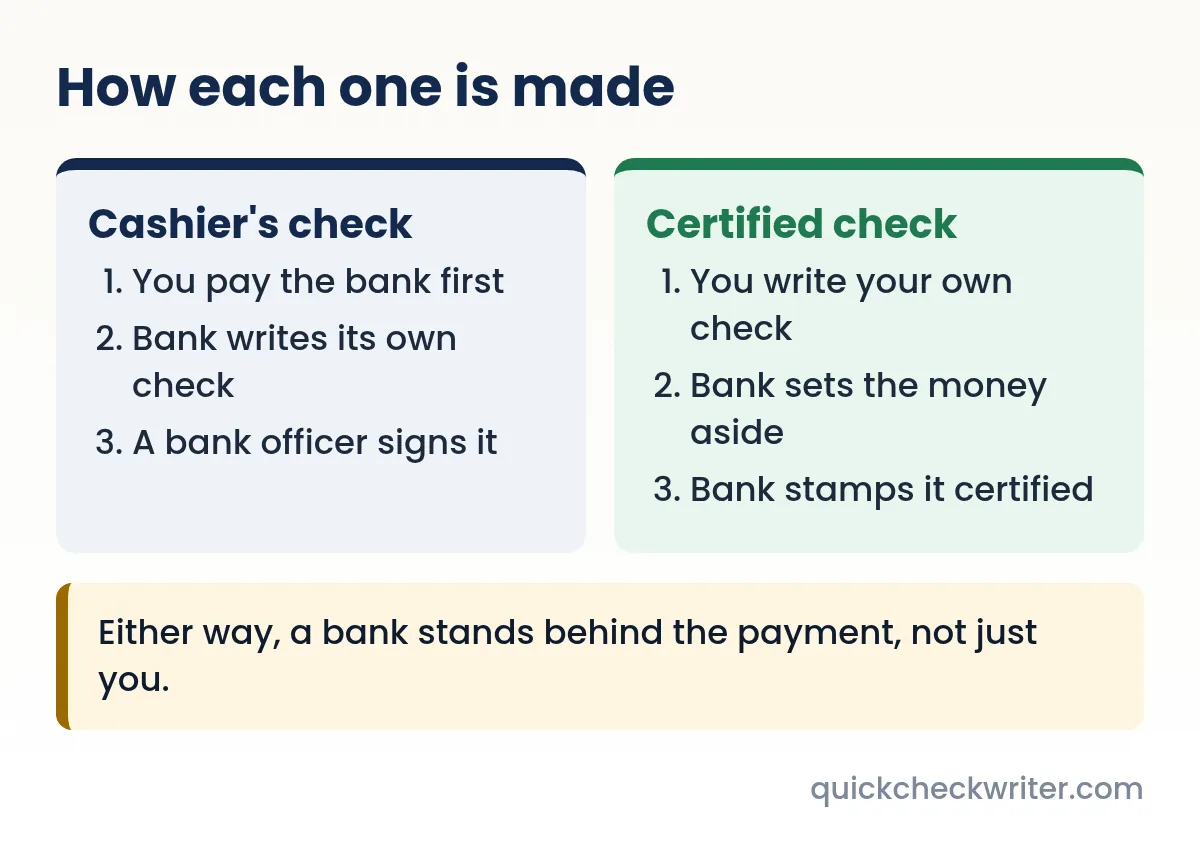
- How a cashier's check works
- How a certified check works
- Which one should you use?
- Depositing one: when can you use the money?
- Fake cashier's checks: how to protect yourself
- If one is lost or stolen
- Do cashier's and certified checks expire?
- How to get a cashier's check, step by step
- Cashier's check, certified check or money order?
- Common mistakes
- Alternatives to consider
- FAQ
The one-sentence difference
A cashier's check is a check the bank writes on its own funds; a certified check is your own personal check that the bank has accepted and guaranteed. In both cases a bank, not just you, stands behind the payment, which is why landlords, car sellers and closing agents ask for them.
The Uniform Commercial Code puts it precisely. A cashier's check is a draft where the drawer and the drawee are the same bank. A certified check is a check accepted by the bank it is drawn on. Federal Regulation CC adds the practical detail: a cashier's check is signed by an officer or employee of the bank as drawer and is the bank's direct obligation, while for a certified check the bank certifies that the signature is genuine and that it has set aside the funds, or that it will pay on presentment.
Side-by-side comparison
| Cashier's check | Certified check | |
|---|---|---|
| Whose check is it? | The bank's | Yours, accepted by your bank |
| Who signs it? | A bank officer or employee | You, plus the bank's certification |
| Where the money comes from | Paid to the bank up front, from your account or cash | Set aside in your account |
| Need an account at that bank? | Usually, though policies vary | Yes, it is drawn on your account |
| Next-business-day availability for the payee | Yes, if deposited in person to the payee's account | Yes, same conditions |
| Can the buyer stop payment? | Generally no | Generally no |
| If lost or stolen | Declaration of loss (90 days) or indemnity bond | Declaration of loss (90 days) or bank's process |
| Six-month stale rule | No federal expiry; check any printed notice | Expressly excluded from the rule |
| Typical availability | Offered by most banks and credit unions | Not every bank offers them; ask |
How a cashier's check works
You go to your bank, branch or sometimes its online banking, and ask for a cashier's check for a specific amount made out to a specific payee. The bank takes the money from your account (or in cash) right away and issues a check drawn on the bank itself, signed by a bank employee. Your name usually appears on it as the purchaser, sometimes called the remitter.
Because the money has already left your account and the bank is the drawer, the payee is relying on the bank's promise rather than yours. The UCC backs that promise with teeth: if a bank wrongfully refuses to pay its own cashier's check, the person enforcing it can recover expenses and lost interest, and in some cases consequential damages.
Fees vary by bank and account type. For example, the current consumer fee schedules of two large banks we checked list a cashier's check at $10, with waivers on some premium accounts.
What about teller's checks and “official checks”?
A teller's check is drawn by a bank on another bank, or payable through a bank. Some institutions issue teller's checks rather than cashier's checks, drawing them on their own account at another bank. For the person receiving it, a teller's check behaves very much like a cashier's check, and Regulation CC treats it the same way for funds availability. "Official check" and "bank check" are informal names banks use for cashier's or teller's checks. See what is a bank draft for more on these terms.
How a certified check works
You write a normal check from your checkbook, or print one, and take it to your bank. The bank confirms your signature and balance, sets aside the amount so it cannot be spent elsewhere, and marks the check as certified, usually with a stamp and an officer's signature. Once certified, the bank has accepted the check and is obligated to pay it.
The bank does not have to certify a check, and refusing is not the same as dishonoring it. Call ahead to see whether your bank still offers certified checks and what it charges.
A check printed on blank stock with a correct MICR line is still your check, and you can ask your bank whether it will certify it like any other personal check. Quick Check Writer prints the bank line in E-13B with the routing, account and check numbers in standard positions; see is it legal to print your own checks.
Which one should you use?
For most people, the question answers itself: use whichever the payee asks for. If they simply say "certified funds," a cashier's check is almost always accepted and easier to get.
- Buying a car from a private seller
- A cashier's check is the usual choice. Meet at the buyer's bank if possible, so the seller can watch it being issued.
- Security deposit or first month's rent
- Landlords often require a cashier's check or money order. Ask before you go to the bank.
- Real estate closing
- Follow the closing agent's written instructions. If a cashier's check is allowed, confirm the exact payee name and amount with the closing agent, by phone at a number you already know.
- Court payments, government fees
- Follow the agency's instructions exactly; some accept only one type.
John Sample is buying a used car from Jane Doe for $8,400. Jane asks for certified funds. John's bank does not certify personal checks, so he buys an $8,400 cashier's check payable to Jane Doe, which costs him a small fee and moves the money out of his account immediately. They meet at John's branch, where Jane watches the teller hand it over. Jane deposits it in person at her own bank the same afternoon, and the funds are available the next business day.
Need to write a check right now?
Quick Check Writer fills in the amount in words, adds the bank line and prints on blank check stock or saves a PDF. Your first check is free, with no account and no card.
Write your first check free →Depositing one: when can you use the money?
Regulation CC requires banks to make funds from a cashier's, certified or teller's check available by the next business day after the banking day of deposit, if the check is deposited into an account held by a payee of the check, in person to a bank employee, and with a special deposit slip if the bank requires one. If you deposit it some other way, such as at an ATM or by mail, the deadline is the second business day.
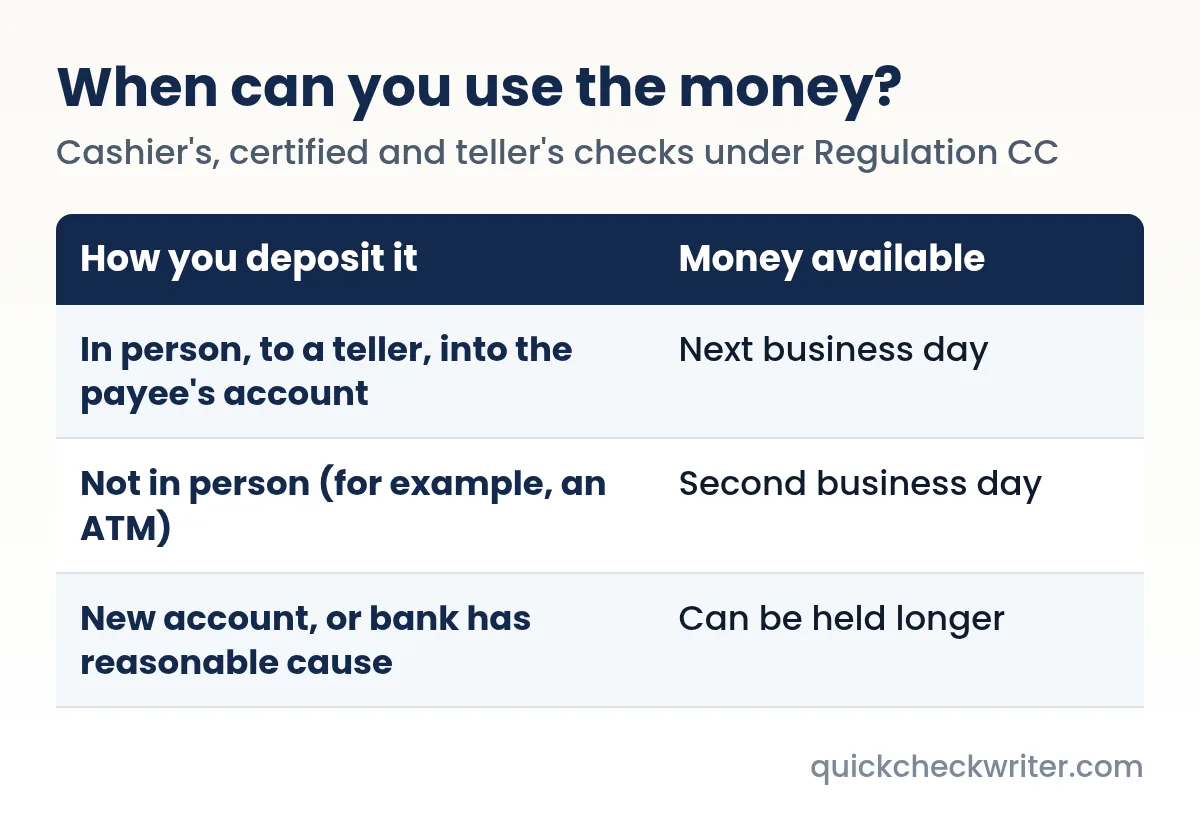
There are exceptions. During the first 30 days of a new account, only the first $6,725 deposited on any one day gets next-day treatment, and the rest can be held longer. Very large deposits and checks the bank has reasonable cause to doubt can also be held. Our guide to check clearing times covers the details.
Next-day availability is a deadline for letting you use the money, not proof that the check is genuine. Counterfeit cashier's checks are common in scams, and if one is returned, your bank can reverse the deposit even after you have spent the funds.
Fake cashier's checks: how to protect yourself
Because people trust official checks, scammers counterfeit them. The FDIC warns that fake checks can look so real that consumers and even bank employees have trouble spotting them. Typical schemes include an online buyer who "accidentally" overpays and asks for the difference back, and work-from-home or mystery shopper jobs that start with an official check.
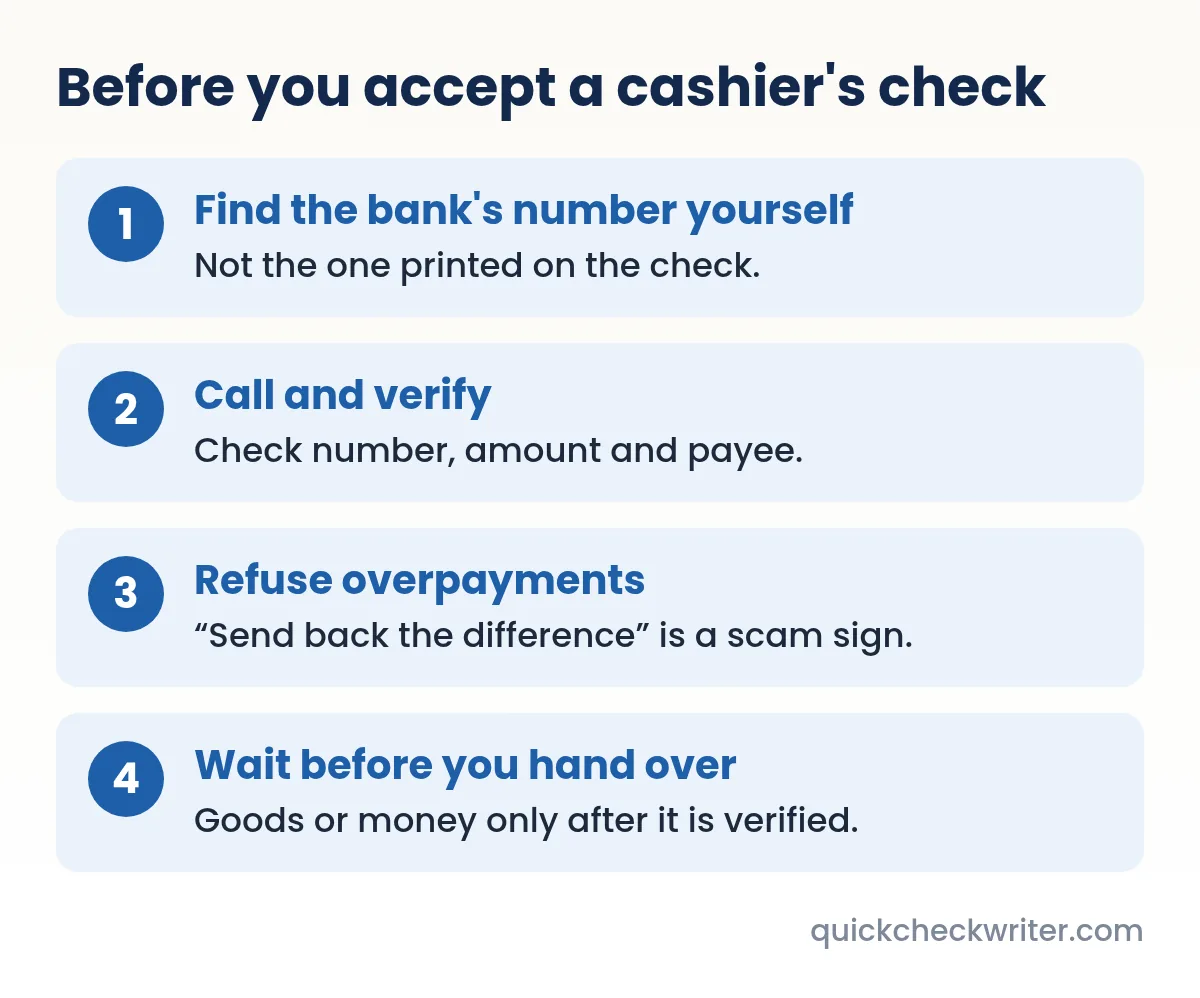
The single most effective step is the FDIC's: find the issuing bank's phone number on its official website, not on the check, call, and ask it to verify the check number, date and amount. Our guide on how to verify a check walks through it. If you think you have received a fake check by mail, the FDIC suggests reporting it to the U.S. Postal Inspection Service and your state attorney general.
If one is lost or stolen
You generally cannot stop payment on a cashier's check, because it is drawn on the bank, not your account, and the bank must honor it when presented. Certified checks work similarly, since the bank has already accepted them.
What you can do is make a claim. Under UCC § 3-312, the purchaser or payee of a lost, stolen or destroyed cashier's, teller's or certified check can send the bank a declaration of loss, under penalty of perjury, and request payment. The claim only becomes enforceable 90 days after the date of the check (or the date it was certified), and until then the bank can still pay the original if someone presents it. Many banks instead require an indemnity bond, a form of insurance that protects the bank if the original turns up, before issuing a replacement. Read more in lost or stolen checks.
Do cashier's and certified checks expire?
The UCC's six-month rule, which lets a bank refuse an old personal check, expressly does not apply to certified checks. Cashier's checks are the bank's own obligation, and federal law sets no expiry date for them, though some banks print a validity period on their official checks. Money from official checks that are never cashed is eventually turned over to the state as unclaimed property after a dormancy period set by state law. See how long a check is good for.
How to get a cashier's check, step by step
- Get the exact payee name
Ask the person or company how the name should read, letter for letter. A cashier's check made out wrong is hard to fix, because you cannot simply void it like your own check.
- Confirm the amount
Ask for the final figure in writing, especially for a closing, a car or a deposit where fees may be added.
- Bring ID and the money
Your bank takes the funds from your account or in cash on the spot. Have a government photo ID ready.
- Check it before you leave
Read the payee name, amount and your name as purchaser (called the remitter) while you are still at the counter.
- Keep the receipt
The receipt or carbon copy has the check number. You will need it if the check is ever lost or stolen.
Cashier's check, certified check or money order?
| Cashier's check | Certified check | USPS money order | |
|---|---|---|---|
| Who pays it | The bank | Your bank | The Postal Service |
| Amount limit | Set by the bank | Your balance | $1,000 per money order |
| Typical cost | Bank fee | Bank fee | $2.65–$3.75 |
| Stop payment? | No | No | No |
| Expires? | No federal limit | No 6-month cutoff | Never |
USPS charges $2.65 for money orders up to $500 and $3.75 up to $1,000. None of the three can be stopped like a personal check; lost ones go through a claim or replacement process instead. For amounts over $1,000, a cashier's check is usually simpler than several money orders.
Common mistakes
- Misspelling the payee. The payee may be unable to deposit it, and you will have to go back to the bank to fix it. Ask how they want it written.
- Buying it too early. If the deal falls through, getting your money back can involve a claim and a wait. Buy it close to the day you pay.
- Losing the receipt. Without the check number, a lost-check claim is slower.
- Accepting one from a stranger without calling the bank. Funds can be available before a fake check is discovered, and you are responsible if it bounces.
- Using a check when a wire was asked for. For a real estate closing, follow the closing agent's written instructions, and confirm any wiring instructions by phone with a number you already know.
Alternatives to consider
- Money order: cheaper for small amounts, often capped per order.
- Wire transfer: fast and final for large amounts, but hard to reverse if you are tricked. See wire transfer vs check.
- Personal check: fine when the payee knows and trusts you, and free if you print your own. See types of checks.
Frequently asked questions
Is a cashier's check safer than a certified check?
For the payee they are similar: a bank stands behind both. Cashier's checks are more widely available and more commonly requested. Either can be counterfeited, so verify with the issuing bank.
Can I get a cashier's check without a bank account?
Some banks sell cashier's checks only to customers; others will issue them to non-customers who pay in cash. Policies vary, so call ahead. A money order is an alternative for smaller amounts.
How long does it take for a cashier's check to clear?
Funds must be available by the next business day if you deposit it in person to your own account as a payee, or the second business day if deposited another way. New accounts and large deposits have exceptions.
Can a cashier's check bounce?
A genuine one should not, but a counterfeit one will be returned, sometimes days after the funds appear in your account, and the deposit will be reversed. Verify any cashier's check from a stranger.
Can I cancel a cashier's check?
Generally you cannot stop payment on it. If it is lost, stolen or destroyed, the issuing bank can handle a claim through a declaration of loss or an indemnity bond. If you still hold an unused check, ask the bank about returning it.
How much does a cashier's check cost?
It depends on the bank and account. At two large banks we checked, a cashier's check costs $10, waived on some premium accounts.
Do certified checks expire?
Certified checks are excluded from the UCC's six-month rule for stale checks. Contact the bank if you hold an old one.
Is a money order the same as a cashier's check?
Not quite. Both are paid up front, but a money order is issued by the Postal Service or a company and usually capped (USPS: $1,000 per order), while a cashier's check is drawn on a bank and can be for larger amounts. Neither can simply be stopped like a personal check.
What is the remitter on a cashier's check?
The remitter is the person who bought the check from the bank when it is made out to someone else. The remitter's name is usually printed on the check so the payee knows who it is from.
Related guides
- What is a bank draft? (vs a check)
- Types of checks: personal, business, cashier's, certified and more
- How to verify a check before you deposit it
- How Long Does a Check Take to Clear?
- Lost or stolen checks: what to do
- Wire transfer vs check
Sources
- UCC § 3-104, Negotiable instrument; check, cashier's check and teller's check defined (Cornell LII)
- UCC § 3-409, Acceptance of draft; certified check (Cornell LII)
- UCC § 3-411, Refusal to pay cashier's, teller's and certified checks (Cornell LII)
- UCC § 3-312, Lost, destroyed, or stolen cashier's, teller's or certified check (Cornell LII)
- UCC § 4-404, Bank not obliged to pay check more than six months old (Cornell LII)
- Regulation CC, 12 CFR 229.2 Definitions (eCFR)
- Regulation CC, 12 CFR 229.10 Next-day availability (eCFR)
- Regulation CC, 12 CFR 229.13 Exceptions (new accounts, repeated overdrafts) (eCFR)
- OCC HelpWithMyBank: Stop payment on a cashier's check
- OCC HelpWithMyBank: Indemnity bond for a lost cashier's check
- FDIC Consumer News: Beware of fake checks
- FDIC BankFind Suite
- NAUPA: What is unclaimed property?
- Wells Fargo Consumer Account Fees and Information (fee schedule example)
- U.S. Bank Consumer Pricing Information (fee schedule example)
- USPS: Money orders (limits, fees, replacement)
- UCC § 3-103, Definitions ("remitter") (Cornell LII)
Last updated November 1, 2026. This page is general information, not legal or financial advice. Quick Check Writer is check printing software; it is not a bank and does not move money.