
Key takeaways
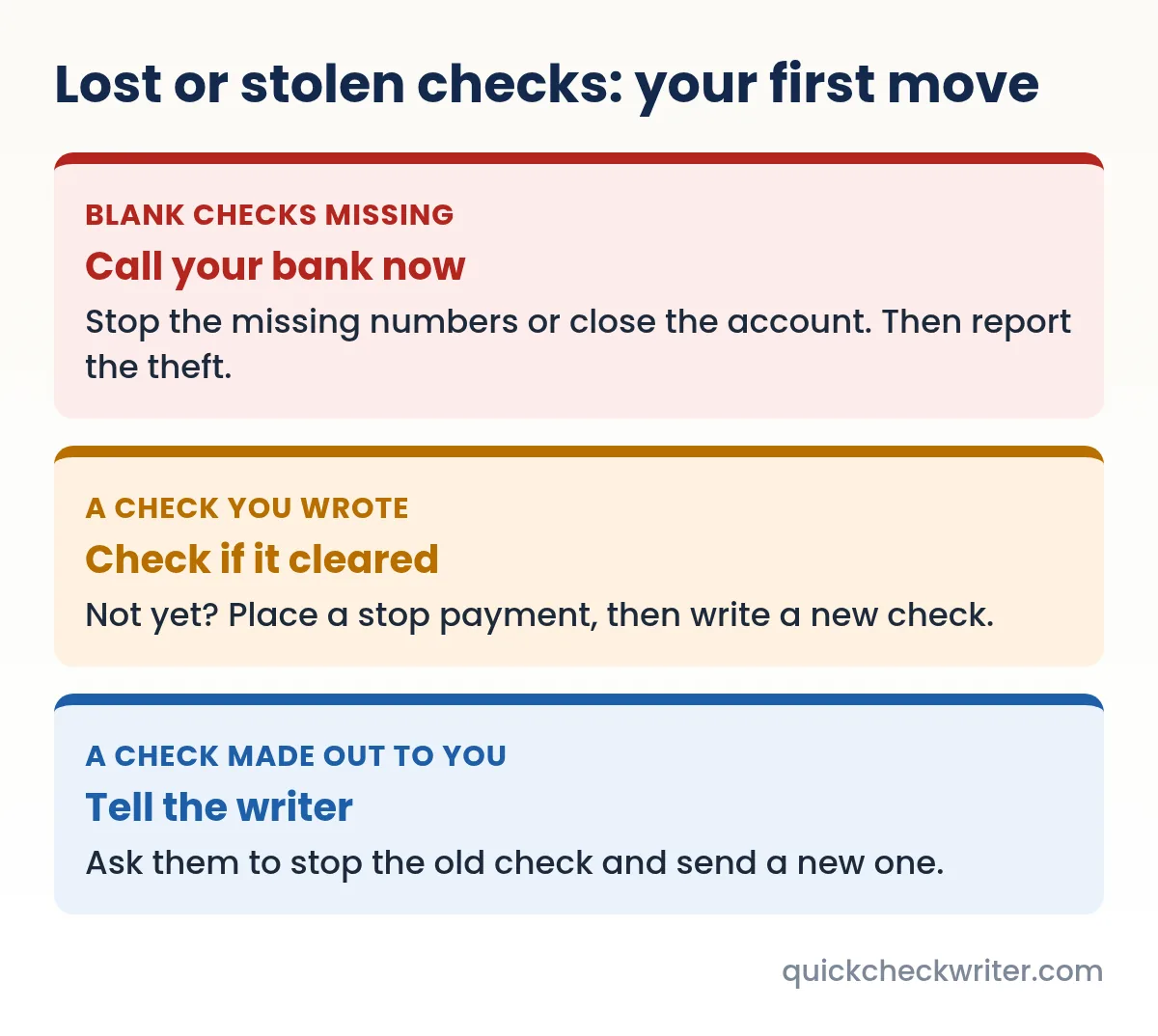
- Missing blank checks are the most urgent: call your bank and consider closing the account.
- A check you wrote that hasn't cleared can be stopped with a stop payment order.
- You generally aren't liable for forged or altered checks, but you must review statements promptly.
- Unreported forged signatures or alterations can't be claimed after one year (UCC § 4-406).
- Report mail theft to the U.S. Postal Inspection Service at 1-877-876-2455.
On this page
- First, figure out which situation you are in
- If blank checks or your checkbook are missing
- If a check you wrote is lost or stolen
- Who pays if a stolen check is cashed?
- If a check made out to you is lost
- What your bank may ask you for
- Lost and stolen checks at a business
- Mail theft and checks
- Why check theft is a bigger risk than it used to be
- Your account number can be misused electronically too
- The first 24 hours: a checklist
- Common mistakes
- Preventing lost and stolen checks
- FAQ
First, figure out which situation you are in
"Lost or stolen checks" covers three different problems, and the first move is different for each:
- Blank checks are missing
- A checkbook, a box of new checks, or a few loose checks from your stock. Nobody has written on them yet, but they carry your account and routing numbers.
- A check you wrote has gone missing
- You mailed or handed over a check and it never arrived, or the payee lost it, or it was taken from a mailbox.
- A check written to you has gone missing
- You received a check and misplaced it before depositing it, or it never reached you.
If blank checks or your checkbook are missing
This is the most urgent case, because anyone holding your checks can try to write them, and they already show your bank's routing number and your account number.
- Call your bank right away
Tell them which check numbers are missing. Ask whether they recommend stopping those numbers or closing the account and opening a new one with a new account number.
- Stop or close
If only a handful of numbered checks are missing, a stop payment on that range may be enough, if your bank offers it. If a whole book or box is gone, or you suspect theft, closing the account is usually the safer choice. The UCC treats an order to close an account like a stop order for timing purposes.
- Move your payments
If you close the account, update direct deposits and automatic payments, and make sure checks you already wrote legitimately will still be paid or are reissued.
- Report the theft
File a police report if the checks were stolen. If they were taken from the mail, report it to the U.S. Postal Inspection Service, online or at 1-877-876-2455. If you think your identity is being misused more broadly, IdentityTheft.gov, run by the Federal Trade Commission, lets you report it and get a recovery plan.
- Watch your account closely
Check activity every day for a few weeks. Report anything you did not write immediately.
If you print your own checks, an unprinted sheet of blank check stock carries no account information until you print on it. That makes a lost pack of blank stock far less dangerous than a lost book of preprinted checks. Keep it locked up anyway, and see our blank check stock guide.
If a check you wrote is lost or stolen
- Check whether it has cleared
Look it up in online banking. If it cleared, look at the image: is the payee and amount what you wrote, and is the endorsement the payee's?
- If it has not cleared, stop it
Place a stop payment order with the check number, exact amount, payee and date. Written orders last six months.
- Tell the payee
Let them know the original is stopped, and agree on how to pay them.
- Reissue with a new number
Write "replaces check #1024" in the memo and void the original in your register.
- If it cleared and something looks wrong
A changed payee name, a raised amount, or a signature that is not the payee's endorsement points to theft or check washing. Report it to your bank at once as fraud.
John Sample mails a $250 check to Jane Doe. Ten days later she says it never arrived. John's online banking shows check 1024 has not been paid, so he places a stop payment and prints a replacement, check 1031, with "replaces #1024" in the memo. Had the image shown the check cashed by someone else for $2,500, he would instead have reported it to his bank as an altered check.
Need to write a check right now?
Quick Check Writer fills in the amount in words, adds the bank line and prints on blank check stock or saves a PDF. Your first check is free, with no account and no card.
Write your first check free →Who pays if a stolen check is cashed?
Generally, a bank may charge your account only for checks that are "properly payable," meaning you authorized them. A check with a forged signature, or one whose amount or payee was altered, is not one you authorized. The UCC also says you are not liable for an overdraft created by a check that you neither signed nor benefited from.
That protection comes with a duty. When your bank sends or makes available your statement, you must review it with reasonable promptness and report unauthorized signatures or alterations.
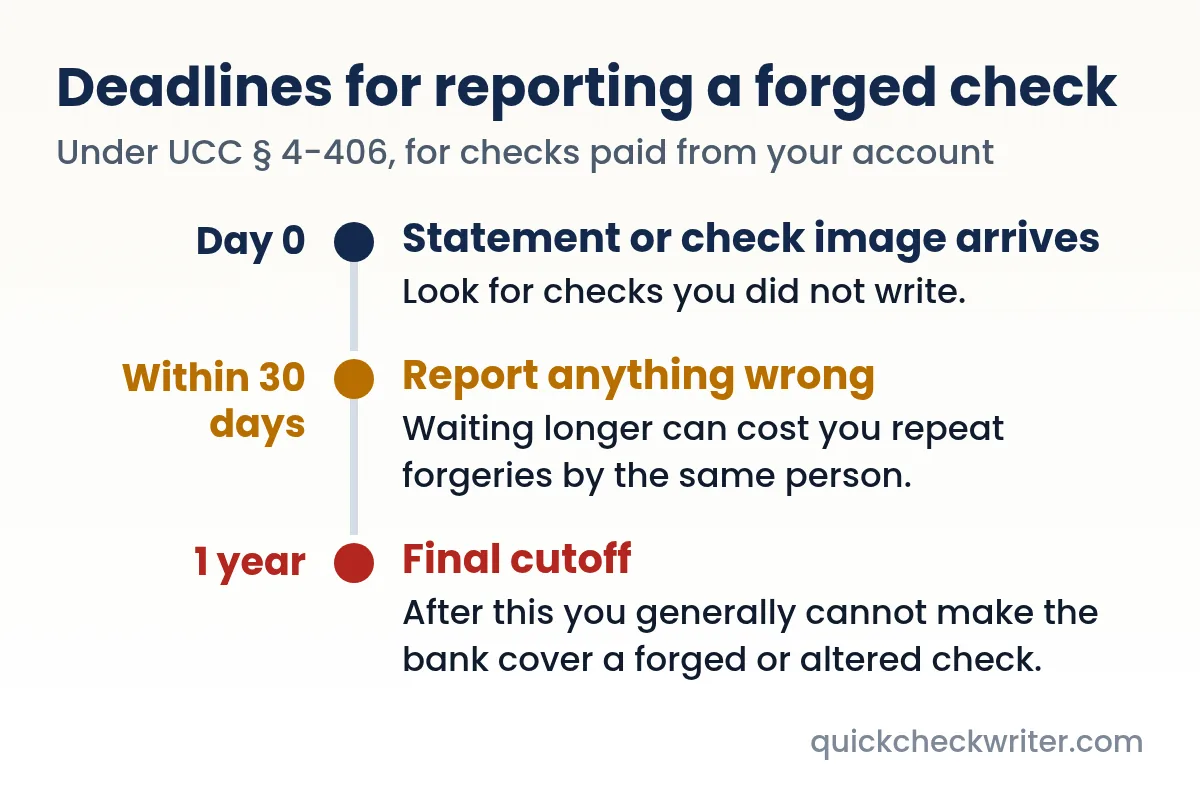
- If you do not, and the bank shows that your delay caused it a loss, you can lose the right to make it reimburse you.
- Repeat forgeries by the same person are a particular risk: once you have had a reasonable time to review your statement, no more than 30 days, later forgeries by that same wrongdoer may be your loss if you did not report.
- After one year from when the statement was made available, an unreported forged signature or alteration can no longer be raised against the bank at all, whatever the bank's own care.
If both you and the bank were careless, the loss can be shared. The practical takeaway is simple: open your statements, look at the check images, and call the bank the same day you see a problem.
If a check made out to you is lost
Losing a check someone wrote to you is mostly an inconvenience, provided you act before someone else tries to cash it.
- Tell the writer promptly
Explain what happened and ask them to stop payment and issue a new check. Offer to cover their stop payment fee if the loss was your fault; it is a fair gesture.
- If you find the original later
Do not deposit it once a replacement is on the way. Return it to the writer or write VOID across it and shred it.
- If it was stolen from your mail
Report it to the Postal Inspection Service and tell the writer, so they watch for it being cashed.
Lost cashier's, teller's or certified checks
These cannot simply be stopped, because the bank, not an individual account, is on the hook. The UCC gives a specific route: the person who bought the check, or the payee, can give the issuing bank a declaration of loss and claim the money. The claim becomes enforceable 90 days after the date of the check (or the date of certification), and until then the bank may still pay the check if it is presented. Many banks instead ask for an indemnity bond, a kind of insurance that protects the bank if the original turns up, before issuing a replacement. Ask the issuing bank which route it uses.
Lost U.S. Treasury checks
For a lost federal check, such as a tax refund or benefit payment, contact the agency that issued it, not your bank. Treasury checks are void one year after issue, so do not wait.
What your bank may ask you for
Banks handle missing checks every day, and the conversation goes faster if you are ready. Expect to be asked for:
- the check numbers involved, or the range if a book is missing,
- the amount, payee and date for any check you wrote,
- when you last saw the checks and how you think they went missing,
- a police report number, if you filed one,
- for a check that cleared but was forged or altered, a signed statement or affidavit saying you did not authorize it.
Keep notes of every call: the date, the person you spoke to and any reference number. If a forged check is involved, those notes show you reported promptly, which matters under the statement rules described above.
Lost and stolen checks at a business
Small businesses face the same problems with higher stakes: a payroll check lost by an employee, a vendor payment that never arrives, or a box of check stock walking out of an unlocked cabinet.
- Payroll check lost by an employee. Confirm it has not cleared, place a stop payment, and issue a replacement with a new number. Note both in your payroll records so year-end totals stay right.
- Vendor says a check never came. Check whether it cleared before reissuing. If it cleared, pull the image; an endorsement that does not match the vendor is a sign of theft.
- Check stock missing. Preprinted business checks carry your account details and need the same urgent response as a stolen checkbook. Blank stock that you print on yourself does not, but count it and lock it up.
- Ask your bank about Positive Pay. Many business accounts offer a service that matches each presented check against a list you send. Our guide to Positive Pay explains how it works.
Mail theft and checks
A common way checks go missing is theft from mailboxes. The Postal Inspection Service recommends picking up mail promptly rather than leaving it in your mailbox, contacting the sender as soon as possible if a check or other valuable mail you expect does not arrive, and filing a change of address with both the Postal Service and your banks when you move. For outgoing checks, our own advice is to hand them over inside a post office or use a secure collection box rather than leaving them in a home mailbox with the flag up. Our guide on how to mail a check safely goes further.
Why check theft is a bigger risk than it used to be
Stolen checks are not a rare problem. In a February 27, 2023 alert, FinCEN, the Treasury's anti-money-laundering bureau, reported a nationwide surge in check fraud tied to mail theft. Banks filed more than 680,000 suspicious activity reports about check fraud in 2022, nearly double the previous year. FinCEN asked banks to refer customers who may be victims of mail-theft check fraud to the U.S. Postal Inspection Service.
The practical lesson: treat a missing check the way you would treat a missing debit card, and act the same day.
Your account number can be misused electronically too
Every check shows your bank's routing number and your account number. A thief does not need the paper check to use them; the numbers alone can be used to set up electronic debits or remotely created checks. That is one reason banks sometimes recommend closing the account after a checkbook is stolen.
For consumer accounts, unauthorized electronic transfers are covered by Regulation E. Report any electronic debit you did not authorize within 60 days after the bank sends the statement that shows it. If you wait longer, you can be liable for later unauthorized transfers that a timely report would have prevented.
The first 24 hours: a checklist
- Within the hour: call the bank
Give the check numbers or the range. Ask about stopping them or closing the account, and write down the name of the person you spoke to.
- Same day: put it in writing
Confirm any phone instructions through online banking or a letter. An oral stop payment lapses after 14 days if it is not confirmed.
- Same day: report the theft
Police for a theft, the Postal Inspection Service for stolen mail, and IdentityTheft.gov if your identity may be misused.
- This week: move your automatic payments
If you open a new account, update direct deposit, autopay and any payees who debit the old account, before it closes.
- Every month after: review your statement
Look at check images and electronic debits, and report anything wrong within the deadlines above.
Common mistakes
- Waiting to see if the check turns up. A stop payment costs less than a cashed check, and an early report protects your rights.
- Closing the account before moving autopay. Bills that bounce off a closed account bring their own fees.
- Not knowing which numbers are missing. A check register with every check number makes the bank call quick and precise.
- Ignoring statements. The UCC and Regulation E deadlines both run from your statement, whether you open it or not.
Preventing lost and stolen checks
- Lock up blank checks and check stock, and keep a count of what you have.
- Keep a register. When every check is logged with its number, you can tell a bank exactly what is missing. Quick Check Writer records each printed check automatically, with search and CSV export.
- Use secure mailing for outgoing checks.
- Write carefully. Fill in every line and draw a line after the payee and amount so nothing can be added; see how to write a check.
- Turn on account alerts for checks clearing over an amount you choose.
- Read every statement, including the check images.
- Shred voided and old checks rather than tossing them.
For a broader plan, see our guide to check fraud prevention.
Frequently asked questions
What should I do if my checkbook is stolen?
Call your bank immediately, give the missing check numbers, and ask whether to stop them or close the account. File a police report, report mail theft to the Postal Inspection Service, and check your account activity daily.
Am I responsible if someone forges my check?
Generally no, because a forged check is not properly payable from your account. But you must review your statements promptly and report it. If you wait more than a year after the statement, you lose the right to make the bank cover it.
Should I close my account if checks are stolen?
If a whole checkbook or box of checks is gone, or someone is already using your account number, closing the account and opening a new one is usually safer than paying for many stop payments. Ask your bank.
What do I do if I lose a check someone wrote to me?
Tell the writer quickly and ask them to stop payment and issue a new one. If you later find the original, return it or void and shred it rather than depositing it.
Can I replace a lost cashier's check?
Yes, but not instantly. Banks either use the UCC declaration-of-loss process, where your claim becomes enforceable 90 days after the check's date, or ask for an indemnity bond before issuing a replacement.
Where do I report stolen mail?
To the U.S. Postal Inspection Service, online or by calling 1-877-876-2455. Also tell your bank and the person who sent or was to receive the check.
Can someone take money electronically with the numbers on a stolen check?
They can try, because the routing and account numbers are printed on every check. For a consumer account, report any electronic debit you did not authorize within 60 days after the statement showing it is sent, so you are protected under Regulation E. Ask your bank whether closing the account is safer.
Do I need a police report for stolen checks?
Your bank may ask for one, and it is useful evidence if forged checks appear later. If the checks were stolen from the mail, also report it to the U.S. Postal Inspection Service.
Related guides
- How to stop payment on a check
- Check washing: how it works and how to stop it
- Check fraud prevention for people and small businesses
- How to mail a check safely
- Cashier's check vs certified check
- Is It Safe to Print Checks at Home?
Sources
- UCC § 4-406, Customer's duty to report unauthorized signature or alteration (Cornell LII)
- UCC § 4-401, When bank may charge customer's account (Cornell LII)
- UCC § 4-403, Customer's right to stop payment (Cornell LII)
- UCC § 3-312, Lost, destroyed, or stolen cashier's, teller's or certified check (Cornell LII)
- OCC HelpWithMyBank: Indemnity bond for a lost cashier's check
- OCC HelpWithMyBank: Stop payment on a cashier's check
- U.S. Postal Inspection Service: Mail and package theft
- Treasury Financial Manual, Chapter 7000 (Treasury checks void after one year)
- IdentityTheft.gov (Federal Trade Commission)
- FinCEN Alert FIN-2023-Alert003: Nationwide surge in mail theft-related check fraud (Feb 27, 2023)
- 12 CFR § 1005.6, Liability of consumer for unauthorized transfers (eCFR)
Last updated November 1, 2026. This page is general information, not legal or financial advice. Quick Check Writer is check printing software; it is not a bank and does not move money.