
Key takeaways
- Mail theft is the main risk: FinCEN reported over 680,000 check-fraud reports from banks in 2022.
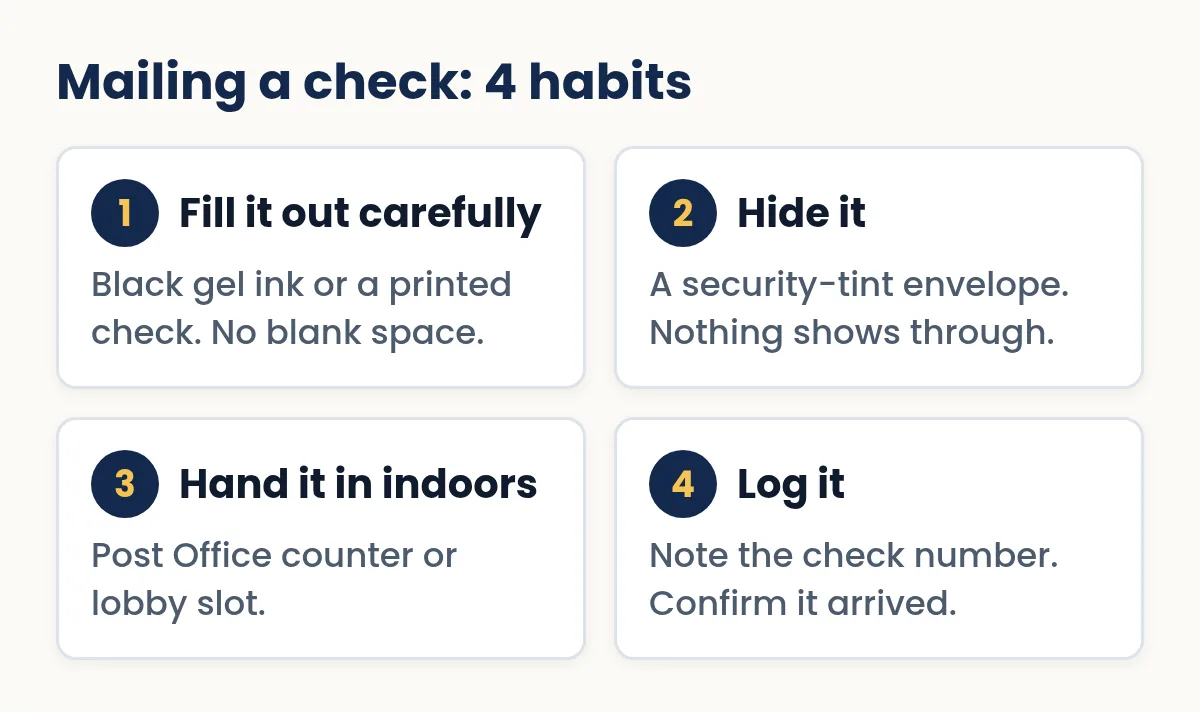
- Use black gel ink or a printed check, and leave no blank space on any line.
- Use a security-tint envelope; nothing on the check should show through.
- Drop it at the Post Office, not in your home mailbox overnight.
- If it goes missing, a written stop payment lasts six months; an oral one lapses after 14 days.
On this page
- Is it safe to mail a check?
- Step by step: how to mail a check
- Choosing the right envelope
- Where and when to drop it off
- Should you pay extra for Certified Mail or tracking?
- Make the check itself harder to misuse
- If a mailed check never arrives
- What not to mail
- Common mistakes to avoid
- Alternatives when mailing feels risky
- Mailing checks for a small business
- Mailing a check to the IRS or a government office
- FAQ
Is it safe to mail a check?
Most mailed checks arrive without trouble, but the risk is real and it has grown. In February 2023 the Financial Crimes Enforcement Network (FinCEN) warned banks about a nationwide surge in check fraud tied to stolen mail. It reported that banks filed more than 680,000 suspicious activity reports about check fraud in 2022, nearly double the year before.
The weak points are predictable. A check is most exposed while it sits somewhere unattended: in your mailbox with the flag up, in a collection box overnight, or in a shared lobby tray. A thief who gets it can try to deposit it as is, alter the payee and amount, or copy your bank numbers onto counterfeit checks.
That does not mean you should never mail a check. It means you should control the few moments when the envelope is out of your hands, and make the check itself hard to change. The rest of this guide shows how.
Fill in every line, use black gel ink or print the check, seal it in an envelope that hides the contents, hand it to the Postal Service indoors, and keep a record of the check number so you can stop payment fast if it goes missing.
Step by step: how to mail a check
- Confirm where the payment should go
Use the payment address printed on the bill or invoice, not the company's general headquarters address. Many businesses process mailed payments at a separate lockbox address, and a check sent to the wrong one can sit for days. If you are paying a person, confirm their mailing address by phone or in person rather than trusting an address that arrived by email or text.
- Write the check completely
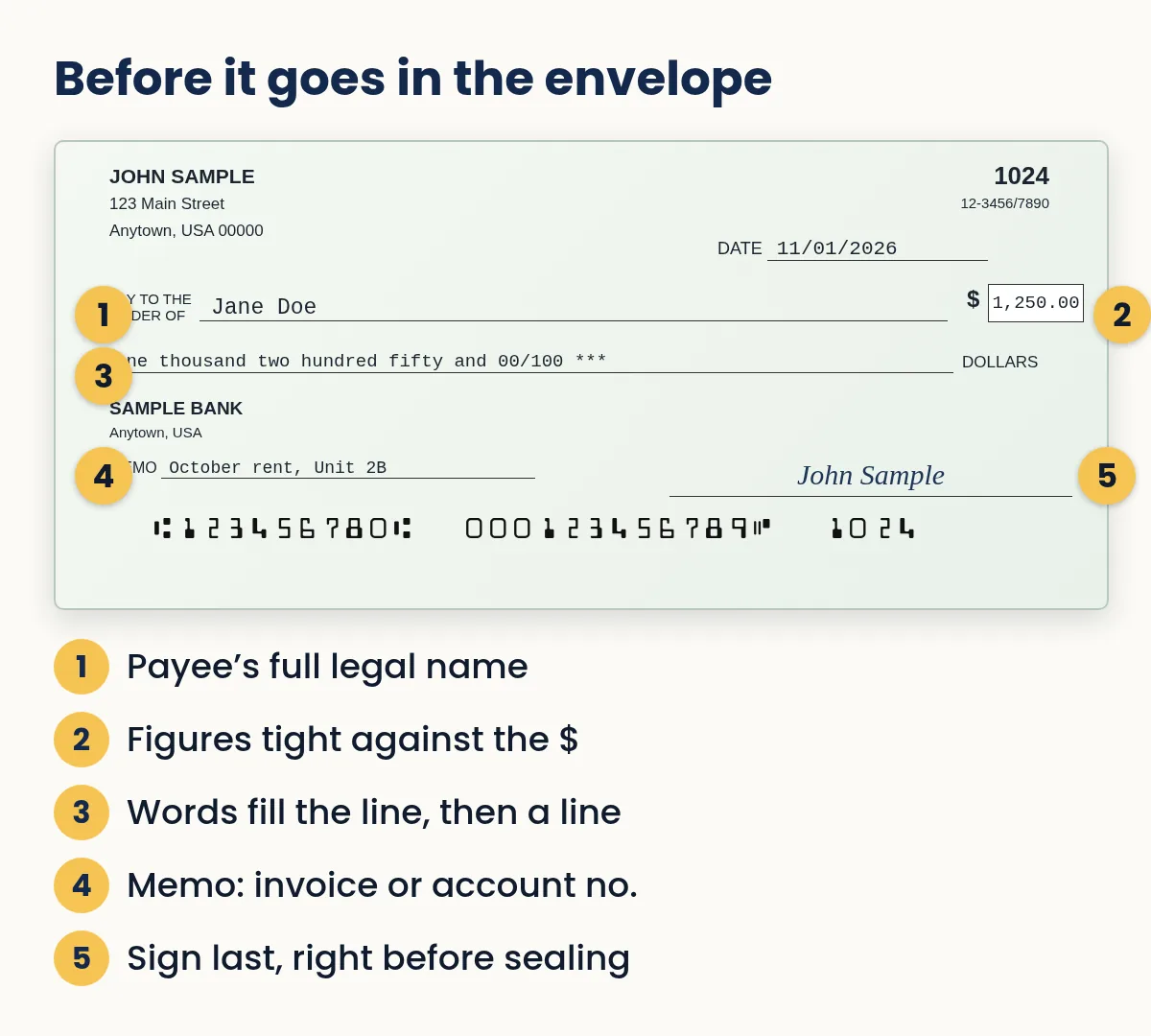
Enter the date, the payee's full name, the amount in figures and in words, and a memo that tells the payee what the money is for, such as an invoice number. Start writing at the far left of each line and draw a line through unused space so nothing can be added. Our guide to writing a check step by step covers each field.
- Use ink that resists washing, or print it
The Office of the Comptroller of the Currency recommends black gel ink because it is highly resistant to check washing, where chemicals lift ordinary ink so a thief can rewrite the payee and amount. If you print your checks, every field comes out typed and uniform, with no gaps to fill in later.
- Sign it last
Sign right before the check goes into the envelope. A signed check lying on a desk is an invitation; an unsigned one is useless to anyone who picks it up.
- Add a cover note if the payee needs one
Many bills come with a remittance stub; return it with the check. If there is no stub, a short note with your name, account number with that company and invoice number helps the payee apply the money to the right account.
- Choose an envelope that hides the check
Use an opaque or security-tint envelope. If you use a window envelope, fold so that only the payee's address shows, never the amount or the bank line at the bottom of the check.
- Hand it to the Postal Service in a secure place
The most protected route is the counter or the indoor mail slot at a Post Office. The OCC suggests using those letter slots when sending checks. Avoid leaving outgoing checks in your home mailbox.
- Record it and follow up
Write the check number, date, payee and amount in your register. Watch your account for the check to clear and ask the payee to confirm receipt if it is a large or time-sensitive payment.
Choosing the right envelope
An ordinary white envelope held up to a light can reveal the amount and even the routing and account numbers printed along the bottom of the check. That bottom line, the MICR line, is exactly what a counterfeiter needs. A security-tint envelope has a printed pattern on the inside that blocks the view.
Window envelopes are convenient because the address is already on the check stub or remittance form. They are fine as long as only the address shows. Test the fold before you seal: if you can see any part of the dollar amount or the MICR line through the window, fold it differently or switch to a plain security envelope.
| Envelope | Hides the check | Best for |
|---|---|---|
| Security-tint, no window | Yes | Personal checks, large amounts |
| Window envelope from the biller | Yes, if folded correctly | Bill payments with a remittance stub |
| Plain white, thin paper | No | Avoid for checks |
| Padded or oversized mailer | Yes | Checks sent with documents; costs more postage |
Don't write “check enclosed” or the amount on the outside of the envelope. Nothing on the outside should say there is money inside.
Where and when to drop it off
The time a check spends waiting for pickup is when it is most exposed. The U.S. Postal Inspection Service advises picking up incoming mail promptly rather than leaving it in your mailbox, and the same logic applies to outgoing mail.
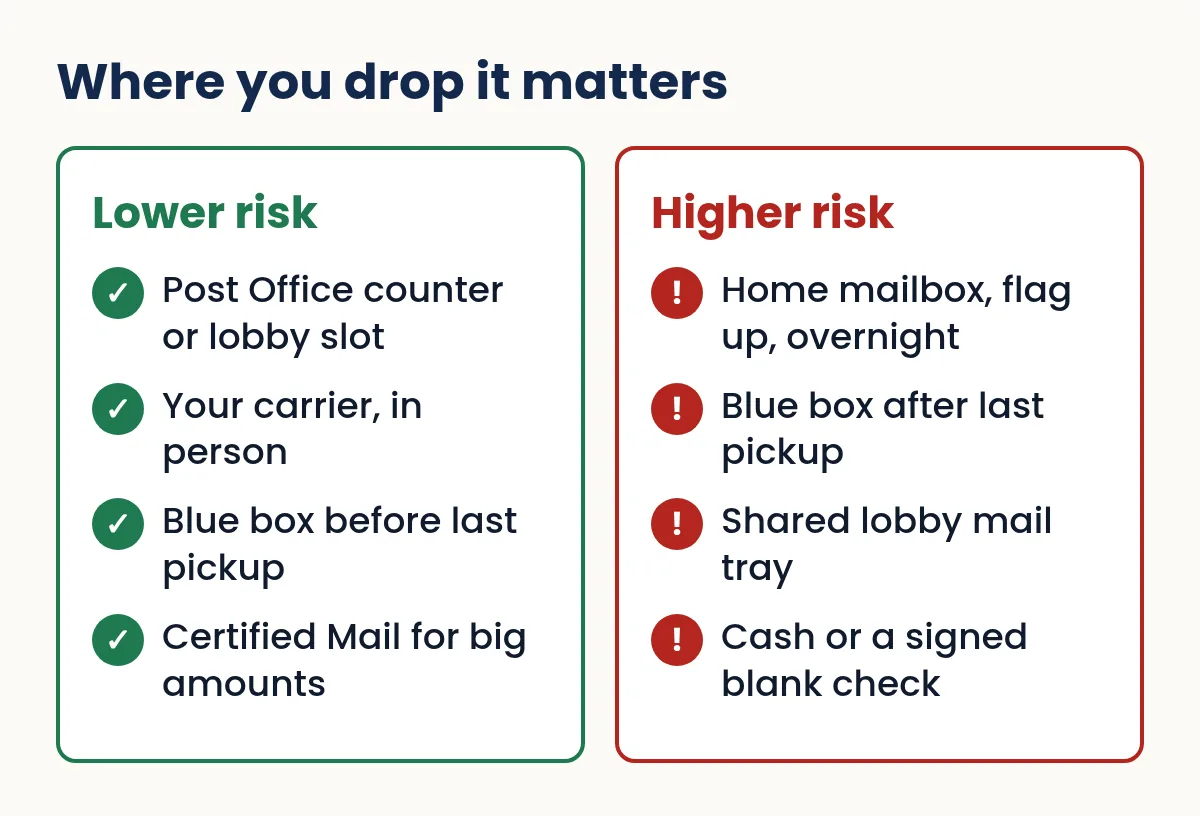
If you can't get to a Post Office, a blue collection box is a reasonable second choice when you drop the letter in shortly before the pickup time posted on the box. Mail left after the last pickup sits there overnight. Raising the flag on a home mailbox signals that something is inside, which is why many people stopped doing it for checks.
Should you pay extra for Certified Mail or tracking?
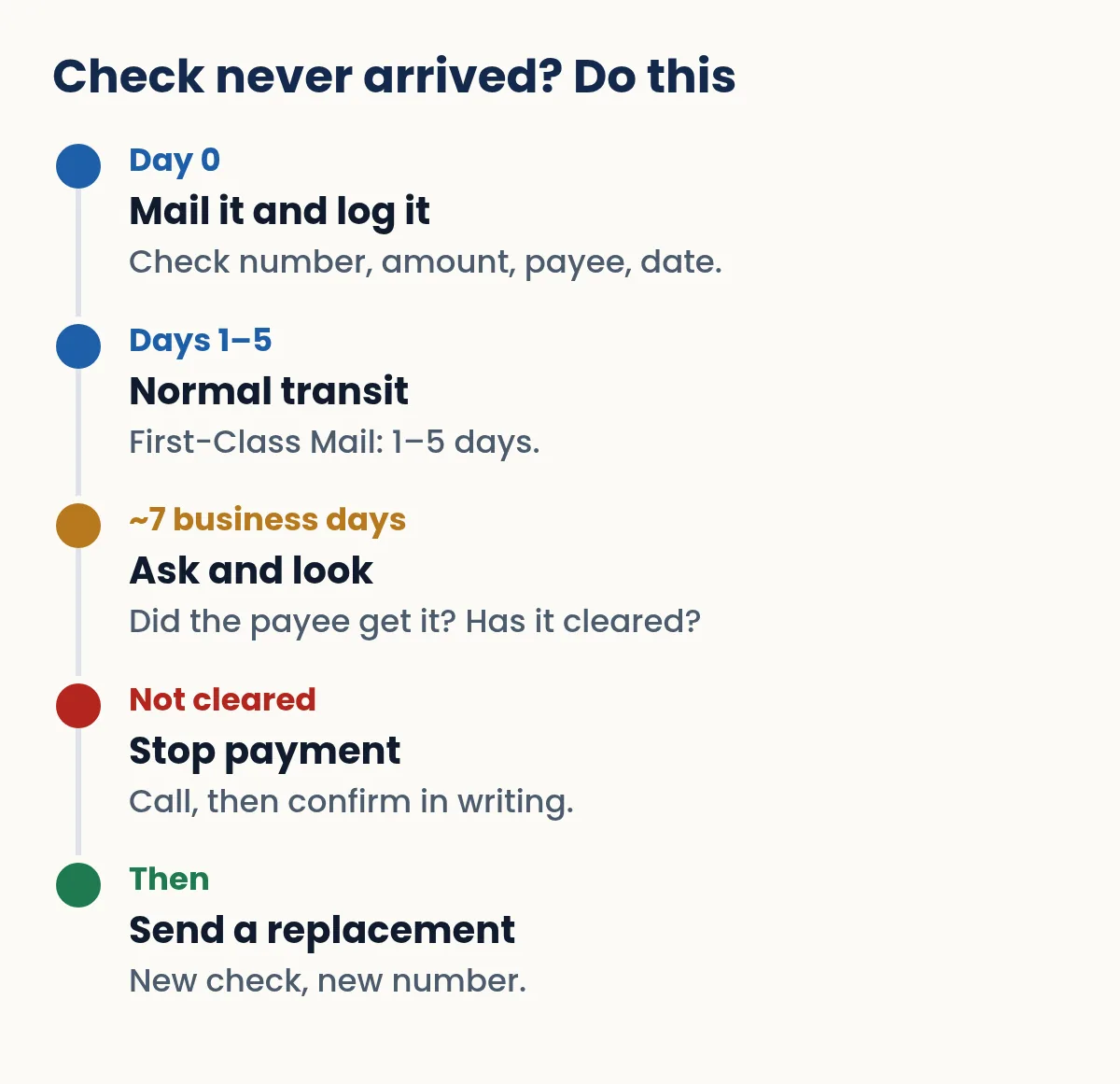
Regular First-Class Mail is how most checks travel. The Postal Service describes it as delivering in 1 to 5 days, and it has no tracking for an ordinary letter. For everyday bills that is usually enough.
For larger payments, deadlines or anything you may need to prove later, add a service that leaves a paper trail. Certified Mail gives you a mailing receipt and can provide electronic confirmation of delivery or a delivery attempt. Adding Return Receipt gets you the signature of whoever accepted the letter. The U.S. Postal Inspection Service also suggests Signature Confirmation when mailing something important.
- First-Class Mail
- Cheapest. Fine for routine bills. No proof of delivery for a standard letter.
- Certified Mail
- A receipt proving you mailed it, plus delivery confirmation. Good for rent, deposits, tax payments and legal deadlines.
- Return Receipt
- An add-on that shows who signed for the letter. Useful when you may need to show the payee received it.
- Priority Mail Express
- The fastest USPS option, with tracking. Worth it only when a payment must arrive the next day or two.
Prices change every year, so check the current rate at the Post Office counter or on usps.com before you send.
Need to write a check right now?
Quick Check Writer fills in the amount in words, adds the bank line and prints on blank check stock or saves a PDF. Your first check is free, with no account and no card.
Write your first check free →Make the check itself harder to misuse
Good mailing habits reduce the chance of theft. A well-prepared check reduces the damage if theft happens anyway.
- Leave no blank space. Fill the payee line and the amount line all the way, then draw a line to the edge.
- Write the payee's full name. “Sample Electric Co.” is harder to alter than “SEC”.
- Never mail a signed blank check. If a payee needs to fill in the amount, pay another way.
- Keep personal data off the check. Don't add your Social Security number, driver's license number or phone number unless the payee truly requires it.
- Use checks with security features. Background patterns, microprinting and warning text make copying and alteration more obvious. See check security features, explained.
When you print your own checks with Quick Check Writer, the amount in words is filled in for you, every field is typed rather than handwritten, and you can add security marks and a “void after 90 days” line. You still mail the check yourself, but it leaves your printer complete and easy to read. Our article on whether printing checks at home is safe explains the trade-offs.
If a mailed check never arrives
A late check is usually just slow mail. But if it has been well over a week and the payee hasn't received it, act before someone else cashes it.
- Check your account first
Search online banking for the check number. If it cleared, look at the check image your bank shows. Was it deposited by the payee? If someone else deposited it or the payee name looks changed, report it to your bank right away as fraud.
- Place a stop payment
If the check has not cleared, ask your bank to stop payment. Under the Uniform Commercial Code, a stop-payment order lasts six months, but an oral order lapses after 14 calendar days unless you confirm it in a record, such as a written or online request. Banks usually charge a fee. Our guide on how to stop payment on a check walks through it.
- Send a replacement
Use a new check number and write “replaces check #1024” in the memo so the payee doesn't accidentally process both. Or switch to a payment method that is harder to intercept.
- Report mail theft
If you believe the envelope was stolen, report it to the U.S. Postal Inspection Service online or at 1-877-876-2455, and tell your bank. The OCC also points victims to IdentityTheft.gov when personal information may have been exposed.
John Sample mails check #1024 for $1,250.00 to Jane Doe for October rent on a Monday. By the following Wednesday, Jane still has nothing. John logs in to his bank and sees #1024 has not cleared, so he places a stop payment, confirms it in writing online, and gives Jane check #1025 in person with the memo “replaces #1024, October rent”. If #1024 turns up later, it will be refused.
What not to mail
The Postal Inspection Service is blunt about cash: don't send it. The same caution applies to a few other things:
- Cash. Once it is gone, it is gone, and there is no stop payment.
- Signed blank checks. Anyone who finds one can write any amount.
- Checks made out to “Cash”. Whoever holds the check can try to cash it. Always name the payee.
- A voided check with no reason to send it. Even a voided check shows your routing and account numbers. Send one only when an employer or biller truly needs it, and prefer a bank letter for direct deposit where possible. See direct deposit and the voided check.
Common mistakes to avoid
Most mailed-check problems come from a handful of small slips. Run through this list before you seal the envelope:
- Writing your own full account number in the memo. The memo is for the payee's reference, such as your account number with them or an invoice number. Your bank account number is already printed on the check.
- Leaving space after the amount. Start the figures right next to the dollar sign and draw a line after the words.
- Mailing to an address that arrived by email. Changed “remit to” addresses are a classic fraud trick. Confirm by phone using a number you already had.
- Forgetting to sign. An unsigned check comes back and the payment is late.
- Not recording it. Without the check number, a stop payment takes longer, because your bank needs to identify the exact item.
The Postal Service offers a free service called Informed Delivery that emails a daily preview of letters scheduled to arrive at an address. A landlord or relative who uses it can tell you the day your envelope shows up, or that it never did.
Alternatives when mailing feels risky
Sometimes a paper check is required, for example by a landlord, a government office or a small vendor. When it isn't, other options avoid the mailbox entirely:
- Hand delivery. For local payments like rent, handing over the check and getting a receipt removes the mail from the picture. See how to pay rent by check.
- Your bank's online bill pay. Many banks will send the payment electronically or mail a check on your behalf from their own system.
- A check sent as a PDF. Some payees accept a check image by email or messaging and deposit it with their bank's mobile app. Ask first. Our guides on emailing a check and sending a check by WhatsApp or text explain when this works.
- Electronic transfers. ACH and wires skip paper altogether. Compare the trade-offs in ACH vs check.
Mailing checks for a small business
Businesses mail more checks and are more attractive targets, so a little process goes a long way:
- Keep blank check stock locked away and limit who can print or sign.
- Mail checks from the Post Office rather than leaving them in an office outbox overnight.
- Reconcile the account often so a cleared check you didn't write stands out quickly. Our guide to bank reconciliation shows how.
- Ask your bank about Positive Pay, a service that compares checks presented for payment against the list you issued. Read what Positive Pay is.
- Keep a register of every check number, payee and amount, so you can answer “did that check go out?” in seconds.
Quick Check Writer keeps a check register on your device automatically: each printed check is logged with its number, payee, amount and date, and you can search it, reprint or void a check, and export the list to CSV.
Mailing a check to the IRS or a government office
Tax payments are one of the most common reasons people still mail checks, and agencies have their own rules. The IRS asks you to make the check payable to “U.S. Treasury”, never to “IRS”, and to write the amount in dollars and cents. On the check itself it wants your name, address and phone number, your Social Security number or EIN, the tax year, and the form or notice number the payment belongs to.
A few more IRS habits worth copying for any agency payment:
- Don't staple or clip the check to the return or payment voucher. Lay it loose on top in the envelope.
- Mail it to the address on your notice or form instructions. Payment addresses differ by form and by state, and they change from time to time.
- Keep proof of mailing. For a payment with a deadline, Certified Mail gives you a dated receipt.
For state tax departments, courts and city offices, copy the payee name and reference details exactly as printed on the bill or notice.
Frequently asked questions
How long does it take for a mailed check to arrive?
The Postal Service lists First-Class Mail at 1 to 5 days. Allow extra time around holidays and for long distances, and remember the payee still needs time to deposit it.
Can I track a check I mailed?
Not with a regular stamp on a letter. Add Certified Mail at the Post Office for a mailing receipt and delivery confirmation. You can also watch your bank account to see when the check number clears.
What pen should I use for a check I am mailing?
Black gel ink. The OCC notes that black gel ink is highly resistant to check washing, the chemical trick thieves use to erase and rewrite the payee and amount.
Is it safe to put a check in my home mailbox with the flag up?
It is the riskiest common option because the flag shows there is outgoing mail inside. Use the counter or indoor slot at a Post Office instead, or hand it to your carrier.
Can I send a check in a regular envelope?
Yes, but hold it up to a light first. If you can see the amount or the numbers at the bottom of the check, use a security-tint envelope or wrap the check in a folded sheet of paper.
What should I do if my mailed check was stolen?
Call your bank to stop payment or report fraud if it already cleared, report the theft to the U.S. Postal Inspection Service at 1-877-876-2455, and send the payee a replacement with a new check number.
How do I mail a check to the IRS?
Make it payable to “U.S. Treasury”, write your name, address, phone number, SSN or EIN, the tax year and the form or notice number on the check, and mail it unstapled to the address in your form instructions or notice. Don’t send cash.
Does Quick Check Writer mail checks for me?
No. Quick Check Writer prints your checks at home or saves them as a PDF. You mail or deliver the printed check yourself, using the steps on this page.
Related guides
- How to stop payment on a check
- Check washing: how it works and how to stop it
- Lost or stolen checks: what to do
- How to email a check
- Check fraud prevention for people and small businesses
- How to write a check, step by step
Sources
- FinCEN: Alert on nationwide surge in mail theft-related check fraud (Feb 27, 2023)
- OCC: Check fraud (ways to avoid it, how to report it)
- U.S. Postal Inspection Service: Mail & package theft
- USPS: First-Class Mail
- USPS: Insurance & extra services (Certified Mail, Return Receipt)
- UCC § 4-403, stop-payment orders (Cornell LII)
- IRS: Pay by check or money order
- USPS: Informed Delivery
Last updated November 1, 2026. This page is general information, not legal or financial advice. Quick Check Writer is check printing software; it is not a bank and does not move money.