
Key takeaways
- Confirm the worker is a contractor, not an employee, using the IRS control factors.
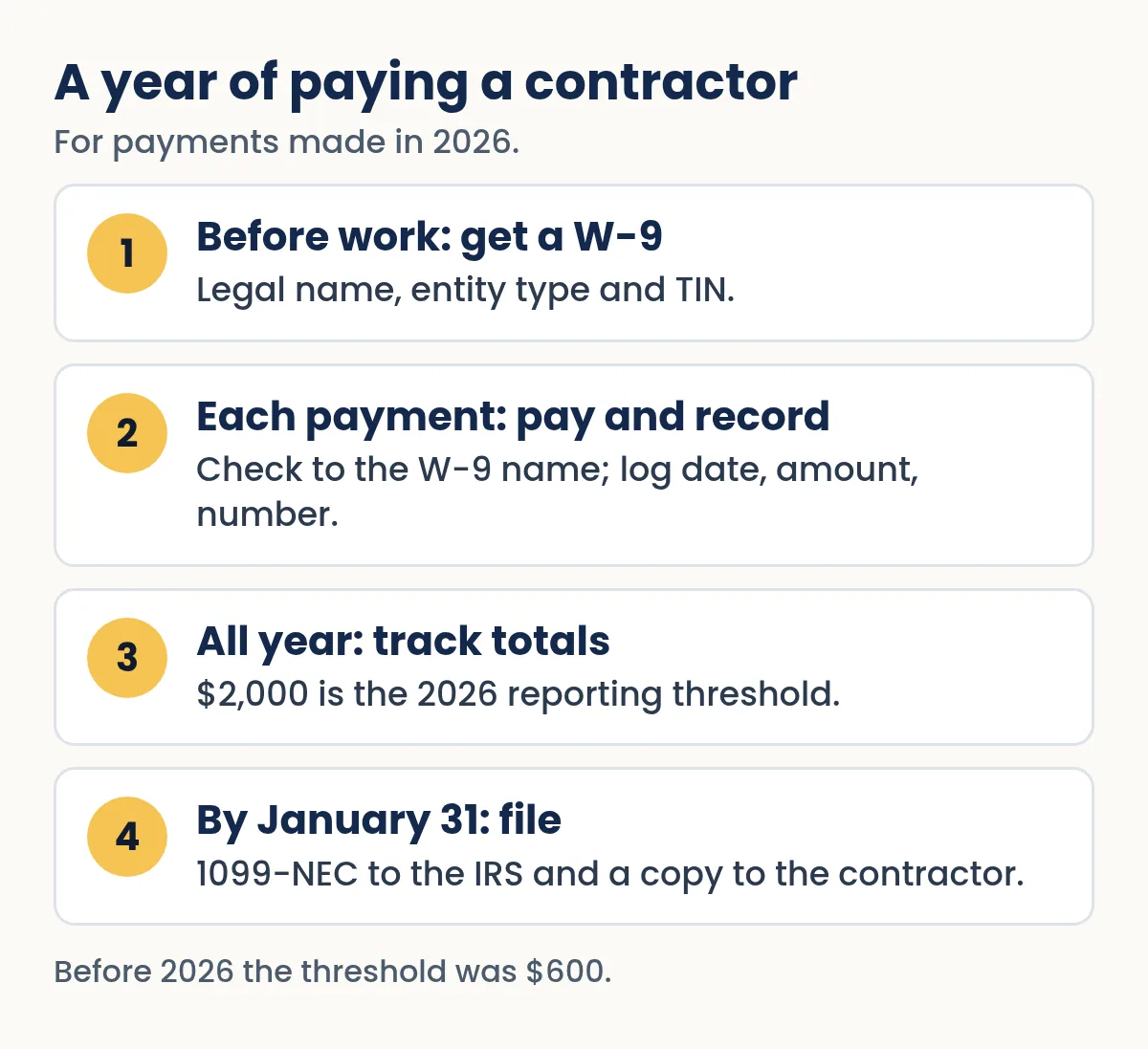
- Collect a W-9 before the first check; use the legal name on the check.
- For payments made in 2026 the 1099-NEC threshold is $2,000 per payee ($600 before 2026).
- Card and payment-app payments go on Form 1099-K, not your 1099-NEC.
- File with the IRS and furnish the contractor's copy by January 31.
On this page
- Why checks work well for paying contractors
- Step 1: Make sure they really are a contractor
- Step 2: Collect a Form W-9 before the first check
- Step 3: Pay by check and record every payment
- Step 4: Know the 1099-NEC rules
- Step 5: File and furnish by January 31
- Situations that need a second look
- What happens if you file late
- Records to keep
- Common mistakes to avoid
- FAQ
Why checks work well for paying contractors
Plenty of small businesses, landlords and nonprofits pay freelancers, tradespeople and consultants by check. A check gives the contractor money they can deposit anywhere, gives you a clear record of what was paid and when, and does not require you to collect or store their bank account details.
Checks also keep tax reporting straightforward. Payments you make directly by check, cash or bank transfer are reported by you on Form 1099-NEC when they meet the threshold. Payments made by credit card or through a third-party payment network are a different story: the IRS instructions say those are reported on Form 1099-K by the payment processor and are not reported on Form 1099-NEC or 1099-MISC.
This page explains federal rules as published by the IRS for payments made in 2026. States may have their own filing rules, and special cases exist. When in doubt, ask a tax professional.
Step 1: Make sure they really are a contractor
Everything on this page assumes the person is an independent contractor, not an employee. Getting this wrong is costly, because employees require payroll tax withholding and a W-2, not a 1099.
The IRS looks at the whole relationship and groups the evidence into three categories:
- Behavioral control
- Do you control, or have the right to control, what the worker does and how they do it?
- Financial control
- Do you control the business side of the job, such as how the worker is paid, whether expenses are reimbursed and who provides tools and supplies?
- Relationship of the parties
- Are there written contracts or employee-type benefits? Will the relationship continue, and is the work a key part of your business?
If it is still unclear, either the business or the worker can ask the IRS for an official determination using Form SS-8. If the person is an employee, see our guide to printing payroll checks instead, and run payroll properly.
Step 2: Collect a Form W-9 before the first check
Form W-9 is how a contractor gives you their correct taxpayer identification number (TIN), either a Social Security number or an employer identification number, along with their legal name and business entity type. Ask for it before you pay anything. It is far easier than chasing a former contractor in January.
- Use the legal name on the check. Make checks payable to the name on the W-9 (the individual's name, or the business name if they have one) so your 1099 and your payments line up.
- Note the entity type. Payments to corporations, including LLCs taxed as C or S corporations, are generally exempt from 1099-NEC reporting, with exceptions such as attorneys' fees.
- Store W-9s securely. They contain sensitive tax ID numbers. Keep them locked up or in a protected system.
If a payee fails to provide a correct TIN, the IRS may require you to withhold federal income tax from reportable payments at the backup withholding rate, currently 24 percent, and send it to the IRS. Getting a completed W-9 up front avoids this.
Step 3: Pay by check and record every payment
- Get an invoice
Even a simple one-line invoice from the contractor documents what the payment is for. Keep it with your records.
- Write or print the check
Payee name exactly as on the W-9, the amount, the date, and the invoice number or a short description in the memo ("Inv 104, October site work").
- Record it
Log the check number, date, payee and amount in your check register or accounting software, and tag it to the contractor. This is what you will total in January.
- Deliver it safely
Hand it over or mail it securely. See how to mail a check.
- Confirm it cleared
When you reconcile your account, confirm the check cleared for the right amount to the right person. Our guide to bank reconciliation walks through it.
Quick Check Writer saves payees on your device and logs every printed check in a register you can search by payee and export to CSV, which makes adding up a contractor's yearly total quick. It does not prepare or file 1099 forms; you use those totals with your tax software, accountant or the IRS's own filing system.
Need to write a check right now?
Quick Check Writer fills in the amount in words, adds the bank line and prints on blank check stock or saves a PDF. Your first check is free, with no account and no card.
Write your first check free →Step 4: Know the 1099-NEC rules
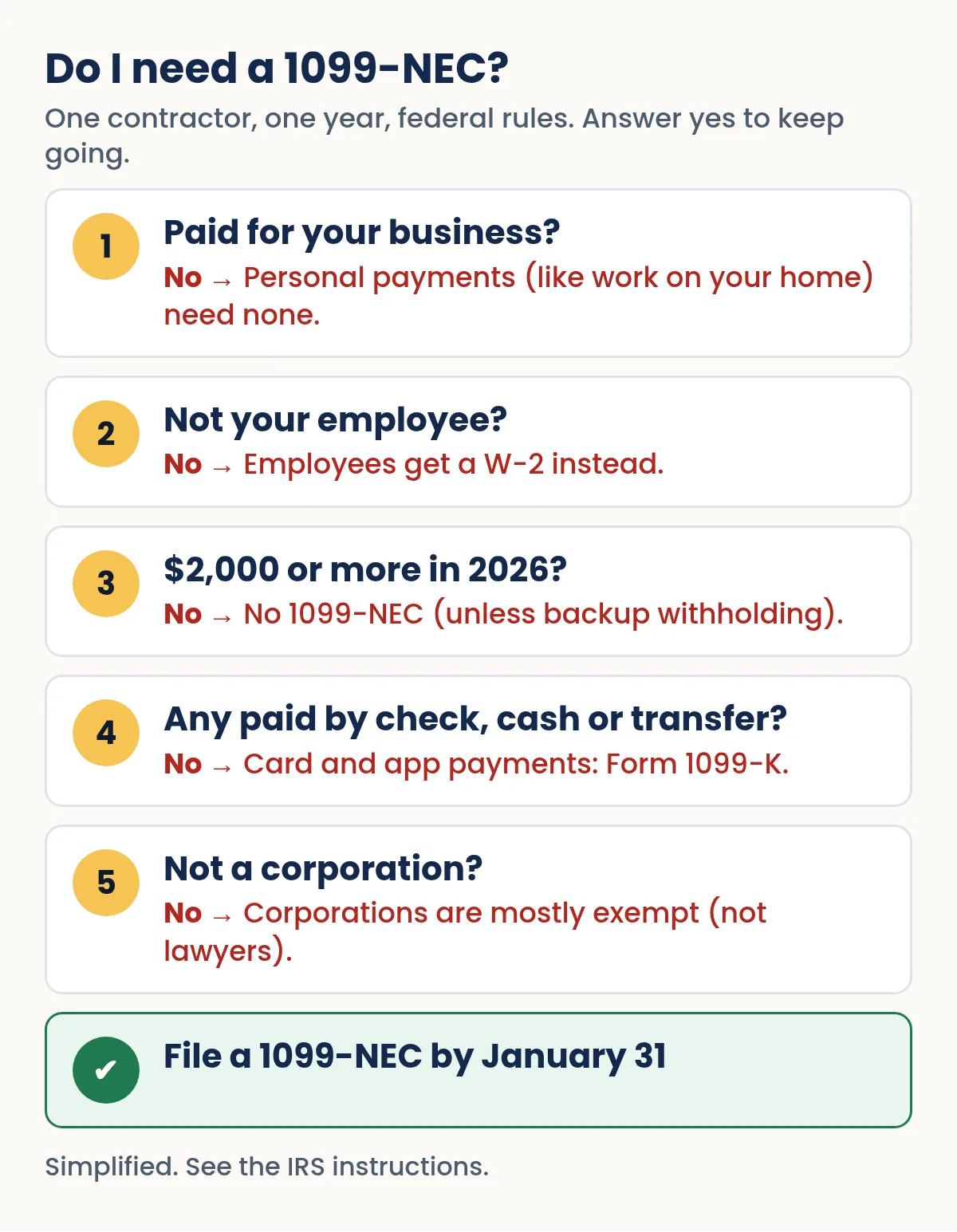
You generally must file Form 1099-NEC for each person you paid, in the course of your trade or business, at least the reporting threshold for services performed by someone who is not your employee (including parts and materials).
| Payments made in | 1099-NEC threshold (per payee, per year) |
|---|---|
| 2025 and earlier | $600 |
| 2026 | $2,000 |
| After 2026 | $2,000 adjusted for inflation; see IRS Publication 1099 |
A few rules trip people up:
- Personal payments don't count. The IRS says to report only payments made in the course of your trade or business. Paying a plumber to fix your own home's sink is personal; paying one to fix your rental property is business.
- Count only the check, cash and transfer payments. Amounts you paid by card or through a payment app are reported by the processor on Form 1099-K, so leave them out of your 1099-NEC totals.
- Corporations are generally exempt. But attorneys' fees for legal services are reportable even when the law firm is a corporation.
- Backup withholding changes the rule. If you withheld any federal income tax under backup withholding, you must file a 1099-NEC for that payee regardless of the amount.
- Nonprofits are included. The IRS treats nonprofit organizations as engaged in a trade or business for these reporting rules.
Step 5: File and furnish by January 31
Form 1099-NEC has a firm deadline: you must furnish the statement to the contractor and file it with the IRS by January 31 of the following year, whether you file on paper or electronically. If January 31 falls on a weekend or legal holiday, the deadline moves to the next business day.
- E-filing. If you have 10 or more information returns in total (W-2s count toward this), you must file electronically. The IRS runs a free online portal called the Information Returns Intake System (IRIS).
- Paper filing. For fewer returns, you can file on paper, but the IRS copy (Copy A) must be the official scannable printed form. The IRS warns that self-printed copies of Copy A from its PDF are not scannable and may draw a penalty.
- Recipient copies. The IRS has made the recipient copies fillable online, so you can complete and furnish them from the IRS website.
- State copies. Some states require their own copy. Check your state's tax department.
John Sample owns a small rental property. In 2026 he pays Jane Doe, a sole proprietor handyman, by check five times for repairs at the rental, totaling $2,350, and once through a payment app for $150. Before the first job he collected her W-9. In January 2027 he filters his check register for "Jane Doe," totals the five checks ($2,350), and files a 1099-NEC for that amount, leaving out the $150 app payment, which the app's processor handles. He furnishes Jane's copy and files with the IRS by January 31.
Situations that need a second look
Most contractor payments are routine. These are the cases that cause the most questions in January.
The contractor is an LLC
An LLC can be taxed several ways, so the name "LLC" alone does not tell you whether to file. The W-9 does: the contractor checks a box for how the LLC is classified. If it is taxed as a C or S corporation, payments are generally exempt (legal fees excepted). If it is a single-member LLC that the IRS disregards, the W-9 shows the owner's name and tax ID, and that is who the 1099-NEC is issued to. If it is taxed as a partnership, a 1099-NEC is generally required.
Payments that straddle two years
The threshold applies per calendar year, based on when you paid. A check you hand over on December 30, 2025 belongs to 2025 (the $600 threshold), even if the contractor deposits it in January. A check dated and delivered in January 2026 counts toward 2026 and the $2,000 threshold. Date every check the day you actually give or mail it, so your register tells the truth.
You overpaid, or a check was never cashed
Report what you actually paid. If a check was voided and reissued, count only the replacement. If a contractor refunded part of a payment, keep the refund record with the original check so your yearly total is right.
You want to double-check a tax ID before filing
The IRS runs a TIN Matching service that lets payers who file information returns check a name and taxpayer ID combination before submitting a 1099. It requires an IRS online account and an application, so it suits businesses that file many forms. For a handful of contractors, a careful look at the W-9 is usually enough.
Your state wants a copy
Many states want 1099-NEC data too. Through the IRS Combined Federal/State Filing program, returns e-filed through IRIS can be forwarded to participating states free of charge for approved filers. Some states still require direct filing or their own forms, so check your state's revenue department each year.
What happens if you file late
Late or missing 1099-NEC forms draw a penalty per return, and the same scale applies to the copy you owe the contractor. The amount grows with the delay. For returns and statements due in 2027 (that is, for payments made in 2026), the IRS lists:
| How late | Penalty per return |
|---|---|
| Up to 30 days late | $60 |
| 31 days late through August 1 | $130 |
| After August 1, or not filed | $340 |
| Intentional disregard | $690, no annual maximum |
Smaller businesses have lower annual maximums than large ones, but for a small business with a few contractors, the per-form amounts are what matter. The cheapest fix is the calendar: total contractor payments in the first week of January, request missing W-9s right away, and file well before the 31st.
Jan 2: filter the register by contractor and total each one. Jan 5: email anyone missing a W-9. Jan 15: enter forms in IRIS or your tax software. Jan 20: file and furnish copies. That leaves ten days of slack before the deadline.
Records to keep
- The contractor's W-9 (securely).
- Invoices and any written agreement describing the work.
- A record of each check: number, date, amount, payee and what it paid for.
- Bank statements showing the checks cleared. IRS Publication 583 notes that certain account statements can prove payment if you don't have the canceled check.
- Copies of the 1099-NEC forms you filed and furnished.
The IRS generally expects you to keep records that support items on a return until that return's period of limitations ends, which is three years in the most common case and longer in some situations.
Common mistakes to avoid
| Mistake | Fix |
|---|---|
| Paying before getting a W-9 | Make "no W-9, no check" a rule |
| Check payee doesn't match W-9 name | Copy the legal name exactly from the W-9 |
| Using last year's threshold | Check the threshold for the year the payment was made |
| Including card or app payments in 1099-NEC totals | Report only check, cash and direct transfer amounts |
| Treating a de facto employee as a contractor | Review the IRS control factors; consider Form SS-8 if unsure |
| Missing January 31 | Total contractor payments in early January, not late |
For the broader process of paying suppliers, approvals and fraud controls, see how to pay vendors by check. To print the checks themselves, see how to print business checks.
W-9 first, the legal name on every check, a clean record of each payment, and a January 31 date on your calendar.
Frequently asked questions
Do I need to send a 1099 to a contractor I paid by check?
Generally yes, if you paid them in the course of your business, they are not your employee or a corporation, and your payments reached the threshold: $2,000 for payments made in 2026, or $600 for payments made before 2026.
What is the 1099-NEC threshold for 2026?
For payments made in 2026 the IRS threshold is $2,000 per payee. It was $600 for payments made before 2026, and after 2026 it may be adjusted for inflation.
When is Form 1099-NEC due?
You must furnish the contractor's copy and file with the IRS by January 31 of the following year. If that date falls on a weekend or legal holiday, the deadline moves to the next business day.
What if a contractor won't give me a W-9?
Without a correct taxpayer identification number you may have to apply backup withholding, currently 24 percent, to reportable payments and send it to the IRS. Ask for the W-9 before the first payment.
Do payments by credit card or payment app go on a 1099-NEC?
No. The IRS instructions say card and third-party network payments are reported on Form 1099-K by the payment settlement entity, not on Form 1099-NEC.
Does Quick Check Writer file 1099 forms?
No. Quick Check Writer prints checks and keeps a searchable register you can export, which helps you total each contractor's payments. Use tax software, an accountant or the IRS filing system for the 1099 itself.
Do I need to file a 1099 for a contractor who worked on my home?
Not for personal payments. The IRS says to report only payments made in the course of your trade or business.
What is the penalty for filing a 1099-NEC late?
It depends on how late. For returns due in 2027 (2026 payments), the IRS lists $60 per return if filed within 30 days, $130 if filed by August 1, and $340 after that or if never filed. Intentional disregard is $690 per return with no annual cap. The same penalties apply to the copy you must give the contractor.
Can I file Form 1099-NEC online for free?
Yes. The IRS Information Returns Intake System (IRIS) has a free web portal where you can type in forms or upload a CSV file, e-file up to 100 returns at a time and download copies for recipients. If you file 10 or more information returns in total, e-filing is required.
Do I send a 1099-NEC to an LLC?
It depends on how the LLC is taxed, which the contractor shows on Form W-9. LLCs taxed as corporations are generally exempt (attorneys excepted). A single-member LLC that is disregarded for tax purposes is reported under its owner's name and tax ID. LLCs taxed as partnerships generally get a 1099-NEC.
Related guides
- How to pay vendors by check
- How to Print Business Checks
- How to Print Payroll Checks
- Check register app that fills itself in
- How to do a bank reconciliation
- ACH vs check: which payment should you use?
Sources
- IRS Instructions for Forms 1099-MISC and 1099-NEC
- IRS: Am I required to file a Form 1099 or other information return?
- IRS Form 1099-NEC (PDF)
- IRS: About Form W-9
- IRS: Backup withholding
- IRS: Independent contractor (self-employed) or employee?
- IRS Publication 583: Starting a Business and Keeping Records
- IRS: How long should I keep records?
- IRS: Information return penalties
- IRS: E-file information returns with IRIS
- IRS: Taxpayer Identification Number (TIN) Matching
- IRS Topic no. 804: Combined Federal/State Filing program
Last updated November 1, 2026. This page is general information, not legal or financial advice. Quick Check Writer is check printing software; it is not a bank and does not move money.