
Key takeaways
- Reconcile every month, soon after the statement arrives.
- Bank side: add deposits in transit, subtract outstanding checks, fix bank errors.
- Book side: record fees, interest, returned checks and your own errors.
- Post journal entries only for book-side adjustments.
- Have someone other than the check signer review and sign off.
On this page
- What a bank reconciliation is, and why it matters
- The reconciling items you will see
- How to do a bank reconciliation, step by step
- A worked example
- Journal entries after the reconciliation
- When the reconciliation won't balance
- Common reconciliation mistakes
- Why speed matters: the reporting clocks
- Controls that make reconciliations meaningful
- Special situations
- Monthly reconciliation checklist
- Keeping the records
- Where check printing fits in
- FAQ
What a bank reconciliation is, and why it matters
Your business has two records of the same checking account: the bank's statement and your own books (a ledger, accounting software or a check register). They will almost never show the same ending balance, because money moves on two schedules. A bank reconciliation explains every difference until both records arrive at the same true cash balance.
The IRS lays out the purpose plainly in Publication 583: reconciling your checking account each month verifies how much money you actually have, makes sure your records include every bank charge, and lets you correct errors in the statement or in your books. It also has a legal side. Under UCC § 4-406, account holders are expected to examine statements with reasonable promptness and report unauthorized signatures or alterations; a business that never reconciles can lose its right to dispute fraud it should have caught.
Reconciliations also catch the quiet problems that never trigger an alert: a duplicated vendor payment, a forgotten subscription, a deposit that never made it to the bank, or a check that cleared for more than it was written for.
The reconciling items you will see
- Deposits in transit
- Deposits you recorded that the bank had not credited by the statement date, such as checks dropped off on the last afternoon of the month.
- Outstanding checks
- Checks you wrote and recorded that have not yet been paid by the bank. Our page on outstanding checks covers tracking and chasing them.
- Bank fees
- Monthly service charges, returned-item fees, wire fees and similar charges that appear on the statement before they appear in your books.
- Interest earned
- Credited by the bank, often unrecorded in your books until you see the statement.
- Returned customer checks
- A check a customer gave you that bounced. The bank reverses the deposit; your books still count it as cash until you adjust. See what happens when a check bounces.
- Electronic items
- Automatic debits, card processor deposits and transfers that happen without anyone writing them down.
- Errors
- Transposed digits, amounts keyed wrong, an item recorded twice, or occasionally a bank encoding error.
How to do a bank reconciliation, step by step
- Gather your materials
The bank statement for the period, your cash account ledger or check register for the same period, and last month's reconciliation (for the outstanding items you carried forward).
- Make sure your own records add up
Before comparing with the bank, confirm your book balance is arithmetically right: beginning balance, plus recorded deposits, minus recorded disbursements. IRS Publication 583 recommends this check first, because it isolates your own errors.
- Match deposits
Tick each deposit on the statement against your records, comparing dates and amounts. Unticked deposits in your books are deposits in transit. Unticked credits on the statement are items you need to record.
- Match checks and withdrawals
Tick each paid check by number and amount, then each electronic debit. Unticked checks in your books are outstanding. Check items from last month's outstanding list too; most should clear now.
- Adjust the bank side
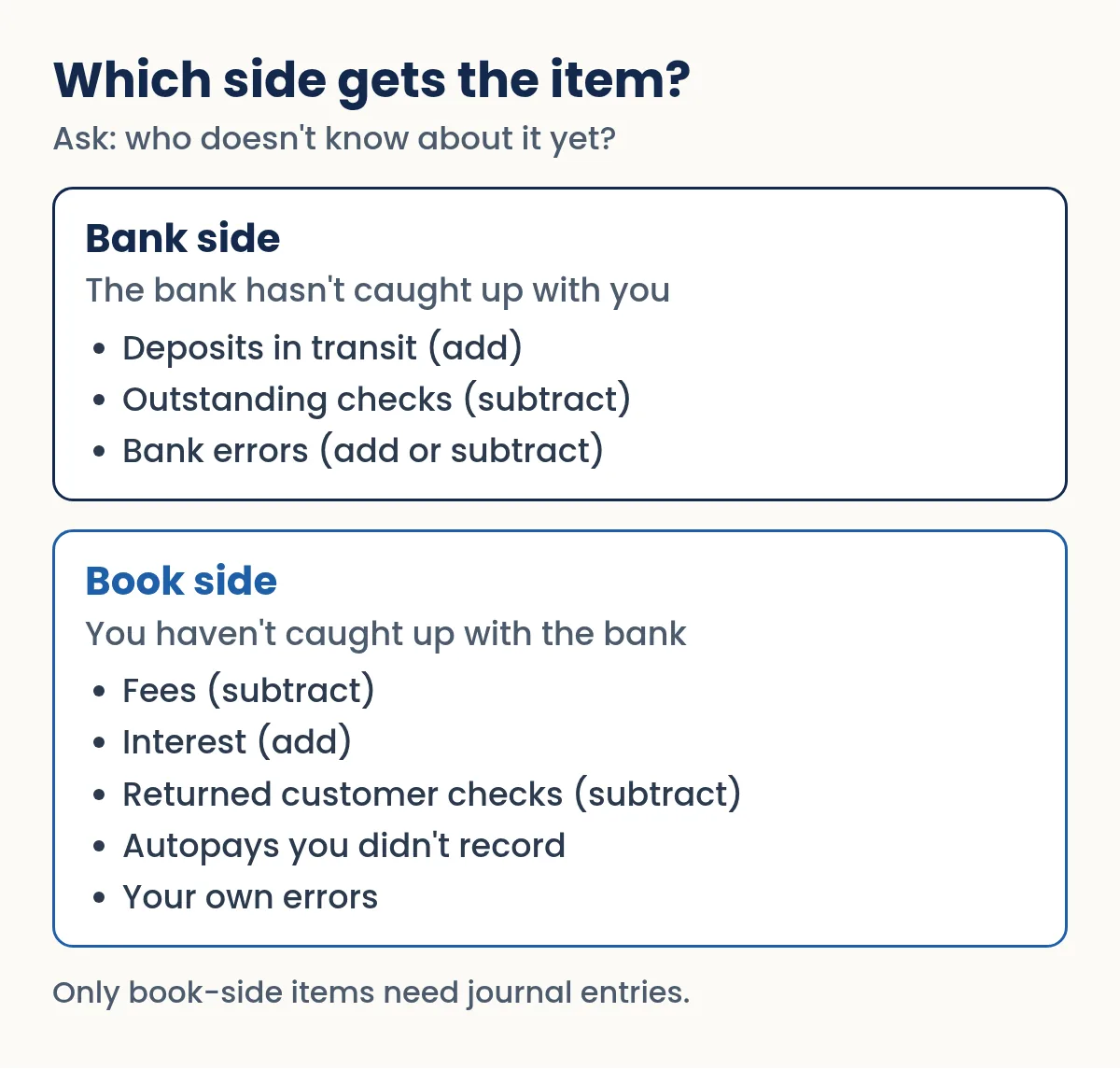
Start with the statement's ending balance. Add deposits in transit, subtract outstanding checks, and add or subtract any bank errors you found. This is the adjusted bank balance.
- Adjust the book side
Start with your book balance. Subtract fees and returned items, add interest and unrecorded credits, and correct your own recording errors. This is the adjusted book balance.
- Compare
The adjusted bank balance and adjusted book balance must be equal to the cent. If they are not, go back through the matching.
- Record the book-side adjustments
Post journal entries for every book-side item so your ledger reflects reality. Bank-side items need no entry; they resolve when they clear.
- Sign, date and file it
Save the reconciliation with the statement. Note who prepared it and who reviewed it.
A worked example
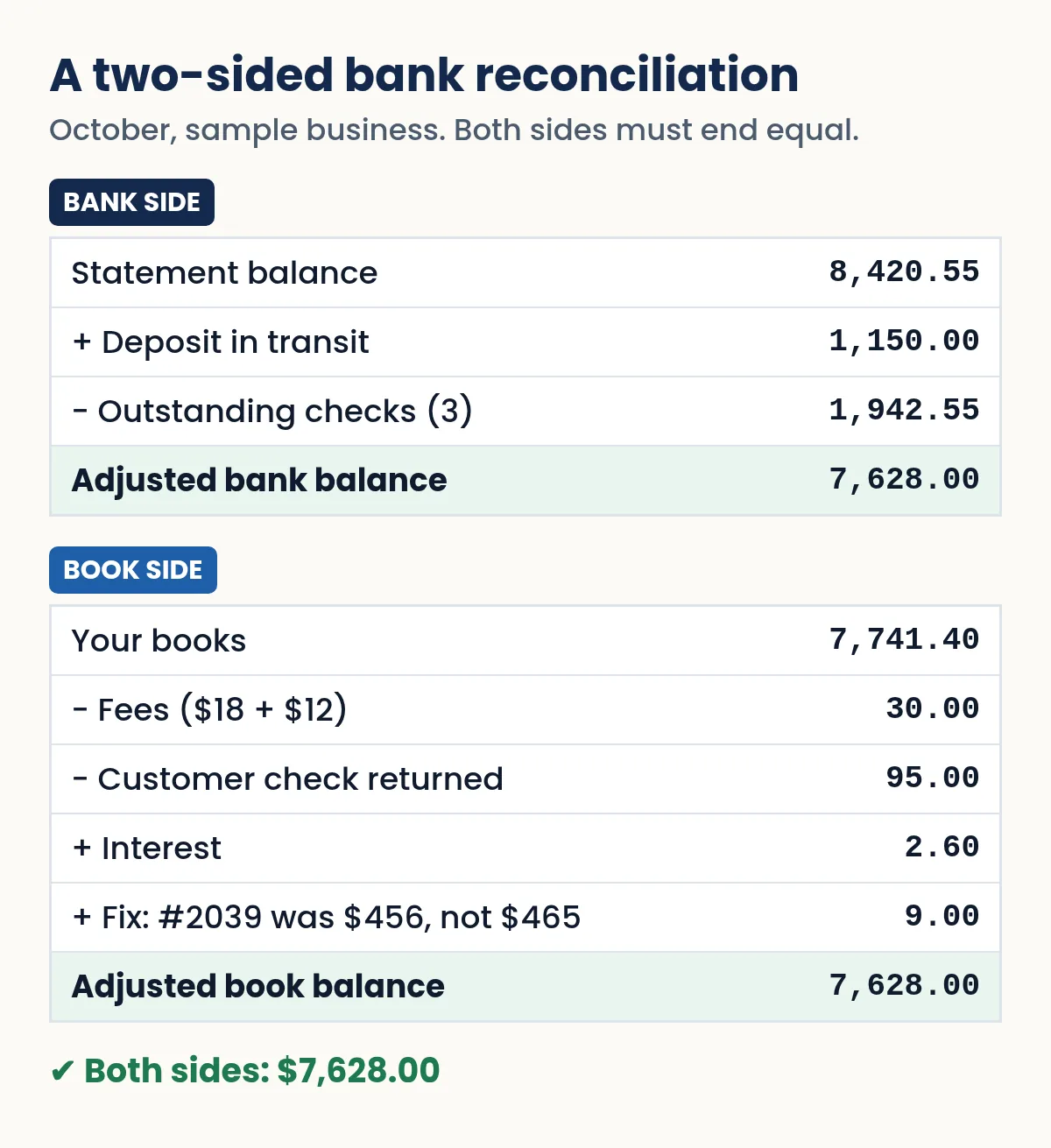
Here is a complete October reconciliation for a sample business, using the two-sided format shown at the top of this page.
The statement ends at $8,420.55. A $1,150.00 deposit made on October 31 isn't on it, so add it. Three checks haven't cleared: #2041 for $640.00, #2043 for $1,215.30 and #2044 for $87.25, totaling $1,942.55. Subtract them. Adjusted bank balance: $8,420.55 + $1,150.00 − $1,942.55 = $7,628.00.
The books show $7,741.40. The statement reveals an $18.00 service fee, a $95.00 customer check returned unpaid plus a $12.00 returned-item fee, and $2.60 of interest. Comparing check images also shows check #2039 was written for $456.00 but booked as $465.00, so the books understated cash by $9.00. Adjusted book balance: $7,741.40 − $18.00 − $95.00 − $12.00 + $2.60 + $9.00 = $7,628.00.
Both sides agree, so the account is reconciled. Now the book-side items go into the ledger.
Journal entries after the reconciliation
| Item | Debit | Credit | Amount |
|---|---|---|---|
| Monthly service fee | Bank fees expense | Cash | $18.00 |
| Returned customer check | Accounts receivable | Cash | $95.00 |
| Returned-item fee | Bank fees expense | Cash | $12.00 |
| Interest earned | Cash | Interest income | $2.60 |
| Correct check #2039 | Cash | Original expense account | $9.00 |
The returned check goes back to accounts receivable because the customer still owes you; follow up with them for payment, and decide whether to pass on the returned-item fee if your terms allow it. If you use accounting software, its reconciliation screen usually lets you create these entries as you go.
Need to write a check right now?
Quick Check Writer fills in the amount in words, adds the bank line and prints on blank check stock or saves a PDF. Your first check is free, with no account and no card.
Write your first check free →When the reconciliation won't balance
Work through these in order:
- Is the difference exactly one item? Look for that amount among your transactions; it is often an unrecorded fee, a missed deposit, or something recorded twice.
- Is it twice an item? A deposit may have been entered as a payment, or vice versa.
- Is it divisible by 9? Transposed digits are the classic cause.
- Did last month reconcile? An old unresolved difference carries forward until you fix it at the source.
- Did a check clear for a different amount? Compare the image with your record. If the bank misread the amount, ask for a correction. If the payee or amount was changed by someone else, treat it as possible fraud and call the bank immediately; see check washing.
Booking an unexplained difference to a miscellaneous account makes the numbers match but hides the cause. If you must close a period with a small unresolved amount, document it and keep investigating.
Common reconciliation mistakes
| Mistake | Why it hurts | Do this instead |
|---|---|---|
| Reconciling to today's online balance | The live balance keeps moving, so nothing ties out | Use the statement's ending balance and its exact closing date |
| Deleting voided checks from the books | Gaps in check numbers look like missing checks | Keep voids in the register, marked void, with $0 amount |
| Posting journal entries for bank-side items | Outstanding checks get subtracted twice | Only book-side items get entries |
| Carrying the same outstanding check for a year | Hides lost checks and unclaimed-property duties | Follow up on anything older than 90 days |
| Reconciling months late | Fraud windows close; details are forgotten | Reconcile within a week of the statement date |
| One person does it all, unreviewed | Errors and theft can hide in the "fix" | A second person reviews and initials |
Why speed matters: the reporting clocks
Reconciling promptly is not only tidy bookkeeping; deadlines run from the date your statement is made available.
- Checks (all accounts). Under UCC § 4-406, a customer who does not review statements with reasonable promptness can lose claims against the bank, especially for repeat forgeries by the same person after about 30 days, and generally loses any claim for a forged signature or alteration not reported within one year.
- Electronic transfers on personal accounts. Regulation E gives consumers 60 days from when the statement showing an error was sent to report it and get the bank's error-resolution process.
- Business accounts. Regulation E protects consumer accounts, not business ones. Business account agreements often set their own, shorter windows for disputing items. Read yours and set your reconciliation schedule to beat it.
Jane Doe runs a small bakery. Her November statement closes November 30 and is online December 2. She reconciles December 4 and spots check #3107 cleared for $2,140 to a name she doesn't recognize; her register says $214 to her flour supplier. She calls the bank the same morning with the check image and her register entry. Had she waited until tax season, the same fraud could have repeated for months before anyone noticed.
Controls that make reconciliations meaningful
A reconciliation done by the same person who writes and signs checks can hide the very problems it is meant to expose. Simple controls fix that, even in a two-person business.
- Separate duties. The person who reconciles should not be the only person who writes, signs or records checks.
- Review and sign off. The owner or a second person reviews each reconciliation, looks at the check images, and initials it.
- Reconcile promptly. Do it within days of the statement date, not months later. Speed matters for fraud claims.
- Investigate old reconciling items. A deposit in transit that never arrives or a check outstanding for months is a red flag.
- Combine with bank fraud tools. Reconciliation finds problems after the fact; services like Positive Pay stop many of them before a check is paid.
Special situations
Several bank accounts
Reconcile each account separately, including savings, payroll and merchant deposit accounts. Transfers between your own accounts should appear on both statements; a transfer that shows up on only one side is a timing difference or an error.
A separate account just for checks
Some businesses keep a dedicated account for issuing checks and fund it only as needed. It makes reconciliation simpler (fewer transaction types) and limits exposure if a check is copied. Our guide to check fraud prevention discusses this approach.
Payment processor deposits
Card processors often deposit net amounts after fees, and may combine several days of sales in one deposit. Record the gross sales and the fees separately so the deposit matches the statement.
Catching up on months of reconciliations
Start with the oldest unreconciled month and work forward one month at a time. Each month's outstanding items feed the next. Trying to reconcile a whole year in one pass makes errors almost impossible to locate.
Monthly reconciliation checklist
- Statement downloaded for the full period
- Book balance arithmetic verified
- All deposits and credits matched; deposits in transit listed
- All checks and debits matched; outstanding checks listed with numbers and dates
- Fees, interest, returned items and unrecorded electronic items identified
- Adjusted bank balance equals adjusted book balance
- Journal entries posted for book-side items
- Check images reviewed for unexpected payees or amounts
- Reconciliation signed by preparer and reviewer, filed with the statement
Keeping the records
Keep each reconciliation with its statement and the supporting documents. For tax purposes, the IRS generally expects you to keep records that support items on a return until the return's period of limitations ends, which is three years in the most common case and longer in some situations. IRS Publication 583 also notes that if you do not have a canceled check, certain account statements can serve as proof of payment, which is one more reason to keep statements organized.
Where check printing fits in
Reconciliation is only as good as your record of the checks you issued. If you print checks with Quick Check Writer, every printed check is logged in a register with its number, date, payee and amount, and voided checks are marked void rather than deleted. You can search the register, export it to CSV, and on the Pro plan export to QuickBooks formats, which makes the "match checks" step faster. Quick Check Writer does not connect to your bank or perform the reconciliation itself; it gives you a clean list to reconcile against. For personal accounts, the simpler version of this process is described in how to balance a checkbook.
Two records, one truth. A reconciliation explains every difference between them, and finds the ones that shouldn't exist.
Frequently asked questions
What is a bank reconciliation?
It is the process of comparing your accounting records with your bank statement and explaining every difference, so both arrive at the same true cash balance for the period.
How often should a business reconcile its bank account?
Monthly, as IRS Publication 583 recommends. Businesses with heavy transaction volume or fraud concerns often reconcile weekly or even daily.
What are deposits in transit and outstanding checks?
Deposits in transit are deposits you recorded that the bank hasn't credited yet. Outstanding checks are checks you wrote that the bank hasn't paid yet. Both are timing differences adjusted on the bank side.
Which items require journal entries?
Only book-side items: bank fees, interest, returned customer checks, unrecorded electronic transactions and corrections of your own errors. Bank-side items resolve when they clear.
What if my bank reconciliation doesn't balance?
Look for a missing or duplicated item, a deposit entered as a payment, transposed digits (differences divisible by 9), and unresolved differences from the prior month. Compare check images with your records.
Can Quick Check Writer reconcile my bank account?
No. Quick Check Writer prints checks and keeps a register you can search and export, which makes matching checks faster, but it does not connect to your bank or perform the reconciliation.
What is the difference between the bank balance and the book balance?
The bank balance is what your statement shows on its closing date. The book balance is what your own records (ledger, register or accounting software) show. They differ because of timing items like outstanding checks and deposits in transit, items the bank recorded that you have not (fees, interest, returned checks), and errors. A reconciliation explains every difference.
Who should prepare the bank reconciliation?
Ideally someone who does not write, sign or record checks, with a second person reviewing it. In a very small business, the owner can review a reconciliation prepared by a bookkeeper, or reconcile personally while someone else prepares checks.
Can I reconcile using online banking instead of the statement?
Online banking is great for spotting problems day to day, but reconcile to the statement: it has a fixed closing date and ending balance, so the numbers can tie out. A live online balance keeps changing as items post.
Related guides
- How to balance a checkbook
- Outstanding checks
- What is Positive Pay?
- Check register app that fills itself in
- What happens when a check bounces
- QuickBooks Check Printing Alternative: Printing on Blank Stock
Sources
- IRS Publication 583: Starting a Business and Keeping Records
- UCC § 4-406, Customer's duty to discover and report (Cornell LII)
- IRS: How long should I keep records?
- CFPB: Regulation E § 1005.11, Procedures for resolving errors
Last updated November 1, 2026. This page is general information, not legal or financial advice. Quick Check Writer is check printing software; it is not a bank and does not move money.