
Key takeaways
- Collect a W-9 and a verified phone number before the first payment.
- Verify and approve every invoice; search for duplicates first.
- Put invoice numbers on the memo or voucher stub.
- Confirm any change of address or payment details by calling a known number.
- Separate who approves, prepares, signs and reconciles.
On this page
- Why many businesses still pay vendors by check
- Before the first payment: set the vendor up properly
- The vendor payment process, step by step
- Use voucher stubs so vendors apply your payment correctly
- Timing: when to pay
- Before you sign: a five-point check
- Common vendor payment mistakes, and how to avoid them
- Internal controls for small teams
- When a vendor says they never received the check
- Situations that need a different approach
- Records to keep
- How Quick Check Writer helps (and what it doesn't do)
- FAQ
Why many businesses still pay vendors by check
Electronic payments are growing, but checks remain common in business-to-business payments, especially with small suppliers, contractors, landlords and anyone who does not want to share bank details. A check gives you a clear paper trail, control over timing, and a way to pay a vendor without collecting or storing their account number.
The trade-off is that checks are slower and need more handling, and every handoff is a chance for an error or for fraud. The process below is designed to keep the convenience while closing those gaps. If you are deciding between methods, our comparison of ACH vs. check lays out the pros and cons.
Before the first payment: set the vendor up properly
Most vendor payment problems start with bad vendor records. Do this once, carefully, for each new vendor.
- Collect a Form W-9. The IRS form gives you the vendor's legal name, business entity type and taxpayer identification number. You will need it if you have to file a Form 1099, and it tells you the exact legal name to put on the check. See paying contractors by check for the 1099 rules.
- Record the remittance address. Use the "remit to" address on the vendor's invoice or W-9, which is often different from their street address.
- Note payment terms. Due dates, early-payment discounts and any late fees.
- Save a phone number from an independent source, such as the vendor's website or a signed contract, so you can verify any future change requests.
A common scam is a message, apparently from a vendor, saying they have a new address or bank account. The FBI's Internet Crime Complaint Center advises verifying all payment changes in person or using a known telephone number. Call the number you saved, not one in the message.
The vendor payment process, step by step
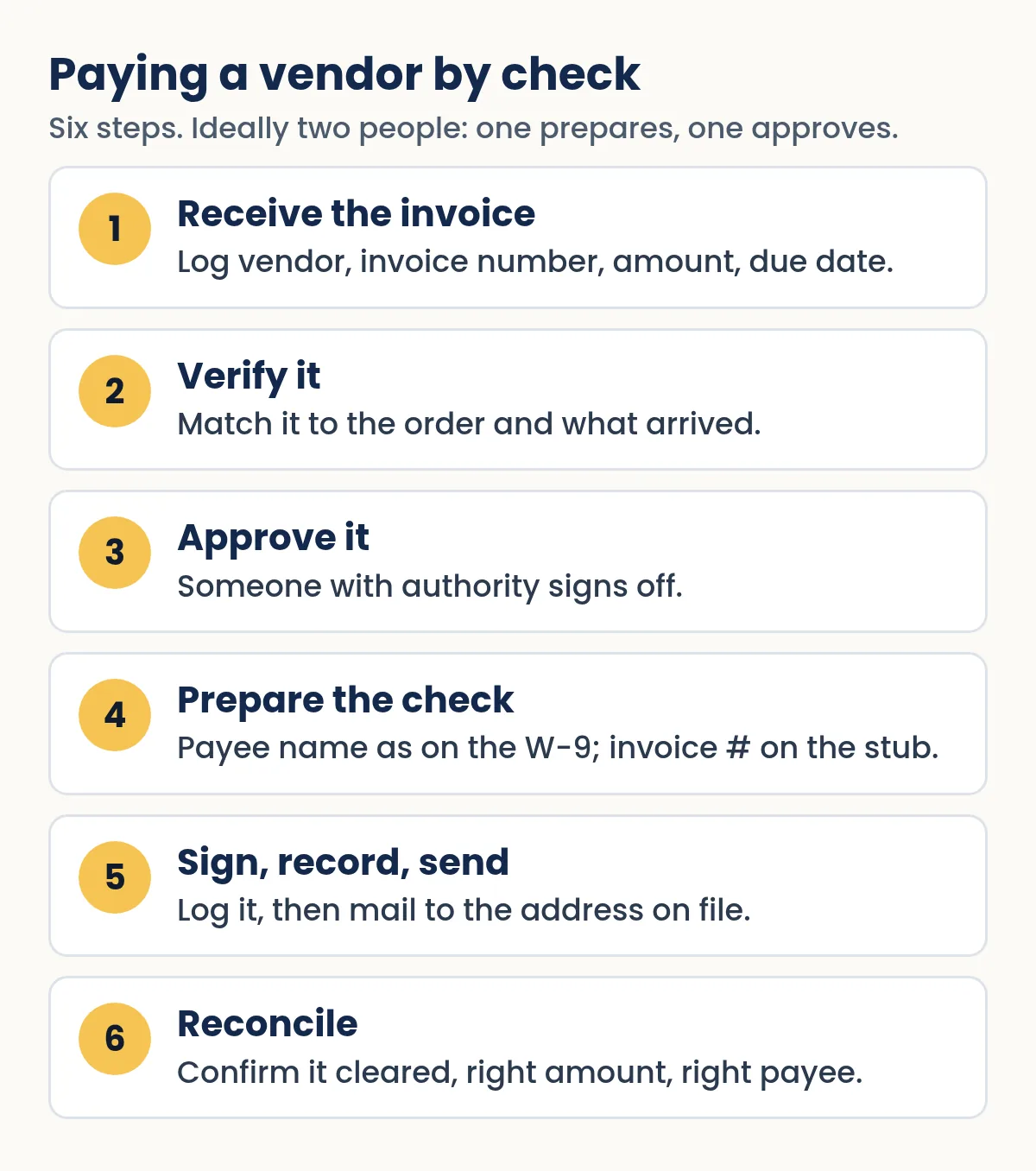
- Log the invoice when it arrives
Record the vendor, invoice number, invoice date, amount and due date in your payables list or accounting software. Logging on arrival, not when you pay, keeps invoices from getting lost and lets you plan cash.
- Verify the invoice
Check that the goods or services were actually ordered and received, and that quantities and prices match what was agreed. Many businesses compare three documents: the purchase order, the receiving record and the invoice. Small businesses can simply confirm with the person who ordered it.
- Check for duplicates
Search your records for the same invoice number and amount. Paying the same invoice twice is one of the most common and most avoidable payables mistakes, especially when a vendor sends a reminder copy.
- Approve it
Someone with authority approves the payment before a check is prepared. Set dollar limits: for example, the office manager approves up to a set amount and the owner approves anything above it.
- Prepare the check
Use the payee's legal name exactly as on the W-9, the correct amount, and the invoice number in the memo or on the voucher stub. Batch payments to the same vendor into one check with each invoice listed.
- Sign it
The signer reviews the backup (invoice and approval) before signing. Some businesses require two signatures above a threshold.
- Record and send
Log the check number against each invoice it pays, mark the invoices paid, and mail the check to the remittance address on file. Our guide on mailing a check safely covers envelopes and timing.
- Reconcile
When the check clears, confirm the amount and payee on the check image. A monthly bank reconciliation catches anything unexpected.
Use voucher stubs so vendors apply your payment correctly
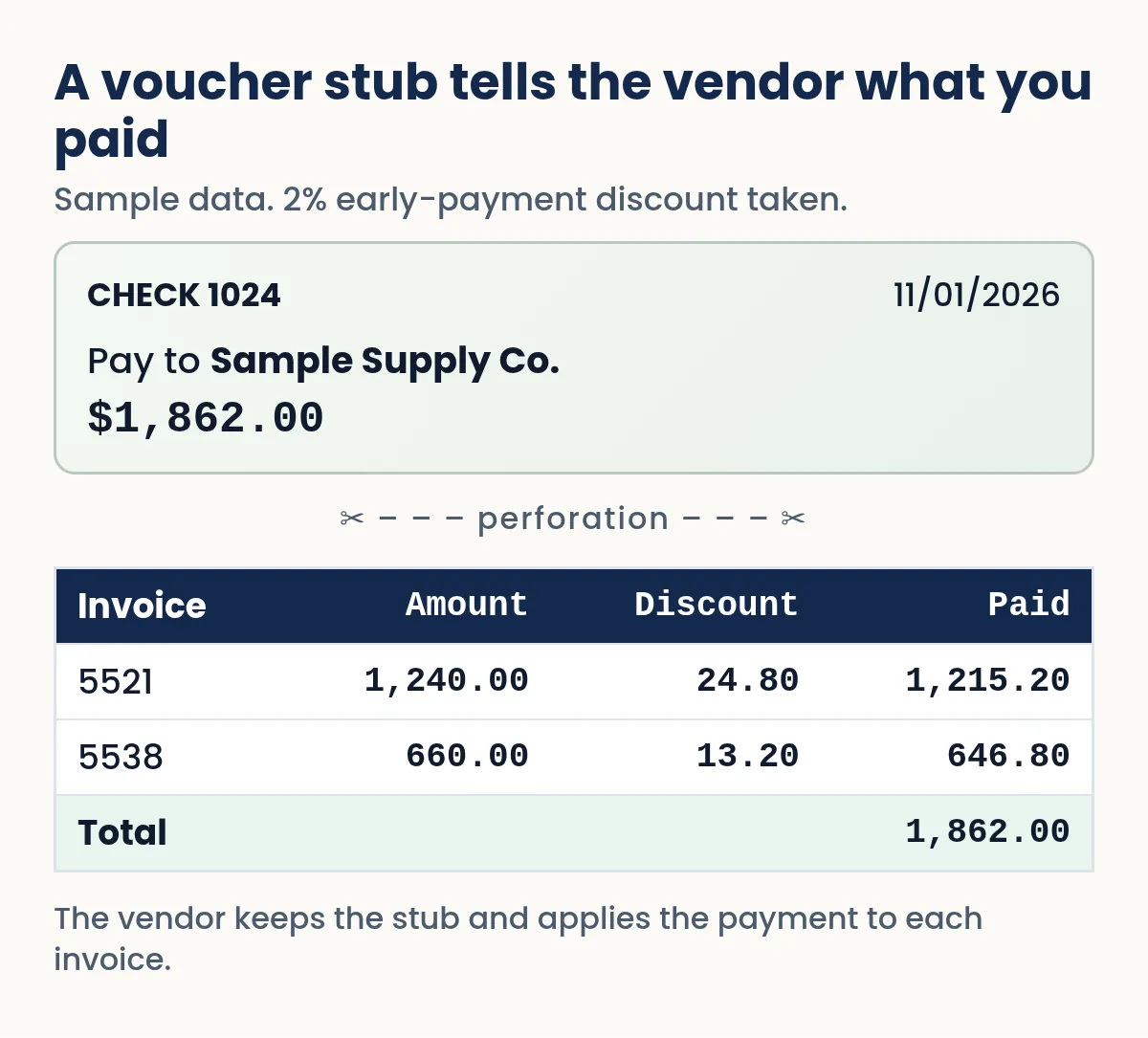
A vendor that receives a bare check for $1,862 may not know which invoices it covers, leading to calls, misapplied payments and false late notices. A voucher check solves this with a detachable stub listing what the payment covers. Put the vendor's invoice numbers, dates, amounts and any discount taken on the stub, and keep the second stub for your files.
Quick Check Writer's top, middle and bottom layouts print two voucher stubs on the sheet. You can add a stub note (for example, the invoice numbers and amounts) and even attach a photo, such as the invoice, to the stub. Our guide to check stubs and voucher checks shows the layouts.
Need to write a check right now?
Quick Check Writer fills in the amount in words, adds the bank line and prints on blank check stock or saves a PDF. Your first check is free, with no account and no card.
Write your first check free →Timing: when to pay
Paying on the due date, not early and not late, is usually the goal. A few points shape the decision:
- Mail time counts. Many vendors consider a check paid when it arrives, not when you mail it. Allow several days for mail, more around holidays.
- Early-payment discounts can be worth it. Terms written as "2/10 net 30" mean you can take a 2% discount if you pay within 10 days; otherwise the full amount is due in 30. Giving up that 2% to keep cash 20 days longer is an expensive trade for most businesses.
- Run payments on a schedule. A weekly or twice-monthly check run keeps the process predictable, makes approvals easier and reduces one-off rush payments, which are where mistakes happen.
- Don't postdate checks to manage cash. A bank can generally pay a postdated check early unless you have given it formal notice. See post-dated checks.
What skipping an early-payment discount really costs
Terms of "2/10 net 30" sound small, but the math is not. If you skip the discount, you keep $98 of every $100 for 20 extra days (from day 10 to day 30) at a price of $2. That is about 2% for 20 days. Over a full year, it works out to roughly 37% (2 ÷ 98 × 365 ÷ 20). Few businesses borrow money that expensively, so if cash allows, paying inside the discount window is usually the better deal.
Two practical points: mail the check early enough that it arrives within the discount period, and show the discount on the stub so the vendor's bookkeeper does not treat it as a short payment.
Before you sign: a five-point check
Keep this list next to wherever checks get signed. It takes under a minute per check.
- Is there an approved invoice behind it? No backup, no signature.
- Does the payee match the vendor record? Same legal name as the W-9, not a similar-looking name.
- Do the numbers agree? The amount in numbers, the amount in words and the invoice total (less any discount) should all match.
- Is the address the one on file? Any new address must have been verified by phone with a known contact.
- Has it been paid before? One last search for the invoice number in your register or payables list.
Common vendor payment mistakes, and how to avoid them
| Mistake | What it costs | Prevention |
|---|---|---|
| Paying an invoice twice | Cash out the door; awkward recovery | Search by invoice number before paying; mark invoices paid |
| Paying a fake vendor or fake invoice | Direct loss | Add vendors only with a W-9 and an approval; verify unfamiliar invoices |
| Sending to a changed address without checking | Payment stolen; vendor still unpaid | Verify changes by calling a known number |
| Missing due dates | Late fees, lost discounts, strained relationships | Log invoices on arrival; run payments on a schedule |
| No invoice reference on the check | Misapplied payments, collection calls | Invoice numbers on memo or stub |
| One person does everything | Errors and fraud go unnoticed | Split approving, preparing, signing and reconciling |
| Not collecting a W-9 | Scramble at 1099 time; possible backup withholding obligations | Collect the W-9 before the first payment |
Internal controls for small teams
You do not need a finance department to have good controls. Even with two people:
- Separate duties. The person who sets up vendors or prepares checks should not also sign them and reconcile the account.
- Require backup for every signature. No invoice, no signature.
- Lock up check stock and track check numbers, including voided ones. See how to void a check.
- Use your bank's fraud tools. Services like Positive Pay compare each presented check against your list of issued checks.
- Review the vendor list a few times a year. Deactivate vendors you no longer use and look for duplicates or unfamiliar names.
John Sample's company receives two invoices from Sample Supply Co.: #5521 for $1,240.00 and #5538 for $660.00, both with 2/10 net 30 terms. The office manager confirms both deliveries and John approves them on day 8. One check for $1,862.00 is printed, with both invoices and the $38.00 total discount listed on the stub, and the check is recorded against both invoice numbers before it is mailed.
When a vendor says they never received the check
- Check whether it cleared
Look up the check number in online banking. If it cleared, open the image: confirm the payee name, the amount and the deposit endorsement on the back. If it cleared to someone else, treat it as fraud and call your bank right away.
- If it hasn't cleared, confirm the address
Compare the address you used with the remittance address on the invoice. A wrong suite number or an old PO box is a common culprit.
- Stop payment, then reissue
Place a stop payment on the original check number before sending a replacement with a new number, so both cannot be paid. See how to stop payment on a check.
- Update your records
Void the original in your register, link the replacement to the same invoices, and note the date you reissued it.
Lost vendor checks that are never cashed become outstanding checks, and in many states, after a long enough period, unclaimed property that must be reported. Following up within a few weeks keeps that from happening.
Situations that need a different approach
A brand-new vendor wants a deposit up front
Deposits are normal for custom orders and some services, but they are also how fake-vendor scams get paid. Before writing the first check, confirm the business exists (a website, a physical address, a phone number you looked up yourself), get a W-9 and a written quote or contract stating the deposit amount, and make the check payable to the business's legal name, never to an individual employee. Note on the stub that it is a deposit, so the final invoice can be reduced by that amount.
The invoice amount is in dispute
If you disagree with a bill, talk to the vendor before sending a partial payment. Be careful with checks marked "paid in full" for less than the amount billed: under the Uniform Commercial Code (§ 3-311), when an amount is genuinely in dispute and a check is offered in good faith with a conspicuous statement that it is full satisfaction, cashing it can settle the whole claim, subject to exceptions such as repaying the check within 90 days. Because the result depends on the facts and on state law, put any settlement in writing and get advice for larger amounts. The same rule matters in reverse when your business receives such a check from a customer.
Paying a vendor from a personal account
It works, but it makes your records harder to follow. The IRS advises opening a business checking account as one of the first steps in a new business, keeping it separate from your personal account, and making payments by check so business expenses are documented. If a personal check is ever used for a business bill, note it in your books right away.
One check or several?
One check per vendor per payment run, listing every invoice on the stub, means fewer checks to print, sign and reconcile. Write separate checks when invoices belong to different departments or jobs that the vendor tracks separately, or when one invoice is disputed and the rest are not.
Records to keep
Keep the invoice, the approval, a copy or record of the check and the vendor's W-9 together, or linked in your system. For tax purposes, the IRS generally expects you to keep records that support items on your return until the return's period of limitations ends, three years in the most common case. IRS Publication 583 also explains that when you don't have a canceled check, certain bank statements can serve as proof of payment.
How Quick Check Writer helps (and what it doesn't do)
Quick Check Writer prints your vendor checks on blank stock with a correct MICR line, fills in the amount in words, and can print your logo and signature. Payee details are saved on your device for next time, you can batch print several saved checks at once, and every check lands in a searchable register you can export to CSV, or to QuickBooks formats on the Pro plan. It does not mail checks, send ACH payments or track invoices for you; you mail the printed check yourself and manage invoices in your accounting system. To get started, see how to print business checks.
Verify the invoice, verify the vendor, reference the invoice on the stub, and separate the hands that touch the money.
Frequently asked questions
What information do I need to pay a vendor by check?
The vendor's legal name, remittance address, the invoice number and amount, and ideally a Form W-9 on file with their taxpayer identification number.
Should I put the invoice number on the check?
Yes. Put it on the memo line or, better, list each invoice on a voucher stub so the vendor can apply your payment correctly.
How do I avoid paying an invoice twice?
Log every invoice when it arrives, search for the same invoice number and amount before paying, and mark invoices paid with the check number once the check is issued.
A vendor emailed new payment instructions. What should I do?
Verify the change by calling the vendor at a phone number you already had, not one in the email. The FBI's Internet Crime Complaint Center recommends verifying all payment changes in person or by a known number.
Do I need a W-9 from every vendor?
It is good practice for any business vendor you pay for services, because you may need their TIN to file Form 1099-NEC. Corporations are generally exempt from 1099 reporting, but the W-9 tells you their entity type.
Can Quick Check Writer mail checks to vendors?
No. Quick Check Writer prints checks on your own printer and keeps a register; you mail the check yourself.
What does 2/10 net 30 mean?
It is a payment term: you may take a 2% discount if you pay within 10 days of the invoice date; otherwise the full amount is due within 30 days. Skipping the discount is the equivalent of borrowing at roughly 37% a year, so paying early is usually worth it when cash allows.
Can I pay a business vendor from my personal checking account?
You can, but the IRS recommends keeping a separate business checking account and paying business expenses by check from it, so your records clearly show what was a business expense. If you do use a personal check, record it in your business books right away.
What happens if I send a check marked "paid in full" for less than the bill?
If the amount is genuinely disputed and the check is offered in good faith with a clear "full satisfaction" statement, the vendor cashing it can settle the whole debt under UCC § 3-311, though there are exceptions (for example, the vendor repaying the amount within 90 days). Discuss disputes first and put any settlement in writing.
Related guides
- Paying contractors by check (and the 1099)
- Check stubs and voucher checks
- How to Print Business Checks
- ACH vs check: which payment should you use?
- What is Positive Pay?
- How to do a bank reconciliation
Sources
- IRS: About Form W-9
- FBI IC3 PSA I-040620: Business Email Compromise recommendations
- IRS Instructions for Forms 1099-MISC and 1099-NEC
- IRS Publication 583: Starting a Business and Keeping Records
- UCC § 4-401, When bank may charge customer's account (Cornell LII)
- IRS: How long should I keep records?
- NAUPA: What is unclaimed property?
- UCC § 3-311, Accord and satisfaction by use of instrument (Cornell LII)
Last updated November 1, 2026. This page is general information, not legal or financial advice. Quick Check Writer is check printing software; it is not a bank and does not move money.