
Key takeaways
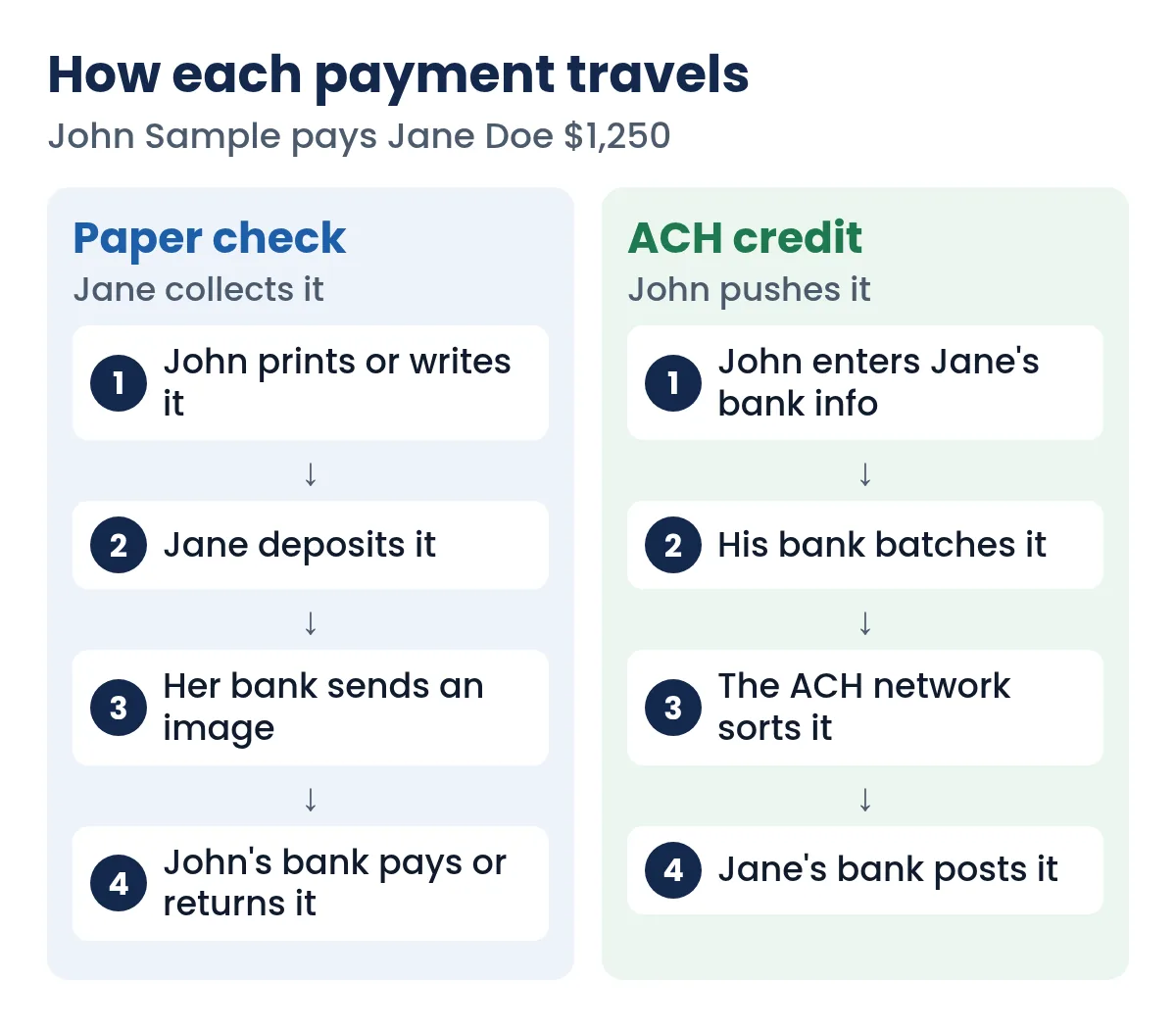
- ACH moves money as electronic batches; a check is collected by the payee when they deposit it.
- ACH usually settles the same day to two business days; checks add mailing and deposit time plus bank holds.
- Consumer ACH is covered by Regulation E; checks fall under the UCC and Regulation CC.
- Choose ACH for payroll and recurring bills, checks for one-off payments and payees without ACH.
On this page
- The short version
- What ACH actually is
- What a check actually is
- ACH vs check, side by side
- Speed: how fast each one really is
- Cost
- Safety and fraud: different risks, not "safe vs unsafe"
- Common mistakes with ACH and checks
- If someone debits your account without permission
- When a check is the better choice
- When ACH is the better choice
- Setting up each one
- Where Quick Check Writer fits
- FAQ
The short version
ACH and checks both move money from one bank account to another, and both rely on the same two numbers: a routing number and an account number. The difference is who starts the transfer and what carries the instructions. With a check, the instructions are printed on paper (or a check image) and the person you pay starts the collection when they deposit it. With ACH, the instructions travel as an electronic file in a batch, and either you push the money (an ACH credit) or the payee pulls it with your permission (an ACH debit).
Neither one is "better" in general. ACH is built for repeat, high-volume payments. A check is built for one payment at a time, to anyone, without first setting up a link between two bank accounts.
What ACH actually is
ACH stands for Automated Clearing House. The Federal Reserve describes it as a nationwide network through which banks send each other batches of electronic credit and debit transfers. Two operators run the central sorting: the Federal Reserve Banks and the Electronic Payments Network (EPN). The rules that every participating bank follows are written by Nacha, the organization that governs the network.
You already use ACH even if you never typed the letters. Typical ACH payments include:
- Direct deposit of a paycheck, Social Security benefit or tax refund (ACH credits).
- Autopay for a mortgage, insurance premium, utility or gym (ACH debits).
- Bank-to-bank transfers you set up in online banking, and many bill-pay and payroll services.
- Converted checks, where a merchant or lockbox uses the numbers on your paper check to create a one-time electronic debit.
- ACH credit
- The payer's bank sends money out. You control it: you choose the amount and the day.
- ACH debit
- The payee's bank pulls money in, based on an authorization you gave. Convenient for bills, but you are trusting the payee to pull the right amount.
- Same Day ACH
- A faster option where a payment is sent and settled on the same banking day, subject to a per-payment limit.
What a check actually is
A check is a written order from you to your bank: pay this person this amount from my account. Everything the bank needs is on the face. The payee, amount and date are in the main area, and the bank line at the bottom (printed in magnetic E-13B characters) carries your routing number, account number and check number. See our labeled guide to the parts of a check for each field.
Once the payee deposits it, the check is usually turned into an image and presented to your bank electronically. Your bank then pays it from your account or returns it unpaid. If a check is drawn for more than you have, your bank can bounce it, and both of you may pay fees; our guide on what happens when a check bounces walks through it.
ACH vs check, side by side
| ACH | Check | |
|---|---|---|
| Who starts it | Payer (credit) or payee with permission (debit) | Payer writes it; payee starts collection by depositing |
| What you need from the payee | Their routing and account number | Just their name (and a mailing address if you mail it) |
| What the payee learns about you | Credit: usually just your name. Debit: your account details | Your name, bank, routing and account number |
| Typical speed | Same day to two business days | Depends on when it's deposited, then bank hold rules |
| Works for a one-off payee | Awkward (needs bank details first) | Yes |
| Good for hundreds of payments | Yes | Slow (printing and mailing each one) |
| Main consumer rules | Regulation E and Nacha rules | UCC Articles 3 and 4, Regulation CC |
| Stopping a payment | Recurring debits: tell your bank at least 3 business days ahead | Stop-payment order before the check is paid |
| Paper record the payee keeps | Bank statement line | The check itself plus any stub |
Speed: how fast each one really is
ACH timing
According to Nacha, ACH payments can be processed within hours on the same business day, or scheduled for the next day; senders of ACH credits can also choose up to two business days. The network settles payments several times every banking day, but not on weekends or federal holidays, because settlement happens through the Federal Reserve's settlement service. A payroll file sent on Friday afternoon therefore may not land until Monday if it misses the day's windows.
Same Day ACH has a per-payment cap. It is $1 million today, and Nacha has announced that the cap rises to $10 million on September 17, 2027. Above the cap you would use a wire instead (see wire transfer vs check).
Check timing
A check has two clocks. The first is delivery: a check sits in an envelope, a drawer or a purse until the payee deposits it. The second is the bank's hold. Federal Regulation CC sets the maximum hold times and requires next-business-day availability for some kinds of deposits, plus the first $275 of other check deposits on a banking day. Our guide on how long a check takes to clear covers the full rules and exceptions.
"Available" and "final" are not the same thing. A bank can let the payee spend deposited check money and still charge it back later if the check is returned. With an ACH credit, the payer's bank has already sent the money, which is why many landlords and employers prefer it for large or regular payments.
Cost
For consumers, both are often free. Many banks don't charge to send an ACH transfer from online banking, and writing a check from your own checkbook costs only the check and a stamp. For businesses the picture varies by bank. Some charge per ACH file or per transaction, some bundle ACH into a monthly treasury package, and payroll or payments software usually adds its own fee. Checks cost money in stock, ink, envelopes and postage, plus the time to prepare and mail them.
If you print your own checks on blank stock, the per-check cost drops a lot compared with ordering pre-printed checks; our guide to what it costs to print your own checks breaks this down. Exact bank fees vary, so check your bank's fee schedule before you choose.
Need to write a check right now?
Quick Check Writer fills in the amount in words, adds the bank line and prints on blank check stock or saves a PDF. Your first check is free, with no account and no card.
Write your first check free →Safety and fraud: different risks, not "safe vs unsafe"
Both methods expose bank details, just to different people. A check shows your routing and account numbers to everyone who handles it. ACH requires the payee's numbers if you push money, or yours if they pull it. Practical risks look like this:
- Checks can be stolen from the mail, altered with chemicals (check washing) or counterfeited using the numbers on the bottom line. Mitigations: mail from inside the post office, use pens and printers that bond ink to paper, and use security features.
- ACH debits can be set up by someone who has your account numbers. Watch statements closely, and use your bank's debit blocks or filters if it offers them.
- ACH credits are vulnerable to "change of bank details" scams, where a fake email asks you to send a vendor's payment to a new account. Always confirm new bank details by phone using a number you already have.
Your rights when something goes wrong
For consumer accounts, ACH transfers are electronic fund transfers under Regulation E. If an error or an unauthorized transfer appears, notify your bank promptly; the regulation's error-resolution process covers notices the bank receives within 60 days after it sends the statement that first shows the problem. You can also stop a recurring preauthorized debit by telling your bank at least three business days before the scheduled date.
Checks fall under the Uniform Commercial Code. You can order your bank to stop payment on a check that hasn't been paid yet; under UCC § 4-403 a stop-payment order lasts six months, but an oral order lapses after 14 days unless confirmed in a record. Our guide on how to stop payment on a check covers fees and timing.
When you hand a paper check to a store or mail it to a lockbox, it may be converted into a one-time ACH debit. Regulation E requires notice of this, and the conversion means the money can leave your account faster than you'd expect from a paper check. Never write a check you can't cover today.
Common mistakes with ACH and checks
| Mistake | What can happen | Better habit |
|---|---|---|
| Changing a vendor's bank details from an email | The payment goes to a fraudster's account | Confirm by phone at a number you already had |
| Writing a check you can't cover today | It may be converted to ACH and debited fast, then bounce | Write it only when the money is there |
| Not reading statements | An unauthorized debit runs for months | Review every statement as soon as it arrives |
| Sending payroll ACH at the last minute | It misses the day's windows and lands late | Send a business day ahead |
| Mailing checks from a home mailbox | Theft and check washing | Mail inside the post office |
| No memo or stub on a check | Payment applied to the wrong invoice | Put the invoice number on the memo or stub |
If someone debits your account without permission
On a consumer account, timing decides how much protection you keep. Regulation E asks you to report an unauthorized transfer that appears on your statement within 60 days after the bank sends that statement; if you wait longer, you can be held responsible for later unauthorized transfers that a timely report would have stopped. On the network side, the Nacha Rules give the consumer's bank a 60-day window to return an unauthorized debit once the consumer signs a written statement that they didn't authorize it.
- Call your bank the day you notice
Say the debit is unauthorized and ask for the dispute or written-statement form.
- Block the sender
Ask about debit blocks or filters so the same company can't pull again.
- Check for paper too
If someone has your account numbers, watch for counterfeit checks as well, and ask whether you need a new account number.
Business accounts don't get Regulation E's protection. Your bank agreement and the Nacha Rules set the deadlines, and they can be short, so business owners should review activity daily.
When a check is the better choice
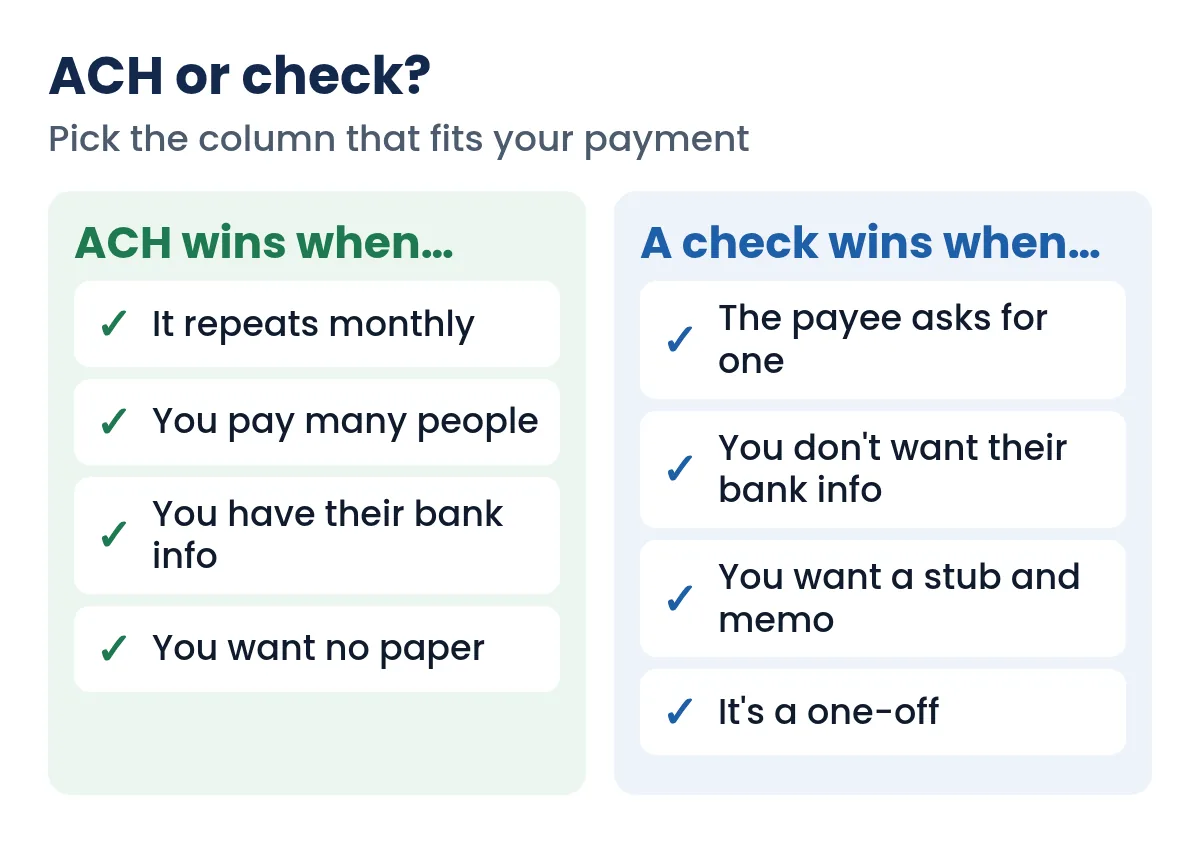
- The payee isn't set up for ACH. Contractors, small landlords, schools, clubs, courts and many government offices still ask for a check, and a check needs nothing set up in advance.
- You don't want to collect someone's bank details. Sending an ACH credit means storing the payee's account number. With a check, they deposit it into whatever account they like.
- You want the paperwork attached. A voucher stub can carry the invoice number, a breakdown or a note, and the memo line tells the payee what the money is for.
- It's a one-time payment. A deposit, a refund, a gift or a settlement doesn't justify setting up a recurring link.
- You want control of timing. You decide when it leaves your hands, and the payee can't pull a different amount later.
When ACH is the better choice
- Payroll and recurring bills. Employees expect direct deposit, and a bill that repeats every month is easier on autopay.
- Volume. One ACH file can pay hundreds of people. Printing, signing and mailing that many checks takes real time.
- Remote payees. No mail delays and no lost envelopes.
- Predictable receiving. If you collect rent or dues, ACH debits with your customers' permission can reduce late payments, though you need a provider and authorization forms to do it properly.
Setting up each one
To send an ACH payment
- Get the payee's details
Ask for the bank name, routing number, account number and account type (checking or savings). Get them in writing, ideally on the payee's letterhead or a voided check.
- Verify by phone
Call the payee on a number you already have to confirm the numbers, especially for a first payment or any change.
- Add the payee in online banking
Use your bank's transfer or bill pay feature, or a payroll or payments provider for business volume.
- Schedule and record it
Pick the date, save the confirmation and record the payment in your books the same day.
To pay by check
- Fill in the essentials
Date, payee, amount in numbers and amount in words, a memo, and your signature. Our step-by-step guide on how to write a check covers every line.
- Record it
Note the check number, payee and amount in your register so you know what is still outstanding.
- Deliver it safely
Hand it over, or follow our guide on how to mail a check.
John Sample runs a small office. His two employees get direct deposit through his payroll provider every other Friday (ACH). The cleaning contractor, Jane Doe, prefers a check once a month, so John prints one with an invoice note on the stub and logs it in his check register. Both are correct choices for those payees.
Where Quick Check Writer fits
Quick Check Writer prints checks; it doesn't send ACH payments, move money or connect to your bank. What it does is make the check side of your payments fast: you type the payee and amount, it fills in the amount in words, adds the bank line in MICR font, and prints on blank check stock with your home printer. Every check is saved in a register you can search, reprint or export, and your bank details stay on your device.
If you pay most bills by ACH and only need the occasional check, that's exactly the case it's designed for. You don't need to order a box of checks you'll use twice a year.
Frequently asked questions
Is ACH faster than a check?
Usually. ACH payments settle the same day or within one to two business days, while a check also has to be delivered and deposited before the bank's hold rules even start. Same Day ACH is faster still, up to its per-payment limit.
Is an ACH payment the same as an eCheck?
Often, yes. Many "eCheck" services use the ACH network to move the money. Others send a check image or a printable check by email. See eCheck vs paper check for the differences.
Can a paper check be turned into an ACH payment?
Yes. A merchant or lockbox can use the numbers on your check to create a one-time electronic debit, as long as you get notice. The money may leave your account faster than a normal check would.
Which is safer, ACH or a check?
They have different risks. Checks can be stolen, washed or counterfeited; ACH credits are a target for fake change-of-bank-details emails, and ACH debits can be misused by someone with your account numbers. Good habits matter more than the method.
Can I cancel an ACH payment?
For recurring debits from a consumer account, you can tell your bank to stop a scheduled payment at least three business days before it's due. A one-time payment that has already gone out is much harder to recall, so call your bank right away.
Do I need my bank's permission to send ACH as a business?
To send ACH files directly you need an arrangement with your bank or a payments provider, because they take on responsibility for your entries. Small businesses usually use their bank's online ACH service or a payroll provider.
Does Quick Check Writer send ACH payments?
No. Quick Check Writer prints checks on blank check stock and saves them as PDFs. For ACH, use your bank's online transfers or a payroll provider.
What happens if an ACH payment bounces?
If the payer's account can't cover an ACH debit, the payer's bank returns it unpaid, much like a bounced check. The payer's bank may charge a fee, and the company that tried to collect may charge its own returned-payment fee.
Can someone take money from my account with just my routing and account number?
They can try, by setting up an ACH debit or printing counterfeit checks. That is why you should watch statements closely. On a consumer account, report an unauthorized debit within 60 days of the statement that shows it.
Related guides
- Wire transfer vs check
- eCheck vs. Paper Check: What's the Difference?
- How Long Does a Check Take to Clear?
- Direct deposit and the voided check
- How to write a check, step by step
- Check fraud prevention for people and small businesses
Sources
- Federal Reserve: Automated Clearinghouse Services
- Nacha: ACH Payments Fact Sheet
- Nacha: Same Day ACH per-payment limit to increase to $10 million (Apr 27, 2026)
- Regulation E, 12 CFR 1005.3 (coverage), eCFR
- Regulation E, 12 CFR 1005.10 (stopping preauthorized transfers), eCFR
- Regulation E, 12 CFR 1005.11 (error resolution), eCFR
- Regulation CC, 12 CFR 229.10 (next-day availability), eCFR
- UCC § 4-403 Stop payment, Cornell LII
- Regulation E, 12 CFR 1005.6 (liability for unauthorized transfers), eCFR
- Nacha: Differentiating unauthorized return reasons (R10/R11, 60-day return timeframe)
Last updated November 1, 2026. This page is general information, not legal or financial advice. Quick Check Writer is check printing software; it is not a bank and does not move money.