
Key takeaways
- A signed blank check can be completed for any amount; your bank may pay it in good faith.
- Never sign before the payee and amount are filled in.
- Blank check stock is paper with no account details, made for printing your own checks.
- Blank stock doesn't expire; a written check can go stale after six months.
On this page
- Meaning 1: a signed check with blanks left open
- Real situations, step by step
- Checklist: closing every gap before you hand over a check
- Signed blank check vs safer alternatives
- Meaning 2: blank check stock for printing your own checks
- Blank check vs similar terms
- Do blank checks expire?
- A third meaning you may run into
- Printing checks on blank stock with Quick Check Writer
- FAQ
Meaning 1: a signed check with blanks left open
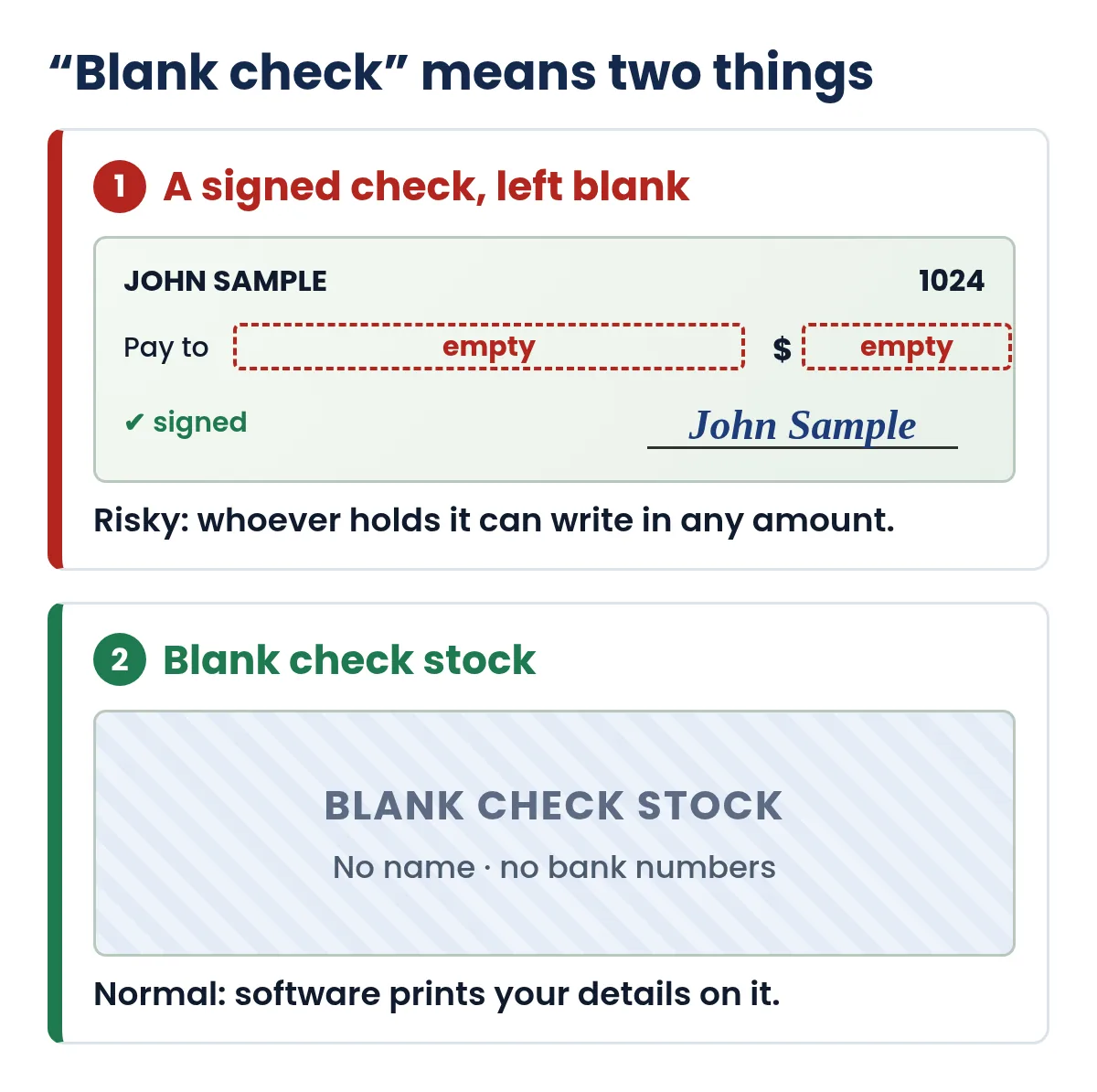
In everyday speech, "writing someone a blank check" means signing a check and leaving the payee, the amount or both for the other person to fill in. Literally, it's an order to your bank to pay whatever they write. Figuratively, it's become shorthand for unlimited authority, as in "the contractor doesn't get a blank check".
Is a signed blank check valid?
Yes, once it's completed. The Uniform Commercial Code calls this an "incomplete instrument": a signed writing that shows it was meant to be finished by adding words or numbers (§ 3-115). If it's completed the way the signer authorized, it can be enforced as completed.
The trouble starts when someone fills it in differently than you agreed. Under the UCC, adding words or numbers to an incomplete check without the signer's authority is an alteration (§ 3-115(c) and § 3-407). But two rules make that cold comfort:
- The burden of proof is on you. Under § 3-115(d), the person claiming the completion was unauthorized has to prove it.
- Your bank can still pay it as completed. Under § 4-401(d)(2), a bank that pays a completed check in good faith may charge your account according to the completed terms, unless it had notice the completion was improper. Section 3-407(c) gives similar protection to someone who takes the check in good faith.
In practice, that means a signed blank check can be filled in for any amount and paid from your account before you know anything has gone wrong.
Don't sign a check until the payee and amount are filled in. If you must leave something open, put a limit in writing on the check, such as "Not valid over $500", and keep a note of who has it.
Safer ways to handle "I don't know the amount yet"
- Wait. Ask for the final invoice, then write the check.
- Write a maximum on the check. A line like "Not valid over $500" near the amount area makes your limit visible to anyone who sees the check.
- Use a different payment. Paying a final invoice by card or online lets you see and approve the exact amount first.
- Give a signed check only to someone you'd trust with that account. And keep a record: check number, who has it and the agreed limit.
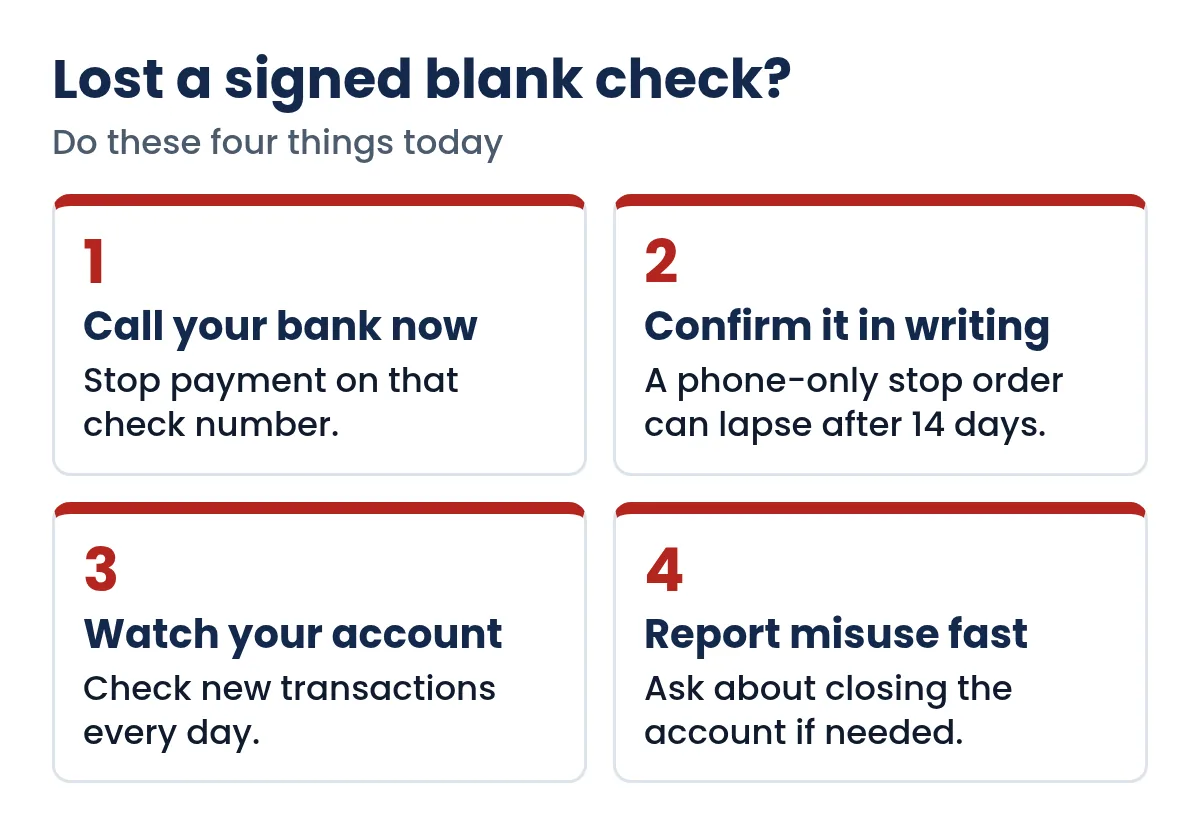
If a signed blank check is lost or misused, act fast: ask your bank to place a stop payment on that check number and watch your account. See how to stop payment on a check and lost or stolen checks.
Checks that are partly blank
Even small gaps can be exploited. A payee line left half empty can have a name added; an amount line without a line drawn through the leftover space can have words squeezed in. When you write any check, fill each field completely and strike out unused space. Our guide on how to write a check shows the habits that close those gaps.
Real situations, step by step
A contractor or seller asks you for a signed blank check
This usually comes up when the final price isn't known yet: a repair that depends on parts, a delivery charged by weight, a deposit "to hold the date". You can almost always meet the need without handing over open-ended authority.
- Ask for a written estimate or a maximum
"Up to $800 for parts and labor" gives you a number to work with.
- Write the check for a fixed amount, or cap it
Pay a deposit for a set sum now and the balance later, or write "Not valid over $800" on the face of the check.
- Fill in the payee's full name
Use the business name on the estimate, not "Cash". A check made out to "Cash" is payable to whoever holds it (UCC § 3-109).
- Record it
Note the check number, payee, date and the limit you agreed in your register before the check leaves your hands.
Someone else needs to pay bills while you're away
Leaving a family member a few signed blank checks feels convenient, but each one is a complete payment order waiting for a number. Safer options: write the checks yourself for the bills you already know, leave them with the payee filled in, or ask your bank what options it offers for letting another person pay from the account. If you do leave a signed check, write the payee and a limit on it and log the check number.
You've lost a signed blank check
Treat it like lost cash with no ceiling. Call your bank and place a stop payment on that check number. Under UCC § 4-403, a stop-payment order lasts six months and can be renewed, but one given only by phone lapses after 14 calendar days unless it's confirmed in a record (in writing or electronically) within that time. Your bank may charge a fee for it; ask. Then watch your account closely, and ask the bank whether closing the account makes sense if more than one check is missing.
A check you didn't expect shows up on your statement
Speed matters here too. Under UCC § 4-406, you must review statements with "reasonable promptness" and tell the bank promptly about an unauthorized signature or alteration you should have spotted. Regardless of care on either side, if you don't report an altered check or forged signature within one year after the statement is made available, you lose the right to make the bank cover it. Your deposit account agreement may set a shorter reporting window, so check it. Report the item, ask for a copy of the check and expect to sign an affidavit if it was altered.
Someone gave you a blank check
If you're the payee, fill in only what was agreed and keep a record of the agreement (a text or an invoice is enough). Writing in more than you were authorized to is an alteration under § 3-115 and § 3-407, and the signer can dispute it. If you're unsure of the amount, ask before you fill it in.
Checklist: closing every gap before you hand over a check
- The payee's full name is written in, never left blank and never "Cash" unless you mean it.
- The amount is written in both figures and words, starting at the far left of each space.
- A line is drawn through the unused space after the payee and after the amount in words.
- The date is filled in.
- The memo says what the check is for (invoice number, account number, month of rent).
- You sign last, after everything else is complete.
- The check number, payee and amount are in your register.
Signed blank check vs safer alternatives
| Option | Your risk | Best for |
|---|---|---|
| Signed check, payee and amount blank | Highest: any payee, any amount | Almost never |
| Payee filled in, amount blank | High: any amount | Only with someone you'd trust with the account |
| Payee filled in, "Not valid over $X" | Limited and visible on the check | Unknown final bill with an agreed ceiling |
| Fixed deposit now, balance later | Low: you see the final amount first | Repairs, events, custom work |
| Wait for the invoice, then write the check | Lowest | Most everyday bills |
Meaning 2: blank check stock for printing your own checks
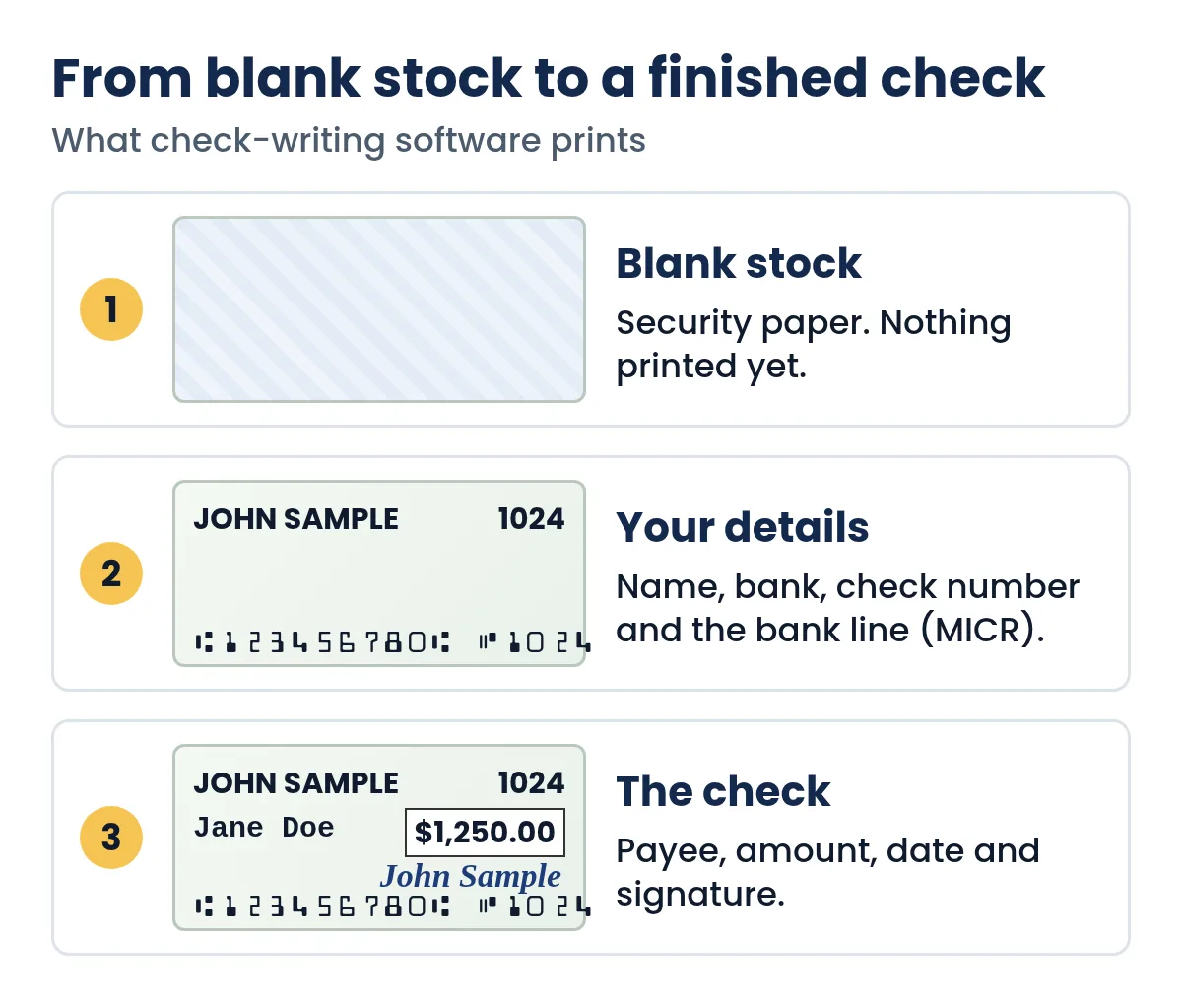
The other meaning is about paper. "Blank checks" or "blank check stock" are sheets of check paper with no account holder's name, no bank information and no check numbers printed on them. You print all of that yourself, together with the payee, amount and signature, using check-writing software and an ordinary printer.
Blank stock isn't plain copy paper. It's usually heavier, with security features built in: background patterns that show erasures, chemically sensitive coatings and, on many sheets, a pre-printed back with endorsement lines and warnings. The format varies too: one check per letter-size sheet with stubs above or below, or three checks to a page. Our blank check stock guide explains what to look for.
Why businesses and individuals use it
- One paper, many accounts
- Because the bank details are printed at the time of printing, the same stock works for every account you have.
- Nothing valuable sitting in a drawer
- A box of pre-printed checks carries your account number on every sheet. Blank stock carries none, so an unused sheet isn't tied to your account.
- Print only what you need
- You print a check when you need one, with the payee and amount already typed in.
- Lower cost per check
- For many people, a pack of blank stock and printer toner costs less than reordering pre-printed checks. Our page on ordering checks vs printing your own compares the options.
Is printing on blank stock legal?
Yes, printing your own checks for your own account is legal in the US, as long as the check carries correct information for an account you're authorized to use. Banks do have practical requirements, especially that the bottom bank line is printed correctly in the right font and position. See is it legal to print your own checks? and do you need MICR ink?.
Worked example: one sheet of blank stock becomes a check
John Sample owes Jane Doe $1,250.00 for October rent. He opens his check-writing app, where his name, Sample Bank, routing number 123456780 and account number 000123456789 are already saved. He types "Jane Doe" as the payee, 1,250.00 as the amount and "October rent, Unit 2B" as the memo. The app writes "One thousand two hundred fifty and 00/100" for him and assigns check number 1024. He loads a sheet of blank stock into his printer, prints, signs the check by hand and tears off the stub. The register now shows check 1024 to Jane Doe for $1,250.00, so the payment is recorded before the envelope is sealed.
The habits from the checklist above still apply to printed checks: the software fills every field and fills the leftover space in the amount line, so there's nothing left open for someone else to complete.
Need to write a check right now?
Quick Check Writer fills in the amount in words, adds the bank line and prints on blank check stock or saves a PDF. Your first check is free, with no account and no card.
Write your first check free →Blank check vs similar terms
- Blank check (signed, unfilled)
- A real check from your account with your signature and missing details. Treat it like cash.
- Blank check stock
- Unprinted check paper. Not linked to any account until you print on it.
- Voided check
- A check with "VOID" written across it, often given to an employer or company to set up direct deposit. It shows your routing and account numbers but can't be used to pay. See how to void a check.
- Counter or starter check
- A temporary check from your bank's branch, often without your name printed. See counter checks and starter checks.
- Check template
- A layout used by software to place every field in the right spot on the paper. See our printable check template.
Do blank checks expire?
It depends which meaning you have in mind:
| Kind of "blank check" | Does it expire? |
|---|---|
| Unused checks from your checkbook | No date limit, but they only work while the account is open and the printed routing and account details are still correct. |
| Blank check stock | No. The paper has no account information, so it stays usable. |
| A written check (even one left blank and later completed) | The date on it matters. Under UCC § 4-404, a bank isn't obliged to pay an ordinary check presented more than six months after its date. See how long a check is good for. |
If your bank merges or changes its routing number, it will tell you whether your old pre-printed checks still work. With blank stock, you simply update the routing number in your software.
A third meaning you may run into
In investing, a "blank check company" is a development-stage company with no specific business plan, or one whose plan is to merge with or acquire an unidentified company. Investor.gov, the SEC's investor education site, notes these are typically speculative investments. It has nothing to do with paper checks, but it shows up in the same searches.
Printing checks on blank stock with Quick Check Writer
Quick Check Writer is built for the second meaning. You enter your name, bank and account details once, then type a payee and amount; the app prints the complete check, including the MICR line in E-13B and the amount in words, onto blank check stock with your home printer. Bank details stay on your device, and every check you print goes into your register. Learn the whole process in how to print checks at home.
Frequently asked questions
What is a blank check?
It has two common meanings: a signed check with the payee or amount left empty, or blank check stock, the security paper with no account details that you print your own checks on.
Is it safe to give someone a signed blank check?
Not really. Whoever holds it can fill in any amount, and a bank that pays it in good faith may charge your account. Fill in the payee and amount before signing.
Is a signed blank check legally valid?
Under UCC § 3-115 it's an incomplete instrument that can be enforced once completed. If it's completed without your authority that's an alteration, but you have to prove it.
What is blank check stock?
Check paper without any names, bank details or check numbers. Check-writing software prints all of those, plus the payee and amount, when you print a check.
Do blank checks expire?
Blank check stock doesn't expire, and unused checks from a checkbook work as long as the account and printed details are current. A written check can be refused after six months under UCC § 4-404.
Can I print checks on blank paper at home?
Yes, on blank check stock with check-writing software and a regular printer. Plain copy paper lacks security features; see our page on printing checks on regular paper.
What does "blank check company" mean?
In investing, it's a company with no specific business plan or one planning to merge with an unidentified company. It's unrelated to paper checks.
What should I do if I lose a signed blank check?
Call your bank right away and stop payment on that check number, then confirm the order in writing: under UCC § 4-403 an oral stop order lapses after 14 days unless confirmed in a record. Watch your account and ask about closing it if several checks are missing.
How long do I have to report an altered or forged check?
Review statements promptly. Under UCC § 4-406, if you don't report an alteration or unauthorized signature within one year after the statement is made available, you can't make the bank cover it, and your account agreement may set a shorter deadline.
Is a check made out to "Cash" like a blank check?
Close to it. Under UCC § 3-109, a check payable to "Cash" is payable to bearer, so anyone holding it can cash or deposit it. Write the payee's name instead whenever you can.
Can someone fill in a blank check for more than we agreed?
They're not allowed to: completing a check beyond what the signer authorized is an alteration under UCC § 3-115 and § 3-407. But you'd have to prove it, and a bank that pays in good faith may still charge your account, so never rely on that protection.
Related guides
- Blank Check Stock: A Complete Guide
- How to print checks at home
- How to write a check, step by step
- Is It Legal to Print Your Own Checks?
- How to stop payment on a check
- Can you print checks on regular paper?
Sources
- UCC § 3-115 (incomplete instrument), Cornell LII
- UCC § 3-407 (alteration), Cornell LII
- UCC § 4-401 (bank may charge completed item), Cornell LII
- UCC § 4-404 (checks more than six months old), Cornell LII
- Investor.gov (SEC): Blank check company
- UCC § 4-403 (stop-payment orders), Cornell LII
- UCC § 4-406 (duty to examine statements; one-year limit), Cornell LII
- UCC § 3-109 (payable to bearer or order), Cornell LII
- HelpWithMyBank.gov (OCC): check paid for the wrong amount
Last updated November 1, 2026. This page is general information, not legal or financial advice. Quick Check Writer is check printing software; it is not a bank and does not move money.