
Key takeaways
- Counter checks are printed at the branch, on request, with your real routing and account numbers.
- Starter (temporary) checks come with a new account to use until ordered checks arrive.
- Expect a small fee for counter checks, for example $2 per check at one large bank.
- They may lack a printed name, address or check number; record each one in your register.
- For regular use, ordering checks or printing your own is more practical.
On this page
- What a counter check is
- What a starter check is
- Four ways to get a check quickly
- How much do counter checks cost?
- How to get counter checks
- Will people accept a counter check?
- Which one fits your situation?
- How to fill out a counter check correctly
- Common mistakes
- Counter checks vs printing your own checks
- Terms that sound alike
- Keeping counter and starter checks safe
- Other ways banks give you checks
- FAQ
What a counter check is
A counter check is a check your bank prints for you at the branch, on the spot, when you need one or a few and do not have your checkbook. Tellers can print them because they come straight from your account record: the bottom of the check carries the same routing number and account number as your regular checks, in the magnetic-ink bank line that machines read.
Banks use different names. Wells Fargo's consumer fee schedule, for example, lists "personalized temporary checks (counter checks)," and many credit unions call them temporary checks. They are all the same idea: real checks on your real account, printed at the counter.
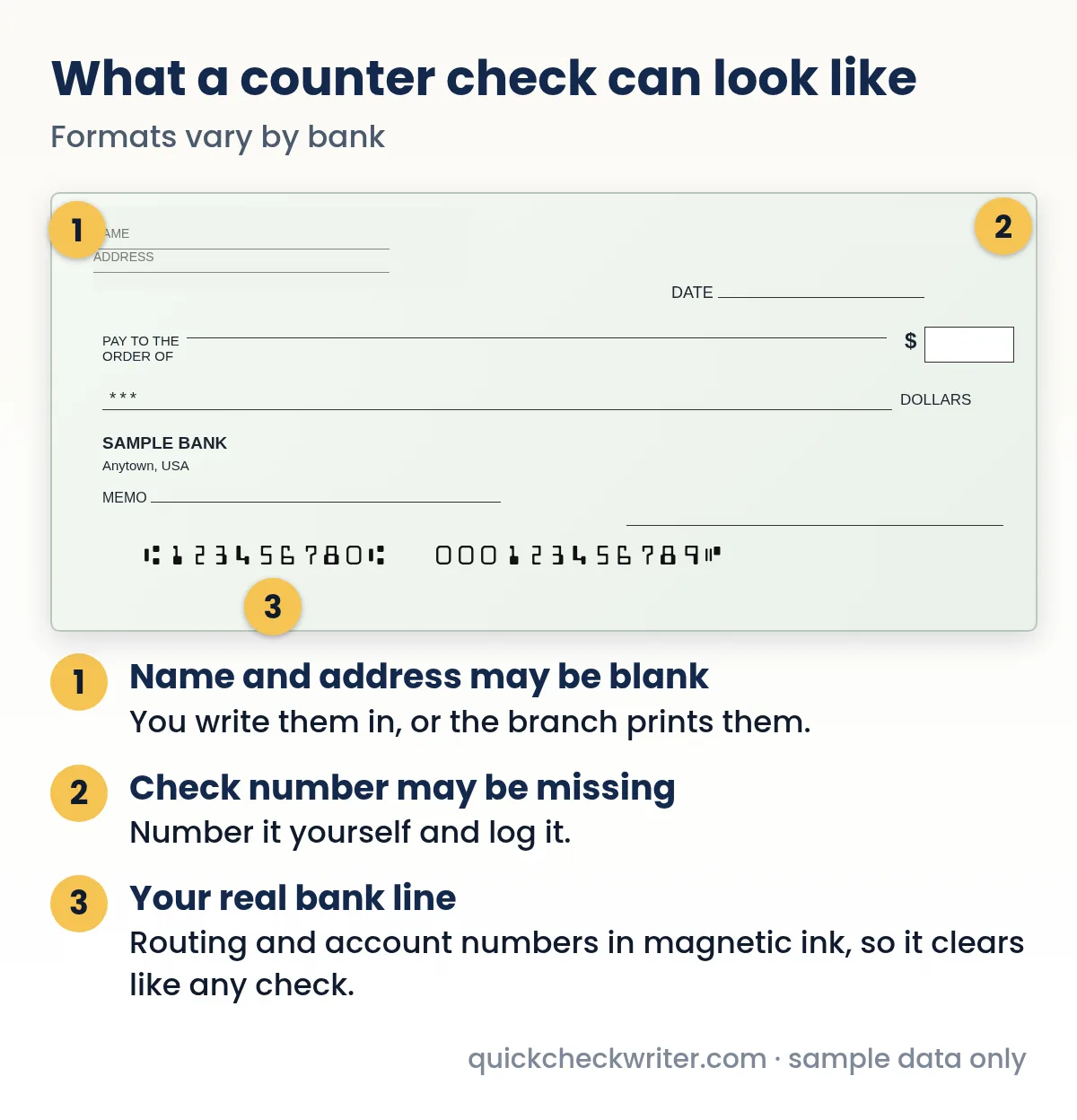
How counter checks differ from your regular checks
- Name and address: some banks print them, others leave a blank area for you to fill in.
- Check number: often missing or not in sequence with your checkbook, so number and log them yourself.
- Design: plain, without the pattern or security features of an ordered check.
- Quantity: usually a single sheet or a handful, not a box.
What a starter check is
Starter checks, sometimes called temporary checks, are a small batch of basic checks you receive when you open a checking account, to tide you over until your ordered checks arrive. Some institutions hand them over at account opening; others mail them. Navy Federal Credit Union, for example, tells new members they will receive starter checks in 7 to 10 business days.
Like counter checks, starter checks may be plain, with your name and address missing or added by hand. They draw on your real account and clear normally.
Banks can apply longer holds to deposits during the first 30 days of a new account. Under Regulation CC, the next-day availability rules then apply only to the first $6,725 deposited on any one banking day for certain checks, and the rest can be held until the ninth business day. That affects checks you deposit, not the ones you write, but it often comes up at the same time.
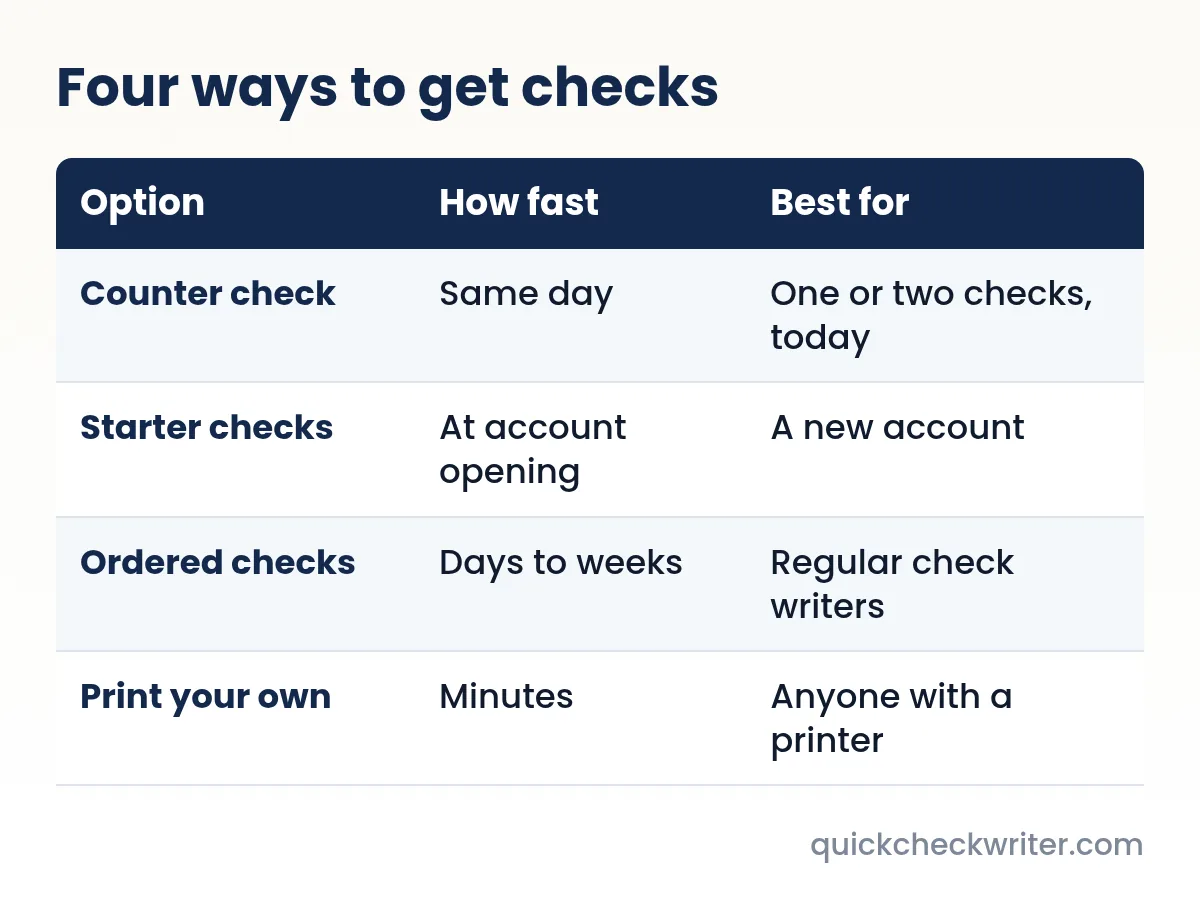
Four ways to get a check quickly
If you need a check today, a counter check is usually the fastest route that involves your bank. If you write checks regularly, ordering a box or printing your own on blank check stock is more practical in the long run.
How much do counter checks cost?
Most banks charge a small fee. Current published fee schedules we checked include $2.00 per counter check at U.S. Bank, $3 per sheet of three at Wells Fargo, and four temporary checks for $2 at one credit union. Some banks waive fees on certain accounts, and policies change, so ask before you go. Starter checks are often included when you open an account.
How to get counter checks
- Call your branch first
Confirm they print counter checks, how many you can get, and the fee. Some limit how many you can get; one credit union's fee schedule we checked caps counter checks at eight per member.
- Bring photo ID and your account details
The teller will verify who you are before printing checks on your account.
- Ask for your name and address to be printed
If the bank offers it, this makes the check look more familiar to payees.
- Number and record each check
Write the check number on it if there is none, and add it to your register so your balance stays accurate.
Need to write a check right now?
Quick Check Writer fills in the amount in words, adds the bank line and prints on blank check stock or saves a PDF. Your first check is free, with no account and no card.
Write your first check free →Will people accept a counter check?
A counter check is a valid check drawn on your account, and the bank it is drawn on processes it like any other. Acceptance is up to the payee, though. A landlord who knows you or a utility company will usually take it. Some merchants and individuals are wary of checks that lack a printed name and address, because those details help them judge who wrote the check, and they may ask for ID or a different form of payment.
If a payee needs extra assurance, a cashier's check or money order is the usual answer. If you are setting up direct deposit and an employer asks for a voided check, a counter check often works; many banks also provide a printed direct deposit form instead. See direct deposit and the voided check and how to void a check.
John Sample opens a new checking account on a Monday and needs to pay a $650 security deposit on Wednesday. His ordered checks will not arrive for about two weeks. He stops by the branch, asks for a counter check, has the teller print his name and address on it, writes the payee, Jane Doe, and the amount, and records it in his register as check "C1." On Thursday he discovers the landlord wanted a cashier's check after all and gets one instead, voiding the counter check.
Which one fits your situation?
You just opened an account and checks are on order
Ask for starter checks at account opening, or a few counter checks if the branch prints them. Use them for the one or two payments that cannot wait, and pay everything else online until your box arrives.
You ran out of checks and need one today
A counter check is the fastest route through your bank. Call ahead to confirm the branch prints them and what they cost, and bring photo ID. If you print checks yourself, you can also print one at home in a few minutes on blank check stock.
The payee says “no personal checks”
A counter check is still a personal check, so it will not satisfy that rule. Buy a cashier's check or money order instead.
Your employer wants a voided check for direct deposit
A voided counter check usually works because it carries your real routing and account numbers. Many banks also offer a printable direct deposit form in online banking, which avoids the trip.
A small business needs checks this week
Counter checks are awkward for business use: they may not show the business name, and you pay per sheet. Printing your own business checks on blank stock gives you numbered checks with your business name, address and logo the same day. See how to print business checks.
How to fill out a counter check correctly
- Add your name and address if the top is blank
Write them neatly or ask the teller to print them. Payees are more comfortable with a check that shows who it is from.
- Give it a check number
If none is printed, write one in the corner that does not repeat a number from your checkbook, and note it in your register.
- Fill every line
Date, payee, amount in numbers and words, and a memo. Draw a line through empty space after the amount so nothing can be added.
- Sign exactly as on your account
The paying bank compares the signature with its records.
- Keep a copy
Snap a photo before you hand it over. Counter checks usually have no carbon copy.
Common mistakes
- Leaving the name area blank. A payee who cannot tell who the check is from may refuse it.
- Reusing a check number. Duplicate numbers make reconciling and stop payments confusing.
- Treating a counter check as guaranteed funds. It can bounce like any personal check if the balance is short.
- Carrying extras around. Unused counter checks carry your full account details. Store them safely or shred them.
Counter checks vs printing your own checks
Counter and starter checks solve a short-term problem. If you write checks regularly, they are inconvenient: a trip to the branch each time, a fee per check, and a plain look. The two long-term options are ordering checks or printing your own.
| Counter checks | Print your own | |
|---|---|---|
| Need to visit the bank? | Yes | No |
| Your name, address and logo | Sometimes | Yes |
| Check numbers in sequence | Often not | Yes |
| Amount in words filled in for you | No | Yes, with software |
| Automatic register | No | Yes, with software |
| Best for | One or two checks, today | Anyone who writes checks regularly |
Printing your own checks is legal when done correctly, and it needs blank check stock and a printer. Quick Check Writer prints your name and address, optional logo, the amount in words and the E-13B bank line on blank stock, and saves every check to a register. Your first check is free. Read more in how to print checks at home, is it legal to print your own checks and order checks or print your own.
Terms that sound alike
Bank vocabulary around checks is easy to mix up. Here is how counter and starter checks fit next to the other terms you will hear at the branch:
- Counter check
- A personal check on your own account, printed by the branch on request. You sign it, and it can bounce if your balance is short, just like any personal check.
- Starter or temporary check
- A personal check from the small batch you get with a new account. Same rules as any personal check.
- Cashier's check
- A check drawn by the bank on itself, paid for up front. The bank, not you, promises payment, so it cannot bounce for lack of funds in your account.
- Certified check
- Your own check that the bank has accepted and guaranteed, after setting the money aside.
- Blank check
- Either a signed check with the amount left open, which you should never hand over, or blank check stock used for printing checks. See what is a blank check.
The key line runs between the first two and the next two. A counter or starter check is still your personal check, so it is only as good as your balance. A cashier's or certified check carries the bank's guarantee, which is why it costs more and why payees who do not know you may insist on one.
No checkbook at all?
If you need to pay someone by check and have neither a checkbook nor time to visit the branch, you still have options, from printing a check at home on blank stock to using your bank's online bill pay service, which at some banks can send a paper check on your behalf. Our guide to writing a check without a checkbook walks through each.
Keeping counter and starter checks safe
Because counter and starter checks carry your full bank line, treat them like any other check:
- Store unused ones securely and shred any you will not use.
- Do not leave the name and payee lines blank when you hand one over; fill every line.
- Record each check in your register as soon as you write it, especially since the numbers may be out of sequence.
- If one goes missing, tell your bank right away; see lost or stolen checks.
Other ways banks give you checks
When you ask a bank for "a check," you may also be offered an official check, meaning a cashier's or teller's check drawn on the bank's own funds. That is a different product: you pay up front, the bank guarantees it, and it usually costs more than a counter check. It is the right choice when a payee demands guaranteed funds; a counter check is the right choice when they will take your personal check and you simply do not have one with you. Our guide to bank drafts explains the difference.
Frequently asked questions
What is a counter check?
A counter check is a check your bank prints for you at a branch, drawn on your account, for when you need a check right away. It carries your routing and account numbers but may not show your name, address or a check number.
How much do counter checks cost?
Usually a small fee. Published fee schedules we checked include $2 per check at U.S. Bank and $3 per sheet of three at Wells Fargo. Ask your bank, as fees and waivers vary.
Are counter checks legit?
Yes. They are real checks on your account and are processed like any other check. Whether a payee accepts one is up to them, and some prefer checks with a printed name and address.
What are starter checks?
Starter checks are a few basic checks a bank or credit union gives you when you open a checking account, so you can write checks until your ordered checks arrive.
Can I use a counter check for direct deposit?
Often, yes, if your employer accepts a voided check. Many banks also offer a direct deposit form with your routing and account numbers, which some employers prefer.
How long do ordered checks take to arrive?
It varies by bank and printer. One credit union we checked quotes 7 to 14 business days for check orders. Printing your own checks at home takes minutes once you have blank check stock.
Is a counter check the same as a cashier's check?
No. A counter check is your own personal check printed by the branch; it is paid from your account and can bounce. A cashier's check is drawn on the bank's own funds, paid for up front and guaranteed by the bank.
Can I print my own checks while I wait for my order?
Yes. It is legal to print your own checks on blank check stock with your correct routing and account numbers in the MICR line. Quick Check Writer lets you print your first check free; see is it legal to print your own checks.
Related guides
- Order checks or print your own?
- How to print checks at home
- Writing a check without a checkbook
- Direct deposit and the voided check
- How to Void a Check
- Cashier's check vs certified check
Sources
- U.S. Bank Consumer Pricing Information (fee schedule example)
- Wells Fargo Consumer Account Fees and Information (fee schedule example)
- Austin Telco Federal Credit Union FAQs (temporary checks, 4 for $2)
- Beginnings Credit Union: Checking FAQs (check orders 7–14 business days; temporary checks at branches)
- Navy Federal Credit Union: How to switch your checking account (starter checks in 7–10 business days)
- Regulation CC, 12 CFR 229.13 Exceptions (new accounts, repeated overdrafts) (eCFR)
- Summit Credit Union: Fees and limits (counter checks, maximum per member)
Last updated November 1, 2026. This page is general information, not legal or financial advice. Quick Check Writer is check printing software; it is not a bank and does not move money.