
Key takeaways
- Use a slip that matches the account: checking and savings slips are not interchangeable.
- List each check on its own line; extra checks go on the back.
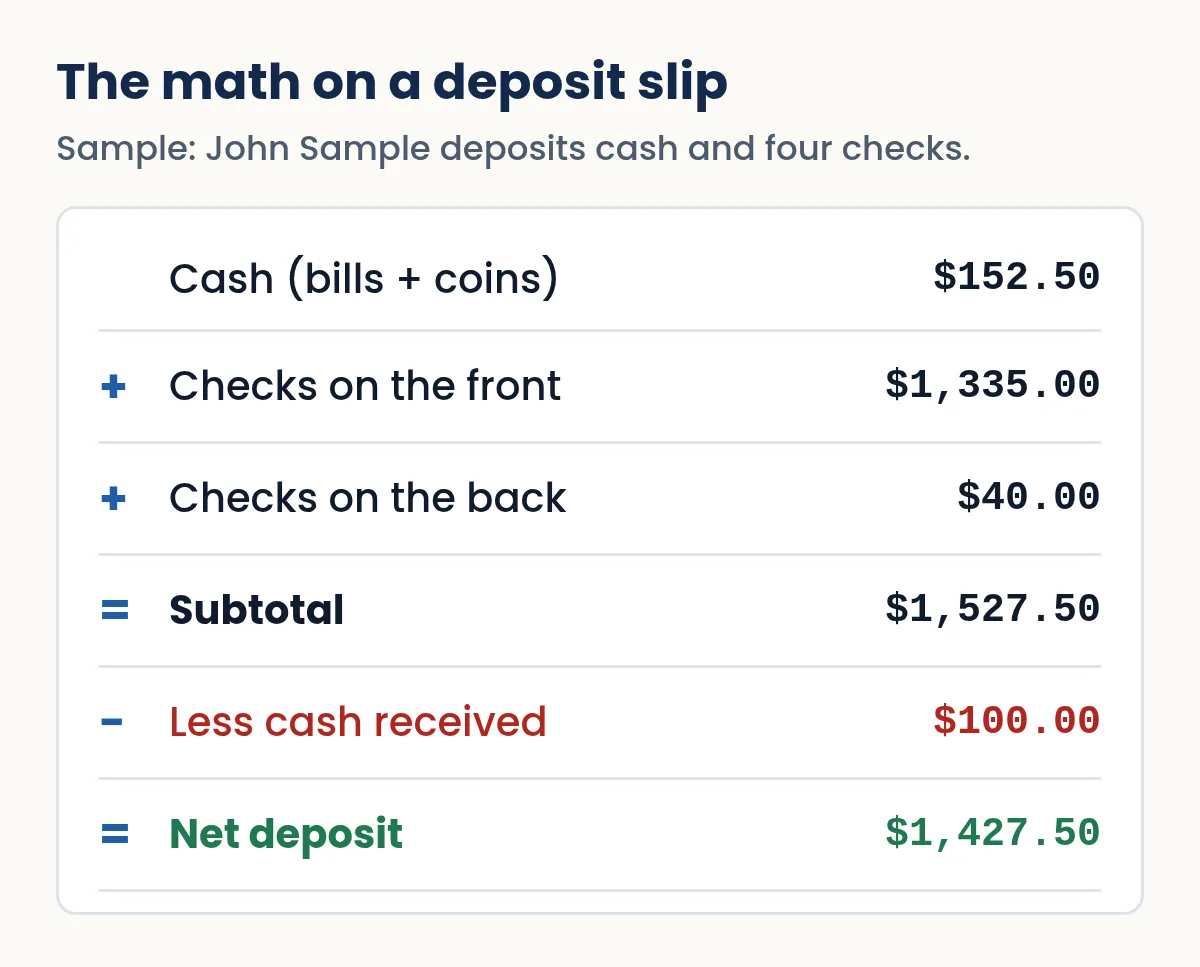
- Net deposit = cash + checks − cash received.
- Sign the slip only if you take cash back.
- Image ATMs and mobile apps usually don’t need a slip.
On this page
- What a deposit slip is for
- How to fill out a deposit slip, step by step
- A worked example
- Filling out a slip in other common situations
- A quick checklist before you hand it over
- Common deposit slip mistakes
- When you need a deposit slip (and when you don't)
- Special deposit slips for faster availability
- Mailing a deposit or using a night drop
- How long to keep deposit slips and receipts
- Large cash deposits
- Deposit slips for a business
- Where Quick Check Writer fits
- FAQ
What a deposit slip is for
A deposit slip, also called a deposit ticket, is a short form that travels with your money into the bank. It tells the bank three things: which account to credit, what you are handing over (cash, checks or both) and the total. The teller or the processing team checks your numbers against what is actually in the envelope or on the counter.
It also protects you. If the bank credits the wrong amount, your copy of the slip and the receipt are your evidence of what you deposited. Slips matter most for deposits that happen without you watching, like a mailed deposit or a night drop.
You can get slips in three places: the back of a checkbook, where they come pre-printed with your name and account number; the counter at a branch, where blank “counter” slips are free; or a reorder from your bank or check supplier.
A pre-printed slip already carries your account number in the magnetic line at the bottom, so it can only go into that account. A blank counter slip has no account number, so you must write it in carefully. One wrong digit can send your money into someone else's account.
How to fill out a deposit slip, step by step
- Write the date
Use the day you hand over the deposit. The bank uses its own processing date for availability, but a dated slip helps you match it to your statement later.
- Check the name and account number
On a pre-printed slip, make sure it is for the account you want; people with checking and savings slips mix them up. On a blank slip, print your name and copy the account number from a check or your bank's app, digit by digit.
- Enter your cash
Count bills and coins separately. Most slips have a line for currency and one for coin; some have a single “cash” line. Put the totals in dollars and cents, for example 150.00 and 2.50.
- List each check on its own line
Write the amount of every check separately rather than one lump sum. Some banks also ask for an identifying number for each check, such as the check number or the fraction-style bank number near the top right of the check. If you run out of lines, continue on the back.
- Carry over the total from the back
Add the checks you listed on the back and write that total on the front line labeled “total from other side” or similar.
- Add the subtotal
Cash plus every check equals the subtotal. This should match the money you are handing over.
- Fill in “less cash received” only if you want cash back
If you want part of the deposit back in cash, write that amount here and sign the slip in front of the teller. If you don't want cash back, leave it blank or write 0.00.
- Write the net deposit
Subtotal minus any cash received is the amount that will go into your account. Double-check the arithmetic; this is the line most often wrong.
- Endorse your checks
Sign the back of each check you are depositing. Writing “For deposit only” under your signature adds protection if the deposit gets separated from the checks. See how to endorse a check for each type.
- Keep your receipt
Ask for a receipt and keep it until the deposit shows correctly on your statement.
A worked example
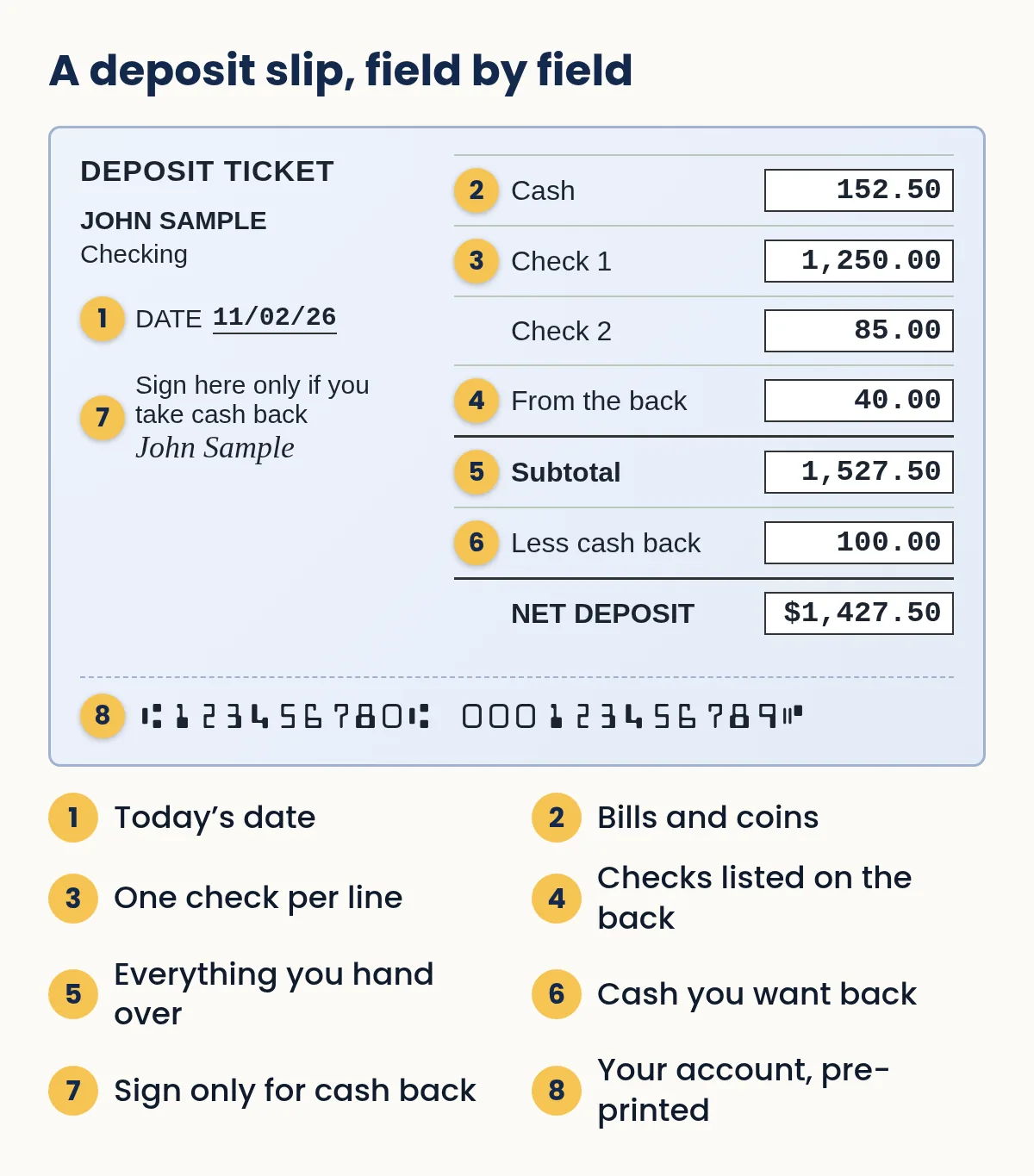
John Sample is depositing $150 in bills and $2.50 in coins, a $1,250.00 rent check, an $85.00 refund check, and two small checks of $25.00 and $15.00. He wants $100 back in cash for the week.
Front of slip: currency 150.00, coin 2.50, check 1,250.00, check 85.00. Back of slip: 25.00 and 15.00, total 40.00, carried to the front. Subtotal: 150.00 + 2.50 + 1,250.00 + 85.00 + 40.00 = 1,527.50. Less cash received: 100.00. Net deposit: 1,427.50. John signs the slip because he is taking cash back.
Filling out a slip in other common situations
The example above uses every line. Most real deposits are simpler, and a few need extra care.
Cash only
Jane Doe is depositing $400 in bills from a weekend sale. She writes 400.00 on the currency line, leaves the coin and check lines empty, and writes 400.00 as both the subtotal and the net deposit. No signature is needed because she takes nothing back.
Timing depends on how she deposits it. Under the federal funds availability rule, cash handed to a bank employee in person must be available by the next business day. Cash deposited another way, such as in a night drop, must be available by the second business day. Many banks are faster than that.
One paycheck, nothing back
John endorses his $1,250.00 paycheck, writes it on the first check line, and copies 1,250.00 to the subtotal and the net deposit. This is the deposit an image-enabled ATM or a phone app handles without any slip at all.
Into someone else's account
You can often deposit into a relative's or a business's account at the counter if you know the name on the account and the account number. Use a slip from their checkbook, or a blank slip with their number copied carefully. Bank policies differ, especially for cash deposits into another person's account, so ask the teller first. You can never take cash back from an account that isn't yours.
A check made out to two people
If a check names two payees joined by “and”, both usually need to endorse it, and it should go into an account held by at least one of them. Our guide to a check made out to two people explains the “and” versus “or” rule.
Many checks at once
When you have more checks than the front and back can hold, use a second slip or ask your bank how it prefers a long list. Some branches accept a printed list or adding-machine tape stapled to the slip; others want everything on their own forms.
A quick checklist before you hand it over
- The slip matches the account: checking or savings, and your name.
- Today's date is on it.
- Every check is endorsed, and each one has its own line.
- The back total, if any, is carried to the front.
- You added the column twice and the net deposit is right.
- You signed only if you are taking cash back, in front of the teller.
- You kept the receipt until the deposit shows in your account.
Common deposit slip mistakes
| Mistake | What happens | How to avoid it |
|---|---|---|
| Using a savings slip for a checking deposit | Money lands in the wrong account | Read the account type printed on the slip before you start |
| Wrong account number on a blank slip | Delay, or a deposit to someone else's account | Copy it from a check or ask the teller to look it up with your ID |
| One total for several checks | Harder to trace if one check is returned | One line per check |
| Arithmetic error | Teller corrects it, or the bank adjusts later | Add the column twice, or use a calculator |
| Forgetting to endorse | Teller asks you to sign; mailed deposits may come back | Sign each check before you leave home |
| Cash back without a signature | Teller won't give cash | Sign in front of the teller |
Need to write a check right now?
Quick Check Writer fills in the amount in words, adds the bank line and prints on blank check stock or saves a PDF. Your first check is free, with no account and no card.
Write your first check free →When you need a deposit slip (and when you don't)
Image-enabled ATMs and mobile banking apps have made the paper slip optional for many everyday deposits. The machine or the app reads each check and records the amount, and your receipt replaces the slip. Our guide to depositing a check with your phone covers the app route, and ways to deposit a check compares every method.
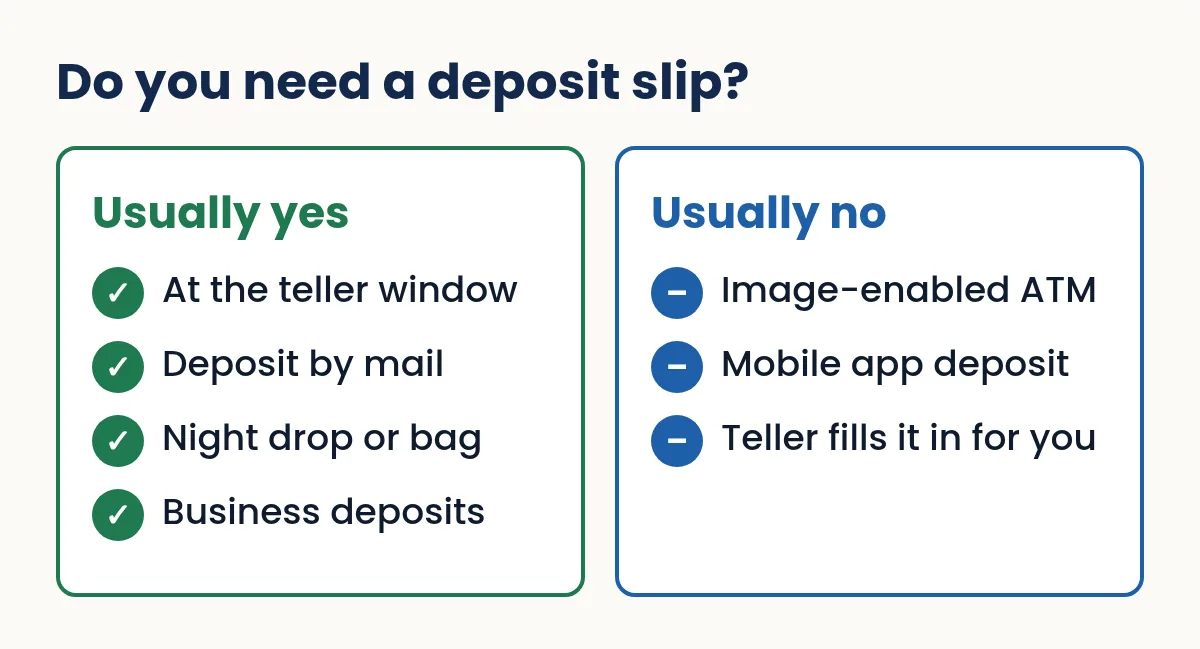
A slip is still the norm when you deposit at a teller window (although many tellers will fill it in for you), when you mail a deposit, when you use a night depository, and for most business deposits that include many checks or bags of cash.
Special deposit slips for faster availability
Here is a detail most guides skip. Federal Regulation CC requires banks to make certain low-risk checks available by the next business day: U.S. Treasury checks, state and local government checks, and cashier's, certified and teller's checks, among others. For some of these, the next-day rule applies only if you deposit them in person to a bank employee and, if your bank requires it, use a special deposit slip or envelope.
If your bank uses special slips, depositing a cashier's check on a regular slip may mean slower access to the money. If you are depositing one of these checks and need the money quickly, ask the teller whether a special slip applies. Our guide to how long a check takes to clear explains the full availability schedule.
Mailing a deposit or using a night drop
Some banks accept deposits by mail, and many branches have a night depository. In both cases the slip is your only voice in the transaction, so fill it in completely and keep a copy or a photo.
Timing works differently, too. Under Regulation CC, a mailed deposit counts as deposited on the day the bank receives it, not the day you mail it. A night-drop deposit counts from the day the bank removes it from the box. Banks may also set a daily cutoff: a deposit made after a cutoff of 2:00 p.m. or later at a branch, or noon or later at an ATM, can be treated as made the next banking day.
- Endorse each check with “For deposit only” and your account number.
- Never mail cash with a deposit.
- Follow the steps in how to mail a check safely for the envelope and drop-off.
- Watch your account until the deposit appears.
How long to keep deposit slips and receipts
Keep each receipt or slip copy at least until the deposit appears correctly on your statement and you have reconciled that month. Many people keep them with their monthly statements for the year. Businesses usually keep deposit records with their accounting records, and how long depends on their tax and audit needs. Ask your accountant how long that should be.
If you deposit through an app, the confirmation screen and the email or notification the bank sends work the same way. Take a screenshot if the app doesn't keep a history.
Large cash deposits
If you deposit more than $10,000 in cash, the bank must file a Currency Transaction Report with the federal government and will ask for your identification. According to FinCEN, this is routine and there is no general prohibition on handling large amounts of cash.
What is illegal is “structuring”: splitting cash into smaller deposits to avoid the report. FinCEN warns that structuring can carry a fine of up to $250,000 and up to five years in prison, even if the money itself is legitimate. Deposit the cash in one go and let the bank file its report.
Deposit slips for a business
A business account gets its own slips, usually wider, with many check lines and sometimes carbon copies. A few habits make the bookkeeping easier:
- Match each line to an invoice. Keep a copy of the slip with the invoice numbers written beside each check.
- Photocopy or scan checks before depositing. If a customer's check is returned, you'll have their details.
- Deposit daily. Fewer checks in the office means less risk, and faster availability.
- Reconcile monthly. Compare each deposit on your statement to your slip copies. See how to do a bank reconciliation.
Where Quick Check Writer fits
Quick Check Writer does not print deposit slips, and it does not deposit money. It is for the other side of the transaction: writing and printing the checks you pay with, on blank check stock or as a PDF, with each one logged in a searchable register. If you are learning the basics of checks, start with the parts of a check.
Frequently asked questions
Where do I get deposit slips?
They come at the back of most checkbooks, pre-printed with your account number. Branches also keep blank slips at the counter, and you can reorder them from your bank.
Do I need a deposit slip to deposit a check?
Not always. Image-enabled ATMs and mobile banking apps don’t need one. Tellers usually want a slip but can often fill one in for you. Mailed deposits and night drops should include one.
What does less cash received mean?
It is the amount of the deposit you want handed back to you in cash. It is subtracted from the subtotal, and you have to sign the slip to receive it.
Can I use someone else’s deposit slip?
A pre-printed slip deposits into the account printed on it, so using someone else’s slip puts money in their account. Use a blank counter slip and write in the right account number instead.
Do I have to sign a deposit slip?
Usually only when you take cash back. A plain deposit with no cash out typically needs no signature on the slip, but you do need to endorse each check.
What if I make a mistake on a deposit slip?
Start a fresh slip if you can. If the bank finds an error after processing, it normally corrects the amount to what was actually deposited and shows the adjustment on your statement.
How do I fill out a deposit slip for cash only?
Write the bills on the currency line and the coins on the coin line, leave the check lines blank, and enter the same total as both the subtotal and the net deposit. Sign only if you are taking some of it back.
What does “list checks singly” mean on a deposit slip?
It means one check per line, each with its own amount, rather than one combined total. If a check is later returned unpaid, the bank and you can see exactly which one it was.
Where is the account number on a deposit slip?
On a pre-printed slip it sits in the magnetic-ink line along the bottom, after the routing number, the same way it does on your checks. Blank slips at the branch have a box where you write it in.
Can Quick Check Writer print deposit slips?
No. Quick Check Writer prints checks, not deposit slips. Use the slips from your bank or checkbook.
Related guides
- Ways to deposit a check
- How to endorse a check
- How to Deposit a Check With Your Phone
- How Long Does a Check Take to Clear?
- The back of a check: what goes there and what to leave blank
- How to cash a check (with or without a bank account)
Sources
- 12 CFR § 229.10, next-day availability and special deposit slips (Cornell LII)
- 12 CFR § 229.19, when funds are considered deposited (Cornell LII)
- FinCEN: Notice to customers, a CTR reference guide (PDF)
- FNBO: How to fill out a deposit slip (bank example of slip lines)
Last updated November 1, 2026. This page is general information, not legal or financial advice. Quick Check Writer is check printing software; it is not a bank and does not move money.