
Key takeaways
- Endorse every check before depositing; mobile deposits often need “For mobile deposit only”.
- Most ordinary checks must be available by the second business day.
- Deposits at another bank’s ATM can be held until the fifth business day.
- Mailed deposits count from the day the bank receives them.
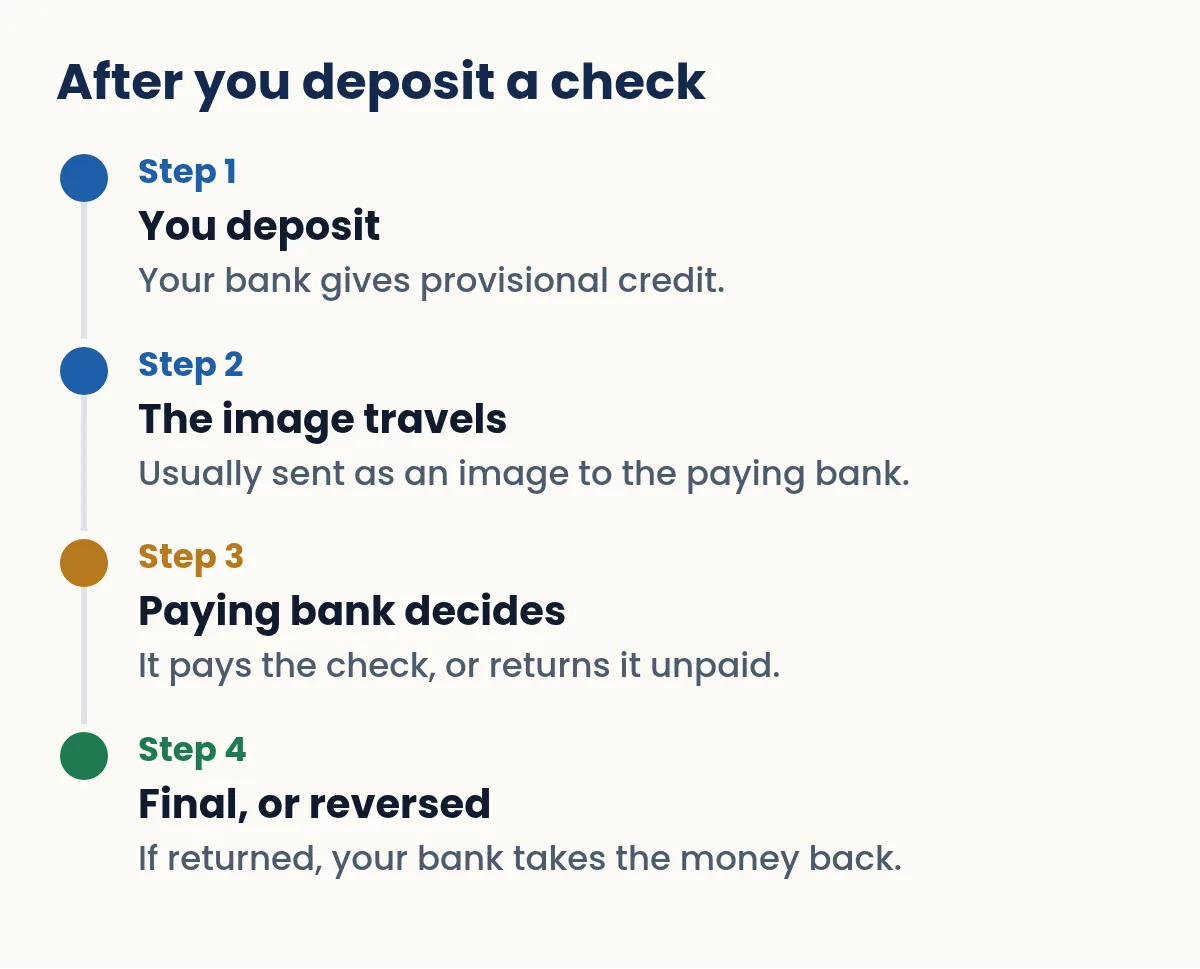
- Available funds can still be taken back if the check bounces.
On this page
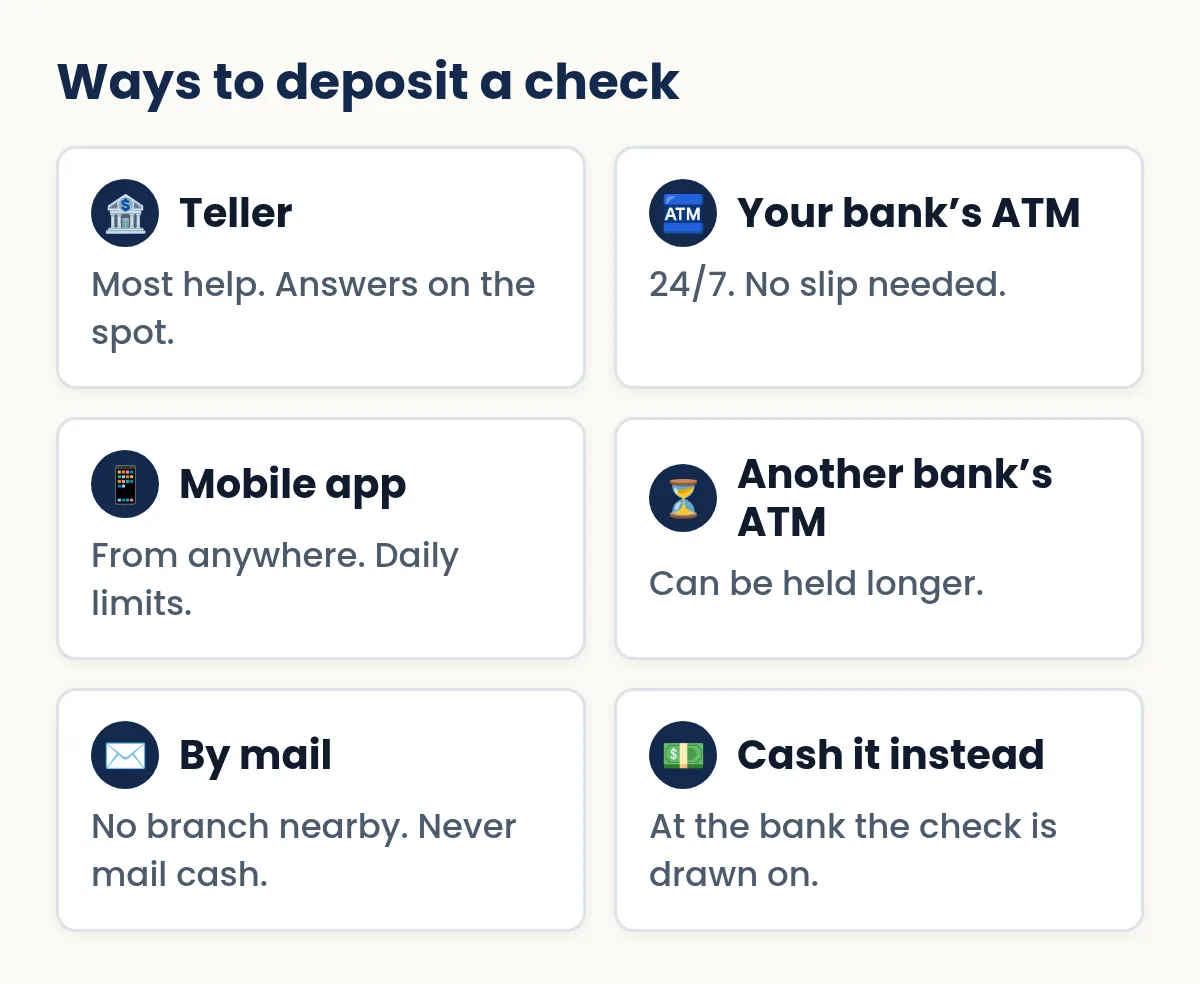
- The quick comparison
- 1. At a teller window
- 2. At your own bank's ATM
- 3. With your bank's mobile app
- 4. At another bank's ATM
- 5. By mail
- Cashing instead of depositing
- Checks that need extra care
- If something goes wrong with a deposit
- When will the money be available?
- Three situations, step by step
- Common deposit mistakes
- Which method should you use?
- Depositing checks you wrote yourself
- FAQ
The quick comparison
| Method | Deposit slip? | Best for | Watch out for |
|---|---|---|---|
| Teller at your branch | Usually | Large, unusual or government checks; cash back | Branch hours and cutoff times |
| Your bank's ATM | No (image ATMs) | After-hours deposits | ATM cutoff can be as early as noon |
| Mobile app | No | Everyday checks, anywhere | Daily limits; keep the paper check for a while |
| Another bank's ATM | No | Only when nothing else is available | Funds can be held until the 5th business day |
| Yes | No branch nearby, no app | Counts from the day the bank receives it |
1. At a teller window
Walking into a branch is the slowest way to deposit a check but often the most useful. A teller can spot problems on the spot, such as a missing endorsement or a mismatched amount, and you leave with a receipt in hand.
In-person deposits also matter for timing. Federal Regulation CC requires next-business-day availability for certain checks, including U.S. Treasury checks, state and local government checks, and cashier's, certified and teller's checks. For several of those categories, the next-day rule applies when the check is deposited in person to a bank employee (and, if your bank requires it, with a special deposit slip). Deposited another way, the bank may take until the second business day.
- Endorse the check
Sign the back inside the endorsement area. Adding “For deposit only” protects the check if it gets separated from you. See how to endorse a check.
- Fill out a deposit slip if your bank uses them
List each check separately. Our guide on how to fill out a deposit slip has a worked example.
- Bring your debit card or ID
Many tellers can look up your account without a slip if you have your card.
- Get a receipt
Keep it until the deposit appears on your statement.
2. At your own bank's ATM
Most bank ATMs now scan checks directly. You insert the check, the machine reads the amount, you confirm it, and the receipt often shows a small image of the check. There is no envelope and no slip.
- Use your own bank's machine. An ATM your bank owns or operates is treated much like a branch deposit.
- Mind the cutoff. Regulation CC lets banks set an earlier cutoff for ATM deposits, as early as noon. A check deposited after the cutoff counts as received on the next banking day.
- Confirm the amount the ATM read. If it misreads the handwriting, correct it on screen before you finish.
- Keep the receipt. It is your proof until the deposit posts.
3. With your bank's mobile app
Mobile deposit, sometimes called remote deposit capture, lets you photograph a check and send it from your phone. It is the most convenient option for everyday checks. Our full guide to depositing a check with your phone walks through the screens; here are the points that trip people up.
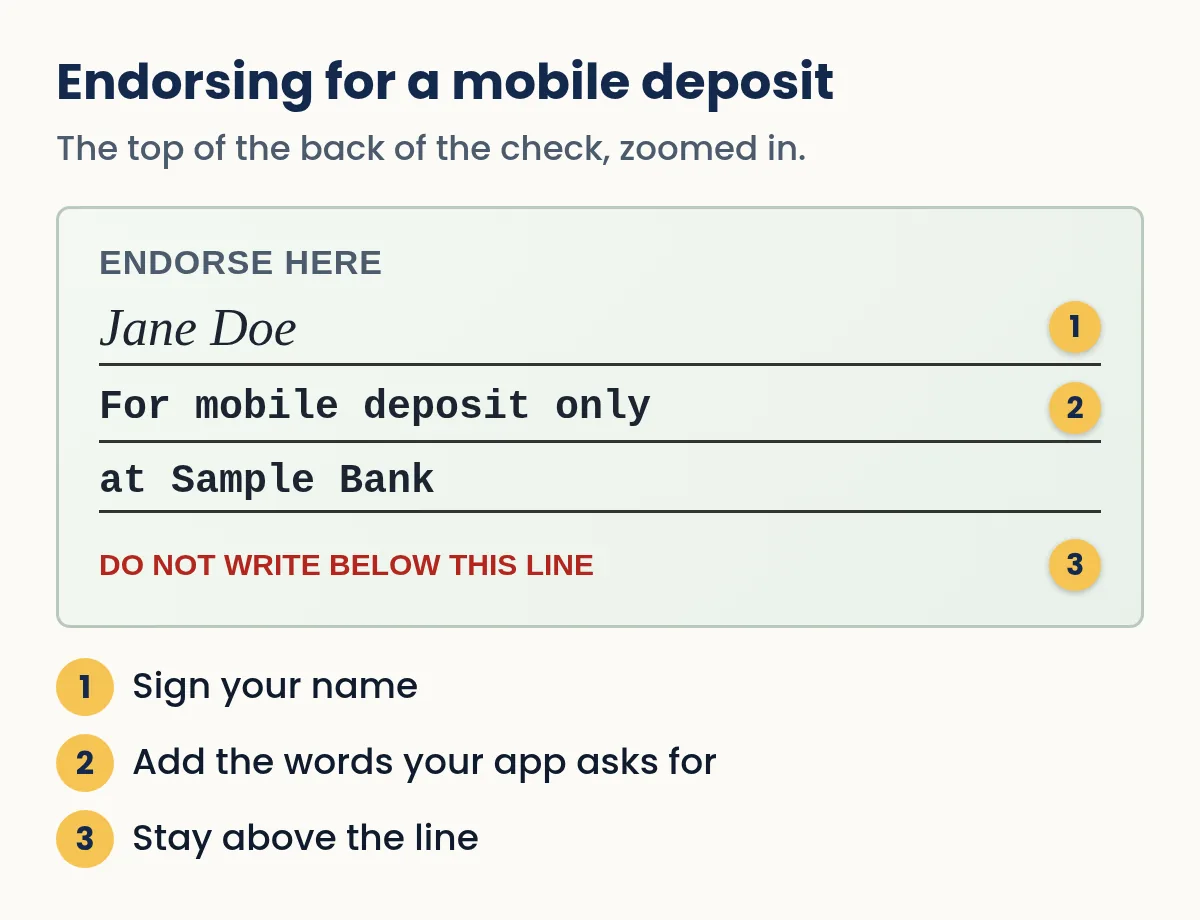
- Endorse exactly as the app asks
Many banks ask you to write a restrictive line such as “For mobile deposit only” under your signature, sometimes with the bank's name. A missing line is a common reason for rejection.
- Photograph on a dark, flat surface
Good light, all four corners visible, no shadows. The bottom line of numbers must be sharp.
- Enter the amount exactly
It must match the amount on the check, cents included.
- Hold on to the paper check
Keep it in a safe place until the deposit is final. How long varies by bank. Then destroy it, for example with a shredder, so it can't be deposited again.
Depositing a check by phone and then again at a branch or through another app is a double deposit. Banks treat it seriously, and the second deposit will be reversed.
Banks set their own daily and monthly mobile deposit limits and their own hold policies for mobile deposits. Check your bank's mobile deposit terms before depositing a large check this way.
Need to write a check right now?
Quick Check Writer fills in the amount in words, adds the bank line and prints on blank check stock or saves a PDF. Your first check is free, with no account and no card.
Write your first check free →4. At another bank's ATM
Some ATMs that your bank does not own will accept deposits for your account, usually through a shared network. It works, but it is the slowest route under federal rules: a bank may hold funds deposited at a nonproprietary ATM until the fifth business day after the banking day of deposit. Use it only when you have no better option.
5. By mail
If you live far from a branch and your bank's app is not an option, many banks accept deposits by mail. Endorse the check, add “For deposit only” and your account number, include a deposit slip, and mail it to the address your bank gives for mailed deposits.
Under Regulation CC, mailed funds count as deposited on the day your bank receives them, so the clock starts later than you might expect. Use the safety steps in how to mail a check safely, and never mail cash.
Cashing instead of depositing
If you need cash and don't have an account, you can often cash the check at the bank it is drawn on, or at a check-cashing business, usually for a fee. That is a different transaction with different trade-offs, covered in how to cash a check.
Checks that need extra care
- A check made out to two people
- If the payee line says “and”, both people usually need to endorse it; “or” usually means either one can. See check made out to two people.
- A check signed over to you
- A check endorsed by the original payee and handed to you (a third-party check) is often refused, especially in apps. Ask your bank before relying on one.
- An old check
- Banks are not obliged to pay a personal or business check presented more than six months after its date, though they may. See how long a check is good for.
- A post-dated check
- A bank may pay a check before the date written on it unless the writer has given proper notice. Read post-dated checks.
- A check from a foreign bank
- Checks drawn on banks outside the U.S. are usually sent for collection, which can take weeks and carry fees. Practice varies by bank, so ask first.
If something goes wrong with a deposit
- The ATM or app read the wrong amount. Contact your bank with your receipt or confirmation. The bank corrects the deposit to the actual amount of the check.
- The app rejected the image. Retake it in better light. If it keeps failing, the check may be damaged or missing information; deposit it at a teller.
- The check was returned unpaid. Your bank reverses the credit and may charge a returned-item fee. Contact the person who wrote it. See what happens when a check bounces.
- The deposit never showed up. Use your receipt to open a claim with the bank right away.
When will the money be available?
Banks must follow the minimum schedule in Regulation CC and publish their own funds-availability policy, which may be faster. Under the federal rules:
- Next business day
- Cash deposited in person to a teller, electronic payments, and certain low-risk checks such as U.S. Treasury checks, U.S. Postal Service money orders, cashier's and certified checks (some only when deposited in person), and checks drawn on the same bank. Also the first $275 of other checks deposited on a banking day.
- Second business day
- Most other ordinary checks, including personal and business checks.
- Fifth business day
- Deposits made at an ATM your bank doesn't own.
- Longer, in exceptions
- New accounts (the first 30 days), the portion of a day's check deposits over $6,725, redeposited checks, accounts with repeated overdrafts, and cases where the bank has reasonable cause to doubt the check will be paid.
Our guides to how long a check takes to clear and check clearing times by bank go deeper.
Funds can be available to spend before the paying bank has actually paid the check. If the check comes back unpaid days later, your bank will take the money back. This is how fake check scams work, so don't spend money from a check from someone you don't know until you are sure it is good. See how to verify a check.
Three situations, step by step
A paycheck deposited in the app on Friday night
Jane Doe photographs her paycheck in her bank's app at 9 p.m. on a Friday. Under Regulation CC, a deposit made after the bank's cut-off time, or on a day that isn't a banking day, counts as made on the next banking day. For Jane that is Monday, so the availability clock starts then, not on Friday night.
- Check the app's cut-off time
Banks may set a cut-off as early as 2 p.m. for deposits at a branch and noon for ATMs and other off-site channels. Apps often publish a later one. It is shown in the app or the funds-availability policy.
- Endorse with the app's wording
Signature plus the restrictive line the app asks for, as in the diagram above.
- Keep the paper check
Write “mobile deposit” and the date on the front, store it safely, and shred it once the deposit is final and your bank's retention window has passed.
A large check from selling a car
John Sample receives a personal check for $9,000 for his car. The federal rules let a bank hold the part of a day's check deposits above $6,725 longer than usual, and the same applies to the first 30 days of a new account. When a bank uses one of these exceptions, it must give you a written notice that explains the hold.
John's best move is to deposit at a teller, ask when the full amount will be available, and not hand over the title until the check has actually been paid. For a big private sale, a cashier's check confirmed directly with the issuing bank is safer still. See cashier's check vs certified check.
A small business with twenty customer checks
A shop that takes checks all week usually endorses each one with a stamp reading “For deposit only” plus the business name and account, then deposits the batch in one go. At a teller that means one slip listing every check; see how to fill out a deposit slip. Many banks also offer business remote deposit, with a desktop scanner or a business app, so checks never have to leave the office. Ask your bank about fees and daily limits.
Common deposit mistakes
- Depositing the same check twice. Photographing a check in the app and later taking it to an ATM is treated as a duplicate. Mark a check after a mobile deposit so it can't be reused by mistake.
- Missing the restrictive endorsement. Many apps reject a check without the exact words they ask for.
- Spending a big deposit from a stranger right away. Available is not the same as paid. Wait until you're sure the check is good.
- Ignoring the hold notice. It tells you the date the money will be available. Plan around it rather than writing checks against the deposit.
- Throwing away the receipt. The ATM receipt or app confirmation is your evidence if the amount is misread or the deposit goes missing.
- Depositing an old or post-dated check without asking. These can be refused or returned later. Check the date before you deposit.
Which method should you use?
- Everyday personal check, normal amount: mobile app or your bank's ATM.
- Cashier's check, government check, or you need the money tomorrow: a teller, in person.
- Very large check: a teller, and ask when the funds will be available before you rely on them.
- Check from a stranger or a deal that feels off: a teller, and ask them to help confirm the check before you spend anything.
- No branch, no app: mail, with a slip, and allow extra days.
Depositing checks you wrote yourself
If you print your own checks, the same deposit methods apply to the person you pay. What makes a printed check easy to deposit is a clean, correctly placed bank line (the MICR line) and clear, typed fields. Quick Check Writer lays out the MICR line in the standard E-13B font at the standard position and fills the amount in words for you, so the check reads the same way to an ATM, an app or a teller as a check from a checkbook. Read MICR font for checks and how to print checks at home.
Frequently asked questions
What is the fastest way to deposit a check?
For next-day access to a cashier’s, certified or government check, deposit it in person with a teller. For everyday checks, your bank’s app or ATM before the daily cutoff is usually just as fast.
Can I deposit a check at any ATM?
Only at ATMs that accept deposits for your bank. Your own bank’s ATMs are best; deposits at an ATM your bank doesn’t own can be held until the fifth business day.
Do I need to endorse a check for mobile deposit?
Yes. Sign the back, and add any wording your bank requires, often “For mobile deposit only” and sometimes the bank’s name.
What should I do with a check after mobile deposit?
Keep it somewhere safe until the deposit is final, for as long as your bank recommends, then shred it so it can’t be deposited again.
Can I deposit a check into someone else’s account?
Policies vary by bank. Many accept a deposit into another customer’s account at a teller if the check is endorsed to that account, but some restrict it. Ask the bank first.
Why is my check deposit on hold?
Banks can hold funds longer for new accounts, deposits over $6,725 in a day, redeposited checks, repeated overdrafts, or when they doubt the check will be paid. They must tell you when the money will be available.
Can I deposit a check without a bank account?
No. A deposit needs an account to land in. Without one, you can cash the check, usually at the bank it is drawn on, or load it onto a prepaid card that accepts check deposits. See how to cash a check.
If I deposit a check on the weekend, when does it count?
On the next banking day. Federal rules treat a deposit made on a non-banking day, or after the bank’s cut-off time, as made on the next banking day, so a Saturday deposit usually counts from Monday.
Is there a limit on mobile check deposits?
Yes, each bank sets its own daily and monthly limits, and they can differ by account type and account age. The app shows your limit before you submit. For a check above it, use a teller or an ATM.
Related guides
- How to Deposit a Check With Your Phone
- How to fill out a deposit slip
- How Long Does a Check Take to Clear?
- How to cash a check (with or without a bank account)
- How to endorse a check
- How to verify a check before you deposit it
Sources
- 12 CFR § 229.10, next-day availability (Cornell LII)
- 12 CFR § 229.12, availability schedule (Cornell LII)
- 12 CFR § 229.13, exceptions (Cornell LII)
- 12 CFR § 229.19, when funds are considered deposited (Cornell LII)
- Chase: How to endorse a check (mobile deposit wording)
- UCC § 4-404, checks more than six months old (Cornell LII)
- UCC § 4-401(c), post-dated checks (Cornell LII)
Last updated November 1, 2026. This page is general information, not legal or financial advice. Quick Check Writer is check printing software; it is not a bank and does not move money.