
Key takeaways
- Personal and business checks are only as good as the account behind them.
- A cashier's check is the bank's own obligation; a certified check is yours, guaranteed by the bank.
- Official checks, Treasury checks and USPS money orders get next-day availability when deposited in person.
- Treasury checks are valid for one year; ordinary checks may be refused after six months.
On this page
- The quick comparison
- Checks drawn on your own account
- Official checks: when the bank stands behind the payment
- If an official check is lost or stolen
- Prepaid and special-purpose checks
- Checks that aren't really paper anymore
- Which type should you use?
- Walk-throughs: picking the right check in real life
- Cost, limits and stopping payment, side by side
- Common mistakes with different check types
- How the rules vary
- Print your own personal and business checks
- FAQ
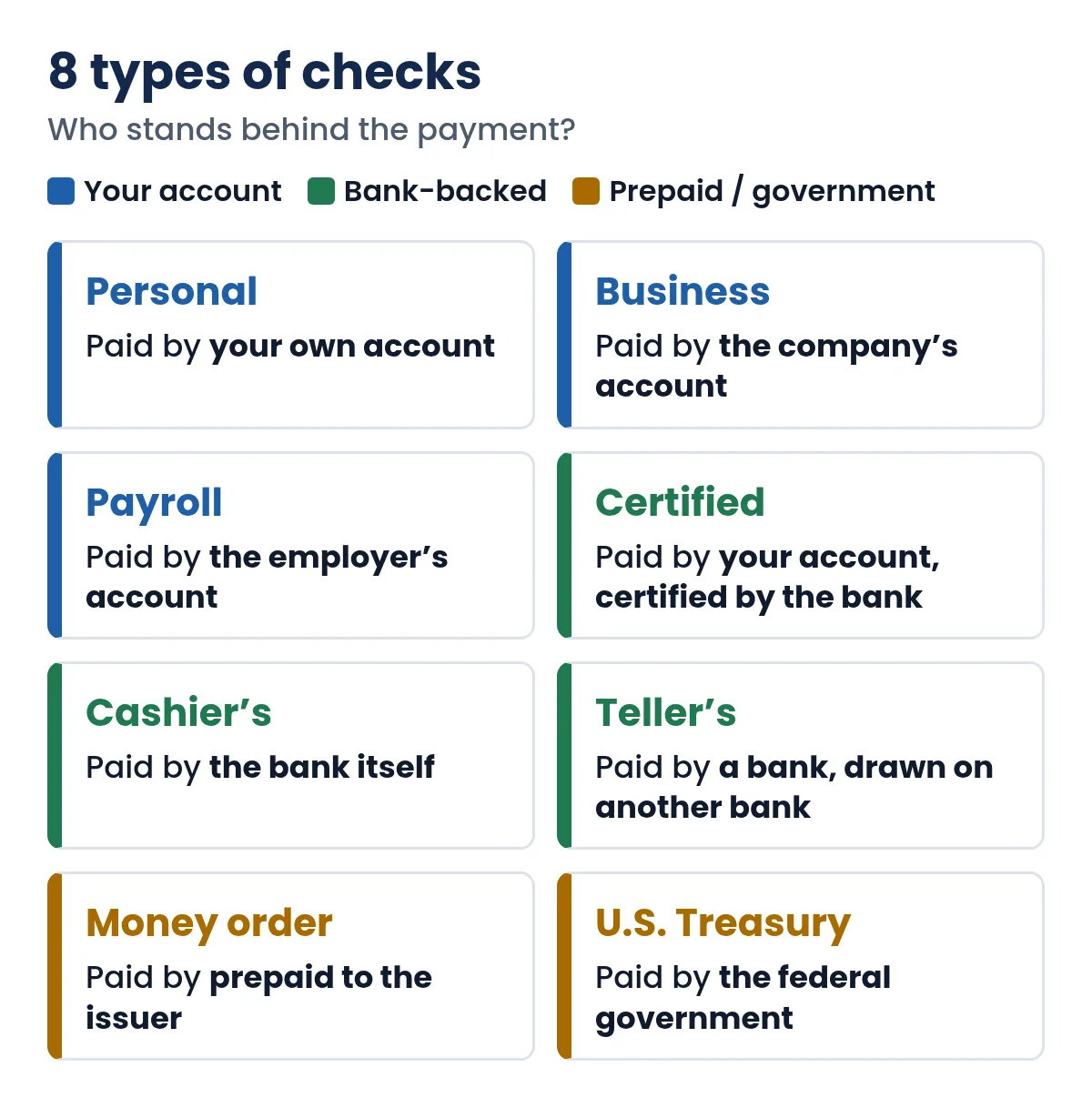
The quick comparison
| Type | Who promises to pay | How long it's good for |
|---|---|---|
| Personal check | Your checking account | Bank may refuse (UCC § 4-404) |
| Business check | The company's account | Bank may refuse (UCC § 4-404) |
| Payroll check | The employer's account | Bank may refuse (UCC § 4-404) |
| Cashier's check | The issuing bank itself | Not covered by § 4-404; bank policies vary |
| Certified check | Your account, with the bank's certification | No, § 4-404 excludes certified checks |
| Teller's check | A bank, drawn on another bank | Not covered by § 4-404; policies vary |
| Money order | The issuer (e.g. the Postal Service) | Issuer's rules apply |
| U.S. Treasury check | The federal government | Valid for one year from issue |
Legally, nearly all of these are "checks". The Uniform Commercial Code defines a check as a draft payable on demand and drawn on a bank, and expressly includes cashier's and teller's checks; it even says an instrument can be a check though it's called something else, such as a "money order" (§ 3-104(f)). The differences come down to whose money stands behind it and how much assurance the payee gets.
Checks drawn on your own account
Personal checks
The check most people picture: drawn on an individual's checking account, signed by the account holder and usually wallet-sized. A personal check is only as good as the account behind it; if there isn't enough money when it's presented, it can bounce. Learn the layout in parts of a check and the routine in how to write a check.
Business checks
Drawn on a company's account and signed by an authorized person. They're often larger than personal checks, printed one per letter-size page with stubs or three to a page, and often include a logo and a voucher showing what the payment covers. See business check vs personal check and how to print business checks.
Payroll checks
A payroll check is a business check used to pay wages, usually with a stub listing hours, gross pay, withholdings and net pay. Many employers print them on blank stock from their payroll records. See how to print payroll checks.
Voucher checks
A check with one or two attached stubs (vouchers) that describe the payment: invoice numbers, dates, discounts. The payee tears off the check and keeps the stub for their records. Our page on check stubs and voucher checks covers layouts.
Counter and starter checks
Temporary checks a branch prints or hands out when you open an account or run out, sometimes without your name on them. They draw on your account like any personal check, but some payees won't accept them. See counter checks and starter checks.
Official checks: when the bank stands behind the payment
When a payee wants more certainty than a personal check gives, such as a car dealer, a landlord at move-in or a closing agent, they'll ask for an official check. The three kinds work differently.
Cashier's checks
A cashier's check is drawn by a bank on itself: the UCC defines it as a draft where the drawer and the drawee are the same bank (§ 3-104(g)). You pay the bank (from your account or in cash), and the bank issues a check signed by one of its officers or employees. Because the bank is the one paying, the payee isn't relying on your balance. Regulation CC adds that a cashier's check is a direct obligation of the bank.
Certified checks
A certified check is your own personal check that your bank has accepted, usually by stamping and signing it (§ 3-409(d)). Under Regulation CC's definition, the bank certifies that your signature is genuine and that it has set aside the funds to pay, or that it will pay on presentment. Banks don't have to certify a check, and some banks no longer offer the service, offering cashier's checks instead.
Teller's checks
A teller's check is drawn by a bank on another bank, or payable through a bank (§ 3-104(h)). Some credit unions issue teller's checks drawn on a bank they work with.
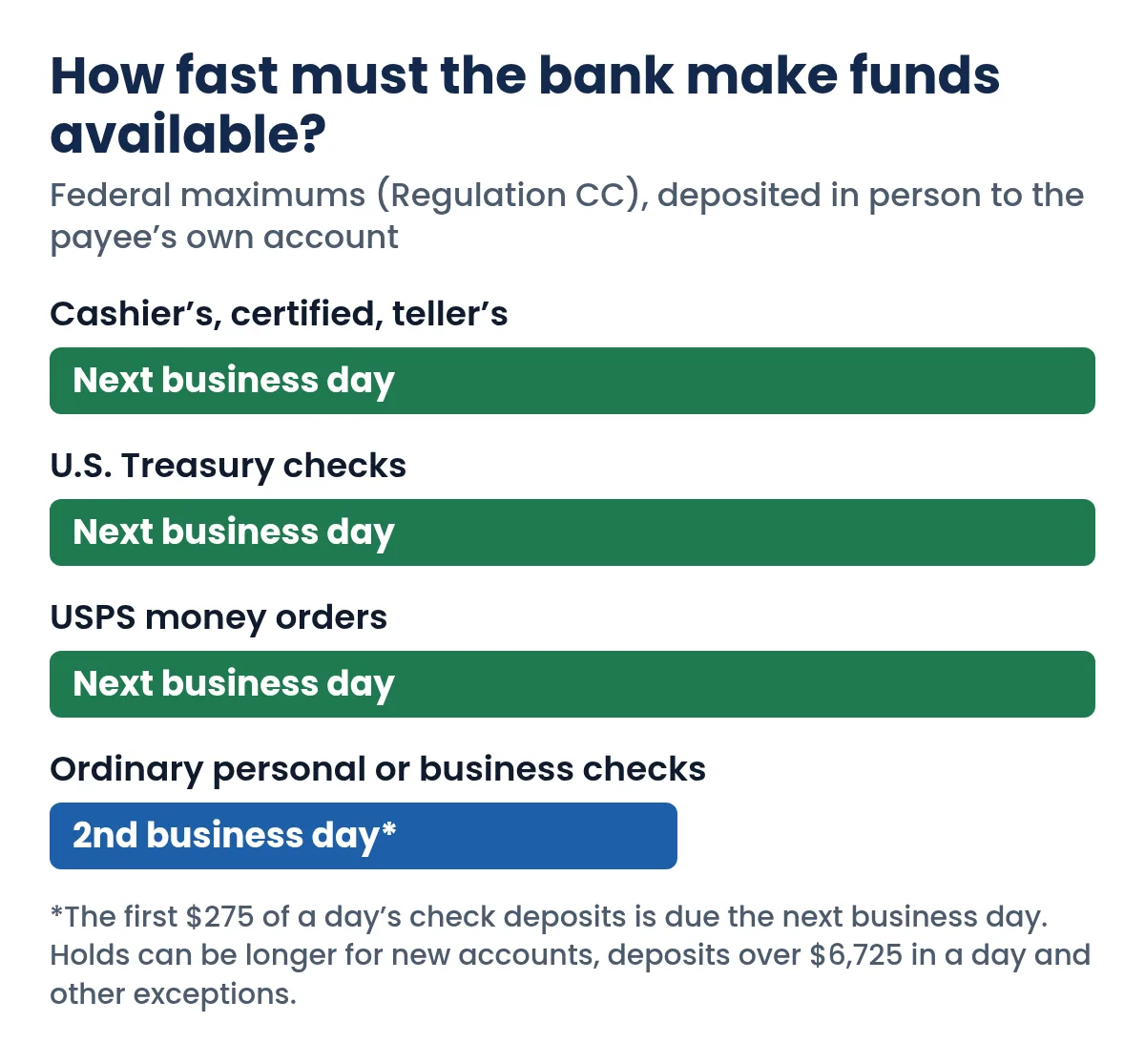
All three get faster access to funds. Under Regulation CC (12 CFR § 229.10(c)), cashier's, certified and teller's checks deposited in person into the payee's account generally must be available by the next business day. The comparison of the two most common kinds is in cashier's check vs certified check.
Counterfeit cashier's checks are a common scam tool. Fast availability isn't proof a check is good: if it turns out to be fake, the deposit can be reversed. Confirm a large official check with the issuing bank, using a phone number you look up yourself. See how to verify a check.
Need to write a check right now?
Quick Check Writer fills in the amount in words, adds the bank line and prints on blank check stock or saves a PDF. Your first check is free, with no account and no card.
Write your first check free →If an official check is lost or stolen
Losing a cashier's, teller's or certified check is more complicated than losing a personal check, because the bank, not you, owes the money. You can't simply stop payment the way you would on your own check.
The UCC gives a specific process (§ 3-312). The buyer or payee files a claim with the bank, including a declaration of loss. The claim only becomes enforceable at the later of when it's made or the 90th day after the check's date (for a certified check, 90 days after the bank accepted it). Until then, the bank may still pay the check if it's presented. After that point, if the check hasn't been paid, the bank pays the claimant instead.
- Report the loss to the issuing bank right away and ask for its claim form.
- Keep your receipt or copy: it has the check's serial number and amount.
- Expect to wait about three months for a replacement or refund.
- Some banks may offer a faster route if you buy an indemnity bond; ask what yours requires.
For personal checks, the process is simpler; see how to stop payment on a check and lost or stolen checks.
Prepaid and special-purpose checks
Money orders
A money order is paid for up front, so there's no account behind it that can come up short. The Postal Service sells domestic money orders up to $1,000 each, payable with cash or a debit card (not a credit card), and lists its fees on its site. Banks, credit unions and some stores sell them too, with their own limits. A USPS money order deposited in person into the payee's account also gets next-business-day availability under Regulation CC.
Traveler's checks
Once a staple of travel, these are pre-printed checks you sign when you buy them and countersign when you spend them. The UCC still defines them: payable on demand and requiring a countersignature that matches the specimen signature on the check (§ 3-104(i)). Today they're rare.
Government checks
Checks issued by the U.S. Treasury, a state or a local government. Treasury checks are valid for one year from their issue date, according to the Bureau of the Fiscal Service. Paper federal checks are also disappearing: Treasury announced it would stop issuing paper checks for most federal payments on September 30, 2025, moving people to direct deposit and other electronic payments. See direct deposit and the voided check.
Checks that aren't really paper anymore
- Substitute checks
- A paper reproduction of an original check, created from an image, that is its legal equivalent under the Check 21 Act. See Check 21 and substitute checks.
- Remotely created checks
- Checks created by a payee, with the account holder's permission, that carry no handwritten signature, such as a "check by phone". See remotely created checks.
- eChecks
- A term used for several electronic payments, including checks converted into ACH debits. See eCheck vs paper check.
- Bank drafts
- A general term for a payment the bank guarantees, often used to mean a cashier's or teller's check. See what is a bank draft.
Which type should you use?
- Everyday bills and people you know
A personal check (or a business check, for business expenses) is fine and costs the least.
- A payee who needs guaranteed funds
Use a cashier's check, or a certified check if your bank offers one and the payee accepts it.
- No checking account, smaller amount
A money order up to its issuer's limit.
- Business payments with paperwork
Voucher checks with stubs that explain each payment.
Walk-throughs: picking the right check in real life
Buying a used car from a private seller
The seller wants guaranteed funds; you don't want to carry thousands in cash. A cashier's check usually fits both.
- Agree on the exact amount and payee name first
The bank prints the payee on a cashier's check, so get the spelling right (for example, "Jane Doe", not a nickname).
- Buy the check at your bank
The bank takes the money from your account (or cash) and gives you a receipt with the check's serial number. Keep it.
- Meet at the bank if you can
If you're the seller, going to the buyer's bank together, or calling the issuing bank at a number you look up yourself, is the simplest way to confirm the check is real.
- Hand over the title only when you're confident
Next-day availability doesn't prove a check is good (more on that below).
Paying a deposit or first month's rent
Landlords and property managers often ask for "certified funds" at move-in. Ask exactly which forms they accept: some take only cashier's checks or money orders. Ongoing monthly rent is usually fine as a personal check; see how to pay rent by check.
Sending a small amount to someone without a bank account
A money order is the usual answer. At the Postal Service, a domestic money order can be up to $1,000; the fee is $2.65 for amounts up to $500 and $3.75 from $500.01 to $1,000, paid in cash or by debit card. Keep the receipt: it lets you track the money order and prove its value if it's lost or stolen.
Paying a supplier or contractor for your business
Use a business check drawn on the business account, ideally a voucher check whose stub lists the invoice number. That stub is the paper trail both sides keep. See paying contractors by check.
John Sample pays his monthly rent with a personal check, pays a $9,000 deposit on a used car with a cashier's check because the dealer requires guaranteed funds, and sends a $60 birthday gift to his niece as a money order because she doesn't have a bank account yet.
Cost, limits and stopping payment, side by side
| Type | Where you get it | Can you stop payment? |
|---|---|---|
| Personal / business | Your checkbook or printed on blank stock | Yes, a stop order lasts six months (UCC § 4-403) |
| Cashier's / teller's | Your bank or credit union, for a fee | No ordinary stop; lost-check claim under § 3-312 |
| Certified | Your bank, if it still offers it | No ordinary stop; lost-check claim under § 3-312 |
| USPS money order | Any Post Office; up to $1,000 each | Issuer's own process; keep the receipt |
| U.S. Treasury check | Issued by the federal government | Contact the issuing agency or Treasury |
Common mistakes with different check types
- Treating "funds available" as "check is good". Banks must make deposited funds available quickly by law, but the FTC warns it can take weeks to discover a check is fake. If it turns out to be fraudulent, the bank can generally reverse the deposit, and recovering the money from the person who gave you the check is usually up to you (HelpWithMyBank.gov).
- Accepting an overpayment. A stranger who sends an official check for more than the price and asks you to wire back the difference is running a well-known scam. Don't accept it.
- Bringing a personal check where certified funds are required. Closings, car dealers and some landlords will turn it away. Ask in advance.
- Letting a check sit. A bank isn't obliged to pay an ordinary check more than six months old (UCC § 4-404), and a Treasury check is good for one year.
- Losing the receipt for an official check or money order. The serial number on it is what the issuer needs to trace or replace the item.
- Buying a money order above the limit. For larger amounts, buy several or use a cashier's check.
How the rules vary
- By bank
- Regulation CC sets the maximum hold, not the minimum: banks may release funds sooner, and each bank sets its own fees and whether it still certifies checks.
- By account age
- An account is "new" for its first 30 calendar days. During that time the next-day rule for official, Treasury and postal checks applies only to the first $6,725 deposited on a day; the rest can be held until the ninth business day (12 CFR § 229.13(a)).
- By deposit size
- For check deposits over $6,725 on one banking day, banks may hold the excess longer than the normal schedule (§ 229.13(b)).
- By how you deposit
- The next-business-day rule for official checks applies when they're deposited in person to a bank employee into the payee's own account; deposits made other ways, such as at an ATM, follow slightly longer timelines (§ 229.10(c)).
- By issuer
- Money orders from stores and other companies follow the seller's own limits and fees, not the Postal Service's.
Print your own personal and business checks
Official checks come only from banks and issuers. But personal, business, payroll and voucher checks can all be printed yourself on blank check stock. Quick Check Writer prints them with your name, logo, bank details, MICR line and signature, in layouts with stubs or three per page, and keeps a register of everything you print. Start with how to print checks at home.
Frequently asked questions
What are the main types of checks?
Personal, business and payroll checks drawn on your own account; official checks such as cashier's, certified and teller's checks; money orders; government checks; and traveler's checks.
What is the difference between a cashier's check and a certified check?
A cashier's check is drawn by the bank on itself. A certified check is your own check that your bank has accepted and guaranteed. Both are considered safer than personal checks.
Which type of check clears fastest?
Under Regulation CC, cashier's, certified and teller's checks, U.S. Treasury checks and USPS money orders deposited in person to the payee's account generally must be available the next business day.
Is a money order a check?
For most legal purposes it works like one. The UCC says an instrument can be a check even if it's called a money order. Postal money orders are capped at $1,000 each.
How long are government checks good for?
U.S. Treasury checks are valid for one year from the issue date. State and local government checks follow their issuer's rules.
Do certified checks expire?
UCC § 4-404's six-month rule doesn't apply to certified checks, so a bank can't refuse one simply for being over six months old. Deposit it promptly anyway.
Can I print my own business or payroll checks?
Yes. You can print personal, business, payroll and voucher checks on blank check stock with check-writing software. Official checks like cashier's checks come only from banks.
Can you cancel a cashier's check?
Not like a personal check. If it's lost, stolen or destroyed, you file a claim with a declaration of loss; under UCC § 3-312 the claim becomes enforceable 90 days after the check's date, and the bank may pay the check if it's presented before then.
What is the safest type of check to accept from someone you don't know?
No paper check is risk-free, because official checks are counterfeited too. A cashier's check you confirm with the issuing bank, using a phone number you look up yourself, is the usual choice; never accept one for more than the price.
Do business checks take longer to clear than personal checks?
Federal hold limits under Regulation CC treat them the same: both are ordinary checks, generally available by the second business day. Your bank's own policy, and exceptions such as large deposits, can change the timing.
How much does a money order cost?
At the Postal Service, $2.65 for amounts up to $500 and $3.75 from $500.01 to $1,000. Banks, credit unions and stores set their own prices and limits.
Related guides
- Cashier's check vs certified check
- Business check vs personal check
- What is a bank draft? (vs a check)
- Counter checks and starter checks
- How long is a check good for?
- Parts of a check, explained
Sources
- UCC § 3-104 (check, cashier's, teller's and traveler's check definitions), Cornell LII
- UCC § 3-409 (certified check), Cornell LII
- UCC § 4-404 (checks more than six months old), Cornell LII
- 12 CFR § 229.2 Definitions (Regulation CC), eCFR
- 12 CFR § 229.10 Next-day availability (Regulation CC), eCFR
- 12 CFR § 229.12 Availability schedule (Regulation CC), eCFR
- 12 CFR § 229.13 Exceptions (Regulation CC), eCFR
- USPS: Money orders (limit, payment methods, fees)
- Bureau of the Fiscal Service: PIRS FAQs (Treasury checks valid one year)
- U.S. Treasury press release: federal paper checks phased out September 30, 2025
- UCC § 3-312 (lost, destroyed or stolen cashier's, teller's or certified check), Cornell LII
- FTC: How to spot, avoid and report fake check scams
- HelpWithMyBank.gov (OCC): Am I liable for a fraudulent check that I deposit?
- UCC § 4-403 (stop-payment orders), Cornell LII
Last updated November 1, 2026. This page is general information, not legal or financial advice. Quick Check Writer is check printing software; it is not a bank and does not move money.