
Key takeaways
- Most often, a bank draft is a cashier's or teller's check: the bank, not you, promises to pay.
- You pay up front, plus a fee; the money leaves your account immediately.
- Payees get next-business-day availability when they deposit it in person.
- You generally can't stop payment on a bank draft.
- “Pay by bank draft” on a bill usually means automatic withdrawal, not a paper check.
On this page
- “Bank draft” has more than one meaning
- How a bank draft works
- Bank draft vs personal check
- When people ask for a bank draft
- How to get a bank draft: a checklist
- How to check a bank draft you receive
- Bank draft, money order or wire?
- Bank drafts in Canada
- Common mistakes
- Can a bank draft be cancelled?
- Automatic “bank draft” payments
- Demand drafts and remotely created checks
- Demand drafts outside the U.S.
- Should you write a personal check instead?
- FAQ
“Bank draft” has more than one meaning
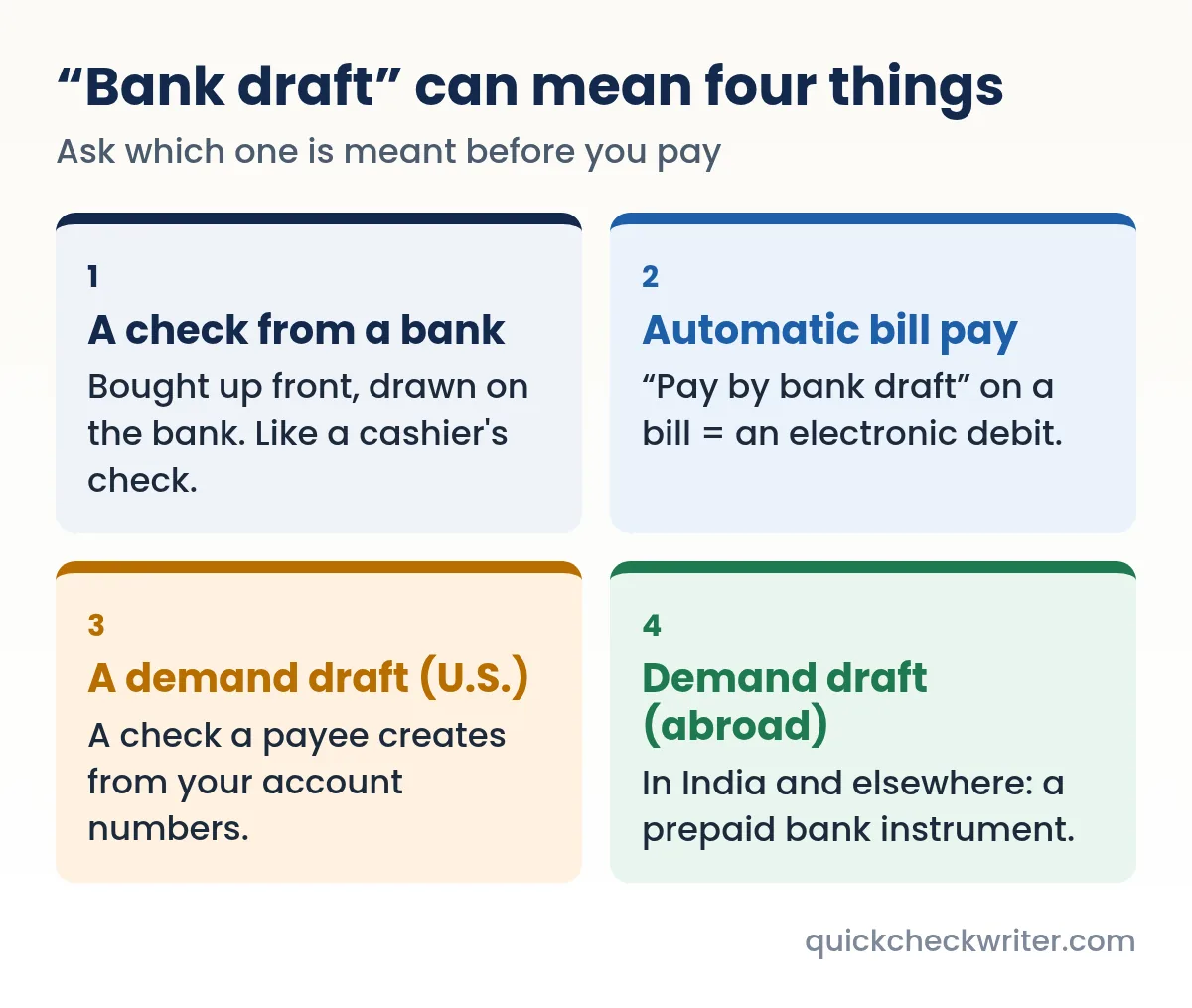
Few banking terms cause as much confusion as "bank draft," because people use it for different things. Before you buy one, accept one or agree to pay by one, it helps to know which meaning is in play.
- A check issued by a bank
- This is the classic meaning and the one most banks use. You pay the bank, and it issues a check drawn on its own funds or on its account at another bank. In U.S. legal terms that is a cashier's check or a teller's check. Some banks call it an "official check" or simply a bank check.
- An automatic withdrawal
- Many utilities and service companies offer payment "by bank draft," meaning they pull your bill from your checking account automatically each month. The City of Concord, North Carolina, for example, lists "Automatic Bank Draft (using checking account)" as a way to pay utility bills. Behind the scenes that is an electronic debit, not a paper check.
- A demand draft
- In the U.S. this phrase often refers to a check that a payee creates from your account and routing numbers, without your signature, also called a remotely created check. In India and some other countries, a demand draft is a prepaid instrument a bank issues after you deposit the amount, similar in purpose to a cashier's check.
- The legal meaning
- Under the Uniform Commercial Code, a draft is any instrument that is an order to pay, as opposed to a note, which is a promise. A check is a particular kind of draft: one payable on demand and drawn on a bank. So technically, every check you write is a draft.
The rest of this guide focuses on the first meaning, a bank-issued check, because that is what people usually mean when someone asks them for a bank draft.
How a bank draft works
- You request it
At a branch, you ask for a draft for an exact amount, payable to a named payee.
- You pay for it up front
The bank takes the amount from your account, or in cash, plus any fee. The money is gone from your balance immediately.
- The bank issues the check
It is signed by an authorized bank employee and drawn on the bank itself (a cashier's check) or on another bank (a teller's check).
- You deliver it
Hand it over or send it securely. Because it is as good as cash to anyone who can negotiate it, treat it carefully.
- The payee deposits it
Federal Regulation CC requires the funds from a cashier's, certified or teller's check to be available by the next business day when deposited in person by a payee into their own account, or by the second business day when deposited another way.
Bank draft vs personal check
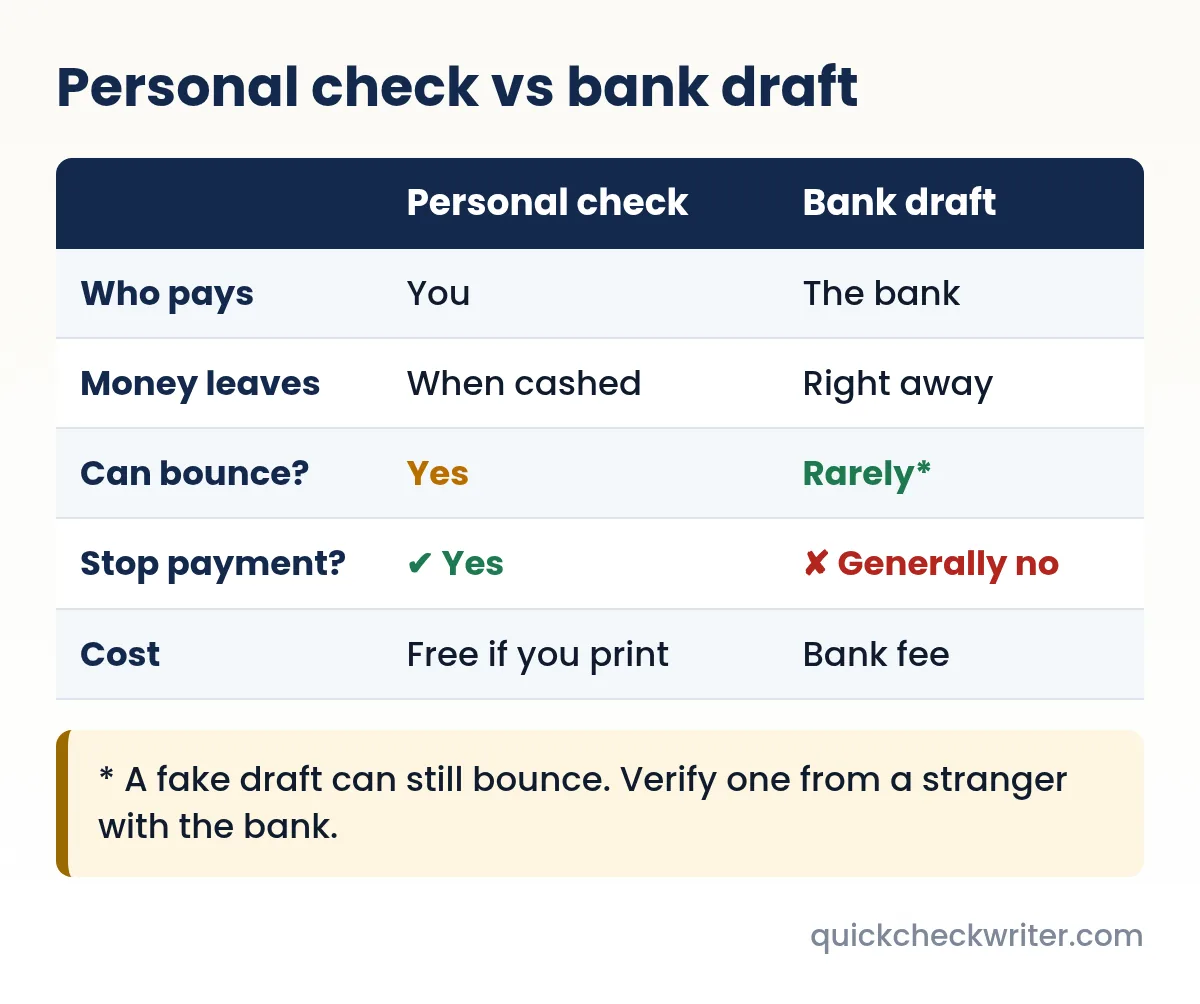
The essential difference is whose promise the payee is relying on. With a personal check, the payee trusts that you have the money and will not stop payment. With a bank draft, the bank has already collected the money and owes it to the payee. If a bank wrongfully refuses to pay its own cashier's check, the UCC lets the holder recover expenses and lost interest, and in some cases more.
That security has trade-offs for you as the buyer. You pay a fee, you have to get the draft from the bank in advance, and you generally cannot stop payment if something goes wrong with the deal. A personal check, by contrast, costs only the check itself and can be stopped before it is paid. If you are not sure which one you need, our guide to types of checks compares them all.
Need to write a check right now?
Quick Check Writer fills in the amount in words, adds the bank line and prints on blank check stock or saves a PDF. Your first check is free, with no account and no card.
Write your first check free →When people ask for a bank draft
- Large purchases from individuals, such as a car or boat, where the seller does not want to risk a bounced check.
- Housing, such as security deposits and closing costs, when the landlord or closing agent asks for certified funds.
- International payments, where a foreign bank draft or a draft in another currency may be requested.
- Court, government and escrow payments, which often specify the form of payment.
For businesses, bank drafts also matter for reporting. The IRS treats cashier's checks and bank drafts with a face value of $10,000 or less as "cash" for Form 8300 purposes in certain transactions, such as when the business knows the customer is trying to avoid the report, so businesses that accept them in large sales should read the IRS guidance.
How to get a bank draft: a checklist
Getting a bank draft takes a few minutes if you arrive prepared. Before you go to the bank:
- Confirm the exact payee name. Ask the person or company how the name should read. A draft made out incorrectly may need to be replaced, which can involve the loss process described below.
- Confirm the exact amount, including any cents. Drafts are not written for "about" an amount.
- Have the funds available in your account, or bring cash if your bank allows that.
- Bring identification, such as a driver's license, especially for larger amounts.
- Ask about the fee. Many banks charge one; some account types waive it.
- Keep the receipt or copy the bank gives you. It has the draft's number and is what you will need if the draft is lost.
Jane Doe is renting an apartment, and the landlord wants the $1,800 security deposit by bank draft. Jane asks for the exact payee name, buys a cashier's check for $1,800 at her bank, pays the bank's fee, and keeps the receipt. She hands the check over at the lease signing and gets a written receipt from the landlord. If the landlord had accepted a personal check, Jane could simply have written one and kept the bank fee.
How to check a bank draft you receive
A real bank draft is about as safe as a check gets. A fake one is worthless, and the loss lands on whoever deposited it. If the draft comes from someone you do not know well, take these steps before you hand over keys, goods or change.
- Look up the issuing bank yourself
Find its phone number on the bank's own website or through the FDIC's BankFind tool, not from the draft or the sender.
- Call and confirm the details
Ask the bank to confirm the draft number, amount, date and payee.
- Be wary of overpayment
A buyer who sends a draft for more than the price and asks for the difference back is following a classic fake-check script.
- Deposit it in person if you can
Under Regulation CC, cashier's, certified and teller's checks deposited in person to a teller, into the payee's account, must be available by the next business day; if not deposited in person (for example, at an ATM), by the second business day.
- Remember that available is not final
Money can be available before a fake is discovered. If the draft turns out to be counterfeit, your bank can take the funds back.
Bank draft, money order or wire?
| Bank draft | USPS money order | Wire transfer | |
|---|---|---|---|
| Best for | Large in-person payments | Small payments | Large, fast payments |
| Amount | Set by the bank | Up to $1,000 each | Set by the bank |
| Speed | Hand it over | Hand or mail | Often same day |
| If it goes wrong | Claim if lost | Replace for $23 | Hard to reverse |
For wires, read our comparison of wire transfers and checks; for the bank-issued check family, see cashier's checks vs certified checks.
Bank drafts in Canada
In Canada, “bank draft” is the everyday name for a bank-issued cheque. The Financial Consumer Agency of Canada describes a bank draft as a guaranteed form of payment backed by the issuing bank, and lists the bank draft fee among the fixed fees banks charge. It also notes that when a cheque does not clear, a bank may ask for a secured method of payment such as a bank draft or cashier's cheque instead.
Common mistakes
- Assuming everyone means the same thing. If a bill or a seller says “bank draft,” ask whether they mean a bank-issued check or an automatic withdrawal.
- Buying a draft for the wrong payee name. Fixing it may mean a claim and a wait for your money.
- Throwing away the receipt. The draft number on it is what the bank needs if the draft is lost.
- Treating “funds available” as “funds verified.” Wait until you have confirmed the draft with the issuing bank.
Can a bank draft be cancelled?
Generally, a buyer cannot place a stop payment on a cashier's check, because it is drawn on the bank, not on the buyer's account. If you still have the unused draft in hand, ask the issuing bank about returning it; if it was lost, stolen or destroyed, the UCC provides a claim process through a declaration of loss, which becomes enforceable 90 days after the check's date, and many banks also ask for an indemnity bond before issuing a replacement. See cashier's check vs certified check for the details, and how to stop payment on a check for personal checks.
Automatic “bank draft” payments
If a bill says you can "pay by bank draft," it almost always means automatic withdrawals from your account. That is convenient, but it works differently from a paper bank draft:
- You authorize the company to pull the payment, usually each month.
- For a recurring electronic debit, federal Regulation E lets you stop a payment by telling your bank at least three business days before the scheduled date. Tell the company too.
- Payments come out on the company's schedule, so keep enough in your account; see overdraft protection.
For a comparison of electronic debits and paper checks, see ACH vs check.
Demand drafts and remotely created checks
A remotely created check is a check that the payee, not your bank, creates, and that does not carry your signature. Regulation CC defines it that way. Businesses sometimes use them with your permission, for example when you authorize a payment by phone and give your account numbers.
Because they can be abused, there are restrictions. The Federal Trade Commission's Telemarketing Sales Rule prohibits sellers and telemarketers from using remotely created payment orders as payment for goods or services sold through telemarketing. If you find a check on your statement that you never signed or authorized, report it to your bank promptly. Our dedicated guide to remotely created checks explains more.
The routing and account numbers printed on every check are enough for someone to attempt a remotely created check or an electronic debit. Share them only with people and companies you trust, and read your statements every month.
Demand drafts outside the U.S.
If you are dealing with a bank in India or a few other countries, a demand draft means something closer to a U.S. cashier's check. Bank of Baroda, for example, describes a demand draft as a prepaid payment instrument issued by a bank after the payer deposits the amount, which guarantees payment to the beneficiary. If someone abroad asks you for a demand draft, ask your U.S. bank whether it can issue a foreign draft or recommend an international wire instead.
Should you write a personal check instead?
If the payee is happy to accept a personal check, it is usually the cheaper and more flexible choice: no bank fee, no trip to the branch, and you keep the ability to stop payment if something goes wrong. If you print your own checks, Quick Check Writer fills in the amount in words and the bank line, and logs each check in your register, so you have a record of every payment. When the payee needs a guarantee, a bank draft is the right tool.
Frequently asked questions
Is a bank draft the same as a cashier's check?
In the U.S., usually yes. When people ask for a bank draft they mean a check issued by a bank from its own funds, which is a cashier's check, or a teller's check drawn by the bank on another bank.
Is a bank draft safer than a personal check?
For the payee, yes, because the bank has already collected the money and promises to pay. But counterfeit bank drafts exist, so verify one from a stranger with the issuing bank using a phone number you look up yourself.
How long does a bank draft take to clear?
Under Regulation CC, funds from a cashier's or teller's check must be available by the next business day if deposited in person into the payee's account, or the second business day if deposited another way.
What does pay by bank draft mean on a bill?
It usually means automatic withdrawal: you authorize the company to take the payment from your checking account each month. It is an electronic debit, not a paper draft.
Is every check a draft?
Legally, yes. The UCC defines a draft as an order to pay, and a check as a draft drawn on a bank and payable on demand.
What is a demand draft?
In the U.S., the term often refers to a remotely created check, made by a payee from your account details without your signature. In India and some other countries it means a bank-issued prepaid instrument, similar to a cashier's check.
Do bank drafts expire?
A U.S. bank draft issued as a cashier's check has no federal expiration date, though some banks print a validity period on their official checks. Money that is never claimed eventually goes to the state as unclaimed property, so deposit a draft promptly or contact the issuing bank about an old one.
Can I deposit a bank draft at an ATM or by phone?
Usually yes, but the timing can differ. Regulation CC gives next-business-day availability to cashier's, certified and teller's checks deposited in person to a teller into the payee's account; deposits not made in person get the second business day, and your bank's own policy may be faster.
Related guides
- Cashier's check vs certified check
- Types of checks: personal, business, cashier's, certified and more
- Remotely created checks (check drafts) and checks by phone
- ACH vs check: which payment should you use?
- How to stop payment on a check
- How to verify a check before you deposit it
Sources
- UCC § 3-104, Negotiable instrument; check, cashier's check and teller's check defined (Cornell LII)
- UCC § 3-411, Refusal to pay cashier's, teller's and certified checks (Cornell LII)
- UCC § 3-312, Lost, destroyed, or stolen cashier's, teller's or certified check (Cornell LII)
- Regulation CC, 12 CFR 229.2 Definitions (eCFR)
- Regulation CC, 12 CFR 229.10 Next-day availability (eCFR)
- OCC HelpWithMyBank: Stop payment on a cashier's check
- OCC HelpWithMyBank: Indemnity bond for a lost cashier's check
- Regulation E, 12 CFR 1005.10(c) Stopping preauthorized transfers (eCFR)
- FTC Telemarketing Sales Rule, 16 CFR 310.4(a)(9) (eCFR)
- City of Concord, NC: Bill pay options (automatic bank draft)
- IRS Form 8300 reference guide (bank drafts as monetary instruments)
- Bank of Baroda: What is a demand draft (India)
- USPS: Money orders (limits and replacement fee)
- FCAC: Review of banking fees in Canada, context (bank draft fee)
- FCAC: Cashing a cheque
- FDIC BankFind Suite
- FDIC Consumer News: Fake checks (Aug 2019)
- UCC § 4-404 (certified checks excluded from six-month rule) (Cornell LII)
- Unclaimed property basics (NAUPA)
- HelpWithMyBank (OCC): Who is liable for a fraudulent check I deposited?
Last updated November 1, 2026. This page is general information, not legal or financial advice. Quick Check Writer is check printing software; it is not a bank and does not move money.