
Key takeaways
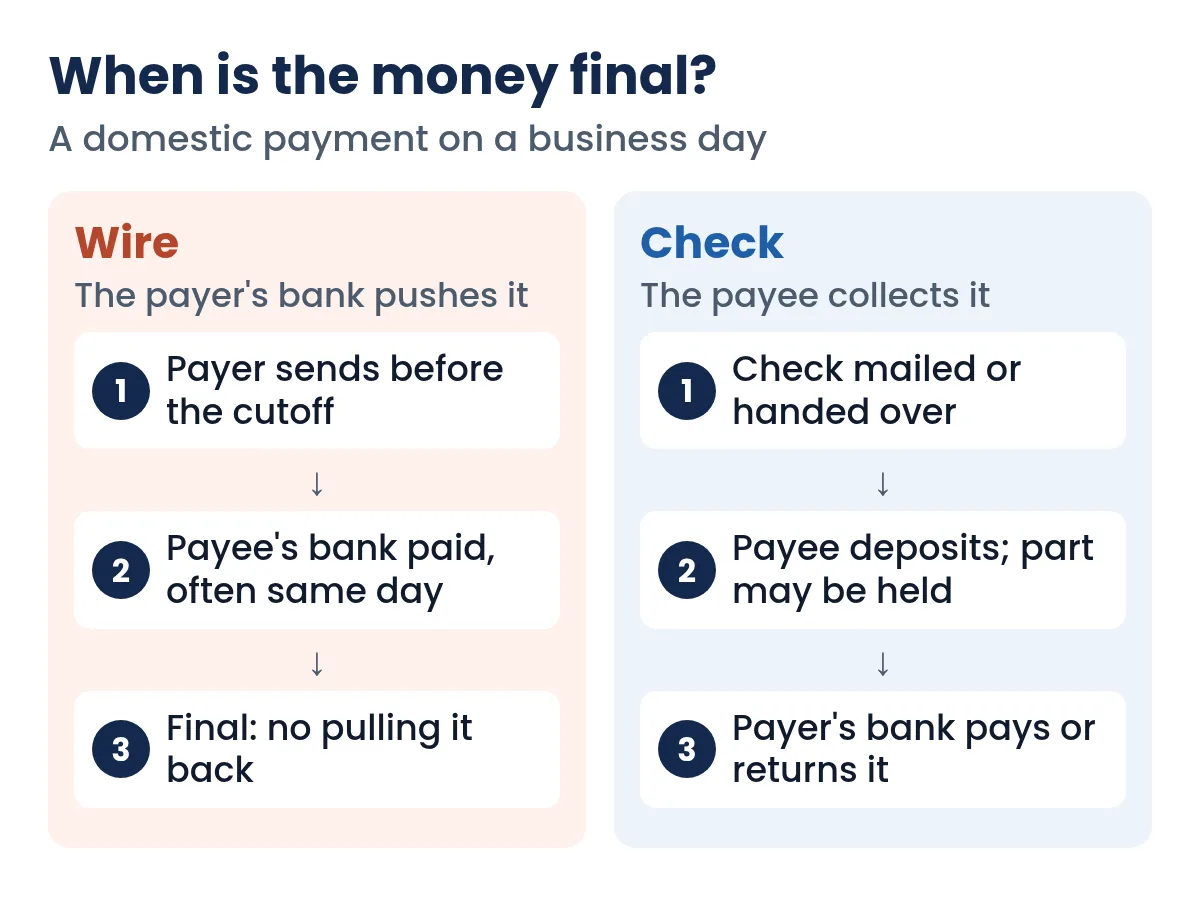
- Domestic wires usually arrive the same business day; checks take days.
- A wire is generally final once accepted; a check can be stopped before it's paid.
- Most domestic wires are not covered by Regulation E; international consumer wires get remittance rules.
- Confirm any wiring instructions by phone before sending.
On this page
- The short version
- How a wire transfer works
- How a check payment works
- Wire transfer vs check, side by side
- Speed
- Cost
- Safety: finality cuts both ways
- When to use a wire
- When to use a check
- Other options between a wire and a check
- How to send a wire safely, step by step
- How to pay a large amount by check instead
- Three common situations, step by step
- If a wire goes wrong: the first hour
- Common mistakes when choosing between a wire and a check
- Where Quick Check Writer fits
- FAQ
The short version
A wire transfer is an electronic payment that one bank sends directly to another, usually arriving the same business day, and once the receiving bank accepts it the money is generally final. A check is a paper order to your bank that the payee has to deposit before anything moves, and it can still be returned unpaid days later. That single difference, finality, drives almost every choice between the two.
Wires make sense for large, time-critical payments where the receiver needs certainty: a home closing, a business acquisition, an urgent supplier payment. Checks make sense for ordinary payments where a few days don't matter and you'd rather keep the ability to stop payment if something goes wrong.
How a wire transfer works
When you send a wire, you give your bank the receiver's name, bank, routing number (for a domestic wire) and account number. Your bank debits your account and sends a payment order through a wire system. Inside the United States, the main system is the Federal Reserve's Fedwire Funds Service, which the Fed describes as a real-time gross settlement system: each payment settles individually, and transfers are immediate, final and irrevocable once processed. Large-value payments can also move through private systems, and international wires usually travel through a chain of correspondent banks using standardized messages.
Wires only move on business days, and each bank sets its own cutoff time for same-day sending. Miss the cutoff, or send on a weekend or federal holiday, and the wire usually goes out on the next business day.
- Domestic wire
- Within the U.S. You need the bank's routing number (sometimes a separate number just for wires) and the account number.
- International wire
- Crosses borders. You'll usually need a SWIFT/BIC code, and often an IBAN or local account format. Exchange rates and intermediary-bank fees can reduce the amount received.
- Beneficiary
- The person or business receiving the wire.
How a check payment works
A check carries your instruction on paper. You fill in the payee, amount and date, sign it and hand or mail it over. The payee deposits it at a branch, ATM or in a mobile app, their bank sends the item (almost always as an image now) to your bank, and your bank pays it or returns it. Federal Regulation CC limits how long the payee's bank can hold the funds, but "available" isn't the same as "final": if your bank returns the check, the payee's bank can reverse the credit. Read how long a check takes to clear for the details.
Wire transfer vs check, side by side
| Wire transfer | Check | |
|---|---|---|
| Typical arrival | Same business day (domestic) | Days: delivery, deposit, then bank holds |
| Can the payer reverse it? | Rarely once accepted | Yes, with a stop-payment order before it's paid |
| Risk of "bouncing" | No, funds leave first | Yes, if the account is short |
| Cost to send | Usually a fee per wire (varies by bank) | Check stock, ink, postage |
| What you need | Payee's bank, routing and account number | Payee's name and address |
| Main legal rules | UCC Article 4A; Regulation E only for consumer remittances abroad | UCC Articles 3 and 4; Regulation CC |
| Best for | Large, urgent, one-time payments | Everyday payments, records, payees without bank details |
Speed
A domestic wire sent before your bank's cutoff on a business day usually arrives the same day, often within hours. International wires take longer, commonly one to several business days, depending on the countries, time zones and how many banks sit in the chain.
A check's speed depends on people as much as banks. Mailing adds days, the payee may not deposit it right away, and then the bank's hold rules apply. If timing is critical, a wire or a cashier's check (see cashier's vs certified checks) is the safer bet.
Behind your bank's cutoff sits the Fed's own clock. The Fedwire Funds Service runs Monday through Friday, excluding designated holidays: its business day opens at 9:00 p.m. Eastern on the evening before and closes at 7:00 p.m. Eastern. Your bank's own cutoff for customer wires comes earlier. The Federal Reserve has announced that it plans to add Sundays and weekday holidays to Fedwire's schedule, to be implemented in 2028 or 2029, so for now a wire requested on Saturday waits for the next business day.
Cost
Banks typically charge to send a wire, and many charge to receive one too. International wires often cost more and can include exchange-rate markups and intermediary-bank deductions. Fees vary widely by bank and account type, so look up your bank's current fee schedule before you rely on a number.
A check costs the paper, ink and postage. Printing your own checks on blank stock makes each check cheap; see how much it costs to print your own checks.
Need to write a check right now?
Quick Check Writer fills in the amount in words, adds the bank line and prints on blank check stock or saves a PDF. Your first check is free, with no account and no card.
Write your first check free →Safety: finality cuts both ways
Finality is what makes a wire attractive to the receiver and dangerous for the sender. Under UCC Article 4A, once the receiving bank has accepted a payment order, cancelling it only works if that bank agrees or a system rule allows it (§ 4A-211). And if the beneficiary's name and account number point to different people, the beneficiary's bank may generally rely on the number (§ 4A-207). In plain terms: a typo or a fraudster's account number can send your money to the wrong place, and getting it back depends on cooperation.
Consumer protections are thinner, too. Regulation E, the rule that protects consumers on debit card and ACH errors, excludes transfers made through Fedwire or similar wire systems used primarily between banks or businesses. The exception is international consumer wires: these count as "remittance transfers," which come with a right to cancel within 30 minutes of paying (for most transfers) and a right to report errors within 180 days of the date the money was supposed to be available.
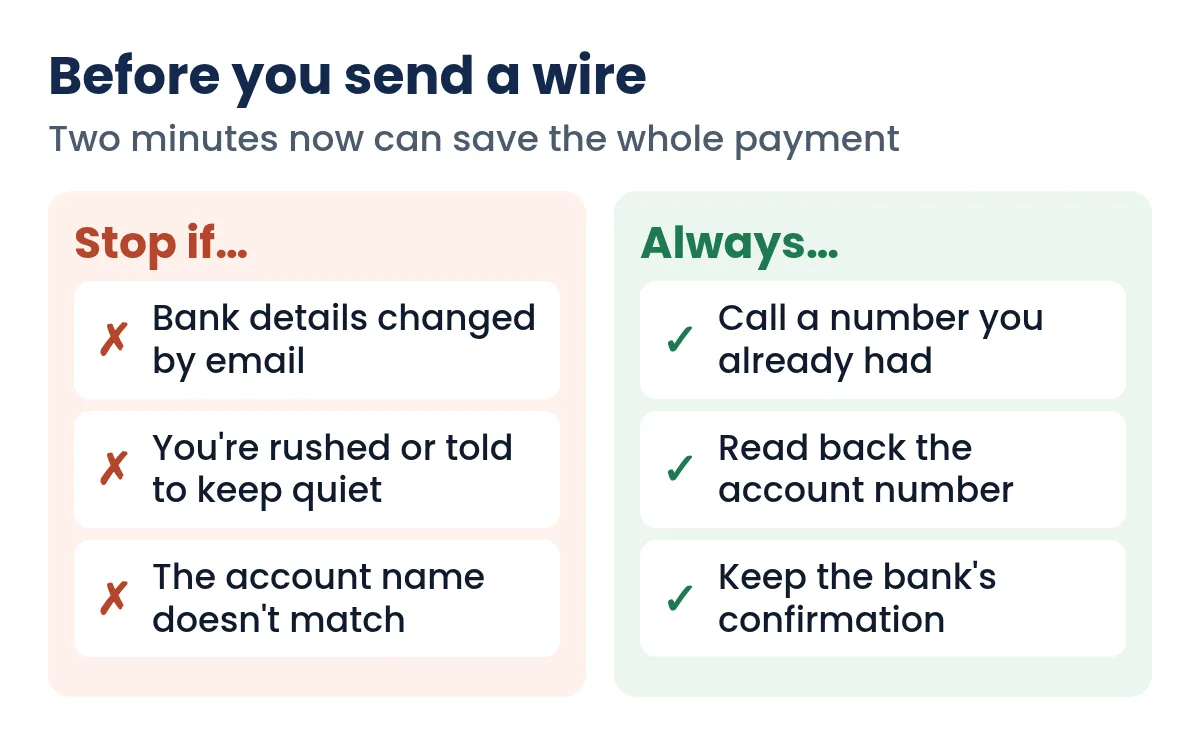
A common pattern: a criminal gets into an email thread about a closing or an invoice and sends "updated" wiring instructions. Never act on bank details received by email or text alone. Call the title company, lawyer or vendor using a number you already had, and read the details back before you send.
Checks have their own risks: mail theft, check washing and counterfeit checks made with your account numbers. But they also give you a safety valve a wire doesn't: until your bank pays the item, you can order a stop payment. Under UCC § 4-403 a written stop-payment order lasts six months and can be renewed. See how to stop payment on a check.
When to use a wire
- Home purchases and closings. Title and escrow companies often require wired funds or a cashier's check because they need good funds on the closing date.
- Large business payments where the receiver won't release goods or documents until the money is final.
- International payments to suppliers or family abroad, where a U.S. check would be slow or hard to deposit.
- Deadlines where a day's delay costs money.
When to use a check
- Everyday bills and services where a few days don't matter.
- Payees whose bank details you don't have and don't want to collect.
- Payments you might need to stop, such as a deposit to a contractor before work starts.
- Payments that need paperwork: an invoice number on the memo line or a detailed voucher stub.
- Small amounts, where a wire fee would be a big share of the payment.
John Sample is buying a used delivery van from a dealer for $18,400 and a set of shelves from a neighbor, Jane Doe, for $150. The dealer wants good funds before releasing the title, so John wires the money after calling the dealer to confirm the account. For the shelves, he hands Jane a check. Paying a wire fee on $150 would make no sense, and a check gives both of them a record.
Other options between a wire and a check
A wire and a personal check sit at two ends of a range. Depending on who you're paying, one of these may fit better:
| Option | Good for | Watch out for |
|---|---|---|
| ACH transfer | Recurring or routine bank-to-bank payments | Usually one to two business days unless sent Same Day |
| Cashier's check | Large payments where the payee wants guaranteed funds but no wire | Counterfeits exist; buy it in person at your own bank |
| Money order | Smaller payments without a bank account | USPS money orders cap at $1,000 each |
| Instant payment networks | Fast transfers where both banks take part, such as the Fed's FedNow Service | Not every bank offers them, and limits vary |
| Personal or business check | Everyday payments with a paper record | Mail delays and bank holds |
Instant payments are the newest option in that range. The Federal Reserve raised the FedNow Service's maximum per-payment limit from $1 million to $10 million in November 2025, but that is a network ceiling: each bank sets its own, often much lower, limit for customers.
For bigger purchases from strangers, avoid anything that leaves you with no way back. A cashier's check bought at your bank, or a wire after a confirmed phone call, beats sending money on the strength of an email.
How to send a wire safely, step by step
- Get instructions from a trusted source
Ask the receiver for wiring instructions in person, on a call you started, or through a secure portal you already use.
- Confirm by phone
Call a number you already had (not one in the email) and read back the bank name, routing number and account number.
- Check the cutoff time
Ask your bank for its same-day cutoff, and start early on the day you need it.
- Send and save the confirmation
Keep the reference number. Some banks give a tracking reference that the receiving bank can use to find the payment.
- Ask the receiver to confirm arrival
If they say it didn't arrive, call your bank immediately; speed matters if anything went wrong.
How to pay a large amount by check instead
If a wire isn't required, a check can work for large amounts too, with a little care. Tell the payee to expect a longer hold on a large deposit (under Regulation CC, the normal availability schedule only has to apply to the first $6,725 deposited in one banking day; the bank can hold the rest for an extra, "reasonable" period). Deliver it in person or by a trackable mail service, and write the invoice or contract number in the memo. If the receiver needs guaranteed funds, ask your bank for a cashier's check, which is drawn on the bank itself.
Three common situations, step by step
Closing on a home
- Ask how the funds must arrive
Early in the process, ask your closing agent whether they accept a wire, a cashier's check, or both, and get the answer in the closing documents rather than an email alone.
- Verify the instructions by voice
Call the title or escrow office at a number from your contract or the company's official site. Read the account details back to them.
- Send a day early if you can
A wire started the day before closing leaves time to fix a problem. Keep the bank's reference number.
- Get a receipt
Ask the closing agent to confirm in writing that the funds arrived.
Paying an overseas supplier
A U.S. check can be slow and costly for a foreign supplier to deposit, so an international wire is usually the practical choice. Confirm the SWIFT/BIC code by phone and agree who pays the fees on each side. If you are a consumer sending money abroad for personal reasons, Regulation E's remittance rules give you a disclosure of the fees and exchange rate before you pay.
Paying a contractor's deposit
Here a check usually beats a wire. If the contractor never shows up, you can still ask your bank to stop payment on a check that hasn't been paid; a wire offers no such window. Write the contract or job number in the memo, keep a copy of the check, and pay the next draw only when the work it covers is done. Our guide on paying contractors by check covers the paperwork.
If a wire goes wrong: the first hour
Speed is everything once you suspect a wire went to the wrong account or a scammer. The Consumer Financial Protection Bureau's advice for closing scams applies to any wire:
- Call your bank immediately
Ask for a wire recall. The sooner the bank contacts the receiving bank, the better the chance the money is still there.
- Report it to the FBI
File a complaint with the FBI's Internet Crime Complaint Center at ic3.gov.
- Warn the real payee
Call the person or company you meant to pay so they know the payment didn't reach them.
Common mistakes when choosing between a wire and a check
| Mistake | Why it hurts | Better habit |
|---|---|---|
| Wiring a deposit to someone you just met | No stop-payment window if they disappear | Pay deposits by check, or by card where offered |
| Trusting new bank details sent by email | The classic route for wire fraud | Confirm by a call you start |
| Starting a wire late in the afternoon | Misses the cutoff; arrives next business day | Ask your bank's cutoff and start in the morning |
| Mailing a check on the deadline | Mail time plus a deposit hold | Hand-deliver, mail early, or wire |
| Wiring a small bill | The fee eats a big share | Use a check or ACH |
| Sending a large check with no warning | The payee's bank may hold most of it | Tell the payee, or use a cashier's check |
Where Quick Check Writer fits
Quick Check Writer doesn't send wires or move money. It prints checks: you enter the payee and amount, it fills in the amount in words and the MICR bank line, and you print on blank check stock or save a PDF. It's a quick way to produce a clean, professional check for the payments where a check is the right tool, with each one saved in a register you can search later.
Frequently asked questions
Is a wire transfer faster than a check?
Yes. A domestic wire sent before your bank's cutoff usually arrives the same business day. A check has to be delivered and deposited, and then the bank may hold part of the funds.
Can a wire transfer be reversed?
Rarely. Once the receiving bank accepts the payment order, cancellation generally needs that bank's agreement. Call your bank immediately if you sent a wire by mistake or to a scammer.
Can a wire transfer bounce like a check?
No. Your bank takes the money from your account before it sends the wire, so there's nothing to bounce. A wire can be rejected or returned, for example if the account number is wrong.
Is it safer to pay by wire or by check?
For the receiver, a wire is safer because it's final. For the sender, a check is often safer because you can stop payment before it's paid. Wire fraud usually involves fake instructions, so always confirm details by phone.
Do I need the same information for a wire and a check?
No. For a check you only need the payee's name, plus an address if you mail it. For a wire you need the payee's bank, routing number and account number, plus a SWIFT code and often an IBAN for international wires.
Does Quick Check Writer send wire transfers?
No. Quick Check Writer prints checks on blank check stock and saves them as PDFs. Wires are sent through your bank.
What time do banks stop sending wires for the day?
Each bank sets its own cutoff, often in the early or middle of the afternoon. The Fed's Fedwire Funds Service itself closes at 7:00 p.m. Eastern on business days, so a request after your bank's cutoff usually goes out the next business day.
Can I send a wire transfer on a weekend?
You can usually request one online, but domestic wires move on business days, so it is sent on the next one. The Federal Reserve plans to add Sundays and weekday holidays to Fedwire in 2028 or 2029.
What should I do if I wired money to a scammer?
Call your bank right away and ask for a wire recall, then file a complaint with the FBI's Internet Crime Complaint Center (ic3.gov).
Is a wire or a cashier's check better for a closing?
Whichever your closing agent requires. Many accept both. A wire arrives faster but must be verified by phone; a cashier's check avoids wiring-instruction fraud but has to be bought in person and carried to the closing.
Related guides
- ACH vs check: which payment should you use?
- Cashier's check vs certified check
- What is a bank draft? (vs a check)
- How to stop payment on a check
- How Long Does a Check Take to Clear?
- Check fraud prevention for people and small businesses
Sources
- Federal Reserve: Fedwire Funds Services
- UCC § 4A-211 Cancellation of payment order, Cornell LII
- UCC § 4A-207 Misdescription of beneficiary, Cornell LII
- Regulation E, 12 CFR 1005.3 (coverage), eCFR
- Regulation E, 12 CFR 1005.33 (remittance errors), eCFR
- Regulation E, 12 CFR 1005.34 (remittance cancellation), eCFR
- UCC § 4-403 Stop payment, Cornell LII
- Regulation CC, 12 CFR 229.10 (next-day availability), eCFR
- USPS: Money orders
- Federal Reserve: Fedwire Funds Service (operating hours)
- Federal Reserve Financial Services: Fedwire and NSS to expand operating days
- Federal Reserve Financial Services: FedNow transaction limit raised to $10 million
- Regulation CC, 12 CFR 229.13 (large deposit exception), eCFR
- CFPB: Mortgage closing scams, how to protect yourself
Last updated November 1, 2026. This page is general information, not legal or financial advice. Quick Check Writer is check printing software; it is not a bank and does not move money.