
Key takeaways
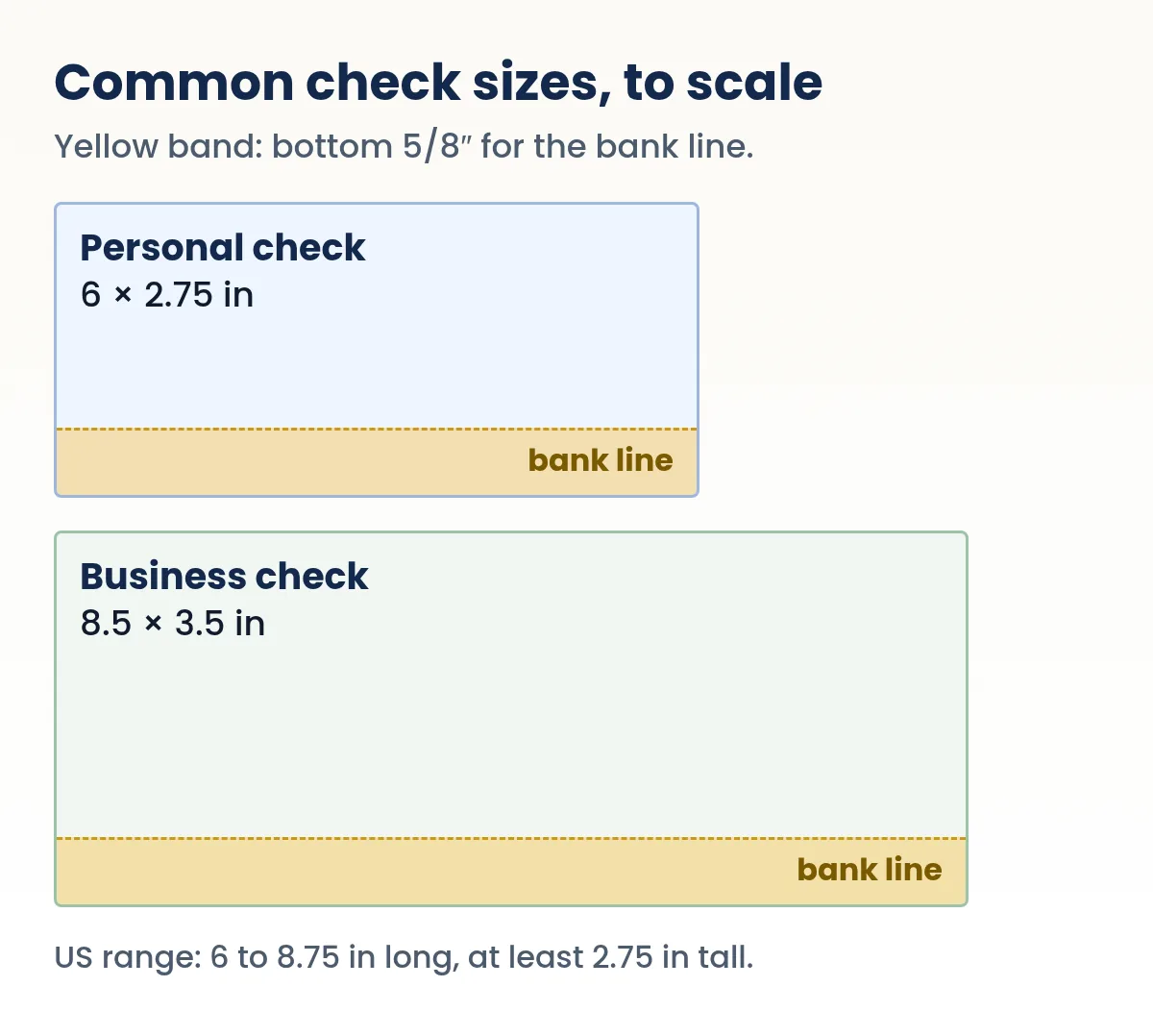
- Personal check: 6 × 2.75 in, the standard minimum.
- Business/voucher check: 8.5 × 3.5 in on a letter sheet with two stubs.
- Three per page: 8.5 × about 3.67 in each.
- The bottom 5/8 inch is the MICR clear band, measured from the bottom edge.
- Always print check layouts at 100% scale.
On this page
- The standard check sizes at a glance
- Why checks have a size range at all
- The measurements inside the check
- Check sizes on a letter sheet
- Can check dimensions be customized?
- How check size affects mailing and storing
- Paper weight: how thick a check should be
- Check size in a PDF
- Check sizes in millimeters
- How to measure a check you already have
- Choosing a size: three examples
- Common size mistakes
- Personal vs business check size: which should you use?
- FAQ
The standard check sizes at a glance
There isn't one "check size." There's an allowed range, and a few sizes that almost everyone uses within it.
| Check type | Typical size (inches) | Where you see it |
|---|---|---|
| Personal (wallet) check | 6 × 2.75 | Checkbooks that fit a wallet or purse |
| Business / voucher check | 8.5 × 3.5 | One-third of a letter sheet, with stubs |
| Three-per-page check | 8.5 × about 3.67 | Letter sheet cut into three equal checks |
| Allowed range (US) | 6 to 8.75 long; 2.75 tall at minimum | Published summaries of the ANSI X9 standard |
| Allowed range (Canada) | 6.25 to 8.5 long; 2.75 to 3.75 deep | Payments Canada Standard 006 |
The personal 6 × 2.75 inch check sits right at the standard's minimum. Business checks use the extra length for a wider amount area, a company logo and, often, extra bank-line fields that personal checks don't have.
A check's "length" is the long side, measured along the bottom edge. Its "height" (Canada says "depth") is the short side. The bottom edge matters most because the bank line is measured from it.
Why checks have a size range at all
Checks travel through sorting machines, ATMs, branch scanners and phone cameras that all expect a document of a familiar shape. Standards bodies set minimum and maximum dimensions so a check doesn't jam a reader, slip through a gap or get cropped when it's imaged.
In the US, the measurements come from standards published by the Accredited Standards Committee X9 (ANSI X9.100-160-1 covers where MICR printing goes and the size of the document). The full standard is sold by ANSI, and readable public summaries describe a minimum of 6 by 2.75 inches and a maximum length of 8.75 inches. Canada's equivalent, Payments Canada Standard 006, publishes its numbers openly: 6¼ to 8½ inches long and 2¾ to 3¾ inches deep.
A check outside these limits isn't automatically "illegal," but a bank's equipment may reject it, and a branch may ask you to write a new one. Staying inside the range is the easy way to avoid trouble.
The measurements inside the check
The outside size gets the attention, but the most important dimensions are inside the check, along the bottom.
- Clear band: bottom 5/8 inch
- The X9 glossary defines the MICR clear band as a horizontal band 0.625 inch high, measured from the bottom edge, on the front and the back. Only the bank line belongs there. Signatures, memos and endorsements should stay above it.
- Bank line position
- The line is right-aligned. Summaries of the standard place it about 5/16 inch from the right edge and about 3/16 inch above the bottom edge, with about 1/16 inch of tolerance.
- Character spacing
- Each E-13B character gets a 0.125-inch space, so the line runs eight characters per inch.
- Reading edges
- In standards language the bottom edge is the "aligning edge" and the right edge, as you look at the front, is the "leading edge." That's why bank-line measurements start at the bottom right corner.
Because the bank line is measured from the bottom right, a business check and a personal check end their bank lines at the same distance from the corner, even though one is 2.5 inches longer. Our MICR font guide explains each symbol, and routing number on a check shows which digits are which.
Check sizes on a letter sheet
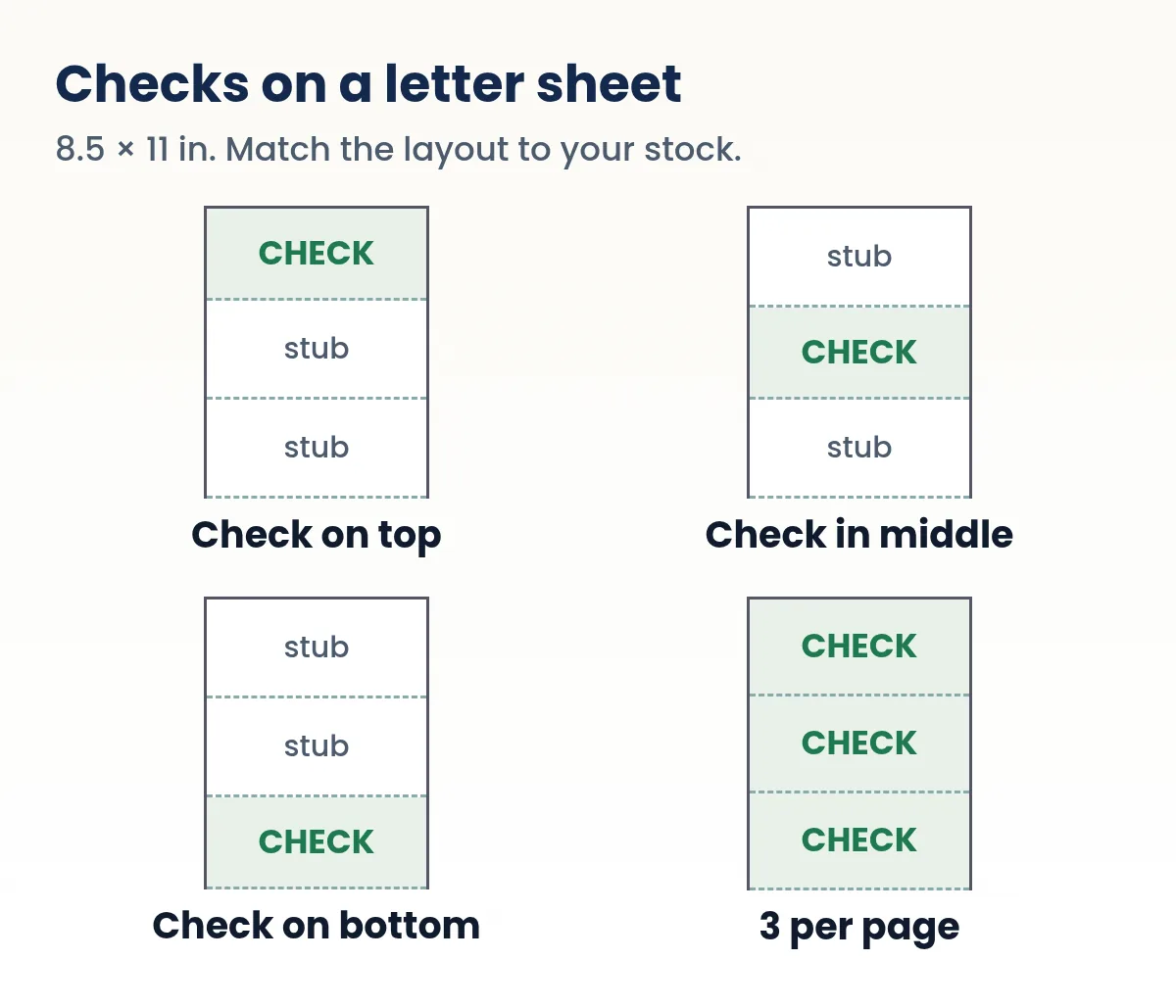
When you print checks yourself, you start with a standard letter sheet (8.5 × 11 inches) of blank check stock. The stock is pre-perforated into a check and one or more stubs, or into three equal checks. The check part is typically about 3.5 inches tall, so the check you tear off is the familiar business size.
Voucher layouts: one check, two stubs
These are the most common business format. The check can be at the top, middle or bottom, and the two stubs carry payment details, such as invoice numbers or a pay breakdown. One stub goes to the payee and one stays in your files. In Quick Check Writer's layouts, the check part is 3.5 inches tall and the stubs share the rest of the page.
Three checks per page
Here the sheet is divided into three equal parts of about 3.67 inches each (11 ÷ 3), with no stubs. It's the cheapest way to print several checks at once and works well for personal or small-business use where you don't need a remittance stub.
Wallet-size checks
Personal checks of 6 × 2.75 inches are less common as blank printable stock. Quick Check Writer's Wallet size layout (in beta) prints a check of exactly that size, so you can line it up on stock made for wallet checks. As with every layout, test on plain paper first.
For a deeper look at each format, see check layouts: top, middle, bottom, 3 per page and wallet and our blank check stock guide.
Need to write a check right now?
Quick Check Writer fills in the amount in words, adds the bank line and prints on blank check stock or saves a PDF. Your first check is free, with no account and no card.
Write your first check free →Can check dimensions be customized?
Within limits, yes. Check printers offer different sizes and layouts, and some software lets you move fields around. But the parts that machines read are fixed:
- The overall size should stay within the standard's range for your country.
- The bottom 5/8 inch stays reserved for the bank line, in the E-13B font, positioned from the bottom right corner.
- The payee, amount, date and signature should stay in the familiar places so tellers, payees and image systems can find them.
What you can usually change freely: the layout (top, middle, bottom or three per page), the style and colors, a logo, your name and address block, the memo and stub text, and small print offsets that line the print up with your stock. In Quick Check Writer, you choose the layout and size (standard or wallet), then use the X/Y offsets in print setup to shift everything a little. The bank line itself always prints in the standard font and position, which is exactly what you want.
Printing a check layout with "Fit to page" or a custom scale shrinks every measurement, including the bank line. Always print at 100% (Actual size).
How check size affects mailing and storing
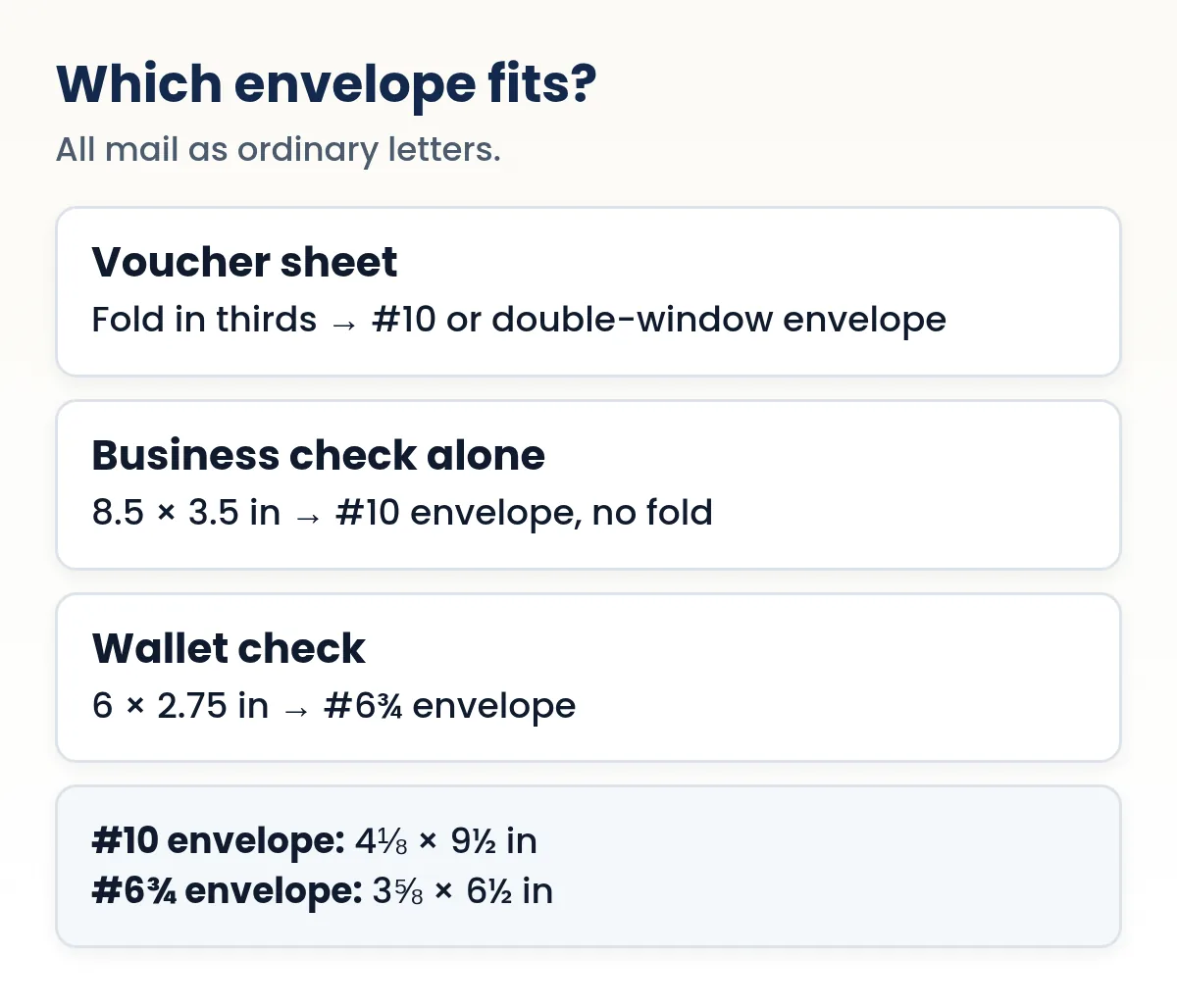
All of the common check formats mail as ordinary letters. The Postal Service defines letter-size mail as at least 5 inches long and 3.5 inches high, and no more than 11.5 inches long or 6 1/8 inches high. A check in a #10 envelope is well inside those limits.
- Voucher sheet: fold the whole page in thirds. A double-window envelope made for voucher checks shows your return address and the payee's address through the windows.
- Business check alone: 8.5 × 3.5 inches slides into a #10 envelope (4 1/8 × 9 1/2 inches) without folding.
- Wallet check: fits a small #6 3/4 personal envelope.
Read how to mail a check safely for the rest of the process.
Paper weight: how thick a check should be
Size isn't only length and height. Check paper is heavier than ordinary copy paper, so it feeds reliably through sorters and feels like a real document. The X9 glossary defines 24-pound bond as paper with a basis weight of 24 lb, about 90 g/m², and 20-pound bond, typical copy paper, as about 75 g/m².
Most blank check stock sold for home and office printers is 24 lb. Heavier is fine if your printer accepts it. Thinner plain paper works for alignment tests, but it lacks the security features and the feel of check stock. See can you print checks on regular paper? for the trade-offs.
Check size in a PDF
A digital check keeps its real-world size only if the file does. A good check PDF is a letter-size page (8.5 × 11 inches) with the check drawn at exact dimensions, so it prints at true size when you choose 100% scale. Quick Check Writer builds its PDFs this way, on your device, using the same layout it prints.
If someone sends you a check as an image instead, it may print at the wrong size, because a photo has no fixed physical dimensions. Ask for a PDF, or read our guide to check PDFs: save, send and print a check as a PDF.
Check sizes in millimeters
Some printers, rulers and design tools work in metric. One inch is exactly 25.4 mm, so the common sizes convert like this:
| Size | Inches | Millimeters |
|---|---|---|
| Personal check | 6 × 2.75 | 152.4 × 69.9 |
| Business check | 8.5 × 3.5 | 215.9 × 88.9 |
| Longest US check (summaries of X9) | 8.75 long | 222.3 long |
| Clear band | 0.625 tall | 15.9 tall |
| Letter sheet | 8.5 × 11 | 215.9 × 279.4 |
| A4 sheet (for comparison) | 8.27 × 11.69 | 210 × 297 |
The last row matters more than it looks. A4, the international paper size set by ISO 216, is about 6 mm narrower and 18 mm taller than US letter. If your printer or PDF viewer is set to A4 while the check stock is letter size, the driver may shrink or shift the page and the bank line lands in the wrong place. Set the paper size to Letter before you print.
How to measure a check you already have
- Measure along the bottom edge
That's the length. Use a ruler with 1/16-inch marks or millimeters.
- Measure the short side
That's the height. Measure from the perforation, not from the edge of a stub.
- Check the bank line
Measure from the bottom edge to the bottom of the characters, and from the right edge to the last character. You should get roughly 3/16 inch and 5/16 inch.
- Compare to your stock
If you are switching to printing at home, measure where your blank stock's perforations fall so you can pick the matching layout.
Choosing a size: three examples
Paying rent once a month
Jane Doe pays her landlord by check on the first of each month. She doesn't need stubs, and she likes having a few checks in her bag. A wallet-size check (6 × 2.75 in) or a three-per-page sheet both work; three-per-page is simpler to buy as blank stock. She keeps a record in the register instead of on a stub.
Paying invoices for a small business
John Sample runs a small landscaping company and pays suppliers every two weeks. Each supplier wants the invoice number with the payment. A voucher sheet with the check on top and two stubs fits: he notes the invoices on the stub, mails the check with one stub, and files the other.
Printing a stack at once
When the job is many checks and no stubs, three-per-page uses a third of the paper of a voucher layout. Separate the checks along the perforations; don't cut them apart with scissors, because a crooked bottom edge moves the bank line relative to the edge the machines read from.
Common size mistakes
- Printing with "Fit to page." Every measurement shrinks a few percent, including the bank line. Use 100% or Actual size.
- Paper size set to A4. Letter and A4 are different shapes. Match the setting to the stock in the tray.
- Layout doesn't match the stock. A check-on-top layout printed on check-on-bottom stock puts the check on a stub. Hold a test print against a sheet of stock before printing.
- Trimming by hand. Tear along the perforation. A trimmed edge that is off by a sixteenth of an inch changes the distance from the bank line to the edge.
- Writing in the clear band. Notes, stamps and signatures that dip into the bottom 5/8 inch can interfere with reading the bank line.
Personal vs business check size: which should you use?
Either works for any payment. Banks process both, and there is no rule that a business must use business-size checks. The choice is practical:
- Use business-size voucher checks if you want stubs for invoice numbers or records, or if you print from a regular office printer.
- Use three-per-page if you print several checks at a time and don't need stubs.
- Use personal wallet-size checks if you want a checkbook to carry with you.
Our guide to business checks vs personal checks covers the other differences, like account names and extra bank-line fields.
Frequently asked questions
What is the size of a standard personal check?
Most personal checks are 6 inches long and 2.75 inches tall, which is the minimum size in the US check standard.
What size is a business check?
Business checks are usually 8.5 × 3.5 inches, so three fit on a letter sheet, or one check plus two stubs in a voucher layout.
What is the maximum size of a check?
Published summaries of the ANSI X9 standard put the maximum length at 8.75 inches. In Canada, Payments Canada Standard 006 sets a maximum of 8.5 × 3.75 inches.
How big is the MICR area on a check?
The bottom 5/8 inch (0.625 inch) is the MICR clear band. The bank line prints inside it, about 3/16 inch above the bottom edge and about 5/16 inch from the right edge.
Can I make my checks a custom size?
You can choose among layouts and adjust print offsets, but keep the check within the standard size range and leave the bank line in its standard position, or a bank's equipment may reject it.
What size envelope fits a check?
A business check or a voucher sheet folded in thirds fits a #10 envelope. A 6 × 2.75 inch personal check fits a #6 3/4 envelope.
Are giant presentation checks real checks?
They are typically props for photos. The actual money is usually paid with a normal-size check or a transfer, because oversized checks don't fit bank equipment.
What size is a check in millimeters?
A personal check is about 152 × 70 mm (6 × 2.75 in). A business check is about 216 × 89 mm (8.5 × 3.5 in). The bank-line band at the bottom is about 16 mm tall.
Can I print checks on A4 paper?
US check stock is letter size (8.5 × 11 in). A4 is a different shape, so a letter layout printed on A4 gets shifted or scaled. Use letter-size stock and set the printer's paper size to Letter.
How big is a check stub?
On a letter-size voucher sheet the check takes about 3.5 inches and the two stubs share the remaining 7.5 inches, roughly 3.75 inches each. Check your stock's perforations, because sellers differ slightly.
Related guides
- Check layouts: top, middle, bottom, 3 per page and wallet
- Blank Check Stock: A Complete Guide
- MICR font for checks: E-13B explained
- The best printer for printing checks
- Parts of a check, explained
- Business check vs personal check
Sources
- ASC X9 TR 100-2013 glossary (MICR clear band 0.625 in; 0.125 in character space; aligning and leading edge)
- X9Assist help: check dimensions and MICR line placement (summary of ANSI X9.100-160-1)
- Payments Canada Standard 006, Specifications for MICR-encoded payment items (document sizes)
- USPS Domestic Mail Manual 101, Physical standards for letters
- ISO 216:2007, writing paper and certain classes of printed matter: trimmed sizes (A4 = 210 × 297 mm)
Last updated November 1, 2026. This page is general information, not legal or financial advice. Quick Check Writer is check printing software; it is not a bank and does not move money.