
Key takeaways
- The real difference is whose account pays.
- Business checks often add stubs, a logo and a larger format.
- The IRS recommends a separate business checking account (Publication 583).
- Checks payable to your business name belong in the business account.
On this page
- The real difference is the account
- Side-by-side comparison
- Do you need business checks?
- Can a business pay with a personal check?
- Walk-throughs: common situations
- What business checks add
- Business checks for different kinds of payments
- Setting up business checks: a checklist
- How business accounts are treated differently
- Common mistakes to avoid
- Ordering vs printing business checks
- One tool for both
- FAQ
The real difference is the account
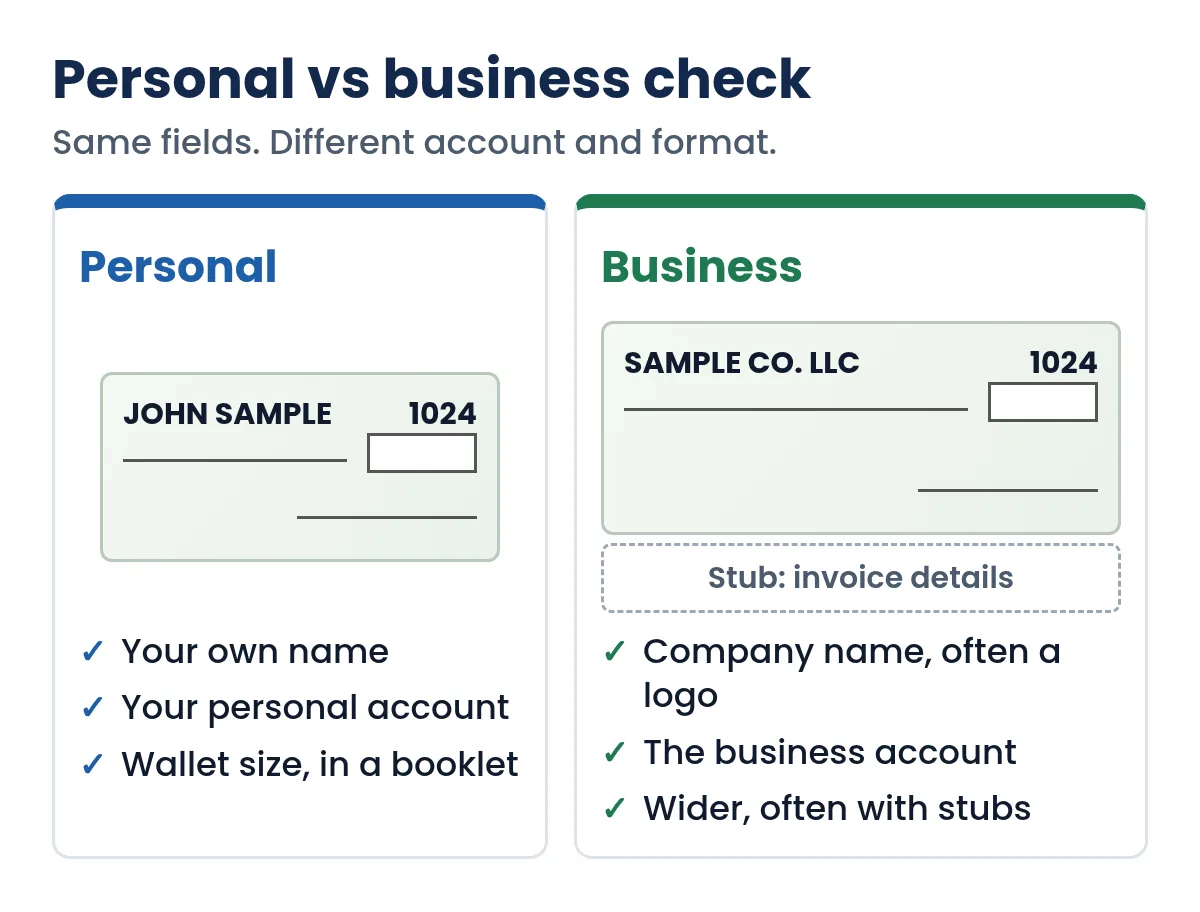
Put a personal check and a business check side by side and you'll find the same fields: date, payee, amount in numbers and words, memo, signature and the bank line with routing, account and check numbers. (Our labeled guide to the parts of a check covers each one.) What changes is whose account the money comes from:
- A personal check draws on an account owned by one or more individuals. It shows their name and is signed by an account holder.
- A business check draws on an account owned by a business: an LLC, corporation, partnership, nonprofit or a sole proprietor's business account. It shows the business name and is signed by someone the business has authorized.
Everything else, from the size to the stubs, follows from that. Businesses need records, controls and room for payment details; individuals mostly need something that fits in a wallet.
Side-by-side comparison
| Feature | Personal check | Business check |
|---|---|---|
| Account owner | An individual or joint owners | The business |
| Name printed | Your name, optional address | Business name and address, often a logo |
| Typical format | Wallet size, in a booklet | Larger; often one per letter-size page with stubs, or three to a page |
| Stubs / vouchers | Rare | Common for invoice or pay details |
| Bank line | Check number usually at the end | Check number often in an extra field on the left |
| Who signs | Account holder | Authorized signers; some accounts require two |
| Fraud tools | Basic alerts | Business services such as Positive Pay are commonly offered |
| Record keeping | Optional register | Needed for bookkeeping and taxes |
The bank-line difference is real but technical. Larger business checks often carry an extra "auxiliary on-us" field, and a Federal Reserve analysis describes large business checks as typically 8 or 9 inches long with that field. Bank deposit guides note that on a business-size check, the check number usually sits there, at the far left. See where is the check number on a check?
Do you need business checks?
If you have a business with its own bank account, yes: checks from that account will print the business name and draw on business funds. The bigger question is whether you need a separate business account in the first place.
The IRS's guide for new businesses, Publication 583, is direct about it: one of the first things to do when you start a business is open a business checking account, keep it separate from your personal checking account, deposit all daily receipts into it and use it for business purposes only. The business checkbook, the IRS says, is your basic source of information for recording business expenses.
Mixing business and personal payments makes it harder to prove deductions, reconcile your books and see how the business is doing. A separate account, with its own checks, keeps a clean paper trail.
Can a business pay with a personal check?
Sole proprietors
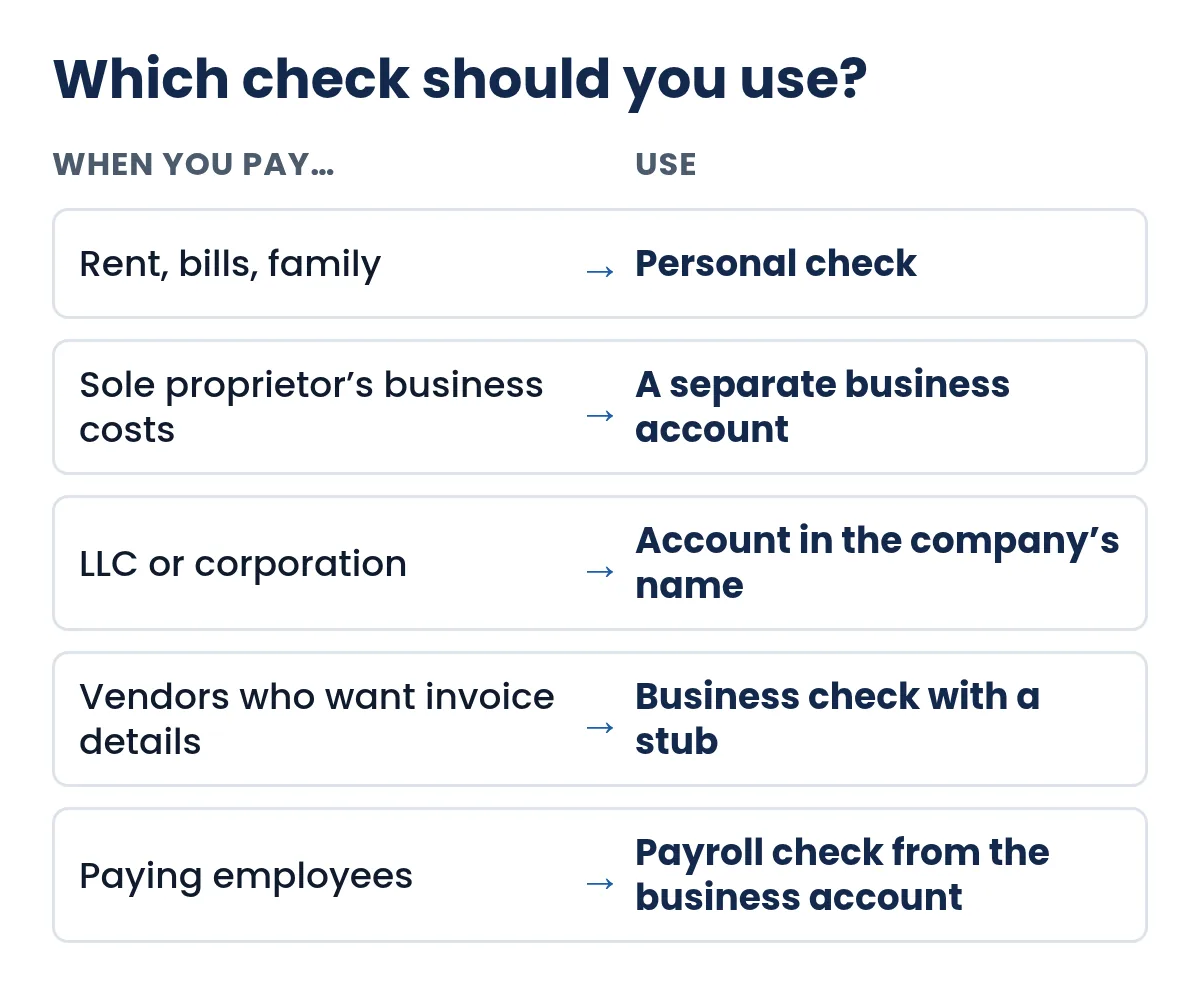
A sole proprietorship isn't legally separate from its owner, so paying a business expense from your personal account isn't forbidden. It's just messy. You'll need to show which payments were for the business, and every personal check you write for business muddles your records. The IRS recommendation above is the practical answer: open a business account as early as you can and pay business expenses from it.
LLCs and corporations
For an LLC or corporation, the company is its own legal entity. Its income should go into an account in the company's name, and its bills should be paid from that account. Paying company bills from an owner's personal account, or the other way round, blurs that line. If you're unsure how your structure should handle it, your accountant or attorney can advise.
Receiving payments
It works the other way too. A check made out to your business name generally needs to go into an account in that name. Banks set their own deposit policies and may refuse to put a business-payable check into a personal account. See how to endorse a check for the right way to endorse checks made out to a business.
Walk-throughs: common situations
Going from side gig to real business
Jane Doe has been taking landscaping jobs on the side and depositing client checks into her personal account. Business is picking up, so she separates the two.
- Decide on the structure
Staying a sole proprietor or forming an LLC changes whose name goes on the account. An accountant or attorney can help with the choice.
- Get an EIN if you need one
The IRS issues Employer Identification Numbers free online, and it warns that you never have to pay a fee for one.
- Open the account in the right name
Bring what your bank asks for. For an LLC or corporation, banks must identify the people who own 25% or more of it and one person who controls it, so expect questions about owners and managers.
- Move business money through it
Deposit every client payment into the new account and pay business costs from it, as IRS Publication 583 recommends.
- Set up business checks and a register
Print or order checks in the business name and log each one, so your bookkeeping has a clean source.
You paid a business bill from your personal account by mistake
- Note it right away
Record the date, payee, amount and check number, and keep the invoice with it.
- Tell whoever keeps your books
How it's recorded (for example, as a reimbursement or an owner contribution) depends on your business structure; your accountant will know.
- Fix the habit, not just the entry
Keep business checks where you pay bills, so the right account is the easy one to reach for.
Paying yourself from the business
Writing a business check to yourself is normal, whether it's an owner's draw, a reimbursement or a paycheck. What matters is the record: the memo and register entry should say what the money is for. How it's taxed depends on your structure, so ask your tax adviser.
Need to write a check right now?
Quick Check Writer fills in the amount in words, adds the bank line and prints on blank check stock or saves a PDF. Your first check is free, with no account and no card.
Write your first check free →What business checks add
- Stubs and vouchers
- One or two detachable stubs carry invoice numbers, dates, discounts or payroll details. The payee keeps one; you keep the other. See check stubs and voucher checks.
- Branding
- A logo and the business name and address make the check look professional and help the payee recognize it. See custom checks with your logo.
- Layouts for printers
- Business checks come in formats that feed through office printers: check on top, middle or bottom of a sheet, or three checks per page. See check layouts.
- Controls
- Businesses often require two signatures above a set amount, keep a numbered register of every check and use bank fraud services such as Positive Pay. See what is Positive Pay and check fraud prevention.
Business checks for different kinds of payments
- Vendor and supplier payments usually go on voucher checks, so the vendor can match the payment to their invoice. See how to pay vendors by check.
- Contractors are paid from the business account and tracked for year-end tax forms. See paying contractors by check.
- Payroll checks carry a stub showing gross pay, withholdings and net pay. See how to print payroll checks.
- Rent and utilities for business premises come from the business account, not the owner's.
Setting up business checks: a checklist
- Open the business account
Use the business's legal name. For an LLC or corporation, the bank will typically ask for formation documents and a tax ID; requirements vary by bank.
- Decide who can sign
Agree with your bank who the authorized signers are and whether checks above a certain amount need two signatures.
- Choose a format
Pick a layout that matches how you pay: voucher checks with stubs for vendors and payroll, three per page for high volume.
- Add your details
Business name, address, logo if you want one, and the account's routing and account numbers, exactly as your bank provides them.
- Set up a register
Record every check: number, date, payee, amount and what it was for. You'll need it to reconcile your statement and at tax time.
- Test before you pay anyone
Print a sample or alignment page first, and if you print your own, ask your bank whether it wants to review a sample check.
How business accounts are treated differently
- Deposit insurance
- The FDIC insures deposits of a corporation, partnership or unincorporated association (including LLCs) separately from the owners' personal deposits, up to $250,000, if the business is engaged in an independent activity. A sole proprietorship or DBA account is not separate: it's added to the owner's single accounts at that bank.
- Opening the account
- Under federal customer due diligence rules, banks must identify each person who owns 25% or more of a legal entity customer, plus one person with significant control, such as a managing member or CEO.
- Funds availability
- Federal hold limits under Regulation CC apply to business checking accounts as well as personal ones. A bank can generally change a business account's availability policy with at least 30 days' notice, according to the OCC's HelpWithMyBank.gov.
- Reporting problems
- Your deposit agreement sets how quickly you must report an altered or forged check, and the UCC sets an outer limit of one year after the statement is made available (§ 4-406). Business agreements may be stricter, so read yours.
- Fees and services
- Business accounts often come with different fees, transaction limits and fraud services. Compare a few banks before you choose.
Common mistakes to avoid
- Mixing accounts. Paying personal bills from the business account (or the reverse) muddies your records and, for an LLC or corporation, the line between you and the company.
- Checks that don't match the account name. The name on the check should match the account title exactly, including "LLC" or "Inc."
- Writing business checks to "Cash". They're payable to whoever holds them (UCC § 3-109) and leave no record of who was paid.
- Skipping the stub or memo. Without an invoice number, the vendor can't match your payment and you'll struggle to explain it at tax time.
- No register. The IRS calls the business checkbook your basic source for recording expenses; keep it up to date and reconcile it every month.
- Depositing business checks into a personal account. Even if a bank allows it, the income ends up in the wrong place in your books.
Ordering vs printing business checks
You can order business checks pre-printed with your details from your bank or a check printer, or print them yourself on blank check stock. Printing your own suits businesses that write checks from more than one account, want stubs filled in automatically, or don't want boxes of pre-printed checks with their account number sitting in a drawer. Our guides on printing business checks and ordering vs printing compare the options.
Jane Doe runs Sample Landscaping LLC. She opens a business checking account in the LLC's name and prints business checks with her logo, three to a page. When she pays Sample Electric Co. $2,480 for invoice 5521, the check's stub lists the invoice number so the electrician can match it, and her copy goes into her records. Her own rent, she still pays with a personal check from her personal account.
One tool for both
Many small-business owners write checks from two places: the business account and their personal account. Quick Check Writer handles both on blank check stock. You can set up more than one bank account (how many depends on the plan; see pricing), each with its own name, address and logo, then print checks with stubs, three per page or in other layouts, with the MICR line laid out for you. Every check is logged in a register you can search and export, and Pro plans can export to QuickBooks. Start with how to print checks at home.
Frequently asked questions
What is the difference between a business check and a personal check?
A business check draws on an account owned by a business and shows the business name; a personal check draws on an individual's account. Business checks are often larger, with stubs and a logo.
Can I use personal checks for my business?
A sole proprietor can, but the IRS recommends opening a separate business checking account and using it for business only. LLCs and corporations should pay from an account in the company's name.
Can I deposit a business check into my personal account?
A check made out to your business name generally belongs in an account in that name. Banks set their own policies and may refuse to deposit business-payable checks into personal accounts.
Are business checks bigger than personal checks?
Often. Large business checks are commonly about 8 to 9 inches long and printed one per page with stubs or three per page, while personal checks are wallet-sized.
Why is the check number on the left of my business checks?
Business-size checks often have an extra MICR field, the auxiliary on-us field, at the left of the bank line, and the check number is usually printed there.
Can I print my own business checks?
Yes. With check-writing software and blank check stock you can print business checks with your logo, stubs and the MICR line on an ordinary printer.
Do I need an EIN to open a business checking account?
It depends on your bank and your business structure, so ask the bank what it requires. If you do need an EIN, the IRS issues one free online and warns never to pay a fee for it.
Is a business account FDIC insured separately from my personal accounts?
For an LLC, corporation or partnership, yes: the FDIC insures its deposits separately from the owners' personal deposits, up to $250,000. A sole proprietorship's account is added to the owner's own single accounts at that bank.
Can I write a business check to myself?
Yes, if you're an authorized signer. Use the memo and your register to record what it's for, such as an owner's draw or a reimbursement, and ask your tax adviser how it's treated.
Do business checks take longer to clear than personal checks?
Not under federal rules: Regulation CC sets the same maximum holds for both. Your bank's own policy, large deposits or a new account can change the timing.
Related guides
- How to Print Business Checks
- Types of checks: personal, business, cashier's, certified and more
- Check stubs and voucher checks
- Check layouts: top, middle, bottom, 3 per page and wallet
- Parts of a check, explained
- How to print personal checks at home
Sources
- IRS Publication 583, Starting a Business and Keeping Records (business checking account)
- Federal Reserve Bulletin 2008, Recent Payment Trends (business checks and the auxiliary on-us field)
- First Merchants Bank remote deposit guide: MICR line fields
- UCC § 3-104 (check definition), Cornell LII
- IRS: Get an Employer Identification Number
- FDIC: Corporation, partnership and unincorporated association accounts
- 31 CFR § 1010.230 (beneficial ownership of legal entity customers), eCFR
- HelpWithMyBank.gov (OCC): Funds availability policy for business accounts
- 12 CFR § 229.2 (definition of account, Regulation CC), eCFR
- UCC § 4-406 (customer's duty to report), Cornell LII
- UCC § 3-109 (payable to bearer or order), Cornell LII
Last updated November 1, 2026. This page is general information, not legal or financial advice. Quick Check Writer is check printing software; it is not a bank and does not move money.