
Key takeaways
- A voucher check is one check plus two stubs on a letter-size sheet.
- Put invoice numbers and a breakdown on the stub; keep full account numbers off it.
- Check on top, middle or bottom: match your perforated stock.
- Federal law doesn't require pay stubs, but many states have rules.
- Keep office copies with the bills they paid, generally 3+ years.
On this page
- Two things people mean by "check stub"
- What a voucher check looks like
- What to put on a stub
- Why use voucher checks?
- How to make a check with stubs in Quick Check Writer
- Worked example: one check, three invoices and a credit
- Stub note templates you can copy
- Choosing check stock for voucher checks
- Payroll pay stubs: what's different
- Paying contractors and vendors with voucher checks
- Stubs and year-end 1099s
- Common stub mistakes
- Keeping and storing stubs
- FAQ
Two things people mean by "check stub"
The phrase covers two different documents, and it helps to know which one you need before you start:
- Voucher stub (payment stub)
- A detachable section printed on the same sheet as a check. It tells the payee what the payment covers (invoice numbers, dates, a breakdown) and gives you a matching copy for your files. A check printed with stubs is called a voucher check.
- Pay stub (payroll stub)
- An earnings statement given to an employee with a paycheck: gross pay, each tax and deduction, and net pay, often with year-to-date totals. It can be attached to a paycheck as a voucher stub or provided separately, on paper or electronically.
This guide is mostly about voucher stubs, which you can print yourself with any check. Payroll stubs need payroll calculations; we cover what they must show and where they come from further down.
What a voucher check looks like
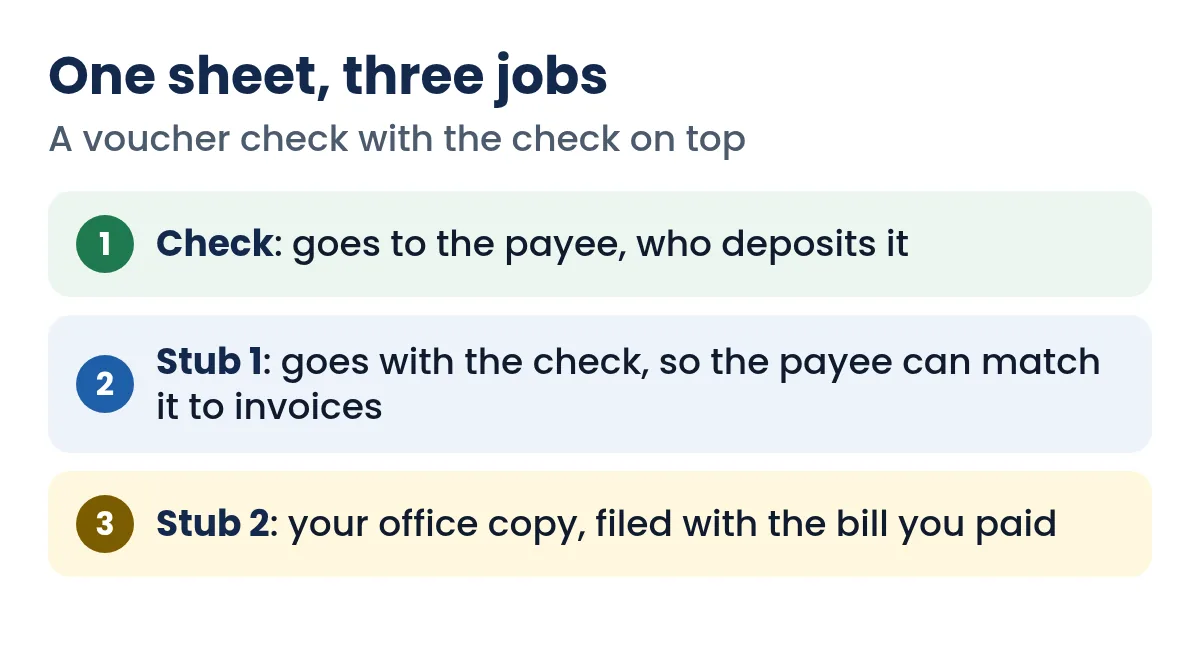
A voucher check is a letter-size sheet (8.5 by 11 inches) divided into three parts: one check and two stubs, separated by perforations on pre-perforated check stock. The check can sit at the top, in the middle or at the bottom of the sheet. Which position you use usually depends on your envelopes and your habits, not on any banking rule. Our guide to check layouts compares the options in detail.
What to put on a stub
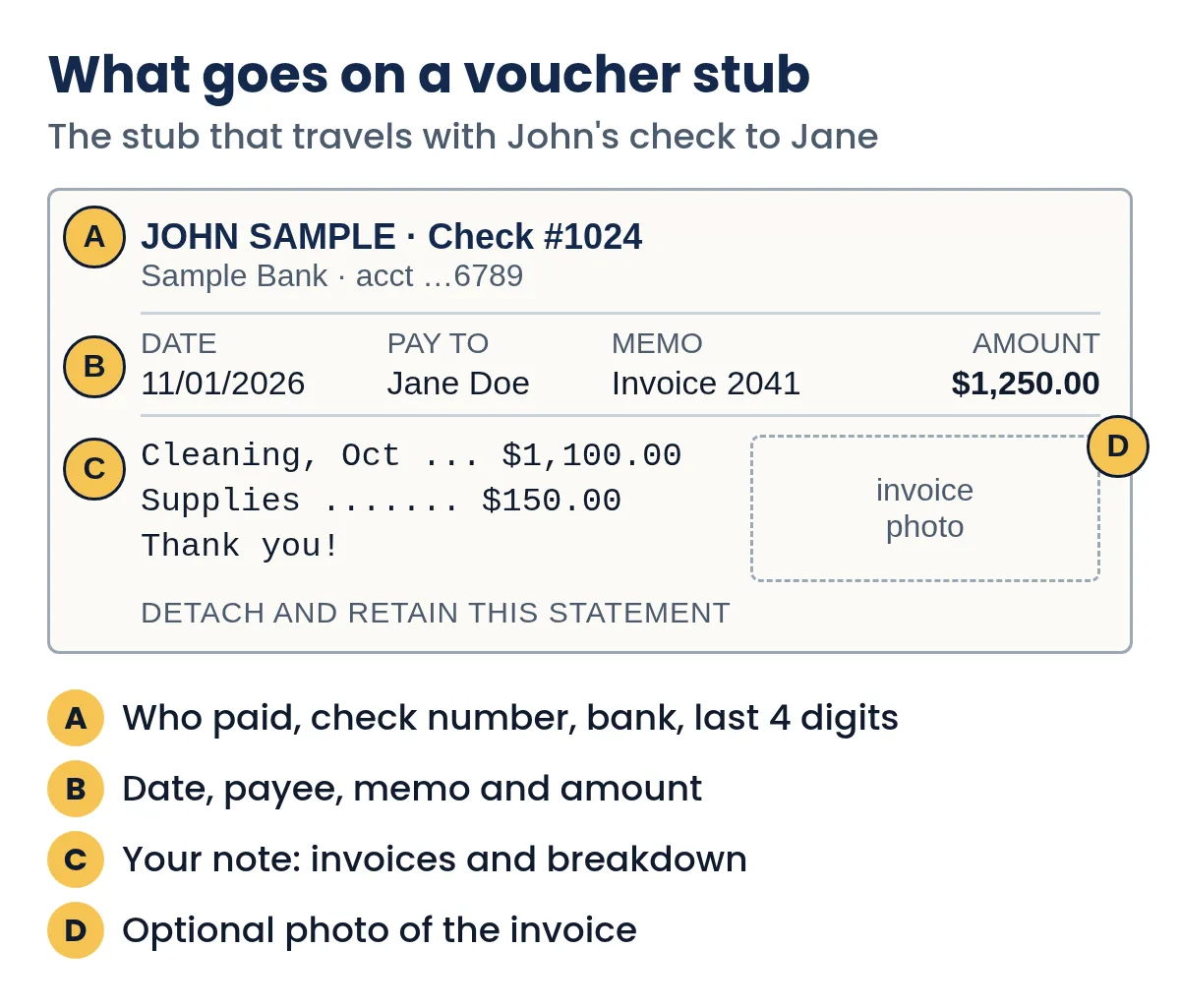
A stub is only useful if it answers the payee's first question: "what is this money for?" A good stub includes:
- Who paid: your name or business name, so the payee knows the source even after the check is deposited.
- Check number, date and amount: the same as on the check.
- Payee and memo: who it's for and a short reference.
- The breakdown: invoice numbers and amounts, any discount or credit applied, and the period covered.
- A note, if needed: "Final payment", "Deposit for job #318", or a thank-you.
Keep bank details to a minimum on the stub. A stub travels separately from the check once it's detached, so it shouldn't carry your full account number; the last four digits are enough for reference.
John Sample pays Jane Doe $1,250 for October cleaning ($1,100) plus supplies she bought ($150). The memo says "Invoice 2041". On the stub he types both lines and adds a photo of the supply receipt. Jane's bookkeeper can match the payment without asking anyone.
Why use voucher checks?
For the person you pay
Businesses receive many payments, and a check alone often says nothing beyond an amount and a name. When one check pays three invoices, or pays an invoice minus a credit, the stub is what lets the payee apply the money correctly. That means fewer "we didn't receive payment for invoice 2039" calls.
For you
The office copy is a paper record of exactly what you paid and why, filed with the bill. It makes month-end reconciliation and tax time easier. The IRS asks taxpayers to keep records that support income and deductions, generally for at least three years after filing (longer in some situations). A stub stapled to an invoice is that record. See how to do a bank reconciliation and outstanding checks for how this fits your books.
For vendors who want a remittance slip
Some companies send a remittance slip with their invoice. You can either mail their slip with your check or copy its key information (account number, invoice number) onto your stub. Either way, the goal is the same: the payment arrives with its reference attached.
How to make a check with stubs in Quick Check Writer
- Fill in the check
Payee, amount, date and memo, as usual. The amount in words is filled in for you.
- Choose a voucher layout
In print options, pick Top, Middle or Bottom. Each prints one check and two stubs on a letter-size sheet. (The 3-per-page and wallet layouts have no voucher stubs.)
- Add a stub note
Under more options, type the breakdown or message in "Stub note". It prints on the stubs, below the date, payee, memo and amount line.
- Attach a photo if it helps
Add a photo of the invoice or receipt; it's resized on your device and printed on the stub next to the note.
- Print on perforated stock
Use voucher-style blank check stock with perforations that match your layout. Print a test on plain paper first and hold it against the stock to check alignment.
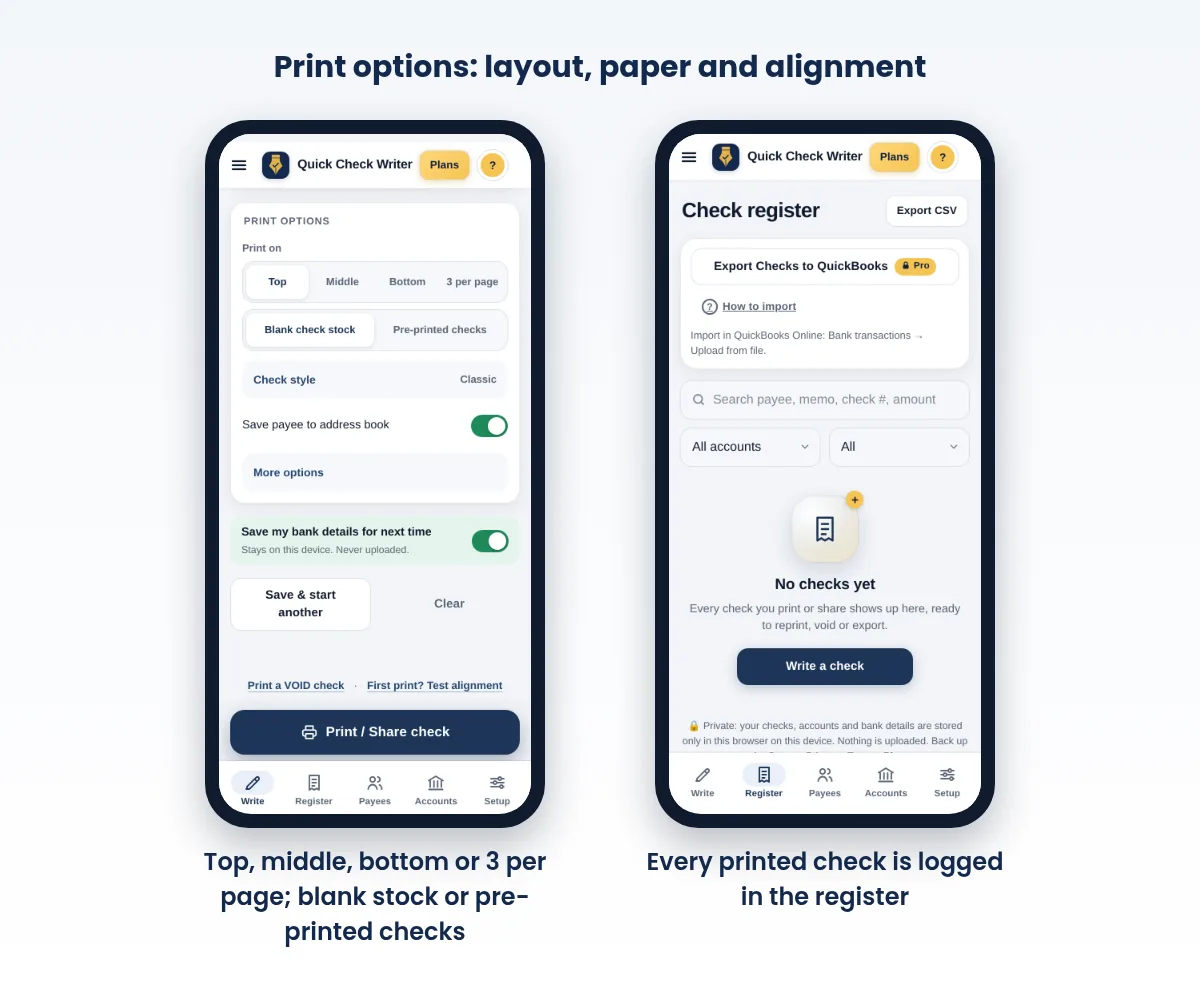
Each stub prints your name, the check number, your bank and the last four digits of the account, then the date, payee, memo and amount, then your note. The first stub carries a "detach and retain this statement" line for the payee; the second is marked as the office copy. Every check you print is also saved to your check register, so you have a digital record even if the paper copy goes missing.
Need to write a check right now?
Quick Check Writer fills in the amount in words, adds the bank line and prints on blank check stock or saves a PDF. Your first check is free, with no account and no card.
Write your first check free →Worked example: one check, three invoices and a credit
John Sample owes Sample Supply Co. for three invoices: #3301 for $480.00, #3307 for $615.50 and #3312 for $210.00, a total of $1,305.50. Sample Supply also issued him credit memo CM-19 for $55.50 after a damaged delivery. John writes one check for $1,250.00 and puts this in the stub note:
Inv 3301 $480.00 · Inv 3307 $615.50 · Inv 3312 $210.00 · Less CM-19 −$55.50 · Total paid $1,250.00
Here's what each side does with it:
- The payee's bookkeeper
Reads the stub, marks all three invoices paid and applies the credit memo. No call, no email, no "short payment" note on John's account.
- John's office copy
Gets stapled to the three invoices and the credit memo, then filed under Sample Supply. If a dispute comes up in six months, the paper answers it.
- John's check register
Logs check #1024, the payee, the date and the amount, so his bank reconciliation matches even if the paper copy is misplaced.
Without the stub, Sample Supply would see a check for $1,250.00 against $1,305.50 of open invoices and would have to guess which invoice was short. That guess is how payments get applied to the wrong invoice and late notices go out for bills you already paid.
Stub note templates you can copy
Short, consistent notes are easier for the payee's bookkeeper than a paragraph. Three patterns cover most payments:
Inv 2039 (Sep) $400.00 · Inv 2041 (Oct) $1,100.00 · Less credit memo CM-12 −$250.00 · Total $1,250.00
Deposit for kitchen job #318, 50% of quote Q-77 dated 10/15/2026. Balance due on completion.
Unit 2B, November 2026 rent. Base $1,200.00 + parking $50.00.
Whatever the format, make the lines add up to the check amount. If they don't, the payee has to guess, and guesses turn into phone calls.
Choosing check stock for voucher checks
Blank check stock comes in several perforation patterns, and the perforations need to match where your software prints the check. Look for stock described as "check on top", "check in middle" or "check on bottom", and match it to the layout you choose. If you already have stock, look at where the perforations fall and pick the layout that fits. The blank check stock guide covers paper weight, security features and where to buy.
Using window envelopes? Turn on the payee address option so the address prints where the envelope window shows it, and pick a layout and fold that puts the address behind the window. Test-fold a plain-paper print first.
Payroll pay stubs: what's different
A payroll stub isn't just a note; it's a statement of wages and withholding. It typically shows the pay period, hours for hourly workers, earnings before taxes, every withholding line, other deductions, the take-home amount, and running totals for the year.
Federal law doesn't require one. The U.S. Department of Labor states that the Fair Labor Standards Act requires employers to keep accurate records of hours worked and wages paid, but does not require them to give employees pay stubs. Many states do have their own pay-statement rules, though, and they differ on what must appear and whether an electronic copy is enough. Your state's labor agency publishes the rules that apply to you.
How state pay-statement rules differ: two examples
Two large states show how specific the rules can get:
- California. Labor Code section 226(a) requires an itemized statement semimonthly or with every payment of wages, given either as a detachable part of the check or as a separate writing. It must show gross wages, total hours (for non-exempt workers), piece-rate details where they apply, all deductions, net wages, the pay period dates, the employee's name with only the last four digits of the Social Security number (or an employee ID), the employer's legal name and address, and each hourly rate with the hours worked at it.
- New York. Section 195(3) of the state Labor Law requires a wage statement with every payment of wages, whether by cash or check. The state labor department says it must include details such as gross and net wages, deductions, hours worked and pay rate, and it publishes a sample statement for hourly workers.
In both states the stub on a paycheck is a legal document, not a courtesy, which is another reason pay stubs should come from payroll software that does the calculations. A voucher stub with a typed note is the right tool for vendors, not for wages.
Quick Check Writer doesn't calculate payroll taxes or produce pay stubs. If you pay employees by check, use payroll software or a payroll service to calculate the amounts and the pay statement, then print the paycheck itself. You can type a short summary in the stub note if you want it on the voucher. See how to print payroll checks.
Paying contractors and vendors with voucher checks
For contractors, a stub is the place to list the job, the invoice and any retainage held back. It also helps at year-end, when you total payments per contractor to see who needs a Form 1099; our guide on paying contractors by check covers that. For vendors, list every invoice the check pays and any credit memo applied. If you pay several invoices with one check, the stub is the only place the vendor sees how you split the money. Read how to pay vendors by check for a full workflow.
Stubs and year-end 1099s
Stubs also save time in January. If you pay independent contractors or rent in the course of a business, you may need to file Forms 1099. For payments made in 2026 and later, the IRS reporting threshold for most nonemployee compensation and rents rose to $2,000 a year per payee (it was $600 before), and it may be adjusted for inflation starting in 2027. Payments to attorneys follow their own rules. A consistent stub note ("Job #318, labor") plus your check register export lets you total each contractor's payments in minutes instead of digging through bank statements. Your accountant has the final word on what to file.
Common stub mistakes
| Mistake | Why it matters | Better |
|---|---|---|
| Stub left blank | The payee can't tell which invoice you paid | Always list at least the invoice or reference number |
| Full account number on the stub | Stubs get detached, filed and passed around | Show only the last four digits |
| Stub total doesn't match the check | The payee has to call to sort it out | List each invoice, then any credit, so the lines add up to the check |
| Wrong layout for the stock | Perforation tears through the check | Match Top/Middle/Bottom to your paper and test on plain paper |
| Office copy thrown away | No paper record when a vendor disputes a payment | File it with the bill it paid |
Keeping and storing stubs
- Staple the office copy to the bill it paid, and file by vendor or by month.
- Keep records as long as the IRS or your accountant advises: at least three years after you file the return they support, longer in some cases.
- Shred, don't toss: stubs carry names, amounts and partial bank details.
- Back up the digital side: export your check register to CSV now and then, and keep a backup of your app data.
Frequently asked questions
What is a check stub?
Usually a detachable section printed next to a check that explains the payment, such as invoice numbers and amounts. In payroll, "check stub" also means the pay statement showing wages, taxes and deductions.
What is a voucher check?
A letter-size sheet with one check and one or two detachable stubs. The payee keeps one stub as a record of what the payment covers, and you keep the other.
Which is better, check on top, middle or bottom?
None is better for the bank. Choose the position that matches your perforated check stock and how you fold the sheet into envelopes. Check on top is the most common for business voucher checks.
Can I print a check stub without a check?
A stub is meant to travel with a payment, so it's normally printed with the check. If you need a standalone record, print the check as a PDF or keep your register entry.
Are employers required to give pay stubs?
Not under the federal Fair Labor Standards Act, which only requires accurate payroll records. Many states have their own pay-statement requirements, so check your state's rules.
Does Quick Check Writer make payroll pay stubs?
No. It prints checks with voucher stubs that carry the payment details and your note or photo. Payroll calculations and pay statements come from payroll software or a payroll service.
Do I need to send the stub with the check?
For voucher checks, yes: the first stub goes with the check so the payee knows what it pays. You keep the second stub as your office copy. If the payee sent you their own remittance slip, you can include that too.
What does “detach and retain this statement” mean?
It tells the payee to tear the stub off before depositing the check and keep it for their records. The bank only needs the check itself.
Is a check stub proof of payment?
A stub shows what you intended to pay and why, but it doesn't prove the check was cashed. The stronger proof is your bank statement or the image of the paid check, which shows it cleared. Keep the stub together with that record.
Related guides
- Check layouts: top, middle, bottom, 3 per page and wallet
- How to Print Business Checks
- How to pay vendors by check
- How to Print Payroll Checks
- Blank Check Stock: A Complete Guide
- Check register app that fills itself in
Sources
- U.S. Department of Labor: FLSA questions and answers (pay stubs)
- IRS: How long should I keep records?
- California DIR (Labor Commissioner): Paydays FAQ, itemized wage statement under Labor Code 226(a)
- New York State Department of Labor: Wage statements, Labor Law 195.3
- IRS: Instructions for Forms 1099-MISC and 1099-NEC (threshold change for tax years after 2025)
Last updated November 1, 2026. This page is general information, not legal or financial advice. Quick Check Writer is check printing software; it is not a bank and does not move money.