
Key takeaways
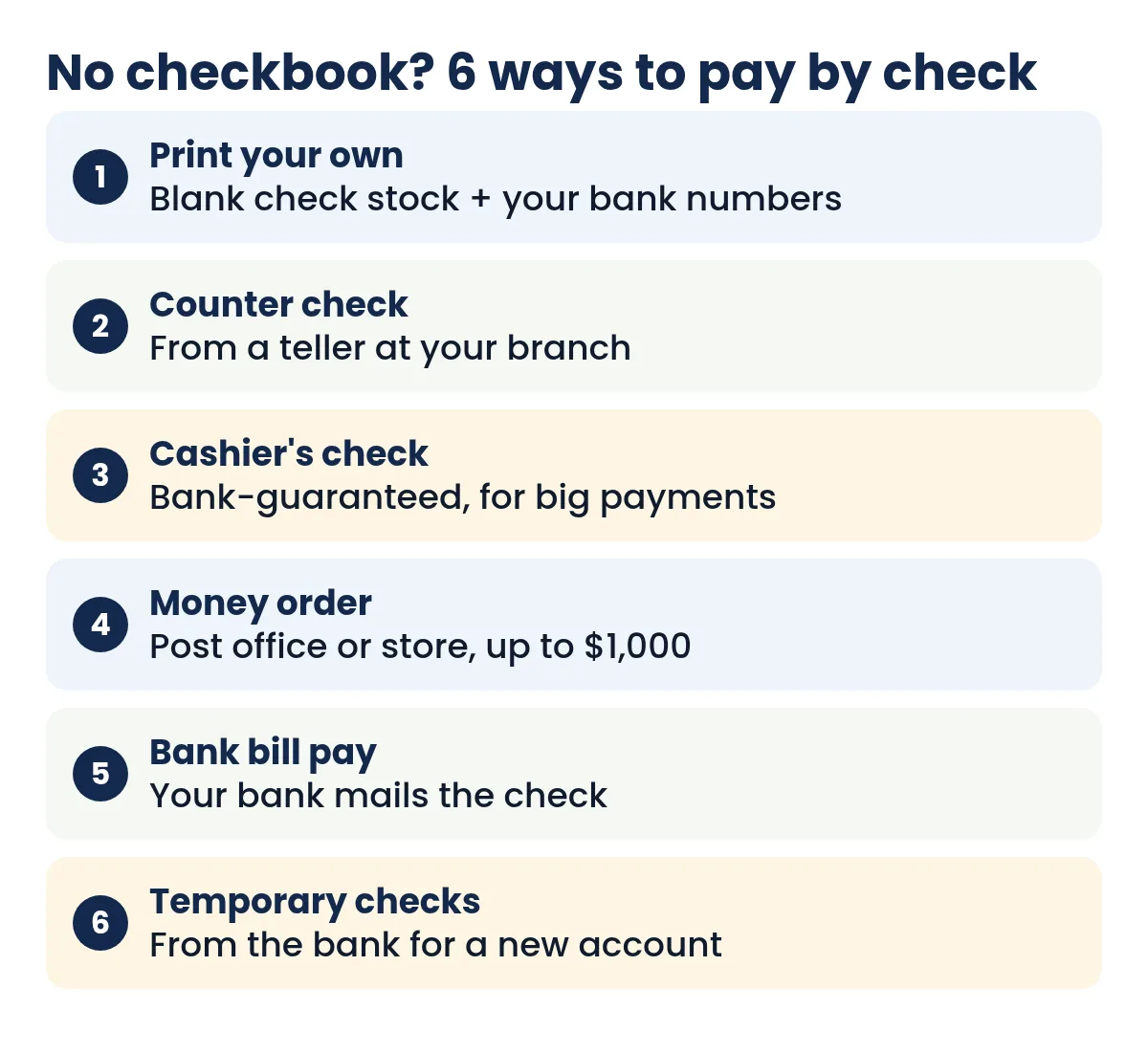
- A check is an order to your bank; it doesn't need to come from a checkbook.
- Printing your own on blank stock takes minutes and uses your own account.
- Counter checks and cashier's checks mean a trip to the bank, usually with a fee.
- USPS money orders go up to $1,000 each.
- Use a separate number range for printed checks.
On this page
- First: what makes a check a check
- 1. Print your own check at home
- Finding your bank numbers without a checkbook
- 2. Get a counter check from your bank
- 3. Buy a cashier's check
- 4. Get a money order
- 5. Use your bank's online bill pay
- 6. Ask for temporary or starter checks
- Three real situations, step by step
- Which option should you choose?
- How the rules vary by bank and payment type
- Checklist before you hand over a check you made yourself
- If you run a business
- Keep home-printed checks secure
- What not to do
- Paying without a check at all
- FAQ
First: what makes a check a check
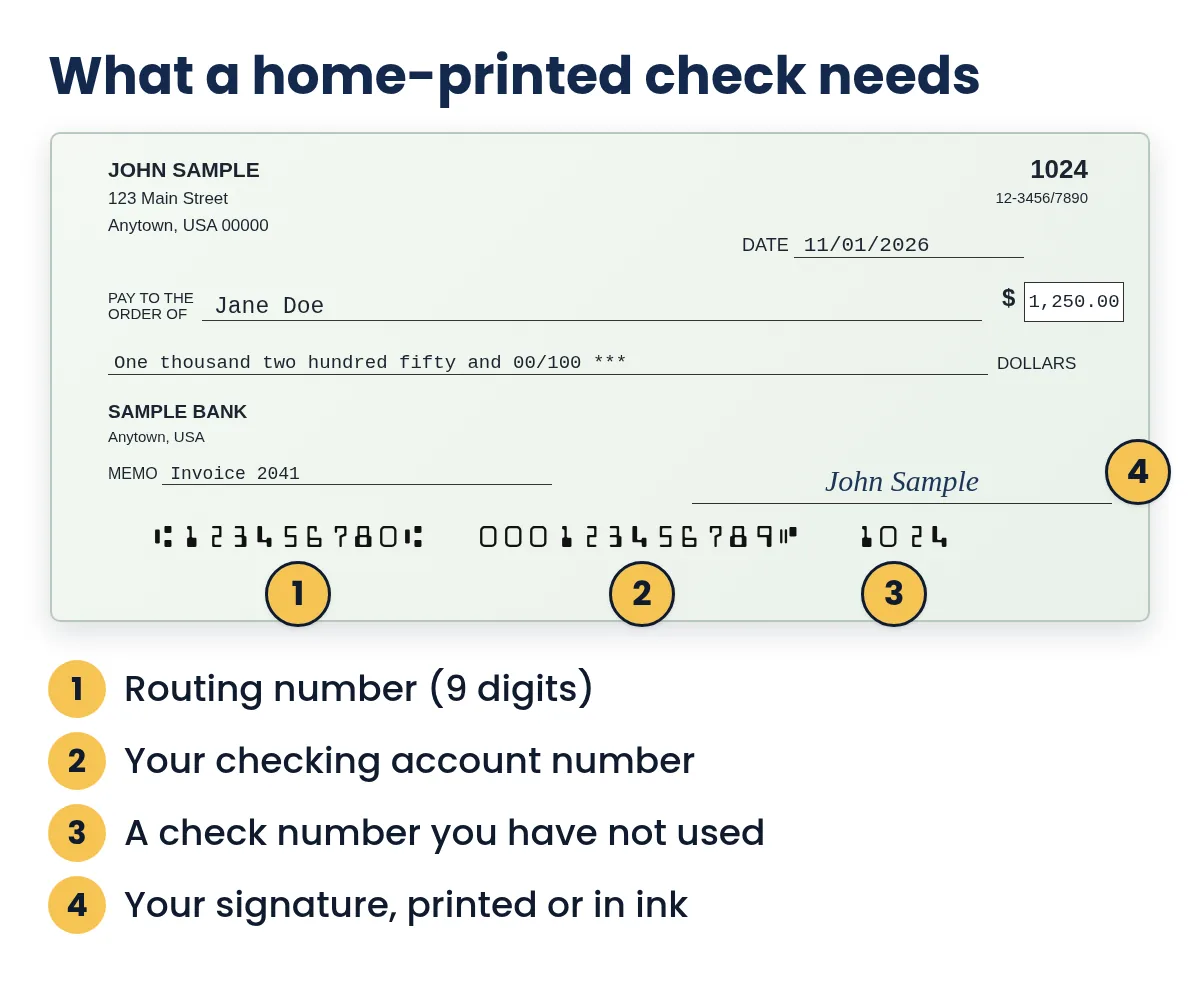
A checkbook is just a convenient pad of pre-printed forms. Legally, a check is an order to your bank to pay someone on demand; the Uniform Commercial Code defines it as a draft payable on demand and drawn on a bank (UCC § 3-104). Nothing in that definition requires paper that came from your bank's check supplier. What makes a check work in practice is that your bank can identify the account and process it: a correct routing number and account number, usually printed in magnetic MICR characters along the bottom, plus a payee, an amount, a date and an authorized signature.
That's why you have several routes when the checkbook is empty, lost or still in the mail. Some create a check drawn on your own account; others create a different kind of check (from your bank or a money-order issuer) that the payee will accept just as readily, or more so.
1. Print your own check at home
This is the fastest route if you have a printer. You print a full check, including the MICR line, onto blank check stock: special paper with security features and nothing printed on it yet. The result is a normal check drawn on your account, the same as one from a checkbook.
What you need
- Your routing and account numbers. They're in your online banking, on a statement, or on an old check. Our guide on finding your routing and account number shows where to look.
- Blank check stock from an office supply store or online. See the blank check stock guide for what to buy.
- A printer. Inkjet or laser both work for most deposits; MICR toner is optional for low volumes. Do you need MICR ink? explains when it matters.
- Check software that lays out the fields and the MICR line in the right positions.
Step by step
- Enter your account details once
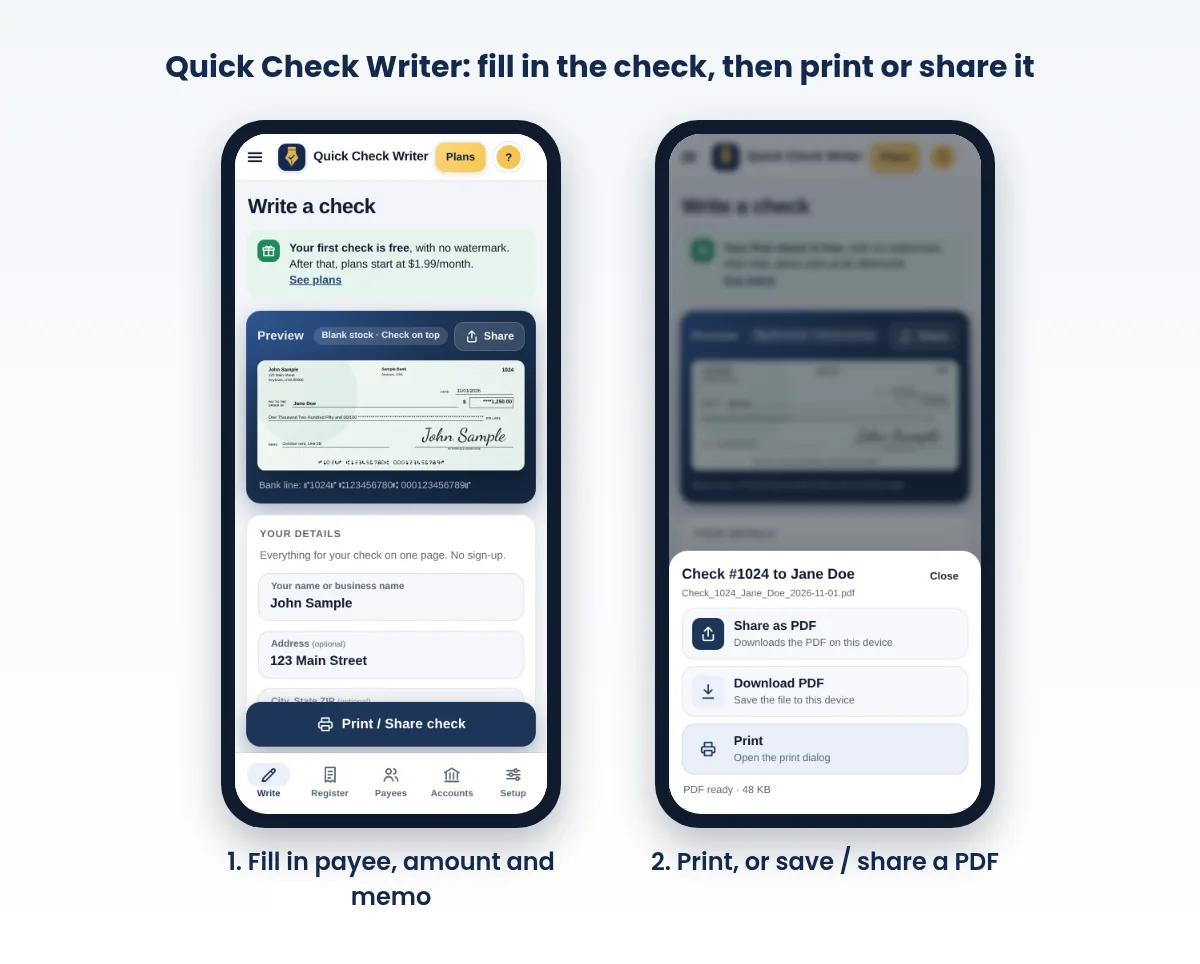
Your name and address, bank, routing number and account number. In Quick Check Writer these stay on your device; they aren't uploaded.
- Pick a starting check number
Choose a range that can't collide with your checkbook, for example 5001 if your paper checks are in the 1000s. Duplicate numbers confuse your records and can make the bank flag a check.
- Fill in the payment
Payee, amount, date and memo. The amount in words is filled in for you, which avoids the most common check mistake.
- Print a test on plain paper
Hold it over a sheet of check stock against a light to confirm it lines up, then print the real one.
- Sign and record
Sign by hand or add a saved signature, and the check lands in your register automatically.
Is it allowed? Yes. Printing your own checks is legal as long as they're drawn on your own account and you're authorized to sign; our article is it legal to print your own checks? covers the details. For a full walkthrough of printers, stock and settings, see how to print checks at home.
Need to write a check right now?
Quick Check Writer fills in the amount in words, adds the bank line and prints on blank check stock or saves a PDF. Your first check is free, with no account and no card.
Write your first check free →Finding your bank numbers without a checkbook
To print a check you need two numbers that normally sit on the bottom of every check: the 9-digit routing number and your account number. If you have no checks to copy them from, your bank already shows them elsewhere.
- Your bank's app or website. Most banks show both numbers in the account details. In one large bank's app, for example, you open the account tile and tap "Show details" to reveal the account and routing numbers.
- A monthly statement. The account number is printed on it; many banks print the routing number too.
- A voided check or deposit slip from an older pad, if you still have one for the same account.
- The branch or phone line. A teller can print or tell you both numbers after confirming your identity.
Read the numbers back digit by digit. One wrong digit can get the check returned, and you'll only find out days later.
2. Get a counter check from your bank
Most banks will print one or a few checks for you at a branch, called counter checks. They're drawn on your own account, show the bank's information and your account number, and are handy in a pinch. Downsides: you need to visit a branch, many banks charge a small per-check fee, and some payees hesitate to take a check without your name pre-printed on it. Our guide to counter checks and starter checks covers what to expect.
3. Buy a cashier's check
A cashier's check is drawn on the bank itself, not on your account. The bank takes the money from your account up front and guarantees the check, which is why landlords, car sellers and closing agents often prefer it. Expect a fee and a branch visit (some banks let you order one online for delivery). Read cashier's check vs certified check to choose between the two.
4. Get a money order
Money orders are prepaid, so they don't bounce, and you don't need a bank account to buy one. U.S. Postal Service money orders can be up to $1,000 each, are paid for with cash or a debit card (not a credit card), and USPS currently charges $2.65 for amounts up to $500 and $3.75 for $500.01 to $1,000. Stores and some banks sell them too, with their own limits and fees. For larger amounts you'd need several, which adds up.
5. Use your bank's online bill pay
Many banks' bill pay services will mail a paper check to a payee who can't take electronic payments. You enter the payee's name and address online, and the bank prints and mails the check. It's convenient for regular bills, but it takes several business days to arrive and you don't control the paper or the mailing. Check whether your bank offers it and how it handles timing.
Does online banking let you print a check?
In most cases, no. Most banks don't let customers download a printable check from online banking; instead they offer bill pay (the bank mails the check), the option to reorder checks, or counter checks at a branch. If you want a check you can print yourself right now, you need check-printing software and blank stock, as in option 1.
6. Ask for temporary or starter checks
When you open a new checking account, banks often hand out a few temporary checks until your personalized ones arrive. They may not show your name and address, so some merchants won't accept them, but they work for paying people you know or a landlord who expects you. If you've just opened an account and need a check today, ask.
Three real situations, step by step
Rent is due tomorrow and your new checks haven't arrived
- Look up your numbers
Open your banking app and copy the routing and account numbers.
- Pick a number range you'll never reach in the checkbook
For example, start printed checks at 5001 so they never collide with the 1001-series pad on its way to you.
- Print and sign
Print one check on blank stock, sign it, and add the unit number and month on the memo line. See how to pay rent by check.
- Record it
Log the number, date and amount so you can match it when it clears.
A seller wants guaranteed funds for a large purchase
For a used car or a security deposit, the other side may refuse any personal check, printed or not. That's what a cashier's check is for: the bank itself is the one paying. Federal Regulation CC requires the payee's bank to make a cashier's, certified or teller's check available by the next business day when it is deposited in person to a bank employee into an account held by the payee. Other deposit methods can take longer. Ask the seller exactly how the check should be made out before you go to the branch, because a cashier's check is hard to change once issued.
You don't have a checking account at all
A personal or printed check needs an account to draw on. Without one, a money order is the usual answer. The Postal Service sells domestic money orders of up to $1,000 each at any Post Office, paid with cash or a debit card (not a credit card), with a fee that depends on the amount.
John Sample owes Jane Doe $1,250.00 for a design job, and his last checkbook is used up. He finds his routing number (123456780) and account number (000123456789) in his banking app, loads blank check stock, and prints check 1024 payable to Jane Doe with "Invoice 2041" on the memo line. Before handing it over he compares the bank line with an old check from the same account: same routing number, same account number, correct symbols. He signs, records check 1024 in his register, and gives Jane the check. Elapsed time: under ten minutes, no trip to the bank.
Which option should you choose?
| Option | Speed | Drawn on | Cost (typical) | Best for |
|---|---|---|---|---|
| Print your own | Minutes | Your account | Low per check | Regular check writers, small businesses |
| Counter check | Same day (branch) | Your account | Small fee at many banks | A one-off check today |
| Cashier's check | Same day (branch) | The bank | Fee varies by bank | Large payments needing guaranteed funds |
| Money order | Same day | The issuer | USPS: $2.65–$3.75 | Up to $1,000, no bank account needed |
| Bank bill pay | Several days | Your account (bank mails it) | Often free | Recurring bills to the same payees |
| Temporary checks | When opening an account | Your account | Usually free | Bridging the wait for ordered checks |
Jane Doe needs to pay a contractor $640 on Friday and her checkbook ran out. A cashier's check would mean a trip to the branch and a fee for a payment that doesn't need a bank guarantee. A money order would work, but she'd need a trip to the post office. She prints check 5001 on blank stock at home, signs it, and logs it in her register. Total time: about five minutes.
How the rules vary by bank and payment type
| Option | What can differ | Ask or check |
|---|---|---|
| Counter check | Whether your bank offers them, the fee, and whether payees accept them | Call your branch first |
| Cashier's check | Fee, ID rules, and how fast the payee gets the money | Next-business-day access applies to in-person deposits by the payee |
| USPS money order | Fee by amount; $1,000 limit per order | Cash or debit only at the counter |
| Bank bill pay | Delivery time and whether a paper check or electronic payment goes out | Your bank's bill pay terms |
Checklist before you hand over a check you made yourself
- Routing and account numbers match your bank's records exactly.
- The check number hasn't been used before and won't be reused by a future checkbook.
- The amount in words matches the amount in numbers.
- The payee's name is spelled the way they will deposit it.
- The date is today's date, not a guess.
- It is signed, by you or with your saved signature.
- The check is in your register, so you can spot it when it clears.
If you run a business
Running out of business checks is more disruptive than running out of personal ones, because vendors and contractors are waiting. A few habits prevent the scramble:
- Keep a small stock of blank check paper on hand, even if you normally order pre-printed checks. It turns an empty checkbook into a five-minute job.
- Use voucher checks for vendor payments so the invoice details travel with the payment; see check stubs and voucher checks.
- Keep printed and ordered checks in separate number ranges and one register, so reconciliation stays simple.
- Decide who can sign and whether any payments need two signatures before you start printing checks in-house.
Our guide on how to print business checks covers layouts, logos and approval habits in more depth.
Keep home-printed checks secure
A checkbook in a drawer and a pack of blank stock both need care, because each sheet can become a check. Store blank stock where you'd store a checkbook, shred misprints (or mark them VOID first), and print a test page on plain paper rather than wasting check stock. Turn on the security options your software offers if you're printing on plain paper, and use the security features already built into good check stock. If a printed check goes missing, treat it like a lost checkbook check and consider a stop payment; see lost or stolen checks.
Before printing a real check, lay a trial printout next to an old check from the same account. Your bank's nine-digit routing code, your account digits and the serial should look identical in format.
What not to do
- Don't write a check on a blank sheet by hand and expect it to be accepted. Without a MICR line and the usual layout, many banks and payees won't process it. Our guide on printing checks on regular paper explains the limits.
- Don't borrow someone else's checks or cross out their name. A check must be drawn on an account you're authorized to use.
- Don't reuse check numbers from your checkbook. Keep printed checks in their own number range.
- Don't send a photo of a check as payment unless the payee agrees and knows how to deposit it. If you need to send a check electronically, see how to email a check.
Paying without a check at all
Sometimes the real question is "how do I pay this person?" rather than "how do I write a check?". If the payee takes them, an ACH transfer from online banking or your bank's person-to-person transfer avoids paper entirely; see ACH vs check. For large, urgent amounts, a wire transfer may be the right tool. When a check is what's needed, the options above get you one today.
Frequently asked questions
Can I still pay by check if I have no checkbook?
Yes. You can print your own check on blank check stock, ask your bank for a counter check, buy a cashier's check or money order, or have your bank's bill pay mail a check for you.
Can I print checks through online banking?
Most banks don't offer printable checks in online banking. They offer bill pay (the bank mails a check) or reorders. To print a check yourself, you need check software and blank check stock.
Is a check I print at home valid?
Yes, if it's drawn on your own account with the correct routing and account numbers and you sign it. Banks process home-printed checks like any other check when the MICR line is printed correctly.
What do I need to print my own checks?
Your routing and account numbers, blank check stock, an inkjet or laser printer, and check printing software that places the MICR line correctly.
Can I write a check on plain paper?
A check doesn't legally have to be on special paper, but many banks and payees won't accept one without a MICR line and standard layout. Blank check stock with security features is the safer choice.
What check number should I use for printed checks?
Use a range that won't overlap your checkbook, such as starting at 5001. That keeps your register clean and avoids duplicate numbers.
How do I find my routing and account number without a check?
Look in your bank's app or online banking under the account details, or on a monthly statement. A teller or the bank's phone line can also give them to you once they confirm your identity.
How long does a cashier's check take to clear?
Under Regulation CC, the payee's bank must make a cashier's, certified or teller's check available by the next business day when the payee deposits it in person to a bank employee into their own account. Other deposit methods can take longer.
Can I buy a money order without a bank account?
Yes. A Post Office sells domestic money orders up to $1,000 each for cash or a debit card. You cannot pay with a credit card, and the fee depends on the amount.
Can I write a check from a savings account?
Checks are normally drawn on a checking account. Some savings or money market accounts come with check-writing, but many don't, so ask your bank before you print or write a check on one.
Related guides
- How to print checks at home
- Counter checks and starter checks
- Blank Check Stock: A Complete Guide
- Is It Legal to Print Your Own Checks?
- Where to find the routing and account number on a check
- Cashier's check vs certified check
Sources
- UCC § 3-104 Negotiable instrument; definition of check, Cornell LII
- USPS: Money orders
- Regulation CC, 12 CFR 229.10 (next-day availability)
- Chase: finding account and routing numbers
Last updated November 1, 2026. This page is general information, not legal or financial advice. Quick Check Writer is check printing software; it is not a bank and does not move money.