
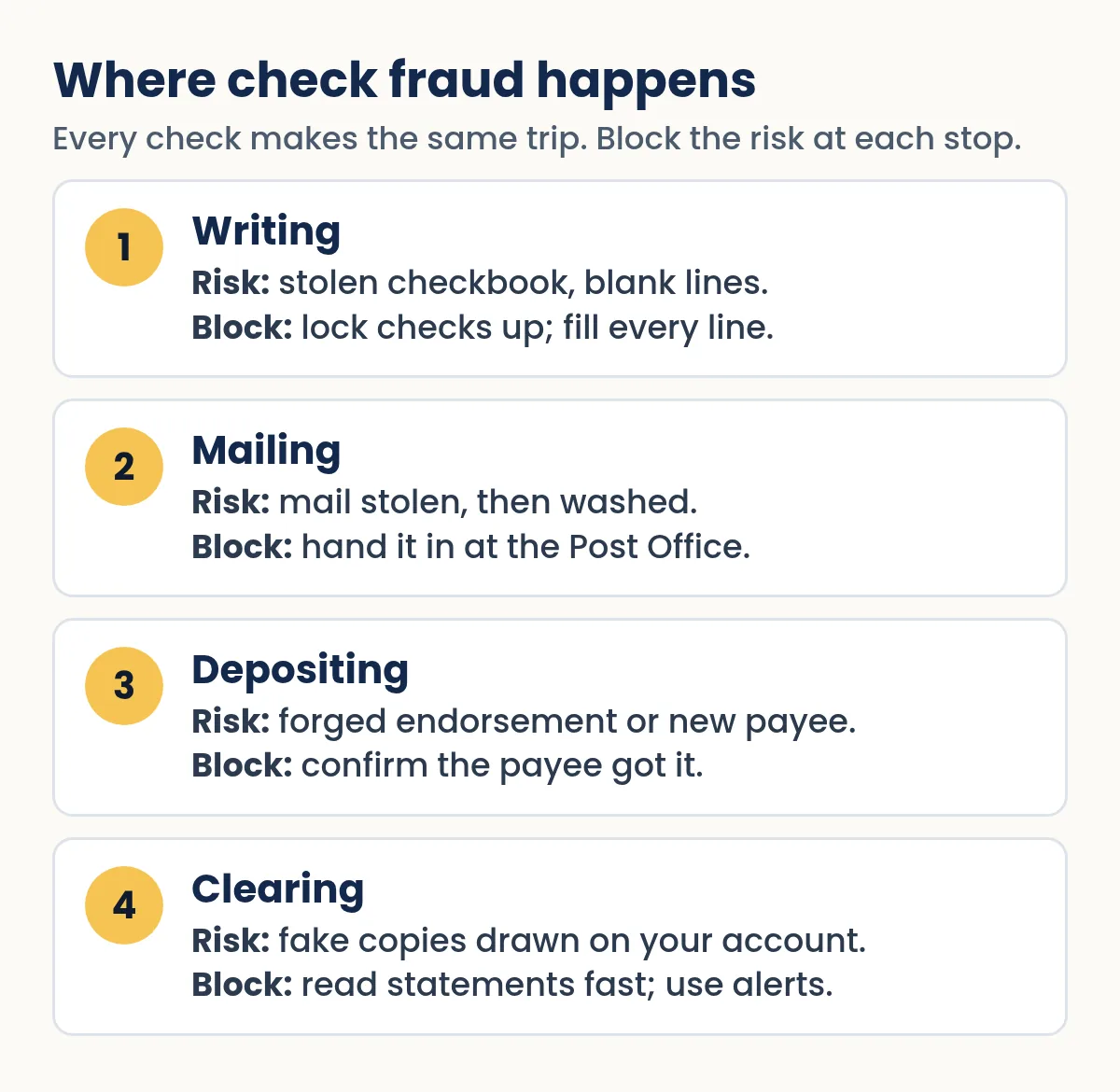
Key takeaways
- Treat blank checks like cash: lock them up and track the numbers.
- Fill every line and draw a line through empty space so nothing can be added.
- Mail checks at the Post Office or before the last pickup, never overnight in your mailbox.
- Turn on clearing alerts, look at check images and reconcile monthly.
- Report problems to your bank right away; the UCC sets a one-year outer limit and your bank may set less.
On this page
- Why check fraud is worth ten minutes of your attention
- The main kinds of check fraud
- Protect checks before you write them
- Write every check so it is hard to change
- Send checks the safe way
- Watch your account like a hawk
- Extra steps for small businesses
- When the fraud comes to you: fake checks you receive
- If you think you have been hit
- A quick self-check
- FAQ
Why check fraud is worth ten minutes of your attention
Paper checks feel old-fashioned, which is part of why criminals like them. A single check hands a stranger your name, your bank, your routing number and your account number, plus a sample of your signature. Anyone who gets hold of one can alter it, copy it, or use it as a pattern for fakes.
The numbers from federal regulators show the scale. In its February 2023 alert, the Treasury's Financial Crimes Enforcement Network (FinCEN) reported that banks filed more than 350,000 suspicious activity reports about potential check fraud in 2021, and over 680,000 in 2022, nearly double. A follow-up FinCEN analysis in September 2024 looked at reports tied to checks stolen from the mail and found that 44 percent of those checks were altered and then deposited, 26 percent were used as templates for counterfeits, and 20 percent were signed fraudulently and deposited.
The good news: most check fraud depends on a handful of predictable weak spots. Close them and you become a much harder target than the next person.
The main kinds of check fraud
It helps to know what you are defending against. Nearly every scheme falls into one of these buckets.
- Alteration (including check washing)
- A real check you wrote is changed. The payee name or the amount is erased, often with chemicals, and rewritten. Our guide to check washing explains the method in detail.
- Counterfeiting
- A brand-new fake is printed using your real account details, usually copied from a check that passed through someone's hands or a mailbox. The fake can look nothing like your real checks and still clear if nobody is watching.
- Forgery
- Someone signs your name on a genuine blank check taken from your checkbook, or signs the payee's name on the back to cash a check that was meant for someone else.
- Fake checks sent to you
- The reverse direction: you receive a check, deposit it, and are asked to send part of the money back. The check bounces later and you owe the bank. The Postal Inspection Service is blunt about this one: there is no legitimate reason for someone to send you a check and ask you to return cash.
- Payment redirection
- Mostly a business problem. A criminal poses as a vendor and asks you to send future payments somewhere new. Checks are affected too when the "new remittance address" is a mailbox the criminal controls.
Protect checks before you write them
Blank checks are the easiest target of all, because nothing needs to be altered. Treat them like cash.
- Lock them up. Keep your checkbook, spare boxes of checks and any blank check stock in a locked drawer, not on a desk or in a car.
- Count what you have. Know which check numbers you have used. A gap in the sequence that you cannot explain is a reason to call the bank.
- Keep fewer blanks around. A few hundred preprinted checks sitting in a closet for years is a few hundred chances. Printing checks only when you need them reduces how many ready-to-use checks exist at all. If you print at home, read our notes on printing checks safely at home and on choosing blank check stock with built-in security features.
- Shred, don't toss. Old checks, voided checks you no longer need, and statements that show check images all go in a cross-cut shredder.
Write every check so it is hard to change
Most alterations exploit empty space or ink that lifts easily. A few habits make a check far harder to edit.
- Fill every field
Date, payee, numeric amount, written amount and signature. Never sign a check with the payee or amount blank.
- Leave no room to add
Start the payee name and the written amount at the far left of their lines, then draw a line through the leftover space. Write the cents as a fraction ("and 00/100") so nobody can tack on extra words. Our guide to writing the amount in words shows the exact format.
- Use the full legal name
Write "Sample Electric Co." rather than "SEC," and never write "Cash" as the payee on a check that will travel.
- Choose ink that resists washing
Many fraud-prevention guides recommend a gel pen whose ink soaks into the paper fibers, which makes it harder to lift than ordinary ballpoint ink. Laser printers fuse toner onto the paper, and a good check stock adds features that reveal tampering.
- Record it right away
Note the check number, date, payee and amount in your register before the check leaves your hands. You cannot spot a fake later if you do not know what you actually wrote.
Printing the payee and amount instead of handwriting them removes two common problems at once: messy handwriting that invites "corrections," and blank gaps at the end of lines. Quick Check Writer fills the written amount automatically and logs every printed check in a register you can search later.
Send checks the safe way
Mail theft is the starting point for a large share of check fraud, which is why FinCEN and the Postal Inspection Service issued their 2023 alert together. The inspection service's own advice is simple:
- Drop outgoing mail in a blue collection box before the last pickup of the day, or hand it in at a Post Office.
- Do not leave mail in your mailbox overnight, and do not raise the flag on a home mailbox to announce that something is waiting inside.
- When you travel, have your mail held at the Post Office or ask a neighbor you trust to collect it.
Use a plain, opaque envelope so the check cannot be read through the paper, and skip writing "check enclosed" or the amount on the outside. For bills that offer other payment methods, consider saving checks for cases where a check is truly needed. Our step-by-step guide to mailing a check safely covers envelopes, tracking and certified mail.
The free USPS Informed Delivery service emails you a grayscale image of the address side of letter mail arriving soon. If a check you expected never shows up after the preview said it would, you know to act quickly.
Need to write a check right now?
Quick Check Writer fills in the amount in words, adds the bank line and prints on blank check stock or saves a PDF. Your first check is free, with no account and no card.
Write your first check free →Watch your account like a hawk
Prevention reduces risk; monitoring limits damage. Fraud spotted in a day is usually a phone call. Fraud spotted in six months can be a loss you cannot recover.
Turn on alerts
Most banks let you set text or email alerts for any check that clears, for withdrawals over a set amount, or for a low balance. Set them. An alert about check 1031 when you have only written up to 1024 tells you something is wrong while there is still time to act.
Look at the check images, not just the totals
Online banking usually shows the front and back of every paid check. Open them. Confirm the payee name, the amount and the signature are what you wrote. A washed check often shows the right check number and date with a different payee.
Reconcile every month
Matching your register to the statement is the single most reliable way to catch a check you did not write or one that was changed. Our guides on balancing a checkbook and bank reconciliation walk through it step by step.
Know the legal clock
Under the Uniform Commercial Code, which every state has adopted in some form, a bank may charge your account only for items that are "properly payable," meaning ones you authorized (UCC § 4-401). A forged or altered check generally is not. But the same code puts a duty on you: when your bank makes a statement available, you must review it with reasonable promptness and report unauthorized signatures or alterations (UCC § 4-406).
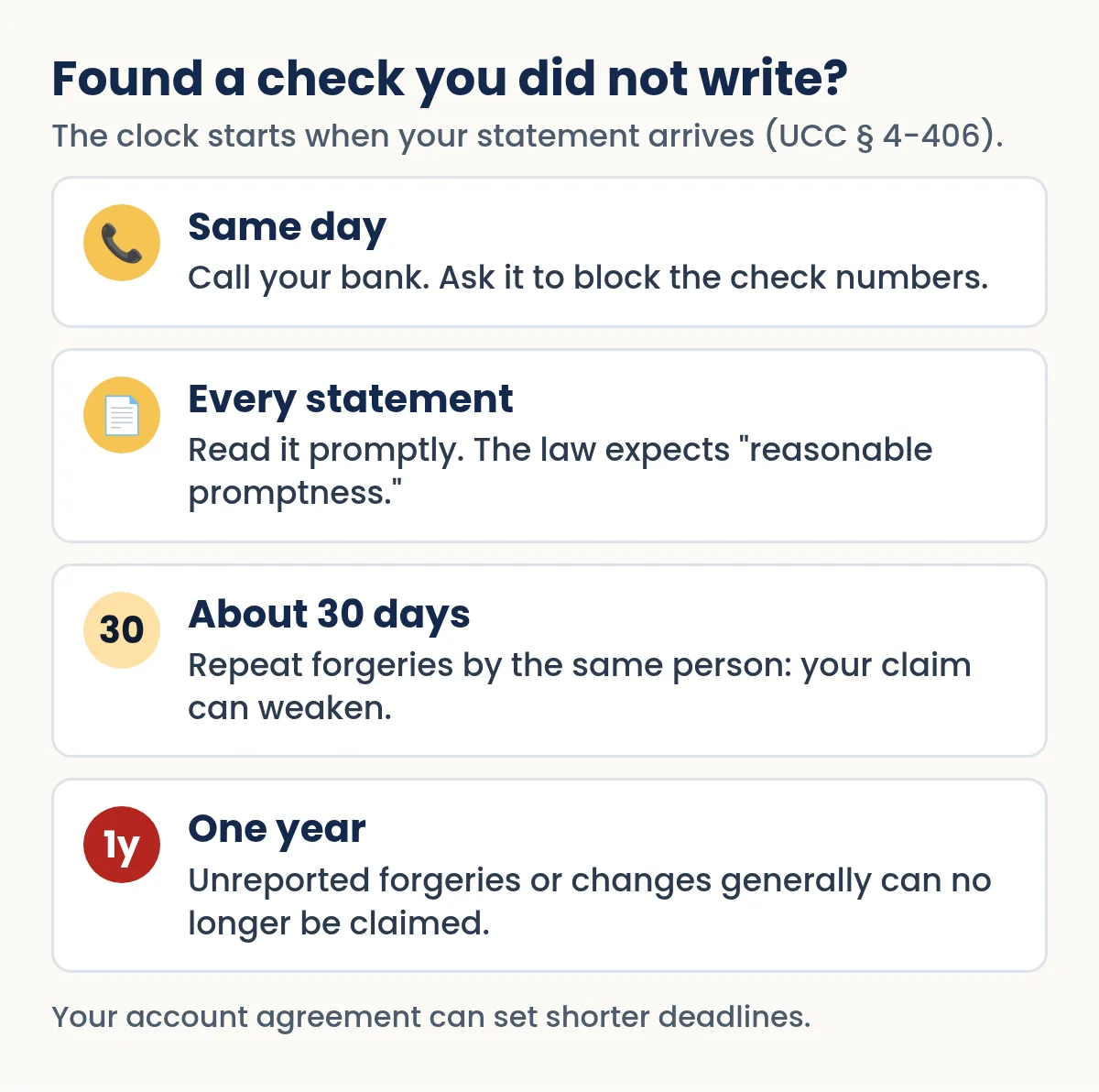
If you sit on a statement and the same criminal keeps passing your checks, the bank may be able to push those later losses onto you once you have had a reasonable time to look, which the code caps at 30 days. And no matter what, if you do not report a forged signature or an alteration within one year after the statement was made available, you generally lose the right to claim it against the bank. Many account agreements shorten these windows, so read yours.
UCC § 3-406 says a person whose failure to use ordinary care substantially contributes to a forgery or alteration can be barred from asserting it. Leaving signed blank checks in a car, or writing a check with wide gaps that make editing easy, are the kinds of facts that come up.
Extra steps for small businesses
Businesses write more checks, for larger amounts, to more payees, and often have several people involved. That makes internal controls as important as external ones.
| Control | What it stops | Effort |
|---|---|---|
| Positive Pay from your bank | Counterfeits and altered amounts or payees on checks drawn on your account | Medium: send the bank a list of issued checks |
| Separate duties | One employee writing, signing and reconciling their own checks | Low: assign tasks to different people |
| Dual signatures over a limit | Large unauthorized checks | Low |
| Verify vendor changes by phone | Payments redirected to a criminal's address or account | Low: call a number you already have on file |
| Separate account for checks | Limits how much is exposed if a check is copied | Medium: keep only what is needed for checks in it |
| Monthly reconciliation by someone else | Missed or hidden fraudulent items | Low |
Positive Pay
Positive Pay is a bank service in which you tell the bank which checks you issued (check number, amount and often payee), and the bank flags any presented check that does not match so you can decide whether to pay or return it. At least one large bank's product sheet warns that failing to use the fraud tools it offers may leave you with losses it will not reimburse. Read our full explainer on what Positive Pay is and how to set it up. Quick Check Writer does not create Positive Pay files, but its register export gives you a clean list of issued checks to work from.
Payment redirection scams
The FBI's Internet Crime Complaint Center recommends verifying every change to payment instructions in person or by calling a phone number you already know, not one listed in the message that asked for the change. That advice applies equally to a "new mailing address" for vendor checks. See our guide on paying vendors by check for a full set of controls.
John Sample runs a small landscaping company. A message that appears to come from his fertilizer supplier says, "We moved; send checks to our new PO box." John calls the supplier's office number from an old invoice, not from the message. The supplier has not moved. He forwards the message to his bank and keeps paying at the address on file.
When the fraud comes to you: fake checks you receive
Check fraud isn't only about checks you write. The other half is checks people send you. The pattern is consistent: a stranger, a "buyer," a new "employer" or a prize letter sends a check, often for more than you're owed, and asks you to send back the difference by wire, gift card or app.
The OCC explains that if your bank credits a deposited check that later turns out to be fraudulent, the bank can generally reverse those funds, and it's usually up to you to pursue the person who gave it to you. Money you have already sent onward is typically gone. Three rules handle almost every version of this scam:
- Never send money back from a check you just deposited, no matter how real it looks or how quickly your bank made the funds available.
- Verify any large check with the bank it's drawn on, using a phone number you look up yourself.
- Be suspicious of any check tied to a job you didn't apply for, a prize you didn't enter, or an overpayment you didn't ask for.
Our guide on how to verify a check walks through the verification steps.
If you think you have been hit
- Call your bank immediately
Report the specific check numbers and amounts. Ask about stop payments on outstanding checks, closing the account, and opening a new one with new numbers if your account details are clearly in criminal hands. Our page on lost or stolen checks covers this in depth.
- Put it in writing
Follow the phone call with written notice through secure messaging or a letter, and keep copies. Banks often ask you to sign an affidavit about forged or altered items.
- Report mail theft
If the check was stolen from the mail, file a report with the U.S. Postal Inspection Service online or by phone at 1-877-876-2455. The inspection service also suggests reporting to your local police.
- Take care of the payee
The person you meant to pay still needs to be paid. Once the bank has the original check number blocked, issue a replacement with a new number.
- Watch for follow-on fraud
Stolen mail often contains other personal details. Review your credit reports and consider a fraud alert or a credit freeze with the credit bureaus.
A quick self-check
If you can answer yes to most of these, you have covered the basics:
- My blank checks and check stock are locked up, and I know which numbers I have used.
- I fill every line on a check and leave no gaps.
- I mail checks at the Post Office or before the last pickup, never from my home mailbox overnight.
- I get an alert when a check clears and I look at check images.
- I reconcile my account every month.
- For my business, more than one person touches each payment, and vendor changes are verified by phone.
Check fraud thrives on gaps: blank spaces, unattended mail and unread statements. Close the gaps and most schemes fail.
Frequently asked questions
What is the most common type of check fraud?
Federal data points to mail theft as a major source. In FinCEN's 2024 analysis of checks stolen from the mail, 44 percent were altered and deposited, 26 percent were used to make counterfeits, and 20 percent were fraudulently signed and deposited.
Will my bank refund a forged or altered check?
Generally a bank can charge your account only for checks you authorized, so a forged or altered check should not be your loss if you report it promptly. Delays, careless handling of checks, or missing your account agreement's deadlines can shift some or all of the loss to you.
How long do I have to report a forged check?
The Uniform Commercial Code sets an outer limit of one year after the statement was made available, and repeat fraud by the same person can become your loss after a reasonable period of no more than 30 days. Many banks set shorter deadlines in their account agreements, so report as soon as you see it.
Do gel pens really prevent check washing?
They help. Gel ink tends to soak into paper fibers, making it harder to remove with chemicals than ordinary ballpoint ink. It is one layer of protection, not a guarantee, so combine it with safe mailing and account monitoring.
Is it safer to print checks or order them?
Both can be safe. Printing checks as needed means fewer blank checks sitting around to be stolen, while good blank stock adds security features. What matters most is how you store, write, mail and monitor checks.
Who do I report stolen mail to?
Report mail theft to the U.S. Postal Inspection Service at uspis.gov or by calling 1-877-876-2455, and tell your bank and local police.
Can someone steal money with just my routing and account number?
They can try. Those numbers are printed on every check you write, and criminals use them to make counterfeit checks or other unauthorized debits. Account alerts, regular review of check images, monthly reconciliation and, for businesses, Positive Pay are the main defenses. Report any item you didn't authorize to your bank right away.
What should I do if I get a check for more than I'm owed?
Don't send back the difference. Overpayment is the classic sign of a fake check scam. Contact the sender through a channel you trust, verify the check with the bank it's drawn on, and if it's a scam, report it to the FTC. If you deposited a fake check, your bank can generally reverse the credit.
Related guides
- Check washing: how it works and how to stop it
- What is Positive Pay?
- Check security features, explained
- Lost or stolen checks: what to do
- How to mail a check safely
- Is It Safe to Print Checks at Home?
Sources
- FinCEN Alert FIN-2023-Alert003: Mail Theft-Related Check Fraud (Feb 27, 2023)
- FinCEN: In-depth analysis of check fraud related to mail theft (Sept 9, 2024)
- U.S. Postal Inspection Service: Check Washing
- U.S. Postal Inspection Service: Check Fraud
- U.S. Postal Inspection Service: Report a crime
- USPS Informed Delivery
- UCC § 4-401, When bank may charge customer's account (Cornell LII)
- UCC § 4-406, Customer's duty to discover and report (Cornell LII)
- UCC § 3-406, Negligence contributing to forgery or alteration (Cornell LII)
- FBI IC3 PSA I-040620: Business Email Compromise recommendations
- Bank of America: Check Positive Pay (product sheet)
- OCC HelpWithMyBank: Am I liable for a fraudulent check I deposit?
- OCC: Check fraud (ways to avoid it and report it)
Last updated November 1, 2026. This page is general information, not legal or financial advice. Quick Check Writer is check printing software; it is not a bank and does not move money.