
Key takeaways
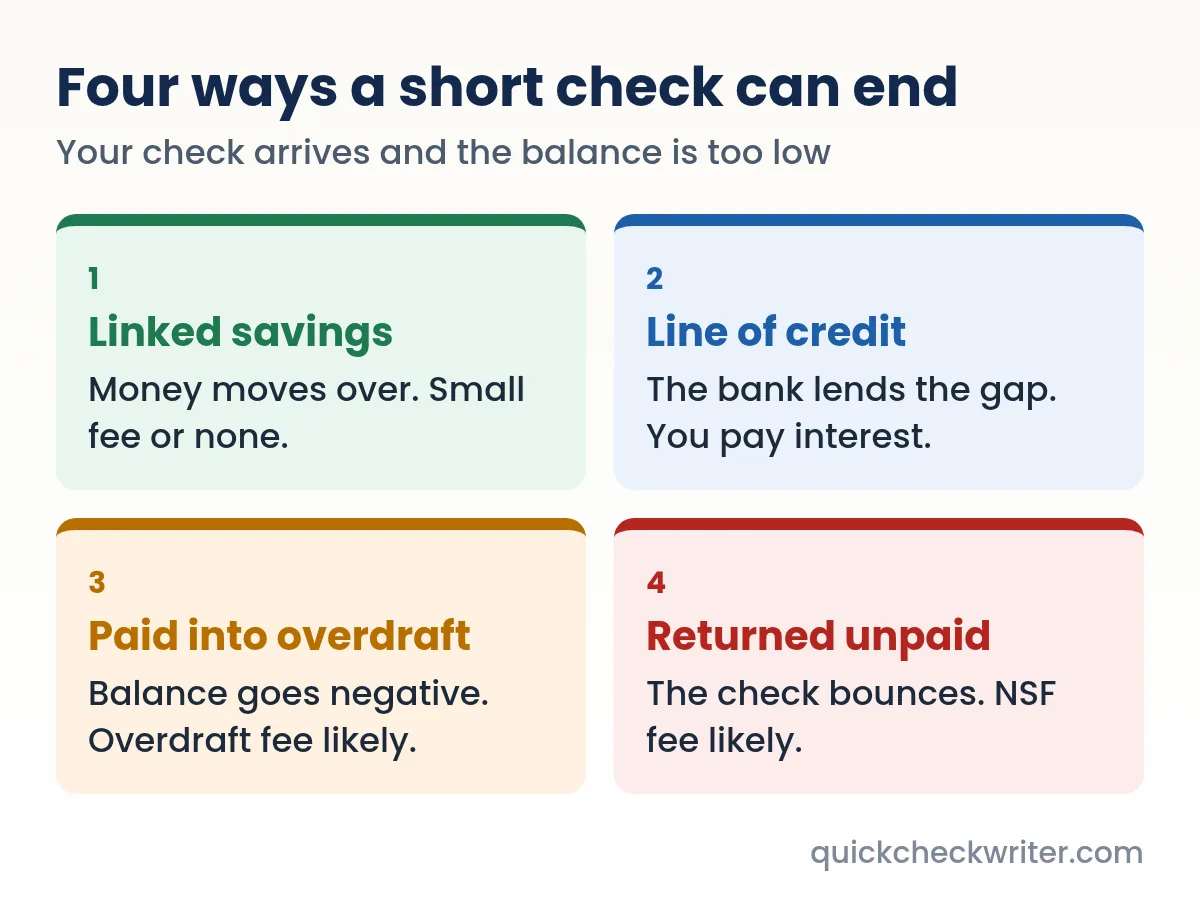
- There are three kinds: a linked savings transfer, an overdraft line of credit, and standard overdraft coverage.
- Linked savings is usually the cheapest. The old six-transfer limit on savings was removed in 2020.
- The overdraft opt-in rule covers only ATM and one-time debit card transactions, not checks.
- Federal law sets no cap on overdraft fees; banks must disclose them.
- Banks aren't required to pay any overdraft, even with coverage.
On this page
- Overdraft protection in plain English
- The three kinds of overdraft coverage
- The detail most people miss: opting out does not cover checks
- How overdraft coverage works on a check, step by step
- Why you can be overdrawn even when you “had the money”
- If overdraft fees are piling up
- Personal and business accounts follow different rules
- Questions to ask your bank before you choose
- Common mistakes
- Is overdraft protection worth it?
- How to set up overdraft protection for checks
- The best overdraft protection is knowing your balance
- FAQ
Overdraft protection in plain English
An overdraft happens when a payment leaves your checking account for more than the money that is available. With a check, that is the moment the check reaches your bank and your balance is too low to cover it. Your bank then has two choices: pay it anyway, leaving your balance negative, or refuse it and send it back.
"Overdraft protection" is the umbrella name for arrangements that make the first outcome more likely or cheaper. The federal bank regulator describes it as an agreement with your bank to cover overdrafts on a checking account, typically for a fee and usually up to a preset limit. It also adds an important caveat: banks are not required to offer overdraft programs, and even when they do, they can keep the discretion to pay or not pay a given item.
In practice, "overdraft protection" can mean three quite different products, and the differences matter a lot for your wallet.
The three kinds of overdraft coverage
1. A link to your savings account
You connect a savings account (or a second checking account) to your checking. When a check would overdraw checking, the bank moves money over automatically. The Consumer Financial Protection Bureau describes this as an option that may carry a transfer fee, but less than the fee for an overdraft. For most people with some savings, it is the best first line of defense.
Old advice warned that savings accounts were limited to six such transfers a month. The Federal Reserve deleted that six-per-month limit from Regulation D in April 2020. Some banks still keep their own limits or fees for excessive transfers, so read your savings account terms.
2. An overdraft line of credit
Some banks let you link a small personal line of credit or a credit card. When a check would overdraw your account, the bank advances the difference from the credit line. You pay interest on what you borrow and possibly a fee when it is used. The CFPB notes this can still be a cheaper way to cover a brief cash shortfall than paying repeated overdraft fees.
3. Standard overdraft coverage
This is the bank simply paying the item and letting your balance go negative, then charging an overdraft fee if your account has one. You repay the negative balance with your next deposit. Federal law does not cap overdraft fees; the regulator says those decisions are made by the bank, which must disclose them and give advance notice of increases.
A federal rule that would have limited overdraft charges at very large banks was adopted in 2024, but Congress disapproved it and the President signed that resolution on May 12, 2025, so it has no effect. Overdraft pricing remains a matter of each bank's account terms.
The detail most people miss: opting out does not cover checks
You may remember signing, or declining, an overdraft opt-in when you opened your account. That choice comes from Regulation E, and it applies only to ATM withdrawals and one-time debit card purchases. A bank cannot charge you an overdraft fee on those unless you affirmatively opted in.
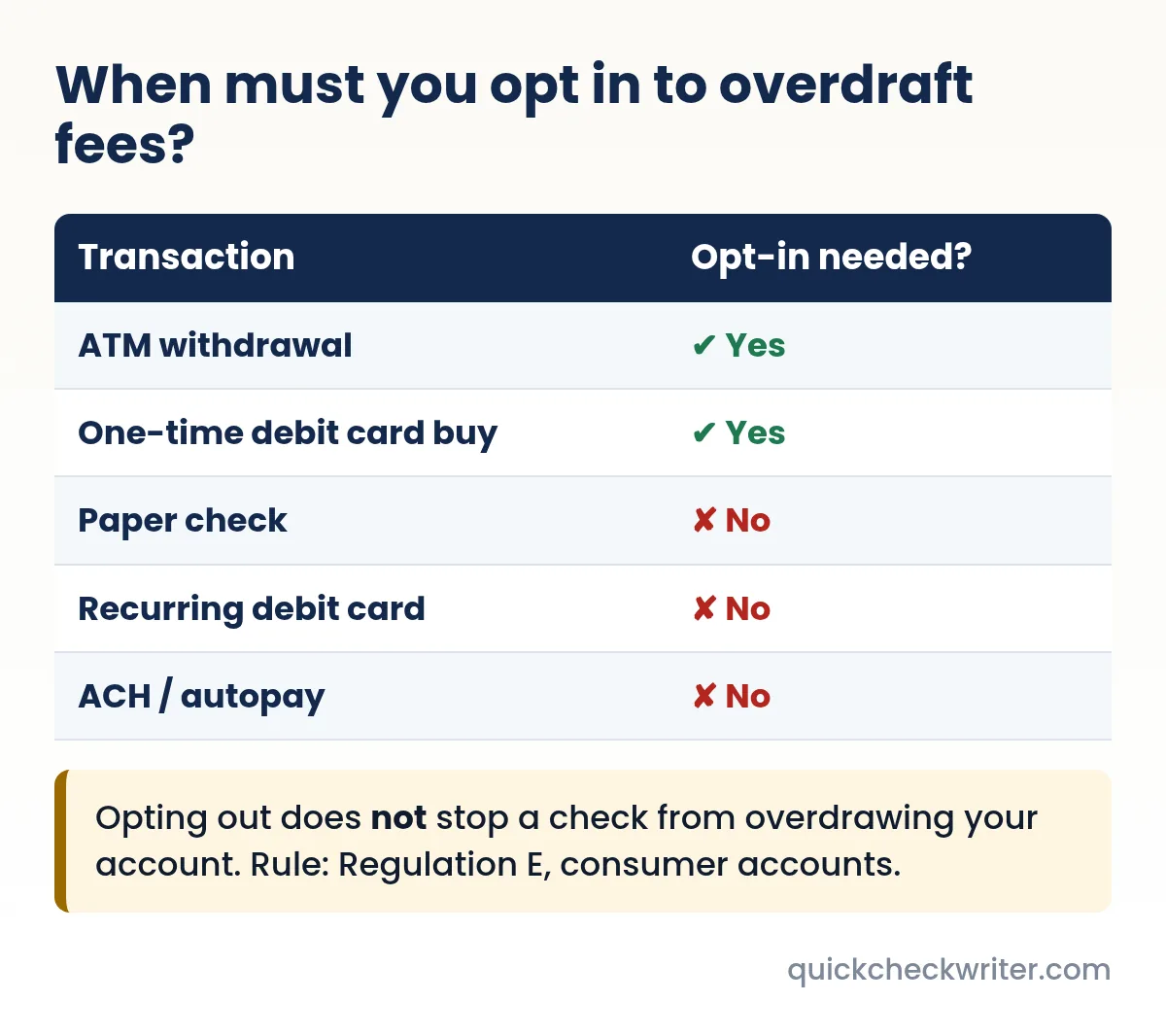
Checks are different. The regulator's guidance is explicit that your consent is not required for the bank to pay overdrafts on checks or automatic bill payments. And if a check overdraws your account, the bank can charge a fee as long as the practice was disclosed in your account agreement. So if you write checks, your account terms for checks matter more than the opt-in box.
Declining debit card overdraft coverage can stop surprise card fees, but it does not stop a short check from being paid into overdraft or returned with a fee. To protect check payments, set up a linked savings account or line of credit, or keep a cushion.
How overdraft coverage works on a check, step by step
- Your check arrives at your bank
Usually electronically, a day or two after the payee deposits it.
- The bank compares it with your available balance
Not your ledger balance. Pending card purchases and holds on recent deposits can make the available figure lower than you expect.
- If you have a linked account or credit line
The bank transfers or advances the shortfall, often in set increments, and the check is paid.
- If you only have standard coverage
The bank decides whether to pay. If it does, your balance goes negative and an overdraft fee may apply. If it does not, the check is returned and an NSF fee may apply.
- You bring the account back to positive
Many banks charge further fees if a negative balance stays unpaid for several days, so cover it quickly.
John Sample has $400 in checking and $2,000 in a linked savings account. A $600 rent check he wrote to Jane Doe arrives. His bank moves $200 (or a larger set increment) from savings to checking and pays the check. John may see a small transfer fee instead of an overdraft or NSF fee, and Jane's deposit is never reversed.
Need to write a check right now?
Quick Check Writer fills in the amount in words, adds the bank line and prints on blank check stock or saves a PDF. Your first check is free, with no account and no card.
Write your first check free →Why you can be overdrawn even when you “had the money”
Surprise overdrafts on checks usually come from timing. A few common causes:
- Deposits are not instantly available
- Banks do not have to make deposited funds available immediately, and deposits made after a cut-off time count as the next business day. The regulator gives the example of a deposit made after the Friday cut-off being treated as Monday's, with next-day funds available Tuesday. Our guide to how long a check takes to clear explains the hold rules.
- Posting order
- You may write checks in number order, but your bank does not have to pay them in that order. Banks may post items in different sequences as long as they follow their disclosed practice, and paying a large check first can create more overdrafts than paying small ones first.
- Forgotten checks
- A check you wrote weeks ago can arrive any day. Until it clears, it is still spent money.
- No warning from the bank
- The regulator notes that banks are not required to notify you when a check bounces for insufficient funds; keeping an accurate register is your job. Most banks offer balance alerts you can switch on.
If overdraft fees are piling up
Overdraft fees can snowball, because each item that arrives while you are negative can bring its own fee. If it happens to you, act in this order:
- Stop the bleeding. Deposit or transfer enough to bring the available balance positive, and hold off on new checks until it is.
- List what is still coming. Go through your register for checks that have not cleared and payments scheduled in the next few days.
- Ask for a refund. Call or message your bank, explain what happened, and ask whether it will reverse some of the fees. Banks often consider a refund for customers who rarely overdraw.
- Change the setup. Link a savings account, ask about a line of credit, or move to an account with lower or no overdraft and NSF fees if your bank offers one.
When an overdraft is not your fault
If your account went negative because someone forged your signature on a check or altered one, the law is on your side. Under the UCC, you are not liable for the amount of an overdraft if you neither signed the item nor benefited from it. Report it to your bank promptly; you have a duty to review your statements with reasonable promptness, and waiting too long can limit your rights. Our guide to lost or stolen checks covers what to do.
Joint accounts
On a joint account, either owner's checks draw on the same balance, so one person's check can overdraw the account for both. Agree on who tracks the register, or keep a shared register that both of you update when you write a check.
Personal and business accounts follow different rules
The opt-in protection described above comes from Regulation E, and Regulation E covers consumer accounts: accounts set up mainly for personal, family or household purposes. A business checking account is outside that definition, so a bank does not need your opt-in before charging overdraft fees on a business account's debit card or ATM transactions. Your account agreement is what governs.
For a small business that writes many checks, that makes the overdraft setup a real cash-flow decision. Many owners link a business savings account or a business line of credit, and keep a cushion in checking on the days large checks are due to clear, such as payroll day.
Questions to ask your bank before you choose
- What does each option cost?
Ask for the overdraft fee, NSF fee, transfer fee, interest rate on any line of credit, and any fee for staying negative.
- Is there a daily cap?
Some banks limit how many overdraft or NSF fees they charge in one day. Ask for the number in writing or find it in the fee schedule.
- Is there a small-overdraft cushion?
Some banks do not charge when you are overdrawn by only a few dollars, or give you until the end of the day to bring the balance back. Ask whether yours does.
- In what order are items paid?
The order can change how many items overdraw. The federal regulator's help site notes that the posting policy generally appears in your account agreement, and items do not necessarily post in the order you wrote them.
- How will you tell me?
Turn on low-balance and overdraft alerts by text or email so you can fix a shortfall the same day.
- Can I turn standard coverage off for checks?
Some banks let you ask them to return checks rather than pay them into overdraft. The fee for a returned check may be the same, so compare before you choose.
Common mistakes
- Assuming “I opted out” means no overdrafts. The opt-out covers ATM and one-time debit card transactions only. A check can still overdraw your account.
- Counting on the ledger balance. Banks decide on the available balance, which can be lower because of holds and pending card purchases.
- Leaving the linked savings account empty. A link only helps if there is money on the other side. Check it after big transfers.
- Forgetting old checks. A check you wrote two months ago can arrive on the same day as rent. Review your outstanding checks before you spend.
- Waiting to repay. Some banks add fees when a balance stays negative for several days, so cover a shortfall as soon as you see it.
Is overdraft protection worth it?
| Option | Typical cost | Payee gets paid? | Best for |
|---|---|---|---|
| Linked savings | Small transfer fee or none | Yes | Anyone with a savings cushion |
| Overdraft line of credit | Interest, maybe a fee | Yes | Occasional short gaps |
| Standard overdraft coverage | Overdraft fee per item, if charged | Usually, at the bank's discretion | Rare, important payments |
| No coverage | NSF fee plus payee's fee, if charged | No | Nobody, if it can be avoided |
For check writers, the payee getting paid matters. A returned rent or utility check can mean late fees, a strained relationship, and a bounced check on your record with that payee. A linked savings account usually delivers the protection without the cost.
How to set up overdraft protection for checks
- Read your fee schedule
Find the overdraft fee, NSF fee, transfer fee, any daily cap and any fee for staying negative. Federal rules require your periodic statement to show total overdraft fees and total returned-item fees for the period and year to date.
- Ask what is available
Linked savings, line of credit, or standard coverage only. Ask whether coverage applies to checks and whether there is a limit.
- Link an account
Usually a few taps in online banking or a short form at a branch.
- Turn on alerts
A low-balance alert at a level that covers your typical largest check gives you time to move money.
- Keep your register current
Overdraft protection is a backstop, not a budget.
The best overdraft protection is knowing your balance
Every check you write is money already promised. If you record checks when you write them, you will rarely be surprised by what clears. Quick Check Writer keeps a register of every check you print with its number, payee, amount and date, and lets you export it, which makes balancing your checkbook and spotting outstanding checks much easier.
Frequently asked questions
Does overdraft protection cover checks?
It can. Linked savings and overdraft lines of credit normally cover checks. Standard overdraft coverage may pay a check at the bank's discretion for a fee. Ask your bank how each option applies to checks.
If I opted out of overdraft, can my check still overdraw my account?
Yes. The opt-out under Regulation E applies only to ATM and one-time debit card transactions. A check can still be paid into overdraft, or returned with a fee, under your account agreement.
Is there a limit on how much a bank can charge for an overdraft?
Federal law does not set a maximum overdraft fee. Banks must disclose their fees and give advance notice before raising them. A 2024 federal rule for very large banks was disapproved by Congress in 2025.
Is a savings account still limited to six transfers a month?
The Federal Reserve removed the six-per-month limit from Regulation D in April 2020. Your bank may still set its own limits or fees, so check your account terms.
Does my bank have to pay a check if I have overdraft protection?
No. Banks are not required to offer overdraft programs and may keep discretion to pay or not pay a particular item even when you are enrolled.
Will my bank tell me if a check overdraws my account?
Not necessarily. Banks are not required to notify you when a check bounces for insufficient funds. Turn on balance and overdraft alerts in your banking app.
Do the overdraft opt-in rules apply to business accounts?
No. The opt-in requirement is part of Regulation E, which covers accounts established mainly for personal, family or household purposes. Overdraft fees on a business account are governed by your account agreement, so read it and set up a link or line of credit if you need one.
Can I ask my bank to bounce checks instead of paying them into overdraft?
Ask. Some banks let you decline standard overdraft coverage so short checks are returned instead. Compare the fees first, because a returned-check (NSF) fee can be similar to an overdraft fee, and the payee may charge you too.
Related guides
- What happens when a check bounces
- How Long Does a Check Take to Clear?
- Check register app that fills itself in
- How to balance a checkbook
- Outstanding checks
- ACH vs check: which payment should you use?
Sources
- OCC HelpWithMyBank: What is overdraft protection?
- OCC HelpWithMyBank: When is consent required for overdraft fees?
- OCC HelpWithMyBank: Can the bank pay a check if my account is overdrawn?
- OCC HelpWithMyBank: Is there a limit on overdraft fees?
- OCC HelpWithMyBank: Why did the bank pay my largest check first?
- OCC HelpWithMyBank: Overdrawn right after a deposit
- OCC HelpWithMyBank: Bank not required to notify you of an NSF check
- Regulation E, 12 CFR 1005.17 Requirements for overdraft services (eCFR)
- Regulation DD, 12 CFR 1030.11 Overdraft disclosures (eCFR)
- CFPB: Know your overdraft options
- CFPB: Overdraft Lending, Very Large Financial Institutions (rule disapproved May 12, 2025)
- Federal Reserve: Savings deposits FAQ (six-transfer limit removed April 24, 2020)
- UCC § 4-401, When bank may charge customer's account (Cornell LII)
- UCC § 4-406, Customer's duty to report unauthorized signature or alteration (Cornell LII)
- 12 CFR § 1005.2, Definitions (account = consumer account) (eCFR)
Last updated November 1, 2026. This page is general information, not legal or financial advice. Quick Check Writer is check printing software; it is not a bank and does not move money.