
Key takeaways
- An RCC is created by the payee, not signed by the account holder.
- Also called a demand draft, check by phone or check by fax.
- The depositing bank warrants the payer authorized it, so unauthorized RCCs can be pushed back.
- Telemarketers have been barred from using RCCs for sales since June 13, 2016.
- Most businesses now use phone-authorized ACH debits or cards instead.
On this page
- What a remotely created check is
- How a check by phone works
- Who uses remotely created checks
- The rules that protect payers
- Which rule covers what
- Can you stop a remotely created check?
- Why speed matters for your bank, too
- Why regulators treat them with suspicion
- How to spot one on your statement
- Don't confuse these terms
- Remotely created check vs other ways to pay by phone
- If you run a business: accepting checks by phone responsibly
- If you're the payer: protecting yourself
- Three situations, step by step
- Common mistakes
- FAQ
What a remotely created check is
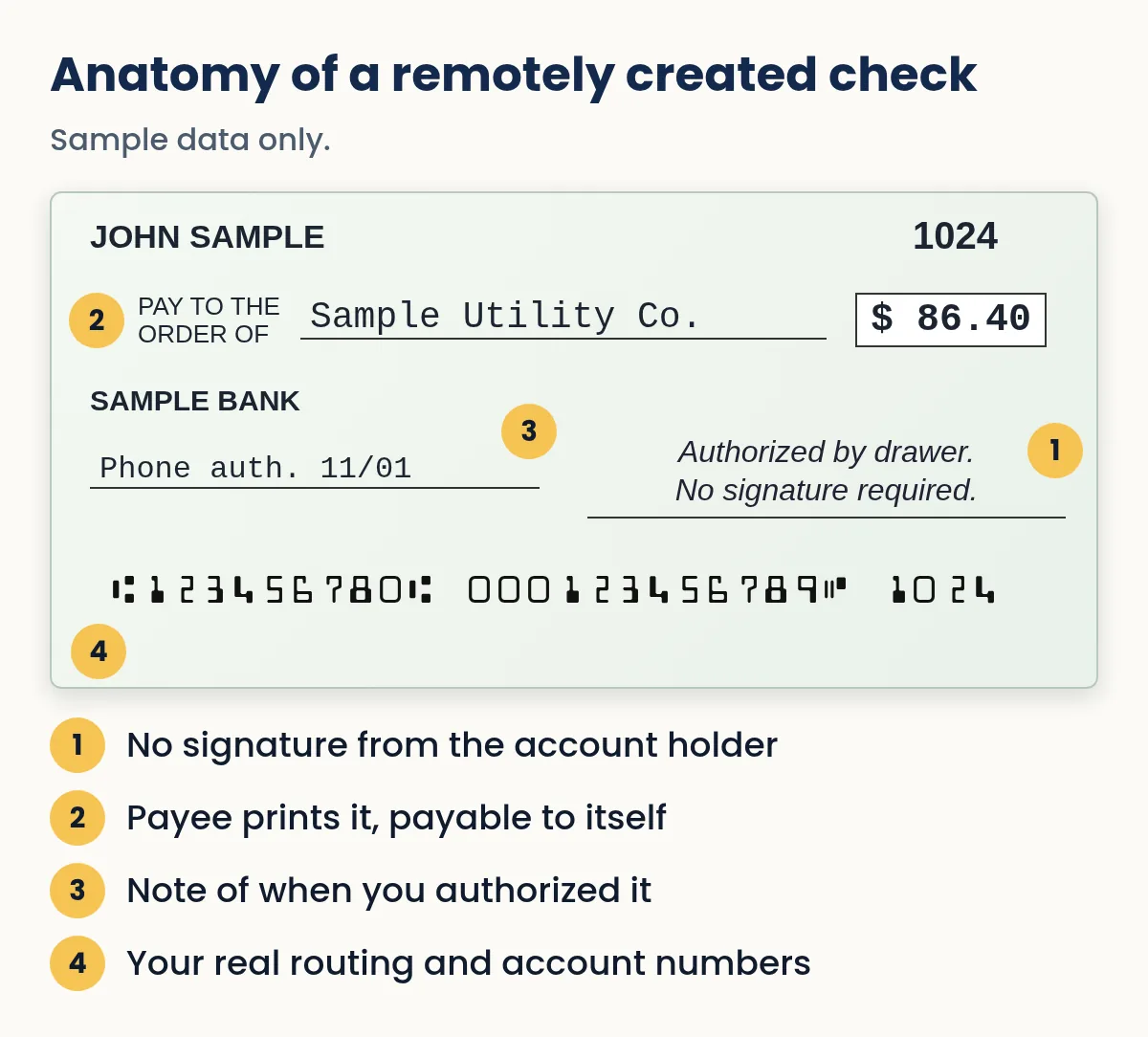
A normal check is created and signed by the account holder. A remotely created check (RCC) flips that around: the payee creates the check, using the payer's bank details and permission. Because the payer never touches it, it carries no signature from them, usually just a line such as “authorized by drawer” or “signature not required”.
Federal Regulation CC defines a remotely created check as a check that is not created by the paying bank and does not bear a signature applied, or purported to be applied, by the person whose account it is drawn on. The Uniform Commercial Code has a near-identical term, “remotely-created consumer item”, for these items when they are drawn on a consumer account.
You'll also hear them called demand drafts, preauthorized drafts, telechecks, or “checks by phone”, “checks by fax” and “checks by web”. The name reflects how the payer gave permission, not a different kind of instrument.
A remotely created check is a paper check drawn on your account, printed by someone you're paying, based on permission you gave them, with no signature from you.
How a check by phone works
- The payer agrees to pay
Over the phone, by fax or online, the payer agrees to a specific amount and gives their bank's routing number and their account number, usually read off one of their own checks.
- The payee records the authorization
A careful business records exactly what was authorized: the amount, the date, the account, and the payer's name. Many send a written confirmation.
- The payee prints the check
Using check-drafting software and blank check stock, the payee prints a check on the payer's account, payable to itself, for the authorized amount.
- The payee deposits it
It clears through the normal check system like any other check, and the amount comes out of the payer's account.
Who uses remotely created checks
Before card payments and electronic bank transfers were everywhere, RCCs let a business take payment from someone who couldn't or wouldn't mail a check. Typical legitimate uses include:
- Bill payments by phone, such as a utility or a lender taking a same-day payment from a customer who is late.
- Recurring payments where the customer signed a standing authorization.
- Businesses whose customers don't use cards, or for amounts larger than a card limit.
- Collections, where a debtor agrees to pay by phone.
The same features that make RCCs convenient make them attractive to fraudsters: anyone who has your routing and account numbers can print one. That is why regulators tightened the rules.
The rules that protect payers
Warranties under Regulation CC and the UCC
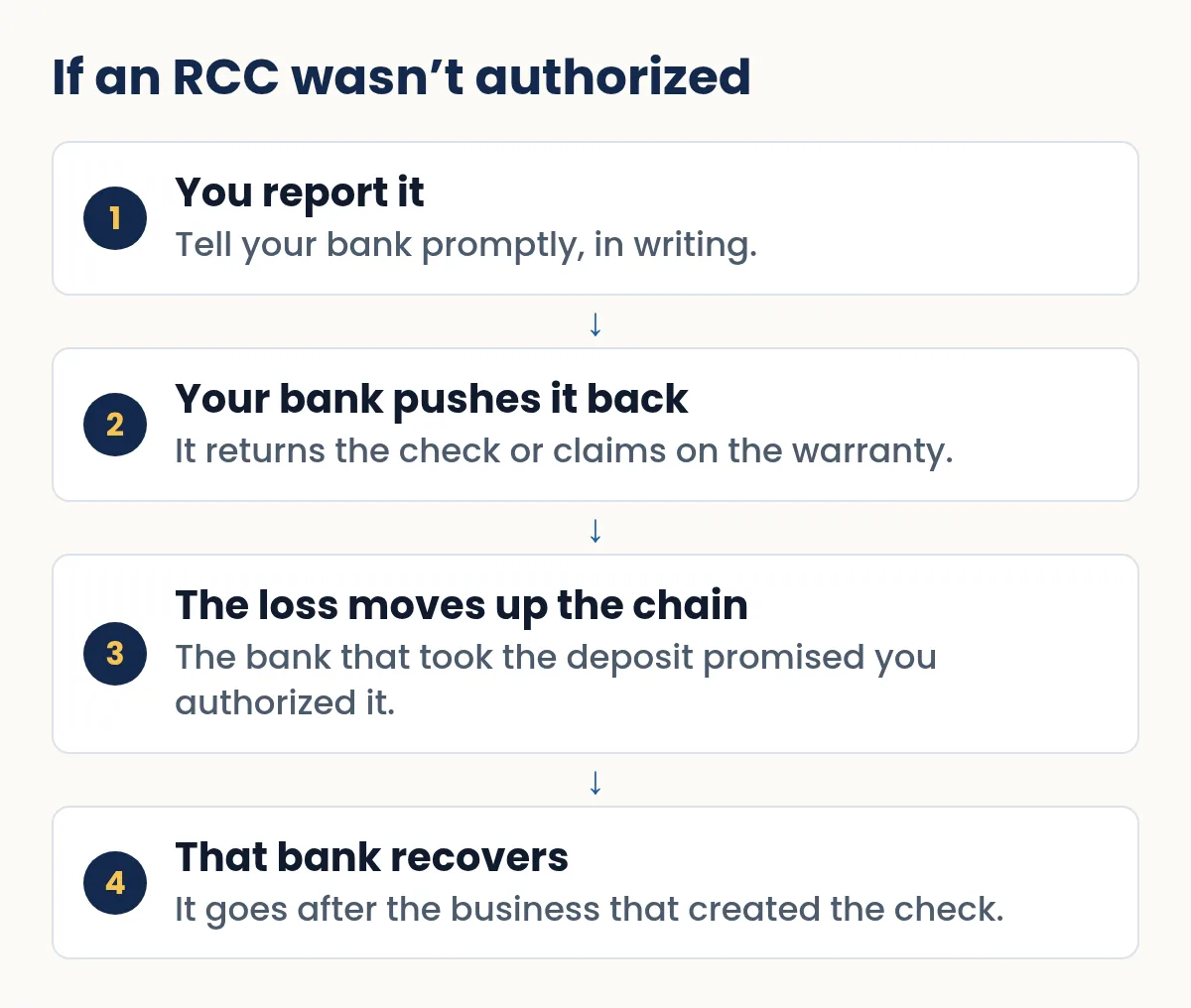
Regulation CC makes a bank that transfers or presents a remotely created check warrant that the account holder authorized it in the amount shown. The UCC contains a matching warranty for remotely-created consumer items. In plain terms: if an RCC drawn on your account wasn't authorized, your bank can push the loss back to the bank that accepted the deposit, which in turn can pursue the business that created it. That gives the depositing bank a strong reason to know its customer.
Banned in telemarketing
Since June 13, 2016, the Federal Trade Commission's Telemarketing Sales Rule has prohibited sellers and telemarketers from creating, or causing to be created, a remotely created payment order as payment for goods or services sold through telemarketing, or for charitable donations solicited that way. If a telemarketer asks for your bank numbers so they can “draft a check”, that alone is a reason to hang up.
Your duty to read statements
Check law expects you to review your statements with reasonable promptness and report problems. Report an RCC you didn't authorize to your bank as soon as you see it, in writing, with the date and amount.
Need to write a check right now?
Quick Check Writer fills in the amount in words, adds the bank line and prints on blank check stock or saves a PDF. Your first check is free, with no account and no card.
Write your first check free →Which rule covers what
Four different sets of rules touch remotely created checks. Each answers a different question, which is why the protection feels scattered.
| Rule | Who it binds | What it does for you |
|---|---|---|
| Regulation CC, 12 CFR 229.34(b) | Banks that send or present an RCC | The sending bank promises the account holder authorized the check, for the amount shown |
| UCC Articles 3 and 4 | Banks and customers, under state law | Matching warranty for consumer items; your right to stop payment; your duty to read statements |
| Telemarketing Sales Rule, 16 CFR 310.4(a)(9) | Sellers and telemarketers | Bans RCCs as payment for telemarketing sales and donations |
| ACH operating rules (TEL entries) | Businesses taking debits by phone | Covers the electronic alternative, not paper RCCs |
Can you stop a remotely created check?
Usually, yes, if you act before it is paid. Under UCC § 4-403, an account holder can stop payment of any item drawn on the account by giving the bank an order that describes it with reasonable certainty, early enough for the bank to act. A remotely created check is an item drawn on your account like any other check.
- Gather what you know
The payee's name, the amount you expect, and the date. If the business gave you a check number or reference, note it.
- Place the stop payment
Call or use online banking. Banks often charge a fee, and the bank needs enough detail to match the item.
- Confirm it in writing
Under the UCC a stop-payment order lasts six months, but an oral order lapses after 14 calendar days unless you confirm it in a record. You can renew it for further six-month periods.
- Revoke the authorization with the business
Tell the payee, in writing, that you withdraw permission. A stop order blocks one item; it doesn't cancel an agreement.
If the check has already been paid, a stop payment is too late. Your route then is the unauthorized-item claim described above. See how to stop payment on a check.
Why speed matters for your bank, too
Your prompt report doesn't only help you. Regulation CC says a bank making a warranty claim should notify the bank that made the warranty within 30 days after it has reason to know of the breach. If it waits longer, the warranting bank is let off to the extent the delay caused a loss. Reporting quickly keeps your bank's claim, and so your refund, on the strongest footing.
Why regulators treat them with suspicion
When the FTC banned remotely created checks in telemarketing, it explained the core problem. Card payments and ACH debits run through networks that watch each merchant's dispute and return rates and can cut off a bad actor. Remotely created checks have no such central monitoring, because the check system is decentralized and banks generally can't tell a remotely created check apart from any other check deposited for collection.
That has two practical consequences. A fraudulent business can run up many unauthorized RCCs before anyone notices a pattern. And the payer usually finds out only when a statement arrives, which is why reading your statement promptly matters so much.
How to spot one on your statement
- No signature. Open the check image in online banking. An RCC shows a printed phrase like “authorized by drawer” where your signature would be.
- A check number you don't recognize. RCCs often carry a number the payee assigned, out of sequence with your own checks. Your check register makes this obvious.
- A payee you dealt with by phone. Match the payee and amount against what you agreed to.
Don't confuse these terms
- Demand draft
- Another name for a remotely created check.
- Bank draft
- A different thing: a check drawn by a bank on its own funds, such as a cashier's check. See what is a bank draft?
- eCheck
- Usually an electronic ACH debit with no paper check at all.
- Substitute check
- A bank-made paper copy of an existing check under Check 21. See Check 21 and substitute checks.
Remotely created check vs other ways to pay by phone
| Remotely created check | Phone-authorized ACH debit | Card payment | |
|---|---|---|---|
| Moves through | The check system | The ACH network | Card networks |
| Payer gives | Routing and account number | Routing and account number | Card number |
| Payer signs? | No | No (oral authorization) | No |
| Allowed for telemarketing sales? | No | Yes, under ACH rules | Yes |
| Paper involved | Yes, a printed check | No | No |
The ACH network's operating rules include a specific entry type for single consumer debits authorized over the phone, with its own authorization requirements. For most businesses today, a phone-authorized ACH debit or a card payment is the cleaner choice. Compare them in ACH vs check and eCheck vs paper check.
If you run a business: accepting checks by phone responsibly
RCCs are still legal outside telemarketing sales, but your bank carries the warranty risk, so it may restrict or monitor them. If you use them:
- Ask your bank first. Some banks don't allow RCC deposits or require approval.
- Get clear authorization. Record the amount, date, account and payer, and send a written confirmation.
- Never draft more than was authorized, and never draft again without a new or standing authorization.
- Protect the account numbers you collect. Treat them like card numbers.
- Expect returns. A payer who disputes an RCC can have it reversed, and you'll bear the loss.
Quick Check Writer is not built for creating checks on other people's accounts. It prints checks on your own accounts, with your bank details stored only on your device. If you want to send a payment, see how to write a check or how to email a check.
If you're the payer: protecting yourself
- Know who has your numbers
Your routing and account numbers are on every check you write. Share them by phone only with businesses you know, for a specific payment.
- Confirm the amount and the date
Write down what you authorized and ask for a confirmation number.
- Watch your account
Look for check images that don't show your signature. Many banks show the image online.
- Report anything you didn't authorize
Tell your bank promptly and ask how to dispute it. If your numbers were stolen, ask about closing the account and opening a new one. See check fraud prevention.
Three situations, step by step
A caller wants your bank numbers to “draft a check”
- Ask what you're buying
If the call is selling you something or asking for a donation, the seller may not take payment this way at all.
- Decline and hang up
Pay through a channel you start yourself, such as the company's official website or a card.
- Watch your account
If you already gave the numbers, watch closely for unsigned checks and tell your bank.
You agreed to one payment, then see a second
- Pull the check image
Confirm it shows no signature and the payee you spoke to.
- Report it in writing
Give the date, amount and check number, and say you authorized only the first payment.
- Stop future items
Place a stop payment if more are expected, and revoke permission with the payee.
Your small business wants to take payment by phone
- Choose the method
For most businesses a card or a phone-authorized ACH debit is simpler and better supported.
- If you still want RCCs, ask your bank
Get its rules in writing before you deposit the first one.
- Record every authorization
Amount, date, account, name, and a confirmation sent to the customer.
Common mistakes
- Treating an RCC as proof of payment. It can be reversed if the payer says it wasn't authorized.
- Drafting a “standing” amount without a standing authorization. Each new check needs permission that covers it.
- Using RCCs for telemarketing sales. That is banned outright.
- Waiting for the next statement. Check images in online banking show problems weeks sooner.
- Reading your account number to anyone who calls you. Share it only on calls you placed to a business you know.
John Sample calls Sample Utility Co. on November 1 to avoid a late fee and authorizes an $86.40 payment by phone. The utility prints a remotely created check on his account with “Phone auth. 11/01/2026, ref 7741” in the memo. Two weeks later John sees a second $86.40 check with no signature on his statement. He didn't authorize it, so he reports it to his bank in writing; under the warranty rules his bank can send the loss back toward the bank that deposited it. He also places a stop payment for any further items and tells the utility, in writing, that his permission covered one payment only.
Frequently asked questions
Is a remotely created check legal?
Yes, when the account holder authorized it. It is illegal to create one without authorization, and sellers may not use them to take payment in telemarketing sales.
What is the difference between a remotely created check and an eCheck?
A remotely created check is a paper check the payee prints and deposits. An eCheck is usually an electronic ACH debit; no paper check exists.
Does a remotely created check need a signature?
No. By definition it doesn’t carry the account holder’s signature. It usually says something like “authorized by drawer” instead.
How do I dispute a remotely created check I didn’t authorize?
Contact your bank promptly, in writing, with the date and amount. Federal rules let your bank pass the loss back to the bank that deposited the check.
Can a telemarketer take a check by phone?
Not as payment for goods or services sold through telemarketing. The FTC’s Telemarketing Sales Rule has prohibited remotely created checks for that since June 13, 2016.
Is a demand draft the same as a remotely created check?
Yes. Demand draft and preauthorized draft are older names for the same kind of payee-created, unsigned check.
Can someone write a check from my account without my signature?
Only a payee you authorized, using a remotely created check. Without your authorization the check isn’t properly payable, and your bank should be told right away so it can return it or claim against the bank that deposited it.
Can I stop payment on a remotely created check?
Yes, if your bank gets the order before the check is paid. A written stop-payment order generally lasts six months; an oral one lapses after 14 days unless confirmed in writing.
What does “authorized by drawer” mean on a check?
It means the check was printed by the payee under the account holder’s authorization instead of being signed. It is the usual mark of a remotely created check.
Can I print a check for a customer who pays me over the phone with Quick Check Writer?
No. Quick Check Writer is for printing checks on your own accounts. To take payment by phone, use a card processor or an ACH service that supports phone authorization.
Related guides
- Can you fax a check?
- ACH vs check: which payment should you use?
- eCheck vs. Paper Check: What's the Difference?
- Check fraud prevention for people and small businesses
- What is a bank draft? (vs a check)
- Where to find the routing and account number on a check
Sources
- 12 CFR § 229.2(fff), remotely created check definition (Cornell LII)
- 12 CFR § 229.34(b), warranties for remotely created checks (Cornell LII)
- UCC § 3-103(a)(16), remotely-created consumer item (Cornell LII)
- UCC § 3-416(a)(6), transfer warranty (Cornell LII)
- UCC § 4-406, customer’s duty to examine statements (Cornell LII)
- 16 CFR § 310.4(a)(9), Telemarketing Sales Rule (Cornell LII)
- Federal Register: Telemarketing Sales Rule amendments, effective dates (Dec 14, 2015)
- Nacha: Voice payments, guide to the operating rules (TEL entries)
- UCC § 4-403, customer’s right to stop payment (Cornell LII)
- UCC § 4-401, when a bank may charge an account; properly payable (Cornell LII)
- 12 CFR § 229.34(k), notice of warranty claim within 30 days (Cornell LII)
Last updated November 1, 2026. This page is general information, not legal or financial advice. Quick Check Writer is check printing software; it is not a bank and does not move money.