
Key takeaways
- Look in the top-right corner first.
- On a personal check the last group of the bottom line repeats it.
- On business checks it's often in an extra field on the left of the bottom line.
- It's not your account number or routing number.
On this page
- Two places to look
- Check number vs routing number vs account number
- Numbers that look like the check number but aren't
- Business checks put it somewhere else
- What the check number is used for
- When the number matters most: stop payments and Positive Pay
- Check numbers on other kinds of checks
- Switching to printed checks without breaking your sequence
- Finding a check number when you don't have the check
- Common check number questions
- Worked example: reconciling by check number
- Common check-number mistakes
- Print checks with the right number every time
- FAQ
Two places to look
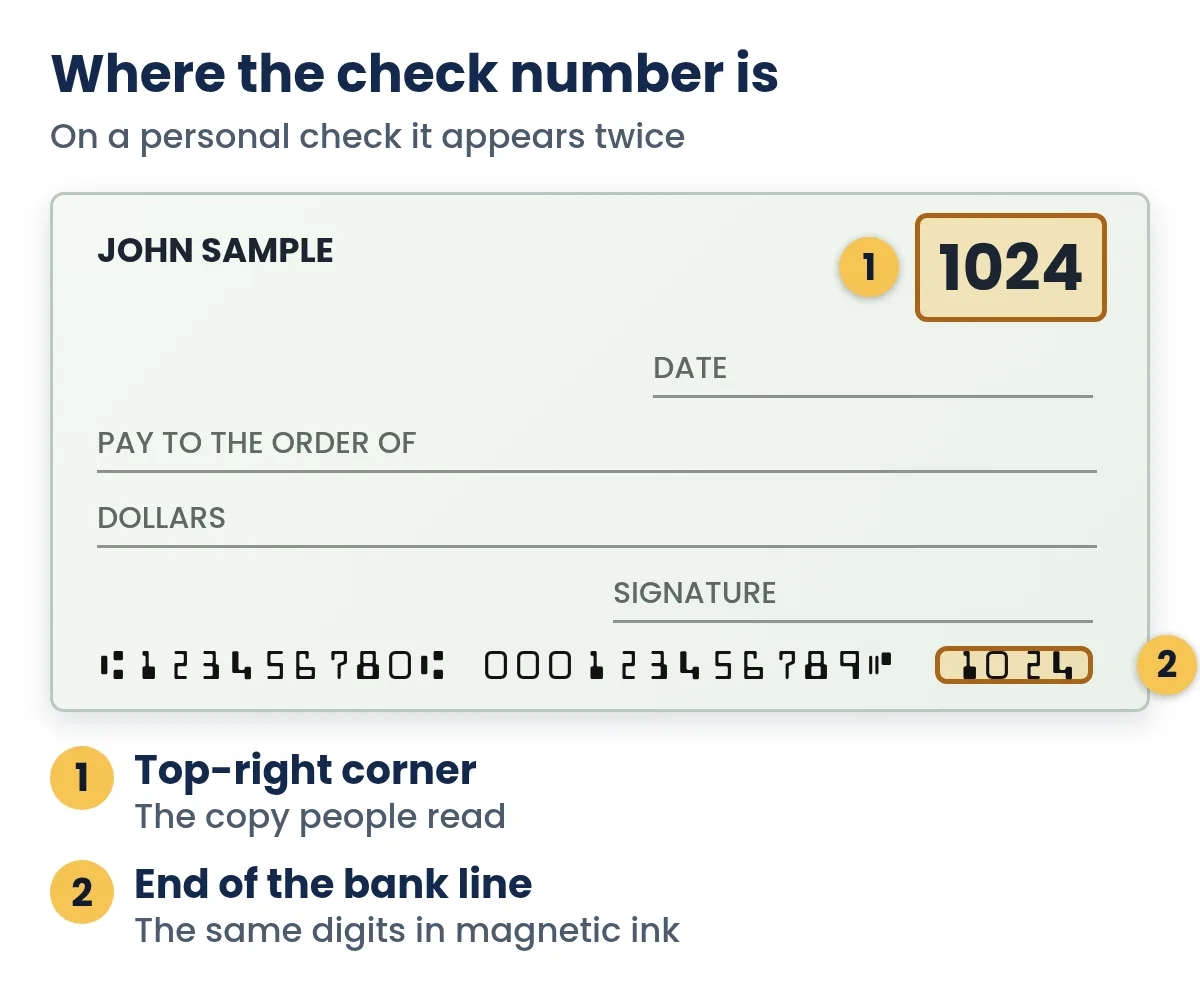
On an ordinary personal check, the check number is printed twice:
- Top-right corner
A plain, easy-to-read number, often in bold, above the date line. This is the copy for people.
- Bottom line (MICR line)
The same digits in magnetic ink, at the end of the row of numbers along the bottom. This copy is for check-processing machines, and it's how the number ends up on your bank statement.
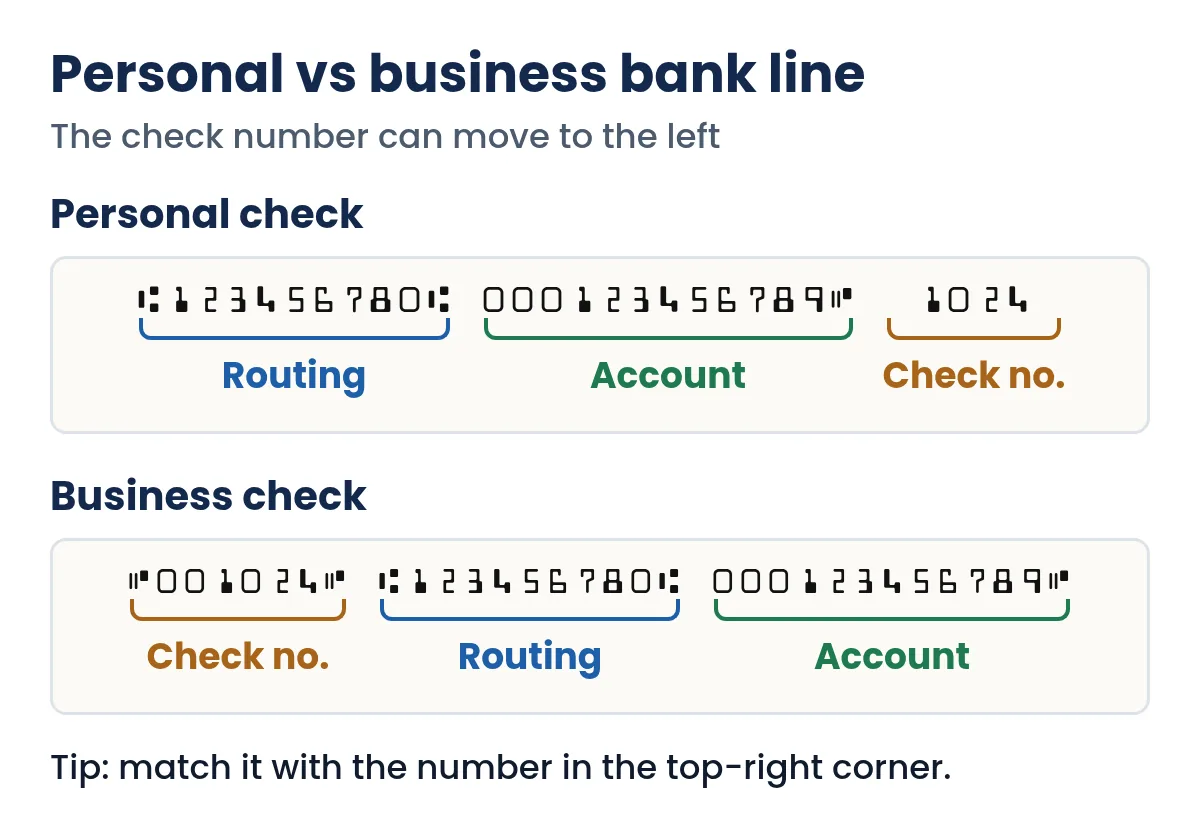
The American Bankers Association describes the bottom line of a personal check in this order: the routing number on the left, then your account number, then the check number. If the number in the top corner and the last group of digits at the bottom match, you've found it.
The routing number is always nine digits and sits between two matching symbols. The check number is the short group, usually three or four digits, that matches the number in the corner.
Check number vs routing number vs account number
The three groups in the bottom line are easy to mix up, especially when you're filling in a direct deposit or bill-pay form. Here's how to tell them apart:
| Number | Where on a personal check | What it identifies |
|---|---|---|
| Routing number | Bottom left, between two transit symbols | The bank that pays the check |
| Account number | Bottom middle, ending with an on-us symbol | Your account at that bank |
| Check number | Top right, and repeated at the bottom | This one check |
The routing number is always nine digits. Account numbers vary in length by bank, and check numbers are usually three or four digits, though they can be longer.
A form that asks for your "account number" never wants the check number. If you're entering numbers for direct deposit or an automatic payment, our guide to the routing and account number on a check walks through it.
Numbers that look like the check number but aren't
The top-right corner of a check can hold more than one number, and that's where most mix-ups start.
- The fraction under the check number
- Many checks print a small fraction such as 12-3456/7890 near the corner. That's a fractional form of the bank's routing information, not the check number. A university treasury office's guide to spotting forged checks notes that it should agree with the nine-digit routing number in the bank line, which is one quick way to sanity-check a check you receive.
- The nine-digit routing number
- Always the group set between the two transit symbols, usually at the bottom left. It identifies the bank, never a single check.
- Your account number
- The longer group in the middle of the bank line, followed by the on-us symbol. It stays the same on every check you write from that account.
- Serial numbers on official checks
- Cashier's checks and money orders carry the issuer's own serial number. It identifies that item at the issuer, not a check from your checkbook.
Business checks put it somewhere else
Larger business checks often have an extra field at the far left of the bank line called the auxiliary on-us field. A Federal Reserve analysis of payment trends describes large business checks as typically 8 or 9 inches long and carrying this field, and bank deposit documentation notes that on a business-size check the check number is usually printed there, in front of the routing number.
So on a business check, read the bottom line from the left: the first short group, set between on-us symbols, is often the check number. Then come the routing and account numbers. The number in the top-right corner still matches it.
Layouts do vary. Bank processing guides note that the check number can appear in several positions in the bank line depending on how the account was set up. When in doubt, match the digits with the number printed in the corner, or ask your bank.
What the check number is used for
- Your own records
- Writing each check's number, date, payee and amount in a register is the easiest way to see which checks are still outstanding. See a check register that fills itself in.
- Bank statements
- Because the number is in the MICR line, your bank's statement and online banking can list each paid check by number, often with an image.
- Stop payments
- When you ask your bank to stop a check, it will usually want the check number, along with the amount, date and payee. See how to stop payment on a check.
- Fraud screening
- Business fraud tools such as Positive Pay compare each presented check's number and amount with the list of checks the business actually issued. See what is Positive Pay.
- Reconciliation
- Matching check numbers against your statement each month shows what has cleared and what hasn't. See how to do a bank reconciliation.
Need to write a check right now?
Quick Check Writer fills in the amount in words, adds the bank line and prints on blank check stock or saves a PDF. Your first check is free, with no account and no card.
Write your first check free →When the number matters most: stop payments and Positive Pay
Stopping a check
The UCC lets an account holder stop payment on a check by giving the bank an order that describes it "with reasonable certainty", in time for the bank to act (UCC § 4-403). The check number is the most precise way to do that. The OCC adds that a bank is generally not liable for paying a stopped check if you didn't give enough information to identify it. The same UCC section sets the time limits:
- A stop-payment order lasts six months, and you can renew it for further six-month periods.
- An oral order lapses after 14 calendar days unless you confirm it in a record (in writing) within that time.
- Find the number
Use your register, carbon copy or the checkbook stub.
- Gather the other details
Exact amount, date, payee name, and the account it was drawn on.
- Place the order
Online, by phone or at a branch. If you call, confirm in writing so it doesn't lapse after 14 days.
- Note it in your register
Mark the check as stopped so you don't count it as outstanding.
Fees and procedures differ by bank, so read your deposit account agreement. More in how to stop payment on a check.
Positive Pay matching
Businesses that use Positive Pay send their bank a list of issued checks, and the bank compares each check presented for payment against that list. One bank's Positive Pay reference guide shows how central the check number is: its exception reasons include a duplicate item (two checks paid with the same serial number), a serial error (a check whose number is missing or couldn't be read) and no issue found (a paid check with no matching entry), alongside amount mismatches. A check printed with the wrong number, or a number reused by mistake, can therefore land in the exceptions queue even when it's genuine.
Check numbers on other kinds of checks
Counter and starter checks
Temporary checks from a branch may have the check number missing, handwritten or printed in a different place, and some don't include your name. Record whatever number appears so your register still lines up. See counter checks and starter checks.
Cashier's checks and money orders
Official checks carry a serial number from the bank or issuer, not one of your personal check numbers. Keep your receipt: you'll need that serial number if the check is lost or you need to confirm it was cashed.
Here's how numbering compares across check types:
| Check type | Where the number is | Who assigns it |
|---|---|---|
| Personal check | Top right, and at the end of the bank line | You (via your check order or software) |
| Business check | Top right, and often at the far left of the bank line | The business |
| Counter or starter check | May be blank, handwritten or printed elsewhere | The bank, if at all |
| Cashier's check, money order | Issuer's serial number | The bank or issuer |
| U.S. Treasury check | Check symbol and serial number | The Treasury |
For Treasury checks, the number does real work: Treasury's own check verification system lets financial institutions look up a check's issue information when they have its routing number, check number and amount.
Checks you print yourself
When you print checks on blank stock, the software assigns the number and prints it in both places. Most programs let you choose the starting number and count up automatically, so you can continue from your last paper checkbook.
Switching to printed checks without breaking your sequence
Moving from a box of bank-ordered checks to printing your own is the most common time for numbering to go wrong. A simple routine keeps it clean:
- Find your last number
Look up the highest check number you've written from that account, in your register or online banking.
- Pick a clearly separate range
Starting well above any old checks you still hold, for example at 5001, keeps the two sources from ever overlapping.
- Decide what to do with leftover paper checks
Either use them up first, or void and shred them. Just don't alternate between two sources with overlapping numbers.
- Test before the real thing
Print on plain paper and hold it over a check to confirm the number lands in the corner and at the right spot in the bank line.
- Tell your bank if you use Positive Pay
Make sure the new numbers appear in the issued-check list you send, or genuine checks will show up as exceptions.
Finding a check number when you don't have the check
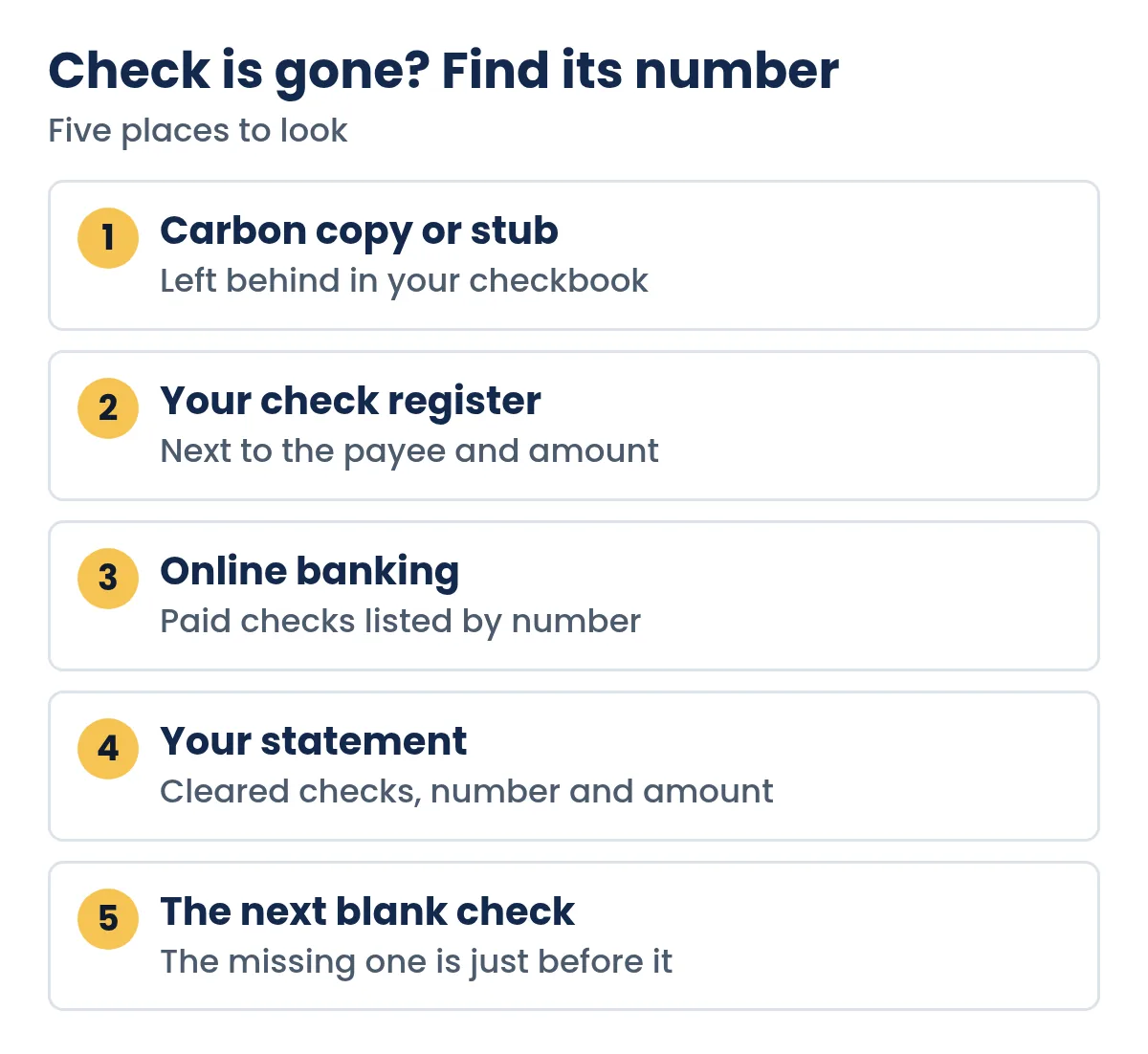
Once a check is gone, you can still track down its number:
- Your checkbook stubs or carbon copies. Duplicate checks leave a copy behind with the number on it; stub-style checkbooks have a numbered stub for each check.
- Your check register. If you logged the check when you wrote it, the number is next to the payee and amount.
- Online banking. Paid checks usually show up in your transaction list by number, and many banks let you open an image of the front and back.
- Your statement. Paper and PDF statements typically list cleared checks by number, date and amount.
- The next unused check. If your checks are in order, the missing number is usually the one before the first blank check left in the book.
If a check is missing and you can't account for it, treat it as possibly lost or stolen. Our guide to lost or stolen checks explains what to do next.
Common check number questions
Do check numbers have to be in order?
No. Banks pay checks in whatever order they arrive, and you can write them out of sequence. Keeping them in order just makes your records easier to follow.
Can two checks have the same number?
It can happen when you switch check sources or reorder checks. A duplicate number doesn't by itself make a check invalid, but it muddles your records and can be flagged by fraud filters such as Positive Pay. If you notice a duplicate, write down both checks carefully and skip ahead to a new range.
What number should my checks start at?
Pick up where your last checks ended, so your register runs in one sequence. If you're starting fresh, choose any starting number that won't clash with checks you've already written from that account.
Is the check number secret?
Not really: it identifies one check, not your account. The routing and account numbers in the same line are the sensitive part, so treat the whole check carefully and shred voided or spoiled checks. See how to void a check.
Worked example: reconciling by check number
John Sample writes three checks in October and logs each one. When his statement arrives, he lines the two lists up by number:
| Check no. | Payee | Register | Statement | Status |
|---|---|---|---|---|
| 1022 | City Water | $64.10 | $64.10 | Cleared |
| 1023 | ABC Roofing | $2,300.00 | not listed | Outstanding |
| 1024 | Jane Doe | $1,250.00 | $1,250.00 | Cleared |
Because every row has a number, nothing has to be matched by guesswork. Check 1023 is simply outstanding, so John subtracts it from his statement balance when he balances the account. If it's still missing after a month or two, he calls the roofer to ask whether it arrived. For the full routine, see how to do a bank reconciliation.
Common check-number mistakes
- Typing the check number into an "account number" field. Direct deposit and bill-pay forms want the routing and account numbers only.
- Reading the routing fraction as the check number. The fraction near the corner is bank information.
- Reusing a number. It confuses your records and can trigger a duplicate-item exception at a Positive Pay bank.
- Corner and bank line don't match. Statements usually report the number read from the bank line, so a mismatch makes your register hard to reconcile. Test-print first.
- Skipping the register. Without a log, finding the number for a stop payment means waiting for the check to clear.
Print checks with the right number every time
If you print your own checks, the number has to appear in the corner and in the MICR line, and it should go up by one with each check. Quick Check Writer does both: it numbers each check, prints the number in the top corner and in the E-13B bank line, and logs it in your register so you can search, reprint or void by number. To learn the rest of the layout, see the parts of a check.
Frequently asked questions
Where is the check number on a check?
In the top-right corner, and again at the end of the MICR line along the bottom. On many business checks the bottom copy is at the far left, before the routing number.
Is the check number the same as the account number?
No. The account number identifies your account and sits in the middle of the bottom line. The check number identifies one check and matches the number in the top-right corner.
How many digits is a check number?
Usually three or four digits, though it can be longer. The routing number, by contrast, is always nine digits.
Why is the check number at the beginning of the bottom line on my business checks?
Business-size checks often use an extra field on the left called the auxiliary on-us field, and the check number is usually printed there.
Do I need the check number to stop a payment?
Usually yes. Banks typically ask for the check number, amount, date and payee to identify the check.
Does a check need to have a number?
There's no rule that a check must be numbered, and some counter checks have none, but numbers make tracking, statements and stop payments much easier.
Do I need the check number for direct deposit?
No. Direct deposit and automatic payment forms ask for your routing number and account number. The check number only identifies one paper check.
Where is the check number on a cashier's check?
A cashier's check carries the issuing bank's serial number, usually near the top right. It isn't one of your own check numbers, so keep your receipt in case you need it.
Does a low check number matter?
It doesn't make a check invalid. Some people who accept checks treat a low number as a sign of a new account; one university treasury guide notes new accounts usually start at 101.
How long does a stop payment on a check last?
Under UCC § 4-403, a written stop-payment order lasts six months and can be renewed. An oral order lapses after 14 calendar days unless you confirm it in writing.
Related guides
- Parts of a check, explained
- Where to find the routing and account number on a check
- Check register app that fills itself in
- How to stop payment on a check
- MICR font for checks: E-13B explained
Sources
- American Bankers Association: About routing numbers
- Federal Reserve Bulletin 2008, Recent Payment Trends (business checks and the auxiliary on-us field)
- First Merchants Bank remote deposit guide: MICR line fields
- American Bankers Association: Routing Number Policy & Procedures
- UCC § 4-403 (customer's right to stop payment), Cornell LII
- HelpWithMyBank.gov (OCC): Can the bank pay a check after I place a stop payment on it?
- Bank of Hawai'i: Positive Pay exceptions, corrections and decisions reference guide
- U.S. Treasury Bureau of the Fiscal Service: Treasury Check Verification System
- Cornell University Division of Financial Services: Spotting forged checks
Last updated November 1, 2026. This page is general information, not legal or financial advice. Quick Check Writer is check printing software; it is not a bank and does not move money.