
Key takeaways
- Washers keep your real signature and change only the payee and amount.
- Most washed checks start as stolen mail, so how you mail matters most.
- Gel ink or printed checks, plus no blank space, make rewriting harder.
- Check images of cleared checks, not just your balance.
- Report an altered check to your bank immediately and to the Postal Inspection Service if mail was stolen.
On this page
- What check washing is
- Step by step: how a washed check is made
- Who gets targeted
- How to protect your checks from washing
- How to tell if one of your checks was washed
- What to do if a check was washed
- Three situations, step by step
- Where else to report it
- Before you seal the envelope: a 30-second check
- Who pays for a washed check?
- Common myths about check washing
- Washing vs. other check fraud
- FAQ
What check washing is
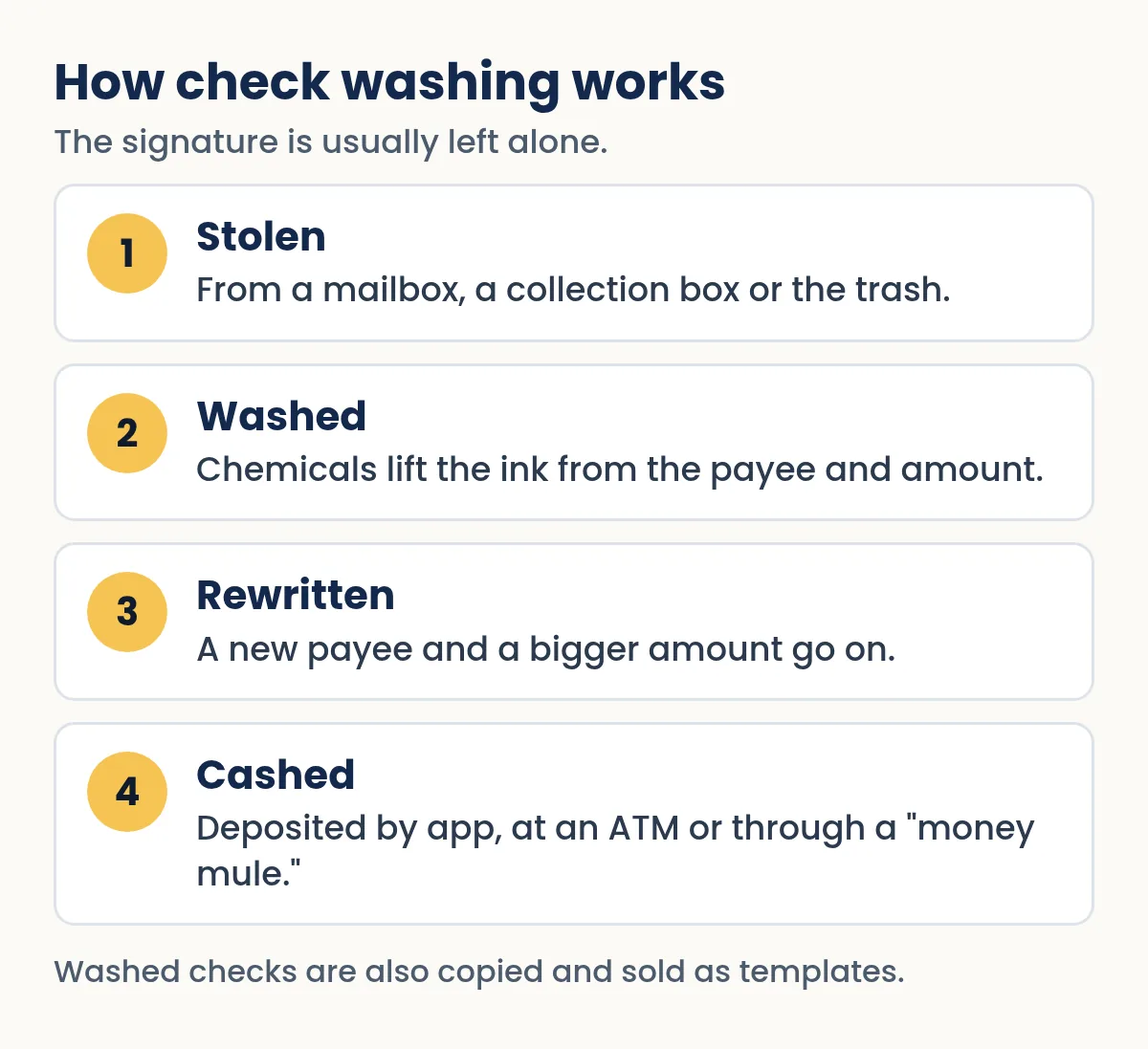
Check washing is the theft and chemical alteration of a genuine check. The criminal does not need to forge anything from scratch. They take a check you really wrote and signed, remove the ink from the fields they want to change, and write in new details.
FinCEN, the Treasury bureau that tracks financial crime, describes it as using chemicals to remove the original ink so the payee, and often the dollar amount, can be replaced. In its 2023 alert, written with the U.S. Postal Inspection Service, FinCEN noted that washers sometimes raise the amount by hundreds or thousands of dollars, and that washed checks can be copied and sold online to other fraudsters.
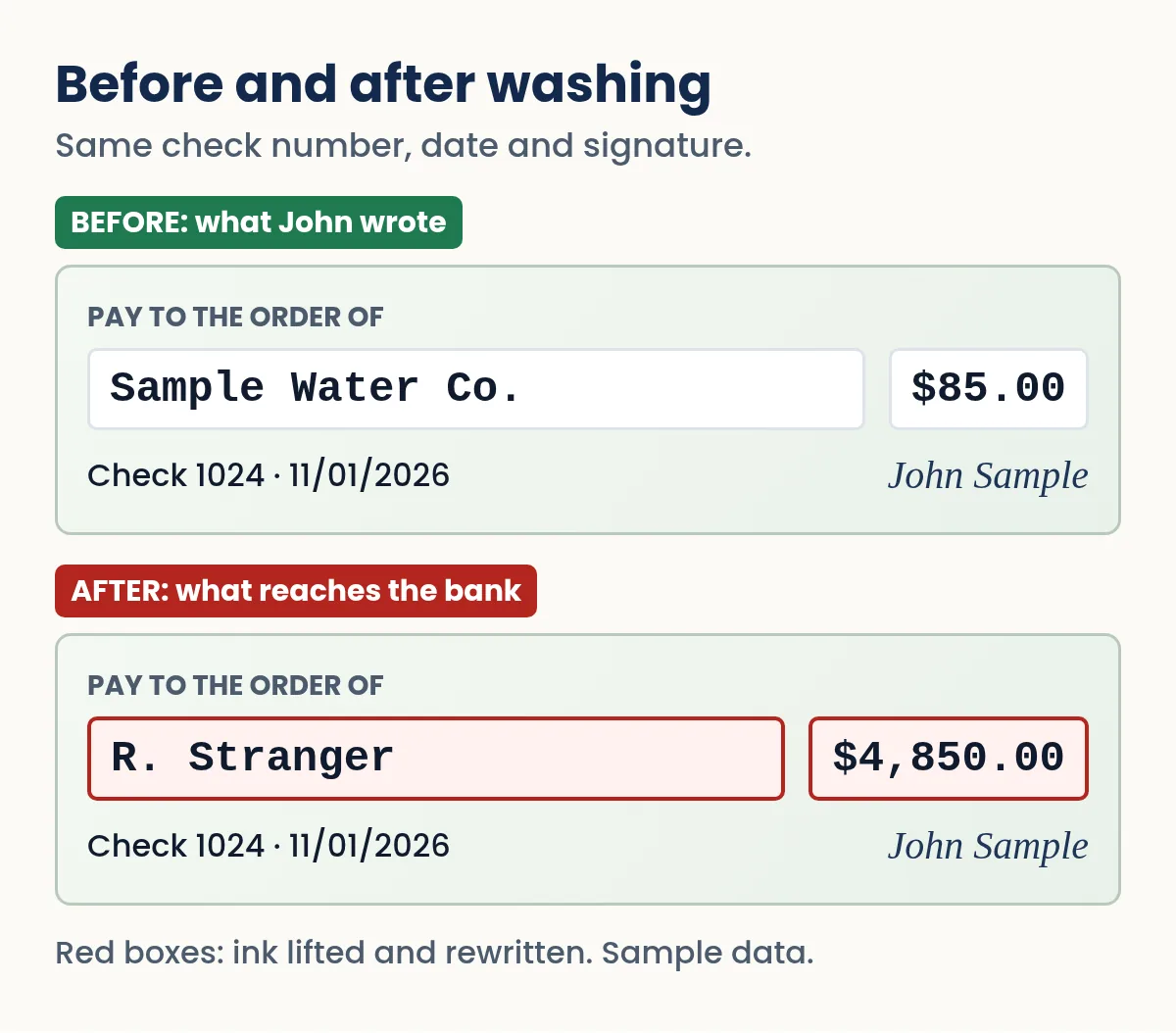
The signature is the part washers usually leave alone, because a real signature is the hardest thing to fake. That is exactly what makes a washed check dangerous: it carries your genuine signature, your real check number and a believable date.
Step by step: how a washed check is made
- The check is stolen
The most common source is the mail: outgoing envelopes taken from home mailboxes with the flag up, blue collection boxes, or mail in transit. Checks are also taken from trash, from desks, and from envelopes left in cars.
- The ink is lifted
The washer masks the signature and treats the payee line and amount areas with household-type solvents until the ink fades. Ordinary ballpoint ink sits on top of the paper, which makes it easier to remove.
- The check is dried and rewritten
Once the paper is dry, the criminal writes in a new payee (often a person, a shell business or "Cash") and usually a larger amount, in both the box and the words line.
- The money is collected
The check is deposited through a mobile app or ATM, or cashed through an account belonging to someone recruited to move money. By the time anyone notices, the funds are often gone.
Who gets targeted
Anyone who mails checks. That said, some patterns make a check more attractive:
- Checks to big billers. Envelopes addressed to utilities, insurers, credit card companies, tax agencies and landlords are obvious "check inside" mail.
- Mail left out overnight. A raised flag on a home mailbox is a signal. Collection boxes after the last pickup are another.
- Checks written in easily lifted ink with wide empty spaces after the payee and amount.
- Accounts nobody watches. A washed check that clears from an account with no alerts and no monthly review may not be found for months.
How to protect your checks from washing
No single habit makes washing impossible, but stacking a few of them makes your checks a poor target.
1. Change how and where you mail
The Postal Inspection Service gives three plain rules: put outgoing mail in a blue collection box before the last pickup of the day or take it inside a Post Office; never leave mail in your mailbox overnight; and have your mail held, or collected by someone you trust, when you are away. For checks you care about, walking them into the Post Office is the most reliable option. Our guide to mailing a check safely goes further, with envelope tips and tracked mail options.
2. Use ink that is hard to lift
Gel ink is widely recommended because it is absorbed into the paper fibers rather than resting on the surface. Printed checks are another option: laser toner is fused onto the paper. Whichever you use, write firmly and do not leave gaps.
3. Leave nothing to fill in
Start the payee name at the left edge of the line and the written amount at the left edge of its line, then draw a line through whatever space is left. Write cents as a fraction, such as "and 00/100." A check with no empty space is much harder to rewrite convincingly. See how to write the amount in words for the exact format.
4. Use check stock with chemical protection
Security check paper can include chemical-reactive features that stain, discolor or reveal a hidden word when solvents touch the paper, plus other features like microprinting and void pantographs. Our guide to check security features explains what each one does and how to spot it, and our blank check stock guide covers choosing paper if you print checks yourself.
5. Write fewer checks that travel
For recurring bills where the biller offers another method, consider using it, and keep checks for times when a check really is the best tool. When you do send one, keep a record of exactly what you wrote.
Keep a copy of every check you send. With Quick Check Writer, each printed check is saved in a register with its number, payee, amount and date, and you can save a PDF copy. If a washed version clears, you have proof of what you actually wrote.
Need to write a check right now?
Quick Check Writer fills in the amount in words, adds the bank line and prints on blank check stock or saves a PDF. Your first check is free, with no account and no card.
Write your first check free →How to tell if one of your checks was washed
You usually find out one of three ways: the payee says the payment never arrived, your balance is lower than expected, or you see an unfamiliar name on a paid check image. Warning signs to look for when you open a check image in online banking:
- A payee name you do not recognize next to a check number and date you do recognize.
- An amount larger than you wrote, sometimes by a round number.
- Handwriting in the payee or amount that does not match the rest of the check.
- Faded, blotchy or discolored areas around the payee line or amount box.
- A deposit endorsement on the back from a bank or person you have never dealt with.
Checking images, not just balances, is what catches this. A monthly bank reconciliation, where you compare every cleared check with your register, turns up a mismatched payee or amount almost immediately.
What to do if a check was washed
- Call your bank right away
Tell them the check number, the amount you wrote and the payee you intended. Ask what forms they need; many banks require a written statement or affidavit for an altered item. Ask whether you should close the account, since the criminal now has your account number.
- Report the theft to postal inspectors
If the check was stolen from the mail, report it at uspis.gov or by phone at 1-877-876-2455. The inspection service also suggests filing a police report and contacting the credit bureaus.
- Stop payment on anything still out
Other checks mailed at the same time may also have been stolen. Consider stop-payment orders on those. Our guide on how to stop payment on a check explains the process and typical fees.
- Pay the real payee another way
Your bill still needs to be paid. Contact the payee, explain what happened, and send a replacement check from your new account or pay by another method.
- Keep records
Save copies of the altered check image, your register entry, the police and postal reports, and every message with your bank.
Three situations, step by step
You paid rent by check, and the landlord says it never came
- Look up the check number in online banking. If it hasn't cleared, place a stop payment and send a replacement (ideally handed over or mailed from inside the Post Office).
- If it cleared, open the image. A strange payee or a bigger amount means it was likely washed: call the bank the same day.
- Tell the landlord in writing what happened and when the replacement is coming, and keep a copy. Your bank dispute and your rent are two separate problems; solve the rent one quickly.
A business check to a vendor cleared to someone else
- Call the bank's fraud line and ask what documentation it needs for an altered item.
- Check the other checks from the same mailing. If several went out together, consider stop payments on any not yet cleared.
- Ask the bank whether to close the account and open a new one, since the criminal now has your account and routing numbers. Update any automatic payments that used the old account.
- Reissue the vendor payment with a note, and tighten the process: payee Positive Pay, mailing from inside the Post Office, and a daily look at cleared items.
A check someone wrote to you was washed
If a customer or relative mailed you a check that never arrived and was cashed by someone else, the fraud claim is theirs to make with their bank, because it was their account that paid. Let them know quickly, share anything that helps (for example, that your mailbox was broken into), and agree on how they will pay you once they have stopped or disputed the original.
Where else to report it
Your bank comes first, and mail theft goes to the Postal Inspection Service. The OCC's check fraud guidance also points victims to:
- The FTC's IdentityTheft.gov (or 1-877-438-4338), which creates a recovery plan if your personal information was exposed.
- The FBI's Internet Crime Complaint Center (IC3), especially if the washed check was sold or used online.
- Local police. Ask for a copy of the report; banks and credit bureaus may ask for it.
Before you seal the envelope: a 30-second check
- Payee and amount written in black gel ink, or printed.
- No blank space after the payee or the amount in words.
- Check number, payee and amount recorded in your register.
- Plain envelope, no "check enclosed" hint on the outside.
- Going inside the Post Office, or into a blue box before the last pickup, not a home mailbox overnight.
Who pays for a washed check?
Under the Uniform Commercial Code, a bank may charge your account only for items that are "properly payable," which means authorized by you and consistent with your account agreement (UCC § 4-401). Changing the payee or amount without your permission is an "alteration" (UCC § 3-407). In general, a check you never authorized in its altered form should not be your loss.
That protection depends on you, though. The code requires you to review statements with reasonable promptness and report alterations (UCC § 4-406). If you do not, and the same criminal keeps passing your checks, later losses can shift to you once you have had a reasonable period, capped at 30 days, to examine the statement. And there is an outer limit of one year from when the statement was made available, after which you generally cannot claim the alteration at all. A person whose own carelessness substantially contributes to an alteration can also lose the right to assert it (UCC § 3-406).
Banks can set shorter reporting windows in their deposit agreements, and many do. The safest rule is to report anything unusual the day you see it.
Common myths about check washing
- "Only old-fashioned people get hit."
- Washers target envelopes, not people. A rent check from a 25-year-old in a collection box after the last pickup is as useful to them as anyone else's.
- "My bank will catch it."
- Banks process enormous volumes of checks automatically, and a washed check carries a real check number, a real signature and valid bank numbers. Your review of cleared checks is often what catches it.
- "Small checks aren't worth stealing."
- The amount you wrote does not matter much, because washers usually raise it. FinCEN's alert specifically mentions increases of hundreds or thousands of dollars.
- "If the check cleared, the money is gone for good."
- Not necessarily. Prompt reporting matters a great deal under the Uniform Commercial Code, which is why speed is the most important thing you control once you spot a problem.
- "Business checks are safe because they're printed."
- Printing helps, but a printed business check can still be stolen, copied or altered. Businesses benefit most from bank tools such as Positive Pay, which compares each presented check with the list of checks actually issued.
Washing vs. other check fraud
| Type | Starts with | Genuine signature? | Best defense |
|---|---|---|---|
| Check washing | Your real, stolen check | Yes | Safe mailing, gel ink or printed checks, no blank space |
| Counterfeit | Your account number, on fake paper | No (copied) | Account alerts, Positive Pay, monthly review |
| Forgery | A blank check from your checkbook | No | Lock up checks and track the numbers |
| Fake check scam | A check someone sends you | n/a | Never send money back from a check you just deposited |
For the full picture, read our guide to check fraud prevention. Businesses that issue many checks should also look at Positive Pay, which catches altered amounts and, in its payee version, altered names.
A washed check carries your real signature. Your best defenses are where you mail it, how you write it, and how quickly you look at what cleared.
Frequently asked questions
What is check washing?
It is a type of fraud where a genuine check is stolen, the ink in the payee and amount fields is removed with chemicals, and new details are written in. The original signature is usually kept, which helps the altered check look legitimate.
Can gel pens prevent check washing?
Gel ink soaks into the paper fibers, which makes it harder to remove than ordinary ballpoint ink. It reduces the risk but does not eliminate it, so combine it with safe mailing and account monitoring.
Will my bank refund a washed check?
Generally a bank can charge your account only for checks you authorized, so an altered check should not be your loss if you report it promptly. Late reporting or carelessness can shift some of the loss to you, and your account agreement may set a short deadline.
How do I know if my check was washed?
Common signs are an unfamiliar payee or a larger amount on a check image with your real check number, or a payee telling you the payment never arrived. Look at the images of cleared checks in online banking.
Is it safe to put checks in a blue mailbox?
The Postal Inspection Service advises using blue collection boxes before the last pickup of the day, or handing mail in at a Post Office. Avoid leaving checks in a collection box overnight or in your home mailbox.
Where do I report check washing?
Tell your bank first. If the check was stolen from the mail, report it to the U.S. Postal Inspection Service at uspis.gov or 1-877-876-2455, and file a police report.
Should I close my bank account after a check is washed?
Ask your bank. Because the criminal now has your routing and account numbers, many banks recommend closing the account and opening a new one. If you do, move automatic payments and deposits to the new account and let outstanding checks clear or replace them first.
Does black ink matter for check washing?
The OCC recommends black gel ink because it is highly resistant to washing. Gel ink is absorbed deep into the paper, while ordinary ballpoint ink rests near the surface, so gel is far harder to lift with chemicals.
Can a washed check be deposited with a phone app?
Yes. Washed checks are often deposited through mobile apps or ATMs, sometimes into accounts opened or borrowed just for the purpose. That is why reviewing your cleared check images, not just your balance, matters.
Related guides
- Check fraud prevention for people and small businesses
- How to mail a check safely
- Check security features, explained
- How to stop payment on a check
- Lost or stolen checks: what to do
- What is Positive Pay?
Sources
- FinCEN Alert FIN-2023-Alert003: Mail Theft-Related Check Fraud (Feb 27, 2023)
- FinCEN: In-depth analysis of check fraud related to mail theft (Sept 9, 2024)
- U.S. Postal Inspection Service: Check Washing
- U.S. Postal Inspection Service: Report a crime
- UCC § 4-401, When bank may charge customer's account (Cornell LII)
- UCC § 3-407, Alteration (Cornell LII)
- UCC § 4-406, Customer's duty to discover and report (Cornell LII)
- UCC § 3-406, Negligence contributing to forgery or alteration (Cornell LII)
- Bureau of the Fiscal Service: U.S. Treasury Check Security Features (PDF)
- OCC: Check fraud (ways to avoid it and report it)
Last updated November 1, 2026. This page is general information, not legal or financial advice. Quick Check Writer is check printing software; it is not a bank and does not move money.