
Key takeaways
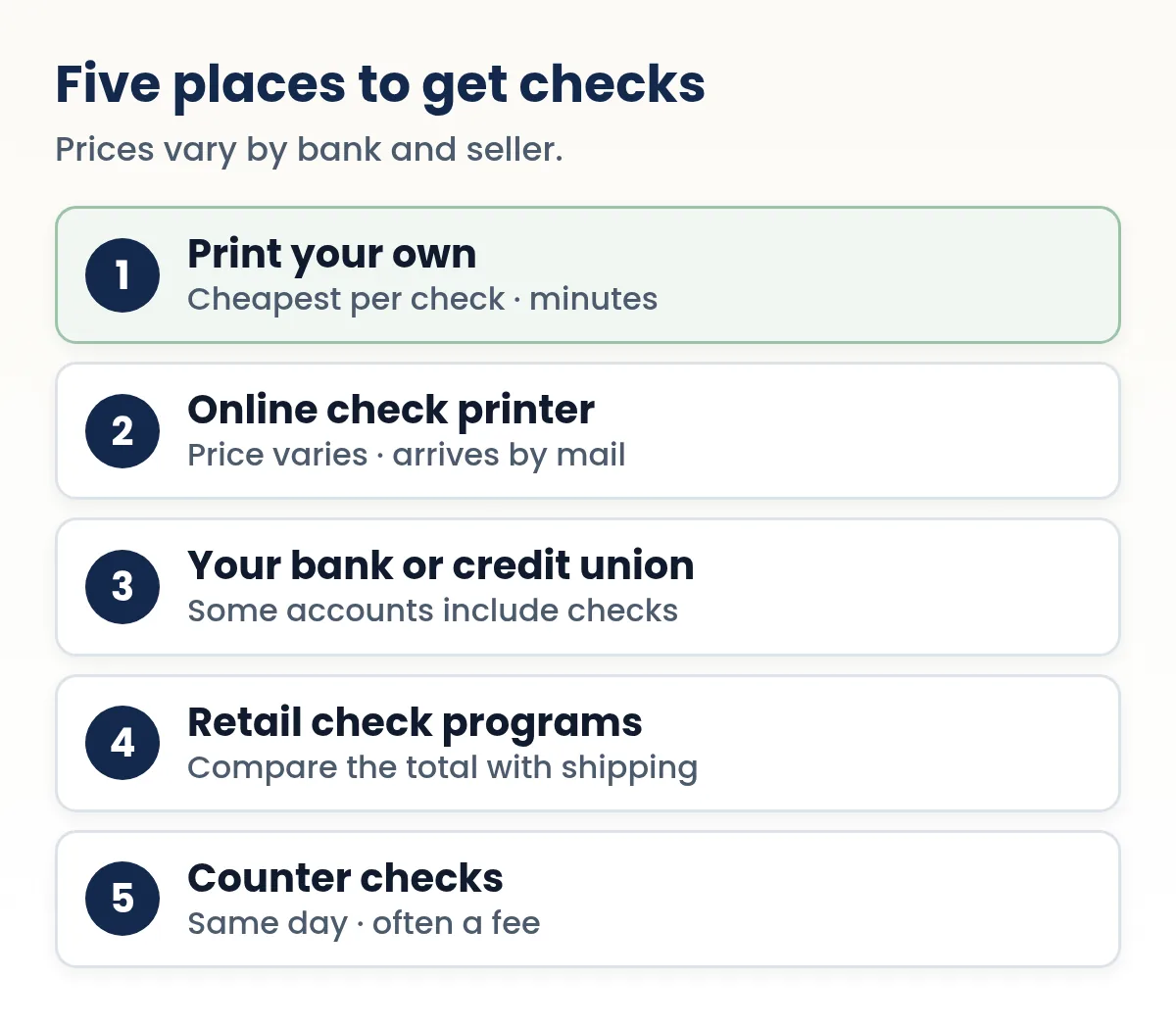
- Printing your own is usually the lowest cost per check and takes minutes.
- Compare ordered checks on the full price with shipping, divided by the number of checks.
- Ask your bank whether your account includes free checks.
- Skip premium designs, rush shipping and add-ons you don't need.
- Only give your account number to a seller you can verify.
On this page
- Your options, compared
- Three shoppers, three different answers
- How many checks should you buy?
- 1. Print your own checks
- 2. Order from a check printing company
- 3. Order through your bank or credit union
- 4. Retail and membership check programs
- 5. Counter checks: the same-day stopgap
- What actually makes checks expensive
- Getting business checks for less
- When ordering a box is still the right call
- What you need to order (or print) checks
- Red flags when ordering checks online
- Is it safe to buy cheap checks?
- FAQ
Your options, compared
| Where | Price per check | How fast | Good for |
|---|---|---|---|
| Print your own on blank stock | Usually the lowest: cents for stock and toner, plus software | Minutes | Regular check writers, several accounts, businesses |
| Online check printing company | Varies by seller | Shipped by mail | A traditional checkbook with a custom design |
| Your bank or credit union | Varies; some account types include checks | Shipped by mail | The simplest reorder, matching your current checks |
| Retail check-ordering programs | Varies | Shipped by mail | Members who already shop there |
| Counter checks at a branch | A fee per sheet is common | Same day | One or two checks in a pinch |
Prices change often and differ by account, design and quantity, so the only fair comparison is the full price you pay, including shipping and add-ons, divided by the number of checks you get.
Three shoppers, three different answers
"Cheapest" depends on how you write checks. Three examples with sample people:
Jane pays a yearly HOA fee, a couple of contractors and a birthday check or two. Her credit union includes basic checks with her account. For her, the cheapest checks are the free ones: she reorders a basic design, picks it up at the branch, and one box lasts for years. Printing would only make sense if she switched to an account without free checks.
John runs a small business with an operating account and a second account for a rental property. Ordering means two boxes of business checks, reordered on two schedules, and new boxes if either account changes. Printing on one pack of blank voucher stock covers both accounts, numbers each check as it prints, and logs it in a register. At his volume the cost per check is a few cents of paper and toner plus a small monthly plan.
A new apartment wants a deposit check and there's no checkbook in the house. Waiting for a mailed box isn't an option. A counter check from the branch works if the landlord accepts it; a check printed at home on blank stock carries the renter's name and address and is ready in minutes. If the landlord asks for guaranteed funds, neither will do and a cashier's check is the answer.
How many checks should you buy?
Buying the biggest box to lower the price per check only saves money if you use the checks. A simple way to size an order:
- Count a normal month
Look at your last three statements and count the checks that cleared.
- Pick a horizon
How long until your details might change? A move, a new bank or a new business name makes pre-printed checks useless.
- Multiply
Checks per month × months in your horizon. If that's fewer than the smallest box, the smallest box is your order. If it's far more, printing on demand avoids the guesswork.
Blank check stock sidesteps the question: it carries no account details, so leftover sheets still work after a move or a new bank.
1. Print your own checks
If you write more than a few checks a year, printing them yourself is usually the cheapest route per check. You buy blank check stock, which has security features but no account details on it, and print each check when you need it with your name, bank details and the bank line in the E-13B font.
Why it tends to cost less:
- No minimum box. You print one check or fifty. Nothing sits unused when you move or change banks.
- One supply for many accounts. The same stock works for your personal account, a business account and a rental property account.
- No shipping. Stock is sold by office supply stores and online, and it doesn't expire when your details change.
The trade-off is a little setup: a printer, an alignment test, and software that places everything correctly. Quick Check Writer runs in your browser and your first check is free. Our guide to the cost of printing your own checks shows the per-check math with worked examples.
2. Order from a check printing company
Independent check printers sell personal and business checks online, usually in boxes of single or duplicate checks. They often have more designs than banks, frequent promotions and business formats like voucher checks.
To get the best price:
- Compare the total at checkout, not the headline price. Shipping and handling can be a large part of a small order.
- Choose a standard design. Character and licensed designs usually cost more.
- Pick single checks unless you really use the carbon copy. A check register keeps the same record for free.
- Order before you run out so you don't pay for express shipping.
You're giving a company your name, address, routing number and account number. Order only from a company you can verify, read its privacy policy, and make sure the checkout page is secure (https). If an offer looks too good to be true, look up the company before you type your account number.
3. Order through your bank or credit union
Your bank is the easiest place to reorder because it already knows your details. Most banks let you reorder online, in the app or at a branch. It's not always the cheapest, but some account types include free or discounted checks. Some banks offer complimentary checks on certain accounts or to certain customers, such as older account holders.
Ask your bank three questions before ordering elsewhere:
- Does my account include free or discounted checks?
- Is there a basic design at a lower price?
- Can I pick the checks up at a branch instead of having them mailed?
The last question matters for safety. The U.S. Postal Inspection Service advises never leaving mail in your mailbox overnight, especially when you're expecting checks. A branch pickup, or a delivery you can track, keeps a box of ready-to-use checks out of a mailbox.
Need to write a check right now?
Quick Check Writer fills in the amount in words, adds the bank line and prints on blank check stock or saves a PDF. Your first check is free, with no account and no card.
Write your first check free →4. Retail and membership check programs
Some retailers and membership clubs offer check ordering, usually fulfilled by a check printing company. Prices can be good for members, but compare the final price with shipping against the other options. The checks themselves are standard checks. What matters is who prints them and how your details are handled.
5. Counter checks: the same-day stopgap
If you need one check today and have no checkbook, many banks will print counter checks at a branch, often for a fee. They're real checks drawn on your account, but they may not show your name and address, so some payees hesitate to accept them. Use them for an emergency, not as your checkbook. We cover them in counter checks and starter checks.
A printed check is often a better same-day option: if you have a printer and a sheet of check stock, you can print a complete check with your name and address in minutes. See how to write a check without a checkbook.
What actually makes checks expensive
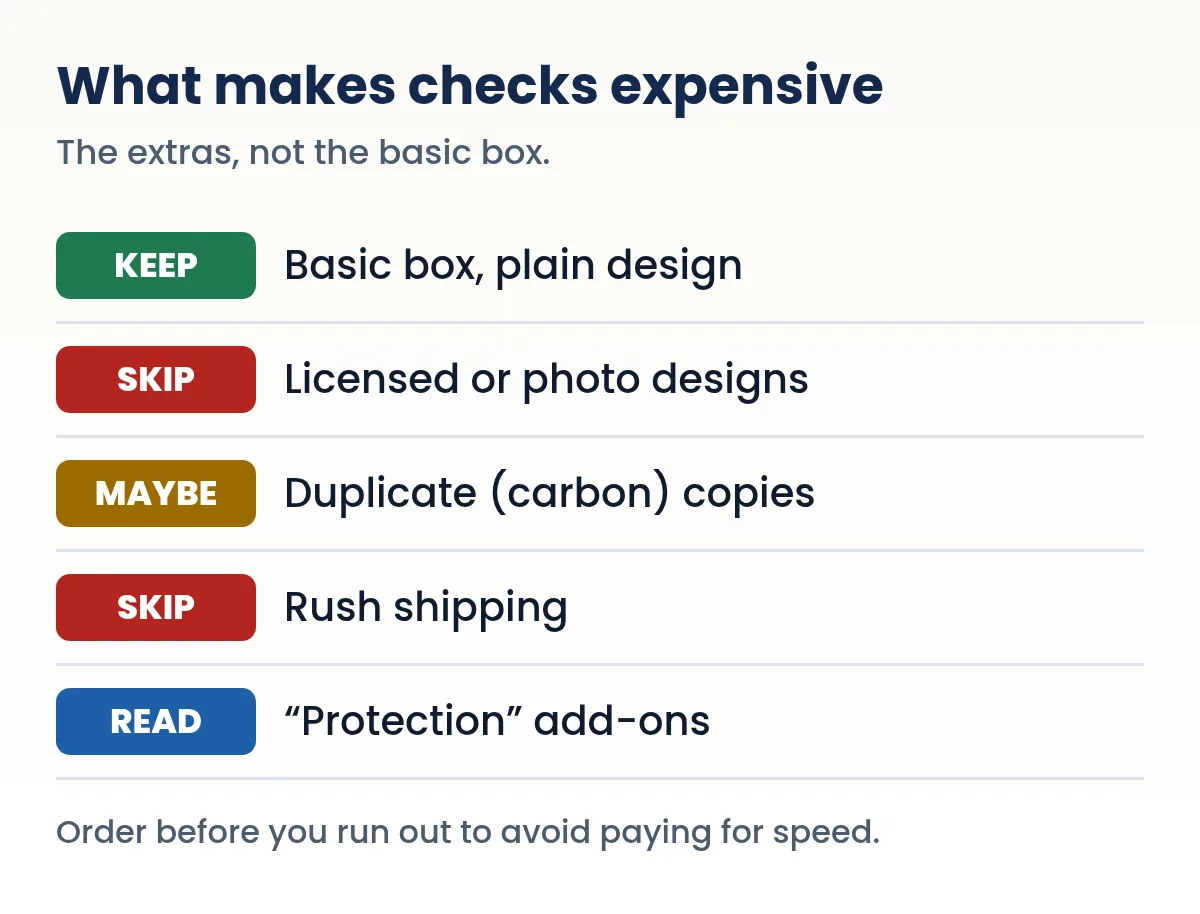
A basic box of checks isn't usually the problem. The cost comes from extras and timing:
- Design upgrades
- Licensed artwork, photos and special finishes cost more than a plain design. Banks don't care what the check looks like, as long as the required parts are clear.
- Duplicates
- Carbonless copies keep a record of each check. If you already track checks in a register or app, you're paying for a record you don't need.
- Shipping speed
- Expedited shipping on a small order can cost as much as the checks. Reordering early avoids it.
- Add-ons
- Covers, address stamps, matching deposit slips and optional "protection" products add up. Read what any protection add-on actually covers before you pay for it.
- Small quantities
- The per-check price is usually higher on the smallest box. If you write very few checks, a large box may outlast your address or bank, which is wasted money too.
Getting business checks for less
Business checks cost more to order than personal ones because they're larger, often come with stubs, and are usually bought in bigger quantities. A few ways to keep the cost down:
- Print on blank voucher stock. One check and two stubs per letter sheet, printed from any office printer. The stubs carry invoice numbers or pay details.
- Use one supply for every account. If you run more than one company or account, blank stock and one app replace a separate box for each. Quick Check Writer's Pro plan holds up to 10 bank accounts.
- Skip pre-printed numbering you'll outgrow. Printed-on-demand checks are numbered as you go, so there are no leftover check numbers when you switch banks.
- Keep the record digital. A register you can export (CSV, or QuickBooks formats on Pro) replaces duplicate copies and manual logs.
Our guide to printing business checks covers layouts, logos and signatures in detail.
When ordering a box is still the right call
Printing isn't the best answer for everyone. A box of ordered checks can make more sense if:
- You write a few personal checks a year and your bank includes checks with your account.
- You don't have, or don't want, a printer at home.
- You want a pocket checkbook to carry and write by hand.
Even then, you can keep a few sheets of blank stock as a backup for the day you run out, or use the pre-printed checks mode to type onto the checks you already have instead of handwriting them.
What you need to order (or print) checks
- Routing number (9 digits) and account number. Copy them from an existing check or your bank's app. Our routing number guide shows where they are.
- The name and address you want printed.
- The starting check number. Start above your last used number so your records don't overlap.
- A proof check. Before you approve an order, compare every digit on the proof with your bank details. A wrong digit means checks that bounce.
When you print your own checks, the same details go into the app once. Quick Check Writer keeps them on your device, not on a server, and numbers your checks automatically.
Red flags when ordering checks online
Check fraud is not a small problem. In a 2023 alert, the Financial Crimes Enforcement Network (FinCEN) reported that banks filed more than 680,000 suspicious activity reports about potential check fraud in 2022, nearly double the year before, and tied much of the rise to stolen mail. A box of checks with your account number on it is exactly what thieves look for, so be picky about who prints and ships it.
- No company details. A seller with no physical address, phone number or privacy policy shouldn't get your account number.
- Pressure and urgency. Countdown timers and "only today" prices on something as plain as checks are a reason to slow down.
- Unexpected requests. A check order needs your routing and account numbers, name and address. It never needs your online banking password, PIN or Social Security number.
- Delivery you can't control. Choose tracked delivery or branch pickup, and bring the mail in the same day it arrives.
- Proofs you didn't read. Approve the proof only after comparing every digit with your bank's numbers.
Is it safe to buy cheap checks?
Price doesn't decide safety. Security features on the paper and how the seller handles your details do. Good check stock, whether pre-printed or blank, typically includes features like microprinting, a void pantograph that shows "VOID" on copies, and chemical protection that stains if someone tries to wash the ink. Look for a list of these features on the product page. Our guide to check security features explains each one.
Whichever way you get checks, protect them the same way: store them somewhere locked, don't leave them in a car or a mailbox, and report missing checks to your bank right away. If checks go missing, read what to do about lost or stolen checks.
Frequently asked questions
What is the cheapest way to get checks?
For most people who write checks regularly, printing them at home on blank check stock is cheapest per check. If you prefer a checkbook, compare your bank and a check printing company on the total price with shipping.
Can I order checks from a company other than my bank?
Yes. Many people order from independent check printers. The checks draw on your account like any other check, as long as the bank details and bank line are correct. Order only from a seller you can verify.
Do banks give free checks?
Some do, usually with certain account types. It varies by bank, so ask yours or check the account's fee schedule.
How can I get a check today?
Ask your bank branch for a counter check, or print a complete check yourself on blank check stock with a check printing app.
Are cheap checks less secure?
Not necessarily. Security comes from features like microprinting, a void pantograph and chemical protection, and from how the seller handles your data. Read the product's feature list.
Is it safe to have checks mailed to me?
It's common, but don't let a box of checks sit in your mailbox. The Postal Inspection Service advises picking up mail promptly when you're expecting checks. Ask whether you can pick them up at a branch or track the delivery.
Can I still use checks with my old address?
Usually yes. The bank processes a check by the routing and account numbers in the bank line, not the printed address. Some payees may find an old address confusing, so update it when you next reorder or print.
Where can I buy blank check stock?
Office supply stores and online sellers carry blank check stock in letter-size sheets: check on top, middle or bottom with stubs, or three checks per page. Choose stock with listed security features and match its layout to your software.
How many checks come in a box?
It depends on the seller and format. Compare boxes by the price per check after shipping and add-ons, and buy only as many as you'll use before your details are likely to change.
Related guides
- Order checks or print your own?
- How much does it cost to print your own checks?
- Blank Check Stock: A Complete Guide
- Counter checks and starter checks
- Check security features, explained
- How to print personal checks at home
Sources
- U.S. Postal Inspection Service: Tips & Prevention (don't leave mail overnight when expecting checks)
- Example bank account page listing complimentary checks for ages 65 and over (West Bank)
- Example bank account page listing complimentary checks on a checking account (First Commerce Bank)
- FinCEN Alert FIN-2023-Alert003 (Feb 27, 2023): nationwide surge in mail theft-related check fraud (680,000+ check fraud SARs in 2022)
Last updated November 1, 2026. This page is general information, not legal or financial advice. Quick Check Writer is check printing software; it is not a bank and does not move money.