
Key takeaways
- Stock and toner together are typically a few cents per check.
- Software is the variable part: compare it as cost per check at your volume.
- Three-per-page stock is the cheapest per check.
- Mailing adds an 82¢ Forever stamp plus an envelope.
- An alignment test on plain paper prevents wasted stock.
On this page
- The quick answer, with real math
- Cost by piece
- Cost per check at different volumes
- How that compares with ordering checks
- What other ways to pay cost
- Ways to spend less on checks
- Three example budgets
- Break-even: when printing beats ordering
- For businesses: the tax side
- A quick cost checklist
- Costs people forget
- FAQ
The quick answer, with real math
Printing a check costs three things: a sheet (or part of a sheet) of blank check stock, a little toner or ink, and your software. Add an envelope and a stamp if you mail it. With typical supplies, the paper and toner come to a few cents. What you pay for software then depends on how many checks you spread it across.
Here is the formula we use. Plug in your own prices:
Cost per check = stock per check + ink per page + (monthly software ÷ checks per month)
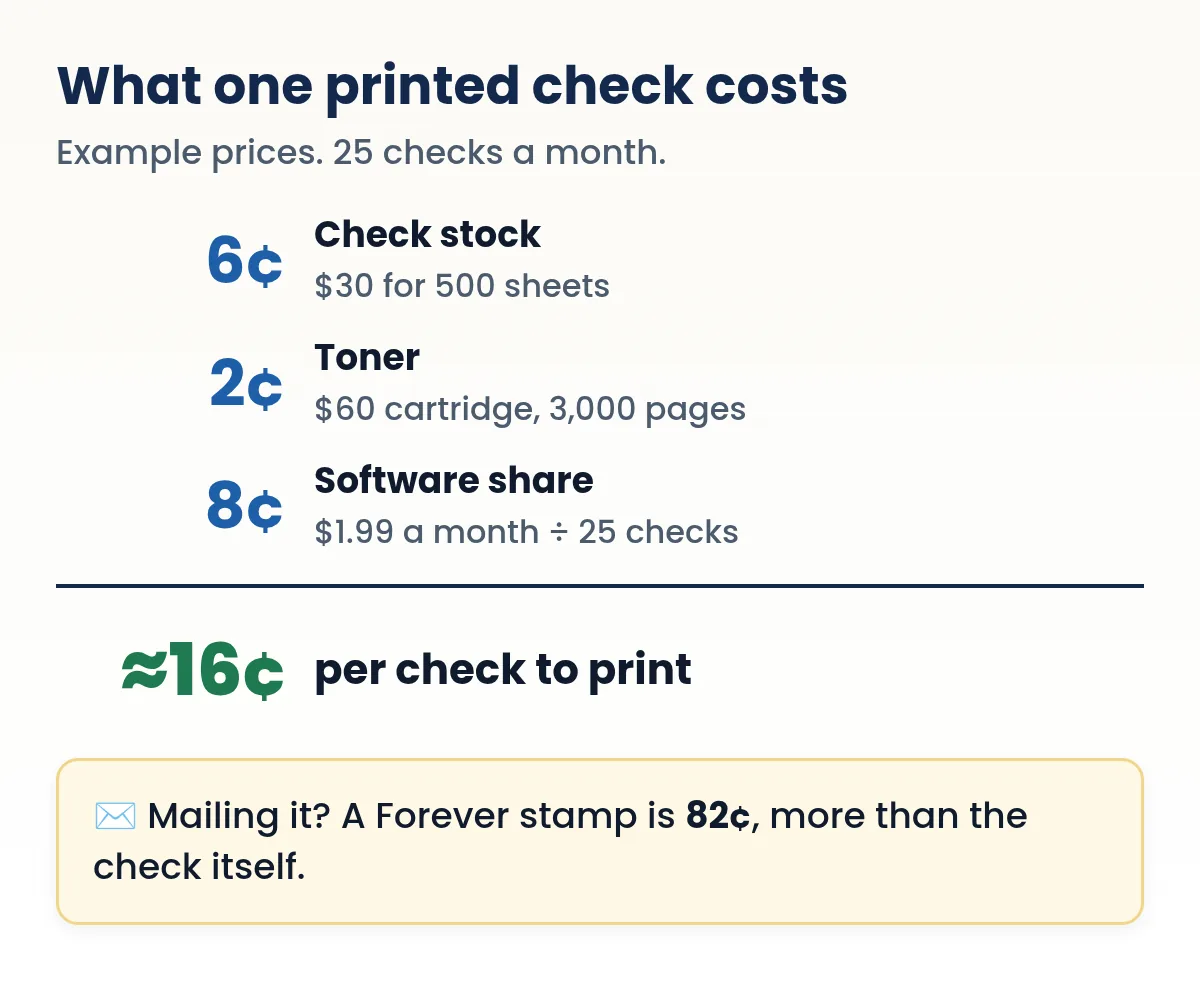
John Sample buys a 500-sheet pack of voucher check stock for $30 (6¢ a sheet). His laser toner cartridge costs $60 and is rated for 3,000 pages (2¢ a page). He pays $1.99 a month for unlimited checks and prints 25 checks a month (8¢ each). His cost per check is 6 + 2 + 8 = 16¢. These prices are examples, not quotes. Check what you actually pay.
Cost by piece
1. Blank check stock
Blank stock is sold in packs and boxes by office supply stores and online sellers. Divide the pack price by the number of sheets, then by the number of checks per sheet:
- Voucher stock (one check and two stubs per sheet): stock cost per check = price per sheet.
- Three-per-page stock: price per sheet ÷ 3. That's the cheapest stock per check.
Larger packs usually cost less per sheet. Look for at least a few security features (microprinting, a void pantograph, a warning box on the back). Our blank check stock guide explains what each one does.
2. Toner or ink
Divide the cartridge price by its rated page yield. A check page uses little toner unless you print a large logo or a dark background style. Laser toner usually works out cheaper per page than inkjet cartridges, but this varies by model. Compare before you buy. See the best printer for printing checks.
3. Software
Check printing software ranges from free tools with limits, to monthly subscriptions, to one-time desktop licenses, to per-check fees on platforms that also process payments. When you compare, convert everything to cost per check at your volume. A cheap per-check fee can cost more than a subscription once you print a lot, and a subscription can cost more than you need if you print twice a year.
Quick Check Writer's first check is free, with no watermark, no account and no card, and every paid plan includes unlimited checks. See current plans.
4. Printer (optional)
If you buy a printer just for checks, spread its price over its useful life. For example, a $150 printer used for three years adds about $4 a month, which disappears into the per-check cost if you print often. If you already own a printer, this cost is zero.
5. Mailing (only if you mail it)
Postage is often the biggest single cost of paying by check. A First-Class Mail Forever stamp costs 82¢ since the July 12, 2026 price change, plus the envelope. Handing a check over in person, or sending a PDF copy where the payee accepts it, avoids this. See how to mail a check safely.
Cost per check at different volumes
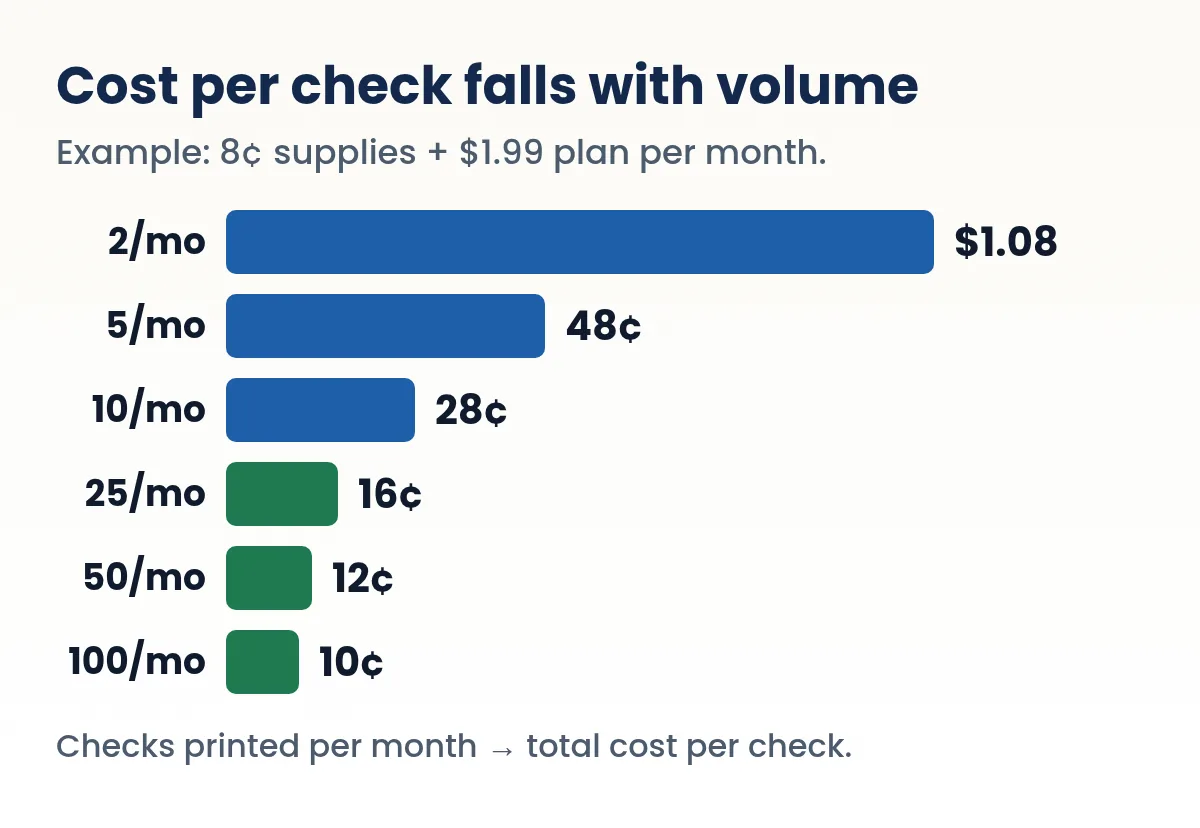
Using the same example prices (8¢ of stock and toner per voucher check, plus a $1.99 monthly plan):
| Checks per month | Plan share | Stock + toner | Total per check |
|---|---|---|---|
| 2 | about $1.00 | 8¢ | about $1.08 |
| 5 | 40¢ | 8¢ | 48¢ |
| 10 | 20¢ | 8¢ | 28¢ |
| 25 | 8¢ | 8¢ | 16¢ |
| 50 | 4¢ | 8¢ | 12¢ |
| 100 | 2¢ | 8¢ | 10¢ |
Three-per-page stock lowers the stock cost to about 2¢ per check in this example, and the yearly plan lowers the plan share. If you only print a check or two in a whole year, your first check is free and the rest of the time you can stay on the free version for drafts and PDFs. Printed checks on the free version carry a "SAMPLE" mark, so subscribe for the month you need real checks and cancel when you're done.
Need to write a check right now?
Quick Check Writer fills in the amount in words, adds the bank line and prints on blank check stock or saves a PDF. Your first check is free, with no account and no card.
Write your first check free →How that compares with ordering checks
Ordered checks come in boxes, priced by quantity, design and add-ons. To compare fairly, take the full price of a box, including shipping and any add-ons, and divide by the number of checks in it. Prices vary widely between banks and check printers, and some bank accounts include checks at no charge, so look at your own bank's fee schedule.
A few things don't show up in the box price:
- Waiting time. Ordered checks arrive by mail, often in a week or two, unless you pay for faster shipping.
- Changes. A new address, a new account or a second business means a new box. Printing on demand avoids leftovers.
- Storage risk. A box of pre-printed checks is a ready-to-use target if it's lost or stolen. Blank stock carries no account details until you print a check.
See order checks or print your own? for a side-by-side, and where to get checks cheap if you'd rather order.
What other ways to pay cost
If the goal is simply to pay someone cheaply, compare checks with the other options too:
| Option | Typical cost to you | Notes |
|---|---|---|
| Printed check, handed over | Cents (see above) | Paper record, payee needs to deposit it |
| Printed check, mailed | Cents + 82¢ stamp + envelope | Allow time for the mail |
| Postal money order | $2.65 up to $500; $3.75 for $500.01–$1,000 | USPS fees; buy with cash or debit |
| Cashier's check | Varies by bank | Guaranteed by the bank; see cashier's vs certified |
| Bank bill pay or transfer | Often free, varies by bank | See ACH vs check |
Ways to spend less on checks
- Test on plain paper first
Wasted check stock is the hidden cost of home printing. One alignment test on plain paper prevents a stack of misprints.
- Choose the layout you need
Skip voucher stubs if you don't use them. Three-per-page stock is the cheapest per check.
- Buy stock in a bigger pack
Larger packs are usually cheaper per sheet. Blank stock doesn't carry your account number, so it doesn't go out of date when you move or switch banks.
- Print in black
Color logos and dark backgrounds use more ink. Black on security stock looks professional and costs less.
- Match the plan to your volume
A monthly plan for busy months and the free first check for one-offs. Compare yearly pricing if you print every month.
- Avoid postage when you can
Hand checks over in person, or give the payee a PDF copy for their records while the paper check travels.
Keep one sheet of plain paper with your saved offsets marked on it. When you change printers or paper, you'll know at a glance whether the alignment moved.
Three example budgets
These use the same example supply prices. They're illustrations, not customer stories.
Rent, a babysitter and the occasional contractor. Three-per-page stock (about 2¢ a check) and an inkjet at 5¢ a page. One sheet prints all three checks in one go. Supplies: about 11¢ for the month. With a $1.99 plan, the total is about $2.10 a month, or 70¢ a check. If the payees accept the checks in person, there's no postage.
Voucher stock so each payment has a stub with the invoice number. 12 sheets at 6¢ plus 2¢ toner each is 96¢ in supplies. The plan adds $1.99. Ten of the checks go by mail, which adds $8.20 in stamps plus envelopes. Postage is about three-quarters of the monthly cost, so handing over or batching payments saves more than any change to paper or software.
Two accounts (operating and a second account) printed from one app, so there's no separate box of checks for each account. Supplies at 8¢ a check come to $3.20. A plan that covers two accounts ($2.99 a month in this example) adds about 7.5¢ a check. The per-check cost lands around 16¢ before postage, and the register export saves time at month-end.
The pattern is the same in every case: the paper and ink are small, software is a fixed monthly amount that shrinks per check, and mailing is the big variable. If you want to cut costs, start with how the check reaches the payee.
Break-even: when printing beats ordering
The fixed part of printing is the software plan; the variable part is a few cents of paper and toner. Ordered checks are almost all variable: you pay per box. That gives a simple way to compare, using your own numbers:
- Find your ordered price per check
Full box price, plus shipping and add-ons, divided by the number of checks. For example, $30 delivered for 120 checks is 25¢ a check.
- Find your printing supplies per check
Stock plus toner or ink. In the example above that's 8¢ on voucher stock.
- Divide the monthly plan by the difference
$1.99 ÷ (25¢ − 8¢) ≈ 12. Above about 12 checks a month, printing costs less in this example; below it, ordering costs less on paper and ink alone.
The math leaves out a few things that often decide it anyway: printing avoids waiting for a box to arrive, you can print for several bank accounts from one pack of stock, and there's no leftover box when your address or account changes. If you print only a handful of checks a year, the free first check and a one-month plan when you need it can cost less than a box you'll never finish.
For businesses: the tax side
For a business, check stock, toner and check-printing software are ordinary office costs. The IRS describes deductible business expenses as costs that are both ordinary (common in your trade) and necessary (helpful for the business), and office supplies and software generally fit that description. Keep the receipts with your books, and ask your tax adviser how your own costs should be recorded. A personal checking account doesn't get a deduction for check costs.
A quick cost checklist
- Price your stock per sheet, not per pack, and note whether it's voucher or three-per-page.
- Look up your cartridge's rated page yield and divide its price by that number.
- Count how many checks you really write in a typical month.
- Add postage only for the checks you mail.
- Add one test sheet of plain paper per new printer or new pack of stock, and nothing for misprints if you test first.
- Compare the result with your bank's or a check printer's delivered price per check.
Costs people forget
- A returned check. If a check bounces, both sides can face fees. Printing doesn't change that. Keep an eye on your balance. See what happens when a check bounces.
- Your time. Typing a check that fills in the amount in words and logs itself in a register is faster than handwriting and reconciling later.
- Record-keeping. A check register that fills itself in saves the hour you'd spend matching bank statements by hand.
Frequently asked questions
Is it cheaper to print your own checks?
For most people who write checks regularly, yes. Stock and toner cost a few cents per check, and the software cost shrinks per check as you print more. If you write only a couple of checks a year, ordering a small box or using another payment method can be just as cheap.
How much does blank check stock cost per sheet?
It depends on the seller and pack size. Divide the pack price by the number of sheets. Three-per-page stock gives you three checks per sheet, so it is the cheapest per check.
How much ink does a check use?
Very little, unless you print a large color logo or a dark background. Divide your cartridge price by its rated page yield for a fair per-page estimate.
How much does it cost to mail a check?
A First-Class Mail Forever stamp costs 82 cents since the July 12, 2026 price change, plus the envelope. A standard check in a #10 envelope mails as a regular letter.
Do I need special software to print checks?
You need something that prints the bank line in the E-13B font in the right place and fills in the check. Quick Check Writer does this in your browser, and your first check is free.
Is a money order cheaper than a check?
Usually not. A USPS money order costs $2.65 for amounts up to $500 and $3.75 for $500.01 to $1,000, while a printed check costs cents.
Is it cheaper to print your own checks?
Usually, once you write more than a handful a month. Supplies are a few cents a check; the software plan is a fixed monthly cost that shrinks per check as you print more. Divide the plan price by the difference between an ordered check and your supply cost to find your break-even.
Is it legal to print your own checks?
Yes. A check is a written order to your bank to pay; the law doesn't require it to be printed by the bank. What matters is a correct bank line, your real account, and your signature. See our guide to whether printing checks at home is legal.
How many checks can I print with one toner cartridge?
Roughly the cartridge's rated page yield, since one sheet usually carries one voucher check or three checks. Yields are measured on a standard test page, so your real count depends on your logo and style.
Related guides
- Order checks or print your own?
- Where to get checks cheap
- Blank Check Stock: A Complete Guide
- The best printer for printing checks
- Free check writer: print your first check free, no account
- How to mail a check safely
Sources
- USPS newsroom: new prices for July 12, 2026 (Forever stamp 78¢ to 82¢)
- USPS: Money orders and fees
- USPS Domestic Mail Manual 101, letter-size standards
- Quick Check Writer pricing
- IRS: Guide to business expense resources (ordinary and necessary expenses)
- UCC § 3-104, negotiable instrument; a check is a draft drawn on a bank (Cornell LII)
Last updated November 1, 2026. This page is general information, not legal or financial advice. Quick Check Writer is check printing software; it is not a bank and does not move money.